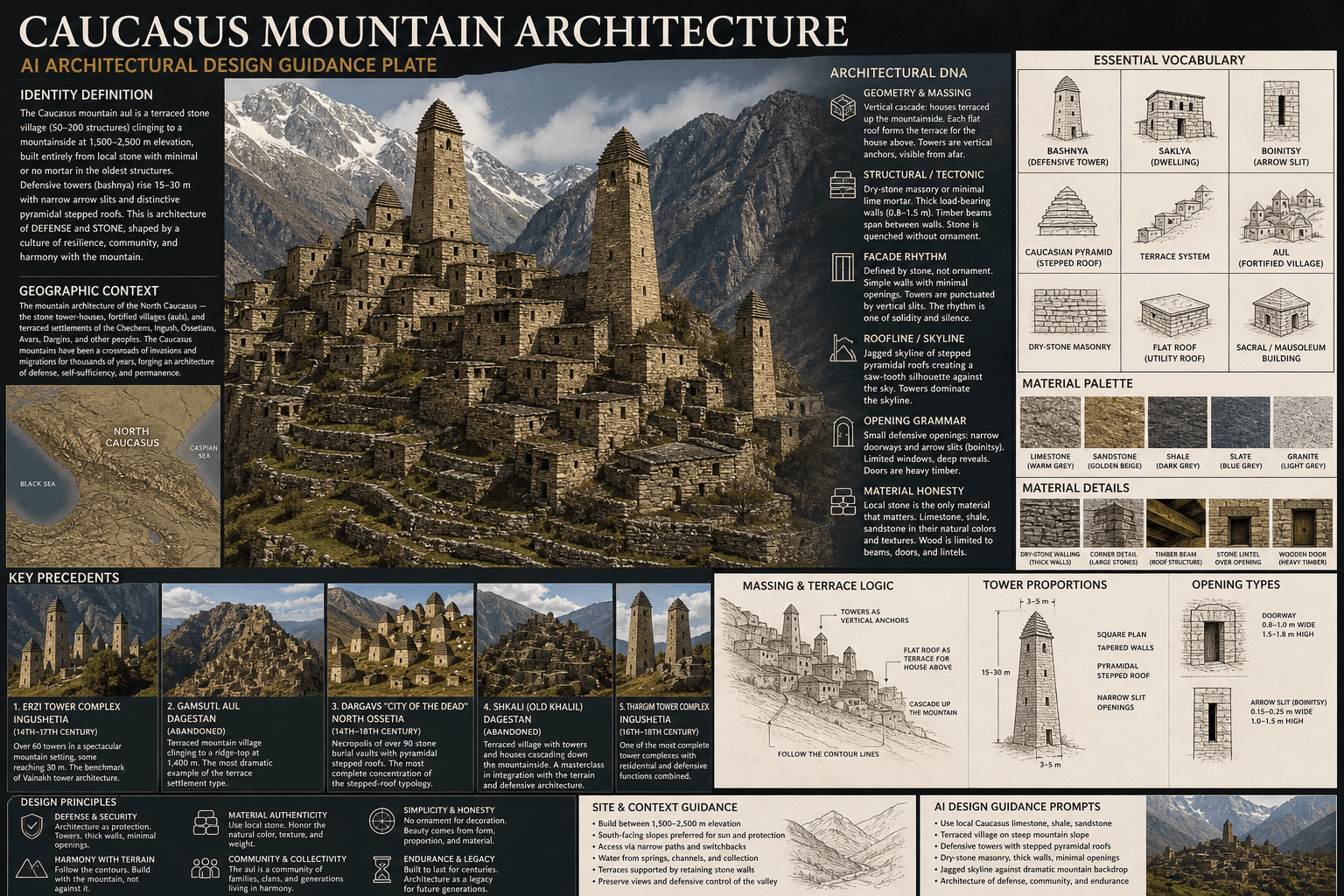
Caucasus Mountain
Russia · mountain architecture of the North Caucasus
The stone towers and flat-roofed auls of the North Caucasus — from the Vainakh (Chechen/Ingush) watchtowers to the Ossetian stone houses and the Dagestani mountain villages, where...
Definition
Caucasus Mountain is a regional architectural identity from Russia. The stone towers and flat-roofed auls of the North Caucasus — from the Vainakh (Chechen/Ingush) watchtowers to the Ossetian stone houses and the Dagestani mountain villages.
- Country
- Russia
- Region
- mountain architecture of the North Caucasus.
- Massing
- The Caucasus mountain aul is a vertical cascade: houses are terraced up the mountainside, each house's flat roof forming the courtyard of the house above.
- Materials
- Materials are the mountain itself: (1) Limestone — the most common building stone in the Caucasus, warm grey to golden-brown.
- Palette
- Warm earth, sandy beige, ochre, clay brown, and sun-softened mineral tones should dominate, with palm green or weathered timber as secondary accents.
- Climate response
- The Caucasus high mountains (1,500–2,500 m) define the architecture: (1) Harsh winters (-20 to -30°C), heavy snow — the thick stone walls (0. 6–1.
Overview
Caucasus Mountain is a regional architectural identity in Russia. The mountain architecture of the North Caucasus — the stone tower-houses, fortified villages (auls), and terraced settlements of the Chechens, Ingush, Ossetians, Avars, Dargins, and other peoples — this is an architecture of DEFENSE and STONE: the Caucasus mountains have been a crossroads of invasion for millennia, and the architecture responds with the vainakhskaya bashnya (Vainakh tower) — a tall, tapering stone to...
Visual DNA
Massing & Form
The Caucasus mountain aul is a vertical cascade: houses are terraced up the mountainside, each house's flat roof forming the courtyard of the house above — the settlement reads as a stepped stone mass, with the towers as vertical accents. The individual dwelling (saklya) is a simple stone rectangle (4–7 m wide, 6–10 m...
Facade Language
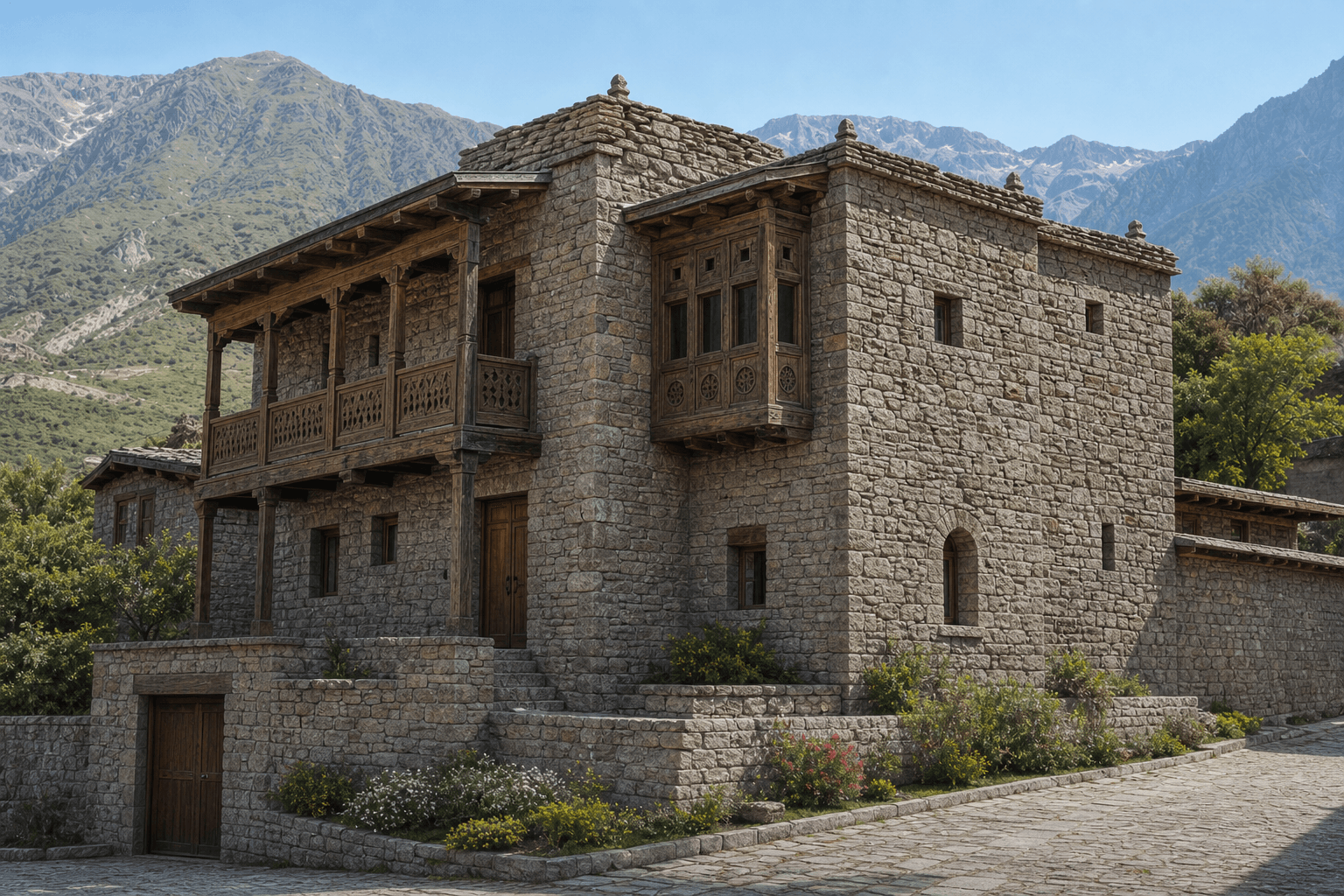
The Caucasian facade is defined by stone, not ornament: (1) The dwelling (saklya) facade — a simple stone wall with one or two small windows, an arched door, and a projecting wooden balcony (often cantilevered on timber beams) on the upper story. (2) The tower facade — a tall stone prism with narrow slit windows (arrow...
Materials & Texture
Materials are the mountain itself: (1) Limestone — the most common building stone in the Caucasus, warm grey to golden-brown. (2) Slate/shale — used in regions with this geology (Dagestan), creating darker, sharper-edged walls.
Color Palette
Warm earth, sandy beige, ochre, clay brown, and sun-softened mineral tones should dominate, with palm green or weathered timber as secondary accents. The palette should read as land-derived rather than polished or urban-generic.
Ornament & Detail
Caucasian ornament is minimal and specific: (1) The tsIurku (tower finial) — the carved stone at the peak of the pyramidal roof — sometimes a simple cone, sometimes carved with a solar disc or a cross. (2) Petroglyphs — carved figures, solar symbols, and handprints on tower walls and door lintels — some are ancient (Br...
Climate Response
The Caucasus high mountains (1,500–2,500 m) define the architecture: (1) Harsh winters (-20 to -30°C), heavy snow — the thick stone walls (0.6–1.2 m) provide thermal mass; the small windows minimize heat loss; the flat roof is designed to hold snow as additional insulation. (2) The terraced construction — the village i...
Landscape & Ground
The mountain architecture of the North Caucasus — the stone tower-houses, fortified villages (auls), and terraced settlements of the Chechens, Ingush, Ossetians, Avars, Dargins, and other peoples — this is an architecture of DEFENSE and STONE: the Caucasus mountains have been a crossroads of invasion for millennia, and...
Reference elevation
Caucasus Mountain — characteristic facade composition, mountain architecture of the North Caucasus.
Context Snapshot
The mountain architecture of the North Caucasus — the stone tower-houses, fortified villages (auls), and terraced settlements of the Chechens, Ingush, Ossetians, Avars, Dargins, and other peoples — th... The Caucasus high mountains (1,500–2,500 m) define the architecture: (1) Harsh winters (-20 to -30°C), heavy snow — the thick stone walls (0.6–1.2 m) provide thermal mass; the small windows minimize heat loss; the flat r...
Contemporary Relevance
Caucasus Mountain is useful today for residential, hospitality, civic, and place-branding work that needs Russia-specific character grounded in local massing, material tone, climate response, and settlement logic rather than generic international styling.
Use this style in Toscape
Explore Caucasus Mountain directly inside Toscape using the Facade Re-Style and Design Options workflows.
Open Caucasus Mountain in the galleryFrequently asked questions
What is Caucasus Mountain?
Caucasus Mountain is a regional architectural identity from Russia. The stone towers and flat-roofed auls of the North Caucasus — from the Vainakh (Chechen/Ingush) watchtowers to the Ossetian stone houses and the Dagestani mountain villages.
What materials define Caucasus Mountain?
Materials are the mountain itself: (1) Limestone — the most common building stone in the Caucasus, warm grey to golden-brown. (2) Slate/shale — used in regions with this geology (Dagestan), creating darker, sharper-edged walls.
What is the Caucasus Mountain color palette?
Warm earth, sandy beige, ochre, clay brown, and sun-softened mineral tones should dominate, with palm green or weathered timber as secondary accents. The palette should read as land-derived rather than polished or urban-generic.
Where does Caucasus Mountain come from?
The mountain architecture of the North Caucasus — the stone tower-houses, fortified villages (auls), and terraced settlements of the Chechens, Ingush, Ossetians, Avars, Dargins, and other peoples — th... The Caucasus high mountains (1,500–2,500 m) define the architecture: (1) Harsh winters (-20 to -30°C), heavy snow — the thick stone walls (0. 6–1.
When should architects use Caucasus Mountain?
Caucasus Mountain is useful today for residential, hospitality, civic, and place-branding work that needs Russia-specific character grounded in local massing, material tone, climate response, and settlement logic rather than generic international styling.
How do you render Caucasus Mountain in Toscape?
Open Toscape on Windows, load your own photo, elevation, sketch, or CAD view, then apply the Caucasus Mountain reference from the built-in style library. The Facade Re-Style and Design Options workflows keep your project geometry and camera while shifting materials, proportion, and detailing toward Caucasus Mountain.