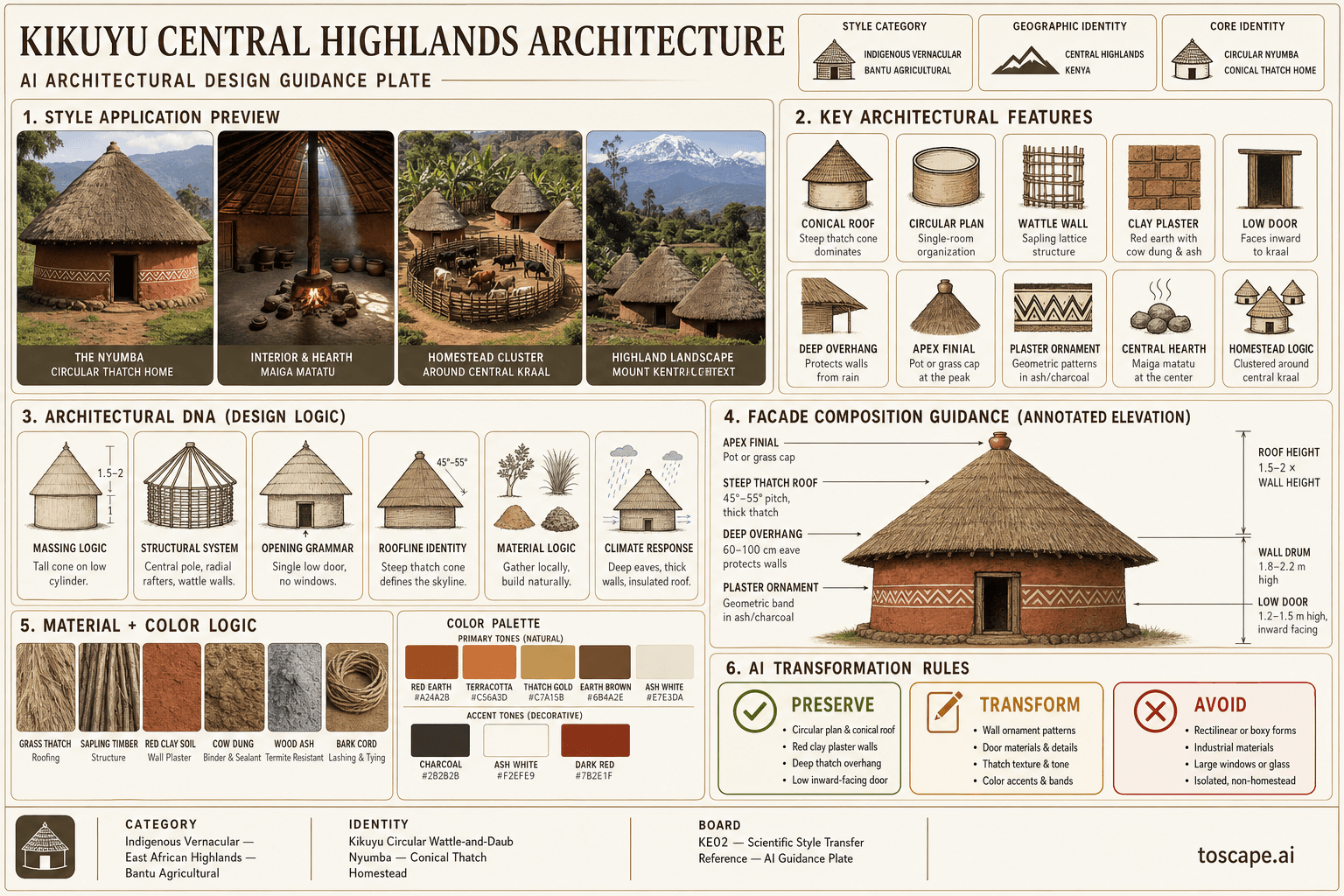
Kikuyu Central Highlands
Kenya · architectural identity of the Kikuyu (Gikuyu) of Kenya's Central Highlands
The circular wattle-and-daub homestead of the Kikuyu people — the nyumba, a conical thatch-roofed roundhouse built from forest materials in the fertile highlands between Mount Keny...
Definition
Kikuyu Central Highlands is a regional architectural identity from Kenya. The circular wattle-and-daub homestead of the Kikuyu people — the nyumba, a conical thatch-roofed roundhouse built from forest materials in the fertile highlands between Mount Keny.
- Country
- Kenya
- Region
- architectural identity of the Kikuyu (Gikuyu) of Kenya's Central Highlands.
- Massing
- The nyumba is a vertical-axis composition — a low circular wall drum capped by a tall steep cone. The proportion is roughly 1:1.
- Materials
- The palette is entirely gathered from the highland forest-edge environment: (1) Red clay soil (nyaga) — the volcanic lateritic soils of the Central Highlands, iron-rich.
- Palette
- White, cream, pale sand, warm timber, and shadow-driven dark metal accents define the palette.
- Climate response
- The Kikuyu homeland (1,200–2,200 m elevation, straddling the equator) has a temperate climate with two rainy seasons (March–May: long rains.
Overview
Kikuyu Central Highlands is a regional architectural identity in Kenya. The architectural identity of the Kikuyu (Gikuyu) of Kenya's Central Highlands — the traditional nyumba (house), a circular-plan dwelling (4–7 m diameter) with walls of wattle-and-daub (mugomba — woven sapling framework plastered with red clay soil mixed with cow dung and ash) and a tall conical thatch roof (grass thatch, makuti, on a radial timber pole frame) extending to a low eave — the homestead (mucii) consistin...
Visual DNA
Massing & Form
The nyumba is a vertical-axis composition — a low circular wall drum capped by a tall steep cone. The proportion is roughly 1:1.5 to 1:2 (wall height : roof height), creating a form that reads as primarily roof — the architecture of shelter in a climate of two rainy seasons.
Facade Language
The facade is the plastered wall surface — a smooth, warm red-brown clay finish, sometimes decorated with finger-traced geometric patterns (circles, zigzags, chevrons) in white ash or charcoal pigment, executed by women while the plaster is still wet. The deep thatch overhang casts a dark shadow band above the wall, vi...
Materials & Texture
The palette is entirely gathered from the highland forest-edge environment: (1) Red clay soil (nyaga) — the volcanic lateritic soils of the Central Highlands, iron-rich, yielding a warm terracotta to deep red-brown color. (2) Saplings — mugumo (fig), mutamaiyu (olive), muringa (coral tree), mikengeria — for the wall fr...
Color Palette
White, cream, pale sand, warm timber, and shadow-driven dark metal accents define the palette. The facade should stay bright and climate-aware rather than heavy, gray, or over-saturated.
Ornament & Detail
Ornament is geometric and executed in the plaster: (1) Wall patterns — finger-traced or incised patterns (circles, zigzags, chevrons, diamond chains) in white ash or charcoal pigment on the red-brown plaster, typically in a horizontal band at mid-wall or around the door frame. (2) The door — sometimes painted with simp...
Climate Response
The Kikuyu homeland (1,200–2,200 m elevation, straddling the equator) has a temperate climate with two rainy seasons (March–May: long rains, October–December: short rains) and moderate temperatures (12–26°C). The nyumba is adapted to this climate: (1) Steep thatch roof — rapidly sheds heavy rainfall, the thick thatch l...
Landscape & Ground
The architectural identity of the Kikuyu (Gikuyu) of Kenya's Central Highlands — the traditional nyumba (house), a circular-plan dwelling (4–7 m diameter) with walls of wattle-and-daub (mugomba — woven sapling framework plastered with red clay soil mixed with cow dung and ash) and a tall conical thatch roof (grass that...
Reference elevation
Kikuyu Central Highlands — characteristic facade composition, architectural identity of the Kikuyu (Gikuyu) of Kenya's Central Highlands.
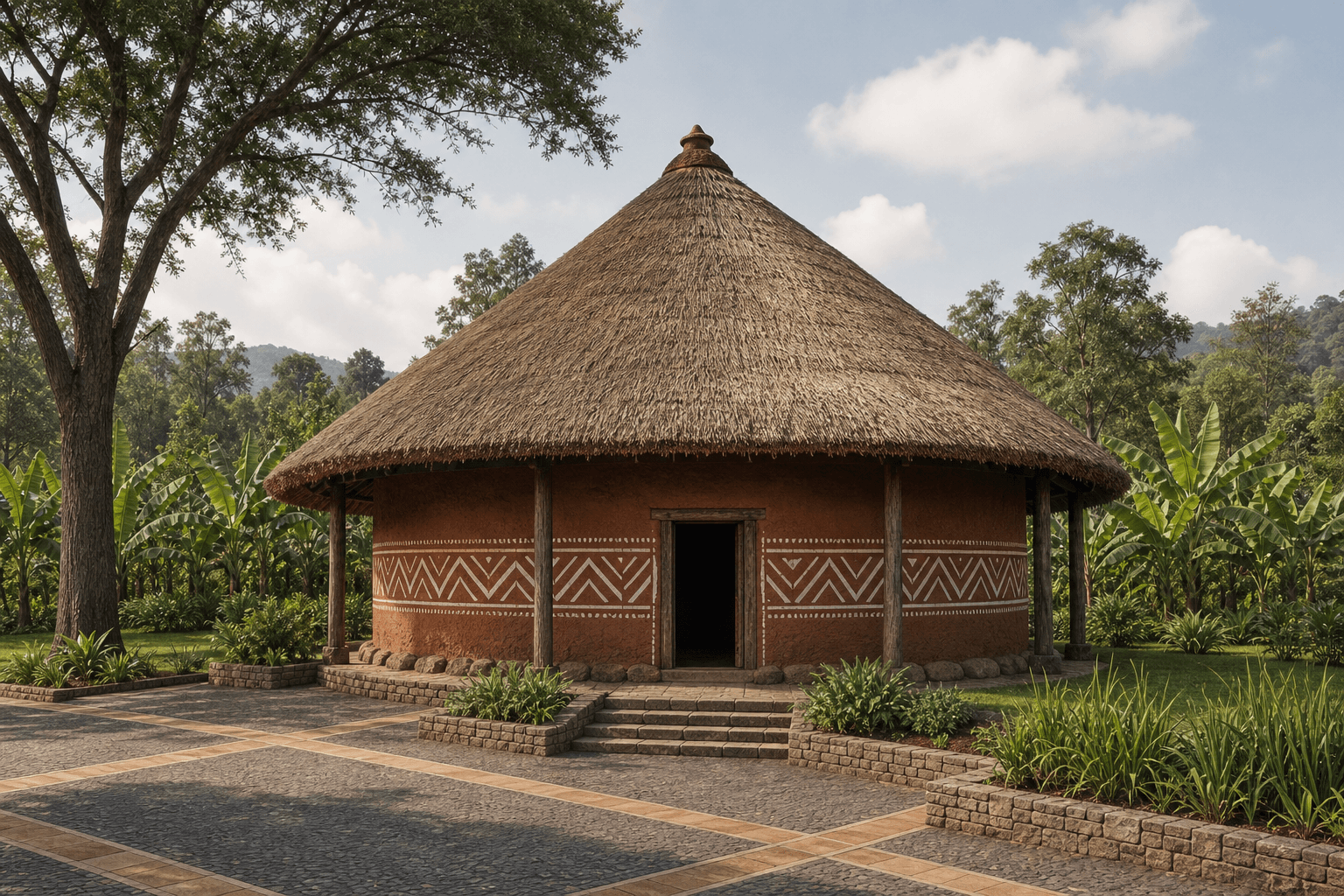
Context Snapshot
The architectural identity of the Kikuyu (Gikuyu) of Kenya's Central Highlands — the traditional nyumba (house), a circular-plan dwelling (4–7 m diameter) with walls of wattle-and-daub (mugomba — wove... The Kikuyu homeland (1,200–2,200 m elevation, straddling the equator) has a temperate climate with two rainy seasons (March–May: long rains, October–December: short rains) and moderate temperatures (12–26°C).
Contemporary Relevance
Kikuyu Central Highlands is useful today for residential, hospitality, civic, and place-branding work that needs Kenya-specific character grounded in local massing, material tone, climate response, and settlement logic rather than generic international styling.
Use this style in Toscape
Explore Kikuyu Central Highlands directly inside Toscape using the Facade Re-Style and Design Options workflows.
Open Kikuyu Central Highlands in the galleryFrequently asked questions
What is Kikuyu Central Highlands?
Kikuyu Central Highlands is a regional architectural identity from Kenya. The circular wattle-and-daub homestead of the Kikuyu people — the nyumba, a conical thatch-roofed roundhouse built from forest materials in the fertile highlands between Mount Keny.
What materials define Kikuyu Central Highlands?
The palette is entirely gathered from the highland forest-edge environment: (1) Red clay soil (nyaga) — the volcanic lateritic soils of the Central Highlands, iron-rich, yielding a warm terracotta to deep red-brown color. (2) Saplings — mugumo (fig), mutamaiyu (olive), muringa (coral tree), mikengeria — for the wall fr.
What is the Kikuyu Central Highlands color palette?
White, cream, pale sand, warm timber, and shadow-driven dark metal accents define the palette. The facade should stay bright and climate-aware rather than heavy, gray, or over-saturated.
Where does Kikuyu Central Highlands come from?
The architectural identity of the Kikuyu (Gikuyu) of Kenya's Central Highlands — the traditional nyumba (house), a circular-plan dwelling (4–7 m diameter) with walls of wattle-and-daub (mugomba — wove... The Kikuyu homeland (1,200–2,200 m elevation, straddling the equator) has a temperate climate with two rainy seasons (March–May: long rains, October–December: short rains) and moderate temperatures (12–26°C).
When should architects use Kikuyu Central Highlands?
Kikuyu Central Highlands is useful today for residential, hospitality, civic, and place-branding work that needs Kenya-specific character grounded in local massing, material tone, climate response, and settlement logic rather than generic international styling.
How do you render Kikuyu Central Highlands in Toscape?
Open Toscape on Windows, load your own photo, elevation, sketch, or CAD view, then apply the Kikuyu Central Highlands reference from the built-in style library. The Facade Re-Style and Design Options workflows keep your project geometry and camera while shifting materials, proportion, and detailing toward Kikuyu Central Highlands.