Chiloé Wooden
Chile · architectural identity of the Chiloé Archipelago (Los Lagos Region, southern Chi...
The tejuela-clad timber churches and palafito stilt houses of the Chiloé Archipelago — where the world's finest wooden ecclesiastical architecture meets vernacular waterfront housi...
Definition
Chiloé Wooden is a regional architectural identity from Chile. The tejuela-clad timber churches and palafito stilt houses of the Chiloé Archipelago — where the world's finest wooden ecclesiastical architecture meets vernacular waterfront housi.
- Country
- Chile
- Region
- architectural identity of the Chiloé Archipelago (Los Lagos Region, southern Chi.
- Massing
- Chilota architecture is vertical (church towers) and linear (palafito rows).
- Materials
- Chiloé is a timber culture — the palette is wood, wood, and wood: (1) Alerce (Fitzroya cupressoides) — the giant Patagonian cypress.
- Palette
- Warm earth, sandy beige, ochre, clay brown, and sun-softened mineral tones should dominate, with palm green or weathered timber as secondary accents.
- Climate response
- Chiloé (42–43°S latitude) has a cool temperate oceanic climate with very high rainfall (2,000–3,000 mm/year), persistent humidity, strong winds, and mild temperatures (5–20°C).
Overview
Chiloé Wooden is a regional architectural identity in Chile. The architectural identity of the Chiloé Archipelago (Los Lagos Region, southern Chile) — a unique wooden architectural culture developed in the isolated, rainy islands of northern Patagonia, expressed in two iconic typologies: (1) The Iglesias de Chiloé (16 UNESCO World Heritage churches, built 18th–19th centuries) — entirely wooden churches with barrel-vaulted timber naves, tejuela-clad facades and roofs, and disti...
Visual DNA
Massing & Form
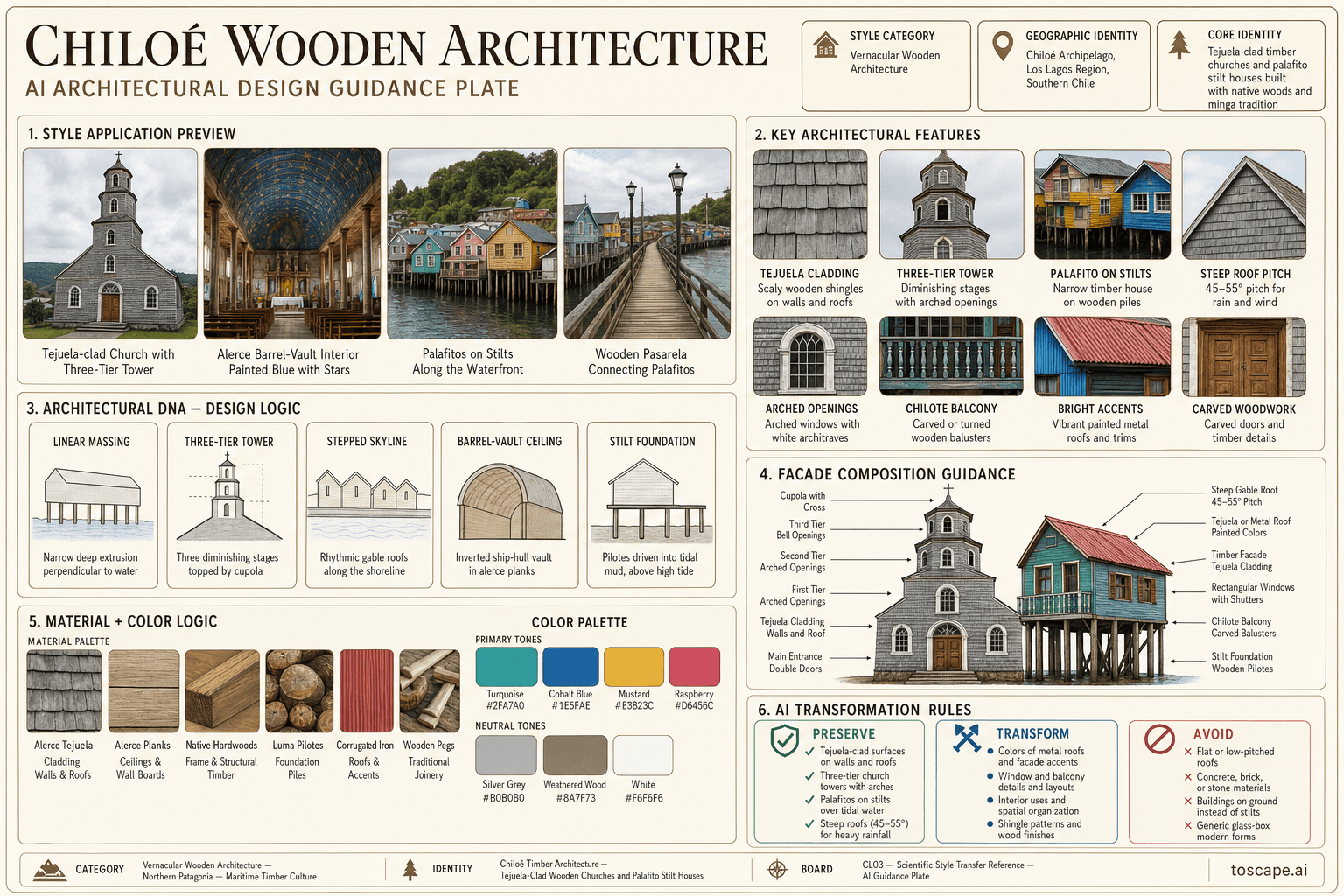
Chilota architecture is vertical (church towers) and linear (palafito rows). The church facades are dominated by the three-tier tower: a central rectangular nave facade flanked by or incorporating the tower, which rises in three diminishing octagonal or square stages, each with arched window openings (for the bells), c...
Facade Language
The church facade is the tower: three tiers of diminishing scale, each tier defined by arched openings (for bells and ventilation), the white-painted wooden architraves contrasting with the silver-grey tejuela cladding. The church body is a simple rectangular tejuela-clad volume with small arched windows.
Materials & Texture
Chiloé is a timber culture — the palette is wood, wood, and wood: (1) Alerce (Fitzroya cupressoides) — the giant Patagonian cypress, sacred tree of the southern forests, prized for its density, rot resistance, and workability — used for tejuelas, planks, and church interiors. (2) Ciprés de las Guaitecas (Pilgerodendron...
Color Palette
Warm earth, sandy beige, ochre, clay brown, and sun-softened mineral tones should dominate, with palm green or weathered timber as secondary accents. The palette should read as land-derived rather than polished or urban-generic.
Ornament & Detail
Chilota ornament is expressed through woodwork: (1) The tejuela pattern — the scaly, shingled surface is the primary ornamental texture, silver-grey, organic, living — the skin of Chilota architecture. (2) Church tower detailing — white-painted architraves, turned balusters in bell openings, triangular pediments on the...
Climate Response
Chiloé (42–43°S latitude) has a cool temperate oceanic climate with very high rainfall (2,000–3,000 mm/year), persistent humidity, strong winds, and mild temperatures (5–20°C). The wooden architecture is a direct climate response: (1) Alerce tejuela — the wood's natural oils and density make it one of the world's most...
Landscape & Ground
The architectural identity of the Chiloé Archipelago (Los Lagos Region, southern Chile) — a unique wooden architectural culture developed in the isolated, rainy islands of northern Patagonia, expressed in two iconic typologies: (1) The Iglesias de Chiloé (16 UNESCO World Heritage churches, built 18th–19th centuries) —...
Reference elevation
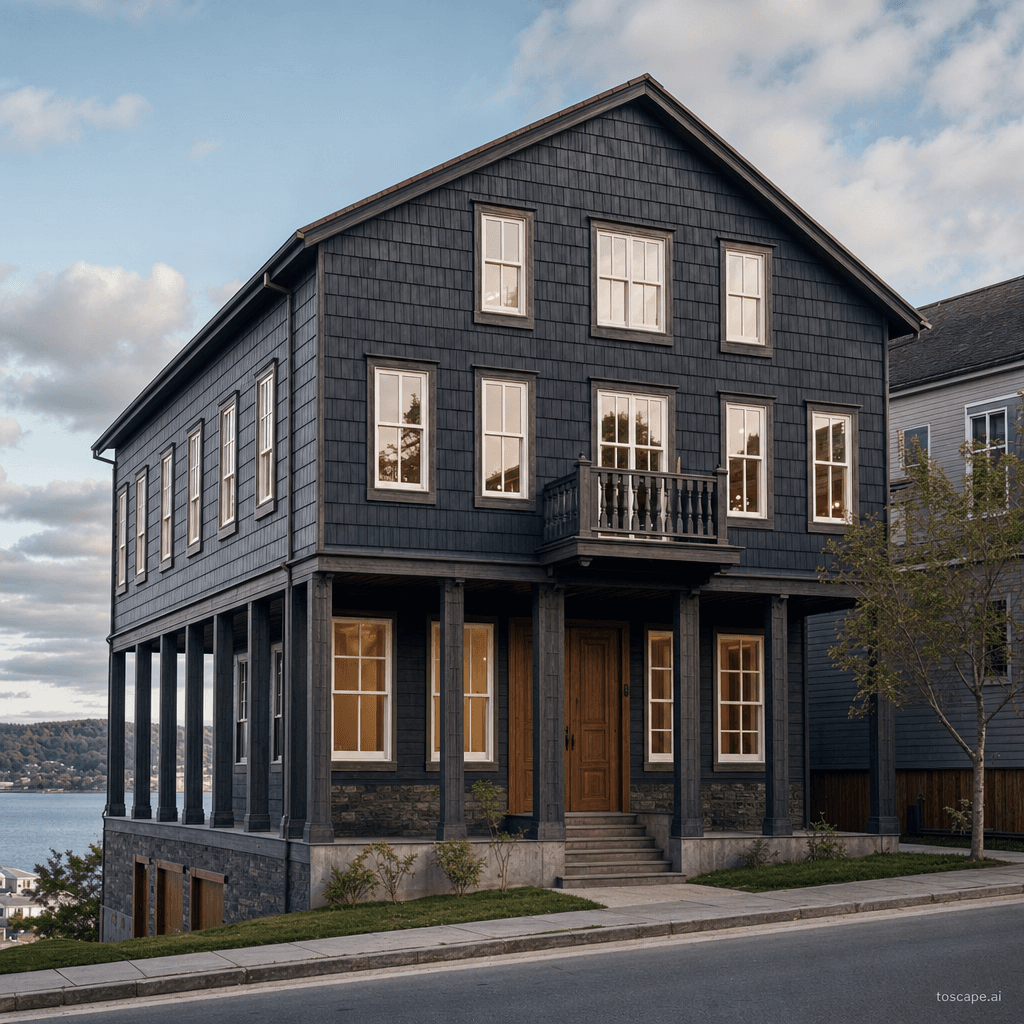
Chiloé Wooden — characteristic facade composition, architectural identity of the Chiloé Archipelago (Los Lagos Region, southern Chi....
Context Snapshot
The architectural identity of the Chiloé Archipelago (Los Lagos Region, southern Chile) — a unique wooden architectural culture developed in the isolated, rainy islands of northern Patagonia, expresse... Chiloé (42–43°S latitude) has a cool temperate oceanic climate with very high rainfall (2,000–3,000 mm/year), persistent humidity, strong winds, and mild temperatures (5–20°C).
Contemporary Relevance
Chiloé Wooden is useful today for residential, hospitality, civic, and place-branding work that needs Chile-specific character grounded in local massing, material tone, climate response, and settlement logic rather than generic international styling.
Use this style in Toscape
Explore Chiloé Wooden directly inside Toscape using the Facade Re-Style and Design Options workflows.
Open Chiloé Wooden in the galleryFrequently asked questions
What is Chiloé Wooden?
Chiloé Wooden is a regional architectural identity from Chile. The tejuela-clad timber churches and palafito stilt houses of the Chiloé Archipelago — where the world's finest wooden ecclesiastical architecture meets vernacular waterfront housi.
What materials define Chiloé Wooden?
Chiloé is a timber culture — the palette is wood, wood, and wood: (1) Alerce (Fitzroya cupressoides) — the giant Patagonian cypress, sacred tree of the southern forests, prized for its density, rot resistance, and workability — used for tejuelas, planks, and church interiors. (2) Ciprés de las Guaitecas (Pilgerodendron.
What is the Chiloé Wooden color palette?
Warm earth, sandy beige, ochre, clay brown, and sun-softened mineral tones should dominate, with palm green or weathered timber as secondary accents. The palette should read as land-derived rather than polished or urban-generic.
Where does Chiloé Wooden come from?
The architectural identity of the Chiloé Archipelago (Los Lagos Region, southern Chile) — a unique wooden architectural culture developed in the isolated, rainy islands of northern Patagonia, expresse... Chiloé (42–43°S latitude) has a cool temperate oceanic climate with very high rainfall (2,000–3,000 mm/year), persistent humidity, strong winds, and mild temperatures (5–20°C).
When should architects use Chiloé Wooden?
Chiloé Wooden is useful today for residential, hospitality, civic, and place-branding work that needs Chile-specific character grounded in local massing, material tone, climate response, and settlement logic rather than generic international styling.
How do you render Chiloé Wooden in Toscape?
Open Toscape on Windows, load your own photo, elevation, sketch, or CAD view, then apply the Chiloé Wooden reference from the built-in style library. The Facade Re-Style and Design Options workflows keep your project geometry and camera while shifting materials, proportion, and detailing toward Chiloé Wooden.