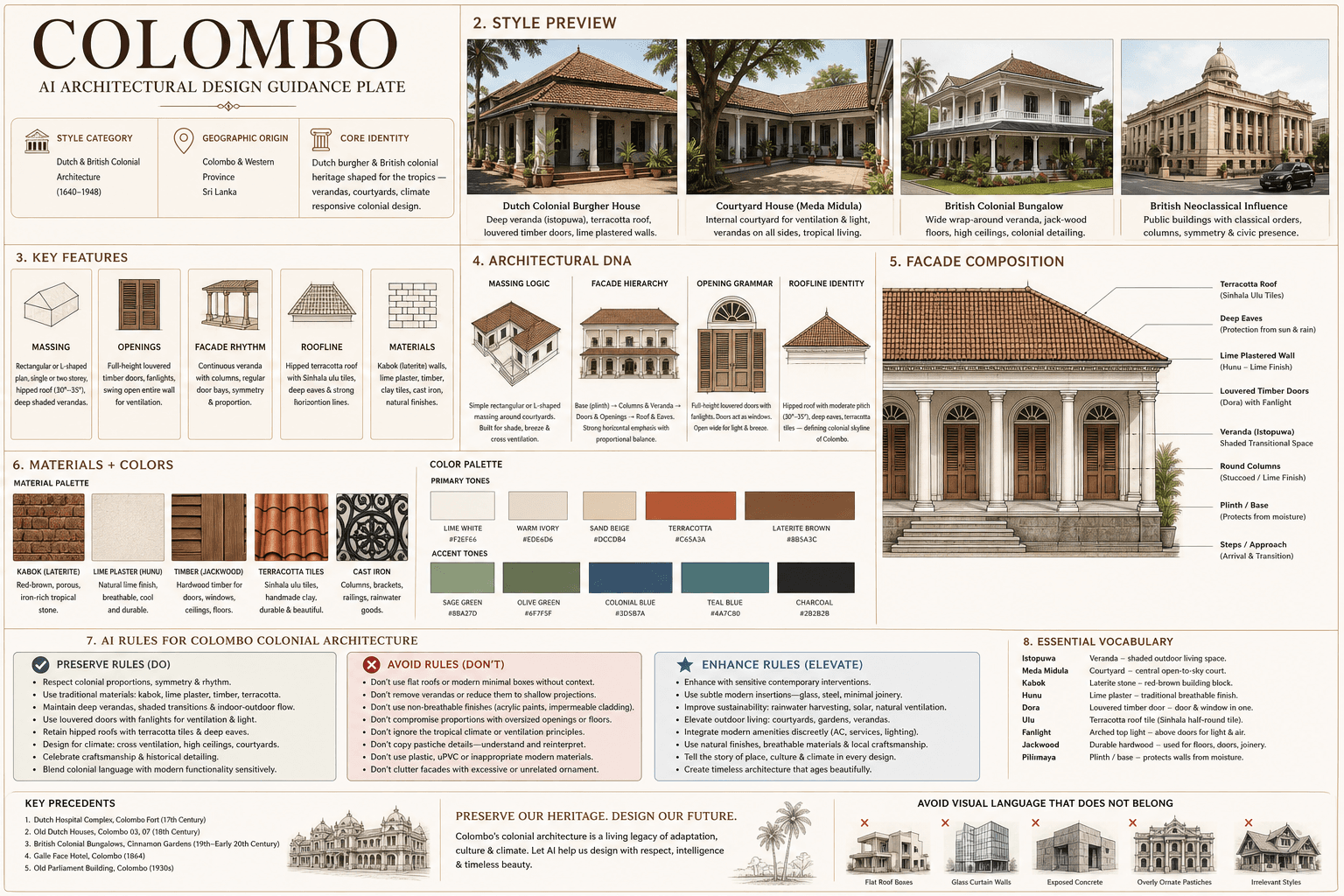
Colombo
Sri Lanka · Colombo and Western Province
Dutch-British Colonial, Tropical Modernism & Geoffrey Bawa Legacy
Definition
Colombo is a regional architectural identity from Sri Lanka. Dutch-British Colonial, Tropical Modernism & Geoffrey Bawa Legacy.
- Country
- Sri Lanka
- Region
- Colombo and Western Province.
- Massing
- Dutch-period houses: rectangular or L-shaped plan, single or two storey, hipped roof with moderate pitch (30-35°).
- Materials
- Kabok (laterite): red-brown, porous, iron-rich tropical weathered rock — cut into blocks, used for walls in colonial and Bawa buildings, often rendered.
- Palette
- White, cream, pale sand, warm timber, and shadow-driven dark metal accents define the palette.
- Climate response
- Tropical monsoon (Af / Am) — hot humid year-round (26-33°C), heavy bimodal rainfall (2,500mm annually), strong southwest monsoon (May-September), high humidity (70-90%).
Overview
Colombo is a regional architectural identity in Sri Lanka. Colombo and Western Province — colonial heritage and tropical modern architecture. Dutch-period (1640-1796) and British-period (1796-1948) colonial architecture: Dutch burgher houses with terracotta-tiled hipped roofs, deep verandas (istopuwa), louvered timber doors and fanlights, thick lime-plastered walls (kabok — laterite blocks rendered with lime), large colonnaded verandas, courtyards (meda midula) for ventilati...
Visual DNA
Massing & Form
Dutch-period houses: rectangular or L-shaped plan, single or two storey, hipped roof with moderate pitch (30-35°). Deep veranda (istopuwa) on street-facing side — the primary social space.
Facade Language
Dutch-period: continuous street veranda with round or square whitewashed columns (or timber posts), louvered timber doors (full-height), fanlights (sihala uluassa) with radiating timber glazing bars or fretwork, lime-rendered walls in white, cream, or ochre, hipped terracotta roof visible behind parapet or with deep ea...
Materials & Texture
Kabok (laterite): red-brown, porous, iron-rich tropical weathered rock — cut into blocks, used for walls in colonial and Bawa buildings, often rendered, sometimes left exposed as texture. Lime plaster (hunu): white, cream, or ochre-tinted, applied over kabok — the finish of 400 years.
Color Palette
White, cream, pale sand, warm timber, and shadow-driven dark metal accents define the palette. The facade should stay bright and climate-aware rather than heavy, gray, or over-saturated.
Ornament & Detail
Dutch colonial ornament is restrained: fanlight design (radiating, sunburst, or geometric), louvered shutter detail (movable horizontal slats in timber frames), bolection moldings around door panels, simple column capitals (tuscan or square-order), occasionally Dutch gable (trapgevel — stepped gable) on church facades....
Climate Response
Tropical monsoon (Af / Am) — hot humid year-round (26-33°C), heavy bimodal rainfall (2,500mm annually), strong southwest monsoon (May-September), high humidity (70-90%). Deep veranda (istopuwa): the primary climate device — shaded outdoor living space, protection from driving rain, buffer zone between hot exterior and...
Landscape & Ground
Colombo and Western Province — colonial heritage and tropical modern architecture. Tropical monsoon (Af / Am) — hot humid year-round (26-33°C), heavy bimodal rainfall (2,500mm annually), strong southwest monsoon (May-September), high humidity (70-90%).
Reference elevation
Colombo — characteristic facade composition, Colombo and Western Province.
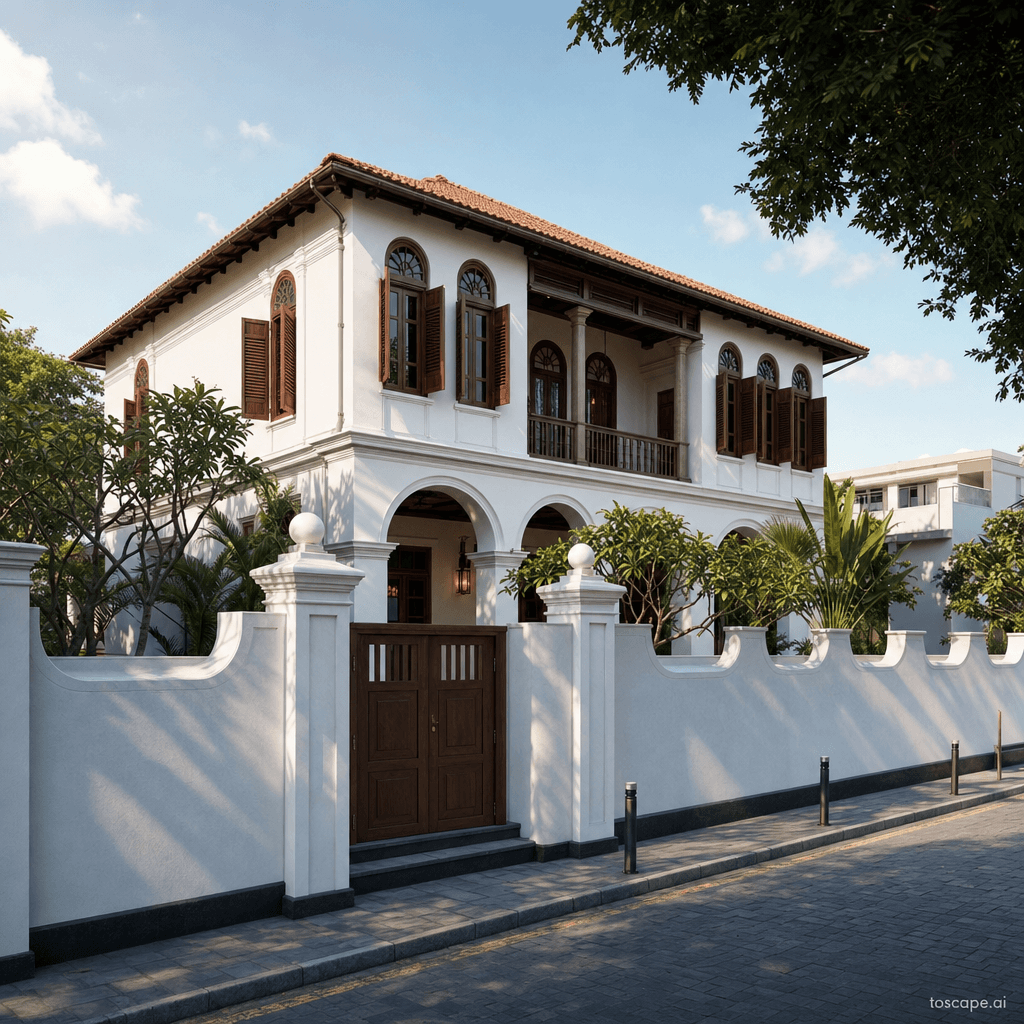
Context Snapshot
Colombo and Western Province — colonial heritage and tropical modern architecture Tropical monsoon (Af / Am) — hot humid year-round (26-33°C), heavy bimodal rainfall (2,500mm annually), strong southwest monsoon (May-September), high humidity (70-90%).
Contemporary Relevance
Colombo is useful today for residential, hospitality, civic, and place-branding work that needs Sri Lanka-specific character grounded in local massing, material tone, climate response, and settlement logic rather than generic international styling.
Use this style in Toscape
Explore Colombo directly inside Toscape using the Facade Re-Style and Design Options workflows.
Open Colombo in the galleryFrequently asked questions
What is Colombo?
Colombo is a regional architectural identity from Sri Lanka. Dutch-British Colonial, Tropical Modernism & Geoffrey Bawa Legacy.
What materials define Colombo?
Kabok (laterite): red-brown, porous, iron-rich tropical weathered rock — cut into blocks, used for walls in colonial and Bawa buildings, often rendered, sometimes left exposed as texture. Lime plaster (hunu): white, cream, or ochre-tinted, applied over kabok — the finish of 400 years.
What is the Colombo color palette?
White, cream, pale sand, warm timber, and shadow-driven dark metal accents define the palette. The facade should stay bright and climate-aware rather than heavy, gray, or over-saturated.
Where does Colombo come from?
Colombo and Western Province — colonial heritage and tropical modern architecture Tropical monsoon (Af / Am) — hot humid year-round (26-33°C), heavy bimodal rainfall (2,500mm annually), strong southwest monsoon (May-September), high humidity (70-90%).
When should architects use Colombo?
Colombo is useful today for residential, hospitality, civic, and place-branding work that needs Sri Lanka-specific character grounded in local massing, material tone, climate response, and settlement logic rather than generic international styling.
How do you render Colombo in Toscape?
Open Toscape on Windows, load your own photo, elevation, sketch, or CAD view, then apply the Colombo reference from the built-in style library. The Facade Re-Style and Design Options workflows keep your project geometry and camera while shifting materials, proportion, and detailing toward Colombo.