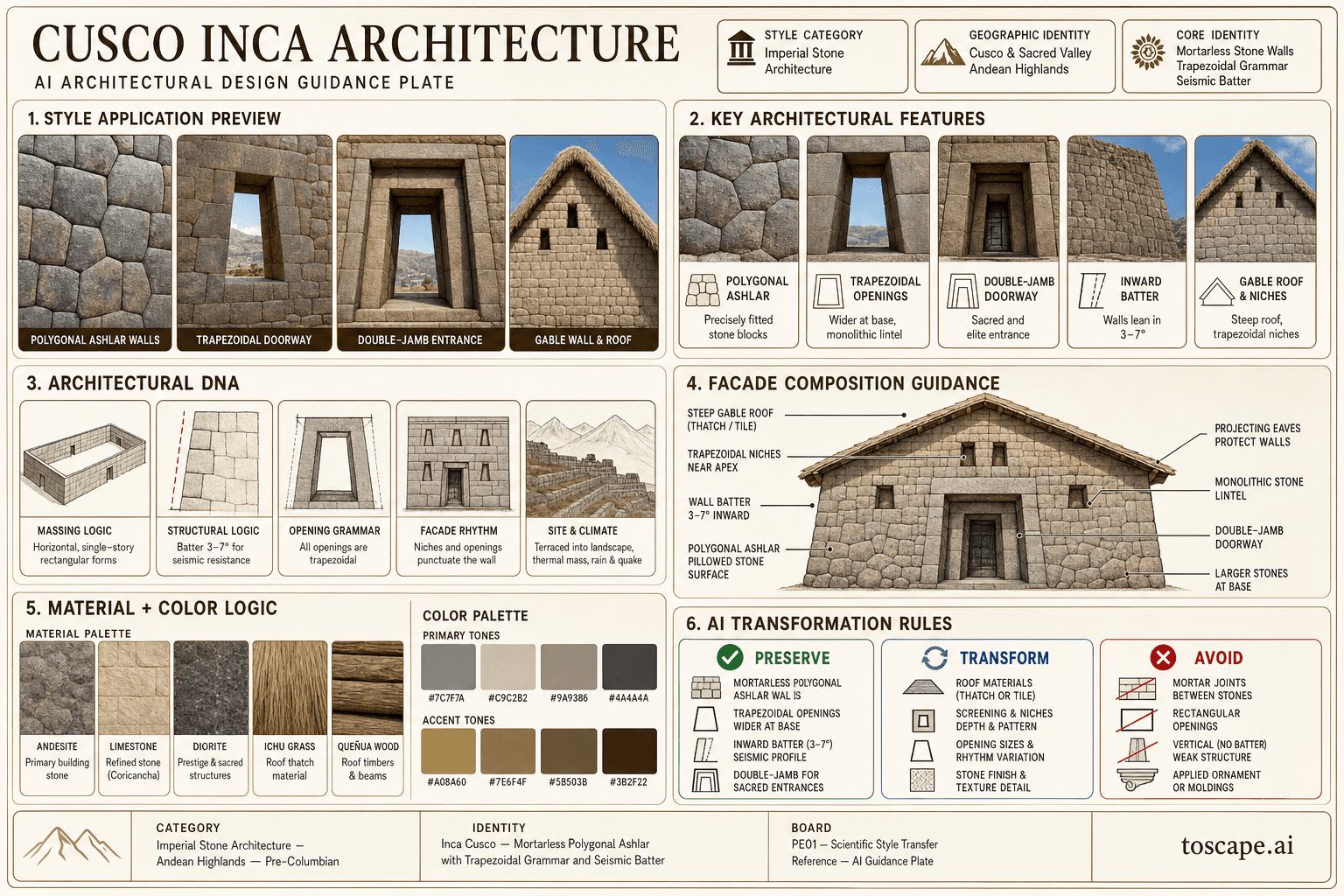
Cusco Inca
Peru · architectural identity of Inca Cusco (UNESCO World Heritage) and the Sacred Vall...
The cyclopean stone masonry of Cusco and the Sacred Valley — the mortarless polygonal ashlar walls of the Inca capital, where andesite and limestone blocks weighing up to 100 tons...
Definition
Cusco Inca is a regional architectural identity from Peru. The cyclopean stone masonry of Cusco and the Sacred Valley — the mortarless polygonal ashlar walls of the Inca capital, where andesite and limestone blocks weighing up to 100 tons.
- Country
- Peru
- Region
- architectural identity of Inca Cusco (UNESCO World Heritage) and the Sacred Vall.
- Massing
- Inca architecture is wall-dominant — the wall IS the architecture.
- Materials
- The stone IS the material — quarried, shaped, and set without mortar, showing its natural color and texture: (1) Andesite — grey to dark grey-green volcanic.
- Palette
- White, cream, pale sand, warm timber, and shadow-driven dark metal accents define the palette.
- Climate response
- Cusco sits at 3,400 m elevation in a highland valley.
Overview
Cusco Inca is a regional architectural identity in Peru. The architectural identity of Inca Cusco (UNESCO World Heritage) and the Sacred Valley — the imperial Inca stone architecture of the 15th–16th centuries, defined by mortarless ashlar masonry (pirka inca / cellular construction) in which massive polygonal or rectangular blocks of andesite, limestone, and diorite are cut and fitted with sub-millimeter precision — walls that are slightly inclined inward (batter of 3–7°...
Visual DNA
Massing & Form
Inca architecture is wall-dominant — the wall IS the architecture. Buildings are typically single-story, rectangular-plan, gable-roofed structures (kallanka: great hall; kancha: courtyard compound) enclosed within the Inca masonry wall.
Facade Language
The Inca facade is the masonry surface itself — a textured, geometric field of stone blocks whose joint lines create an organic, flowing pattern (in polygonal work) or a disciplined grid (in rectangular work). The pillow-like convexity of the blocks catches sunlight, creating a play of light and shadow across the wall...
Materials & Texture
The stone IS the material — quarried, shaped, and set without mortar, showing its natural color and texture: (1) Andesite — grey to dark grey-green volcanic stone, the primary building stone of Cusco, quarried from the Rumiqolqa and Waqoto quarries. (2) Limestone — cream to pale grey, used especially at Coricancha (Tem...
Color Palette
White, cream, pale sand, warm timber, and shadow-driven dark metal accents define the palette. The facade should stay bright and climate-aware rather than heavy, gray, or over-saturated.
Ornament & Detail
Inca ornament is geometric, architectural, and integral — never applied: (1) The stone joint pattern — the flowing interlocking lines of polygonal masonry, each unique, creating a surface of infinite variation. (2) The pillow facing — the convex stone face, catching light and casting soft shadows at joints.
Climate Response
Cusco sits at 3,400 m elevation in a highland valley. The Inca adapted their architecture to: (1) Earthquakes — the wall batter, trapezoidal openings, interlocking stone joints, and lack of rigid mortar create a ductile structure that dissipates seismic energy — Inca walls survive earthquakes that destroy Spanish colon...
Landscape & Ground
The architectural identity of Inca Cusco (UNESCO World Heritage) and the Sacred Valley — the imperial Inca stone architecture of the 15th–16th centuries, defined by mortarless ashlar masonry (pirka inca / cellular construction) in which massive polygonal or rectangular blocks of andesite, limestone, and diorite are cut...
Reference elevation
Cusco Inca — characteristic facade composition, architectural identity of Inca Cusco (UNESCO World Heritage) and the Sacred Vall....
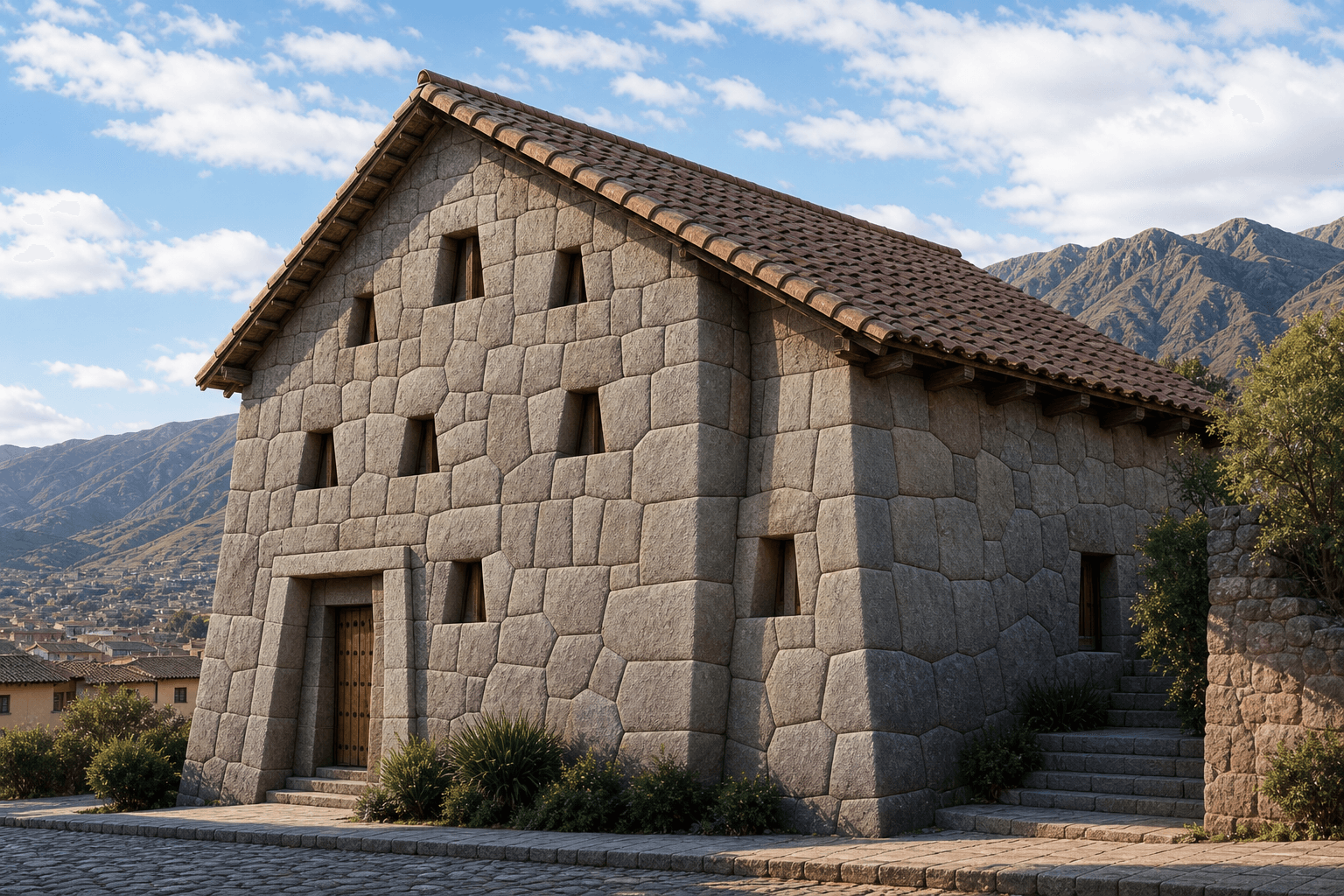
Context Snapshot
The architectural identity of Inca Cusco (UNESCO World Heritage) and the Sacred Valley — the imperial Inca stone architecture of the 15th–16th centuries, defined by mortarless ashlar masonry (pirka in... Cusco sits at 3,400 m elevation in a highland valley.
Contemporary Relevance
Cusco Inca is useful today for residential, hospitality, civic, and place-branding work that needs Peru-specific character grounded in local massing, material tone, climate response, and settlement logic rather than generic international styling.
Use this style in Toscape
Explore Cusco Inca directly inside Toscape using the Facade Re-Style and Design Options workflows.
Open Cusco Inca in the galleryFrequently asked questions
What is Cusco Inca?
Cusco Inca is a regional architectural identity from Peru. The cyclopean stone masonry of Cusco and the Sacred Valley — the mortarless polygonal ashlar walls of the Inca capital, where andesite and limestone blocks weighing up to 100 tons.
What materials define Cusco Inca?
The stone IS the material — quarried, shaped, and set without mortar, showing its natural color and texture: (1) Andesite — grey to dark grey-green volcanic stone, the primary building stone of Cusco, quarried from the Rumiqolqa and Waqoto quarries. (2) Limestone — cream to pale grey, used especially at Coricancha (Tem.
What is the Cusco Inca color palette?
White, cream, pale sand, warm timber, and shadow-driven dark metal accents define the palette. The facade should stay bright and climate-aware rather than heavy, gray, or over-saturated.
Where does Cusco Inca come from?
The architectural identity of Inca Cusco (UNESCO World Heritage) and the Sacred Valley — the imperial Inca stone architecture of the 15th–16th centuries, defined by mortarless ashlar masonry (pirka in... Cusco sits at 3,400 m elevation in a highland valley.
When should architects use Cusco Inca?
Cusco Inca is useful today for residential, hospitality, civic, and place-branding work that needs Peru-specific character grounded in local massing, material tone, climate response, and settlement logic rather than generic international styling.
How do you render Cusco Inca in Toscape?
Open Toscape on Windows, load your own photo, elevation, sketch, or CAD view, then apply the Cusco Inca reference from the built-in style library. The Facade Re-Style and Design Options workflows keep your project geometry and camera while shifting materials, proportion, and detailing toward Cusco Inca.