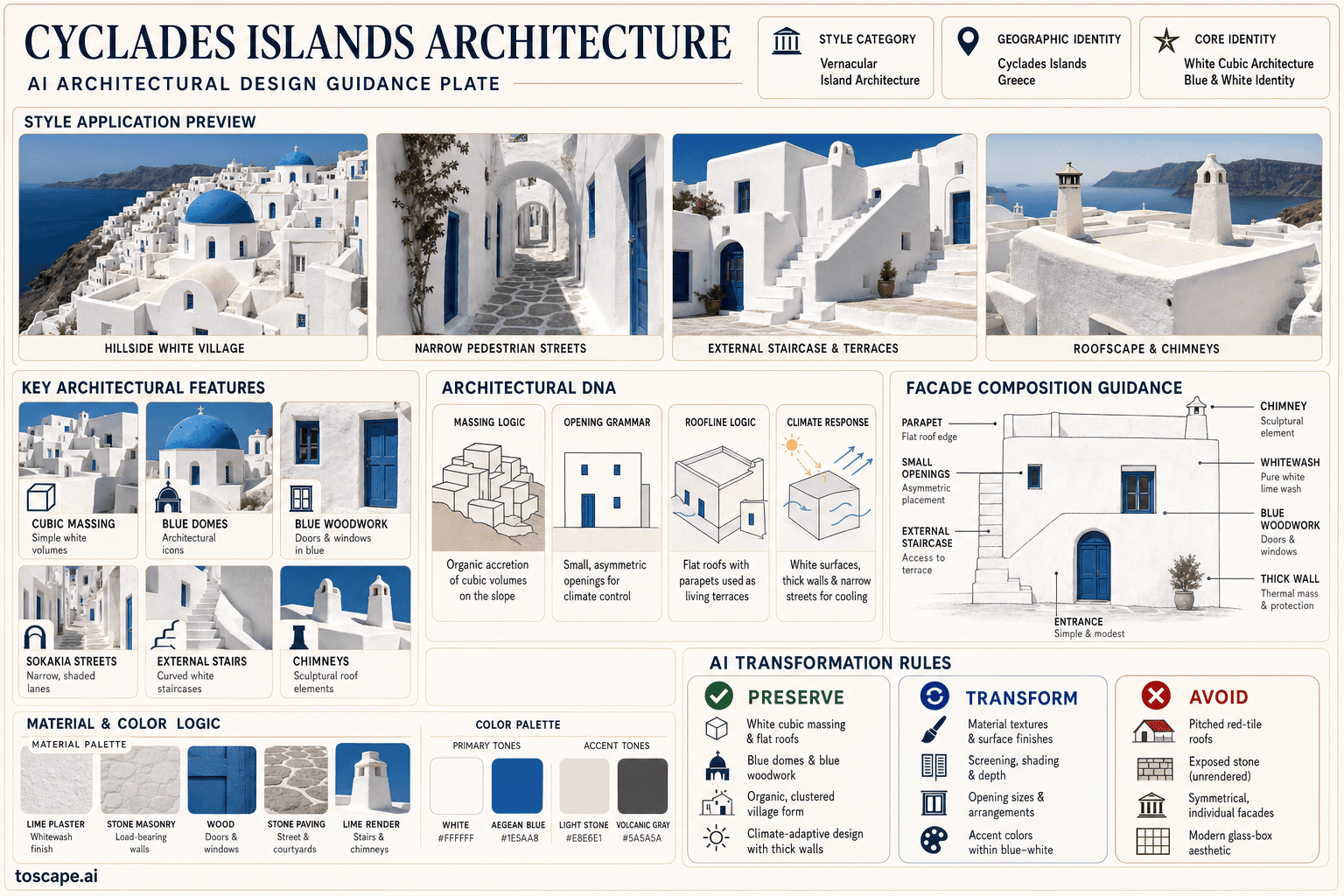
Cyclades Islands
Greece · vernacular architecture of the Cyclades Islands, Greece
The iconic whitewashed cubic architecture of the Aegean islands — Santorini, Mykonos, and the Cycladic archipelago
Definition
Cyclades Islands is a regional architectural identity from Greece. The iconic whitewashed cubic architecture of the Aegean islands — Santorini, Mykonos, and the Cycladic archipelago.
- Country
- Greece
- Region
- vernacular architecture of the Cyclades Islands, Greece.
- Massing
- The Cycladic house is a simple rectangular or L-shaped volume — typically 3–6 m wide × 4–8 m deep, single-storey or two-storey, with a flat roof.
- Materials
- Pure white lime-washed cubic volumes — flat roofs with parapets — blue-painted woodwork (doors, windows, domes) — organic, clustered settlement form on hillsides — narrow.
- Palette
- White, cream, pale sand, warm timber, and shadow-driven dark metal accents define the palette.
- Climate response
- Traditional vernacular architecture of the Cyclades Islands, Greece — one of the most visually recognizable vernacular architectures in the world, defined by whitewashed cubic forms.
Overview
Cyclades Islands is a regional architectural identity in Greece. Traditional vernacular architecture of the Cyclades Islands, Greece — one of the most visually recognizable vernacular architectures in the world, defined by whitewashed cubic forms, blue-domed churches, and an extraordinary adaptation to the Aegean climate. Pure white lime-washed cubic volumes — flat roofs with parapets — blue-painted woodwork (doors, windows, domes) — organic, clustered settlement form on hillsides...
Visual DNA
Massing & Form
The Cycladic house is a simple rectangular or L-shaped volume — typically 3–6 m wide × 4–8 m deep, single-storey or two-storey, with a flat roof. The plan is cellular — rooms are added incrementally as the family grows.
Facade Language
The Cycladic facade is characterized by simplicity and unity: Whitewash (asvestis): All surfaces are coated in brilliant white lime wash — walls, roofs, stairs, streets. The white colour reflects solar radiation and unifies the diverse materials beneath.
Materials & Texture
Pure white lime-washed cubic volumes — flat roofs with parapets — blue-painted woodwork (doors, windows, domes) — organic, clustered settlement form on hillsides — narrow, winding, shaded pedestrian streets (sokakia) — external staircases connecting roof terraces — the "chora" (main village) as a unified sculptural com...
Color Palette
White, cream, pale sand, warm timber, and shadow-driven dark metal accents define the palette. The facade should stay bright and climate-aware rather than heavy, gray, or over-saturated.
Ornament & Detail
Pure white lime-washed cubic volumes — flat roofs with parapets — blue-painted woodwork (doors, windows, domes) — organic, clustered settlement form on hillsides — narrow, winding, shaded pedestrian streets (sokakia) — external staircases connecting roof terraces — the "chora" (main village) as a unified sculptural com...
Climate Response
Traditional vernacular architecture of the Cyclades Islands, Greece — one of the most visually recognizable vernacular architectures in the world, defined by whitewashed cubic forms, blue-domed churches, and an extraordinary adaptation to the Aegean climate
Landscape & Ground
Traditional vernacular architecture of the Cyclades Islands, Greece — one of the most visually recognizable vernacular architectures in the world, defined by whitewashed cubic forms, blue-domed churches, and an extraordinary adaptation to the Aegean climate
Reference elevation
Cyclades Islands — characteristic facade composition, vernacular architecture of the Cyclades Islands, Greece.
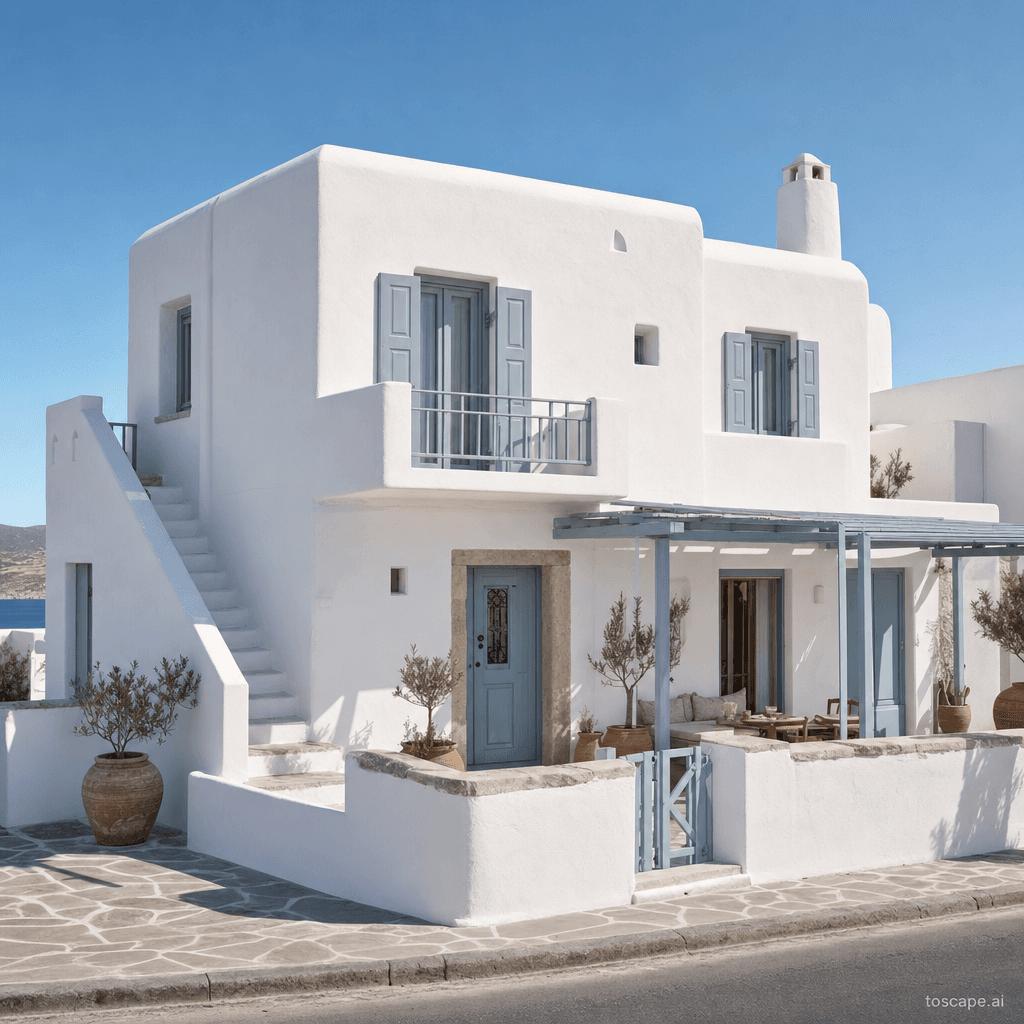
Context Snapshot
Traditional vernacular architecture of the Cyclades Islands, Greece — one of the most visually recognizable vernacular architectures in the world, defined by whitewashed cubic forms, blue-domed church...
Contemporary Relevance
Cyclades Islands is useful today for residential, hospitality, civic, and place-branding work that needs Greece-specific character grounded in local massing, material tone, climate response, and settlement logic rather than generic international styling.
Use this style in Toscape
Explore Cyclades Islands directly inside Toscape using the Facade Re-Style and Design Options workflows.
Open Cyclades Islands in the galleryFrequently asked questions
What is Cyclades Islands?
Cyclades Islands is a regional architectural identity from Greece. The iconic whitewashed cubic architecture of the Aegean islands — Santorini, Mykonos, and the Cycladic archipelago.
What materials define Cyclades Islands?
Pure white lime-washed cubic volumes — flat roofs with parapets — blue-painted woodwork (doors, windows, domes) — organic, clustered settlement form on hillsides — narrow, winding, shaded pedestrian streets (sokakia) — external staircases connecting roof terraces — the "chora" (main village) as a unified sculptural com.
What is the Cyclades Islands color palette?
White, cream, pale sand, warm timber, and shadow-driven dark metal accents define the palette. The facade should stay bright and climate-aware rather than heavy, gray, or over-saturated.
Where does Cyclades Islands come from?
Traditional vernacular architecture of the Cyclades Islands, Greece — one of the most visually recognizable vernacular architectures in the world, defined by whitewashed cubic forms, blue-domed church.
When should architects use Cyclades Islands?
Cyclades Islands is useful today for residential, hospitality, civic, and place-branding work that needs Greece-specific character grounded in local massing, material tone, climate response, and settlement logic rather than generic international styling.
How do you render Cyclades Islands in Toscape?
Open Toscape on Windows, load your own photo, elevation, sketch, or CAD view, then apply the Cyclades Islands reference from the built-in style library. The Facade Re-Style and Design Options workflows keep your project geometry and camera while shifting materials, proportion, and detailing toward Cyclades Islands.