Dayak Longhouse
Indonesia · Dayak longhouse (rumah betang or lamin) of Kalimantan (Indonesian Borneo)
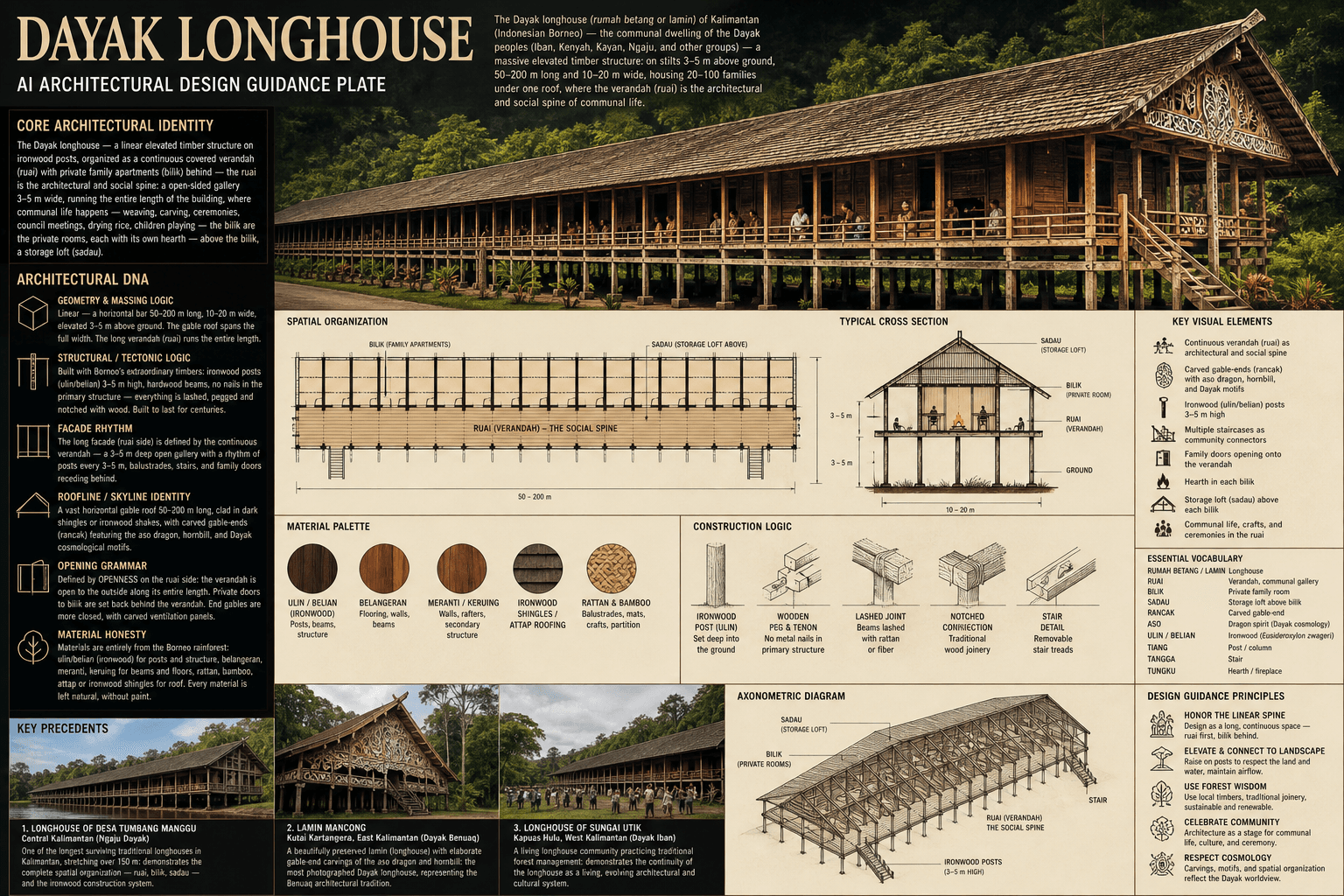
The communal dwelling of Borneo's Indigenous peoples — a linear elevated village under one continuous roof, the rumah betang (longhouse) stretches 50–200 meters along the great riv...
Definition
Dayak Longhouse is a regional architectural identity from Indonesia. The communal dwelling of Borneo's Indigenous peoples — a linear elevated village under one continuous roof, the rumah betang (longhouse) stretches 50–200 meters along the great riv.
- Country
- Indonesia
- Region
- Dayak longhouse (rumah betang or lamin) of Kalimantan (Indonesian Borneo).
- Massing
- The longhouse is linear — a horizontal bar 50–200 m long, 10–20 m wide, elevated 3–5 m above ground.
- Materials
- Materials are entirely from the Borneo rainforest: (1) Ulin/belian (Borneo ironwood, Eusideroxylon zwageri) — the hardest and most durable timber in Southeast Asia.
- Palette
- White, cream, pale sand, warm timber, and shadow-driven dark metal accents define the palette.
- Climate response
- The Borneo equatorial rainforest climate defines the longhouse: (1) Annual rainfall 3,000–4,000 mm, no dry season — the elevation on high posts (3–5 m) is essential.
Overview
Dayak Longhouse is a regional architectural identity in Indonesia. The Dayak longhouse (rumah betang or lamin) of Kalimantan (Indonesian Borneo) — the communal dwelling of the Dayak peoples (Iban, Kenyah, Kayan, Ngaju, and other groups) — a massive elevated timber structure on stilts 3–5 m above ground, 50–200 m long and 10–20 m wide, housing 20–100 families under one continuous roof — the longhouse is organized as a linear series of family apartments (bilik) along one side of a con...
Visual DNA
Massing & Form
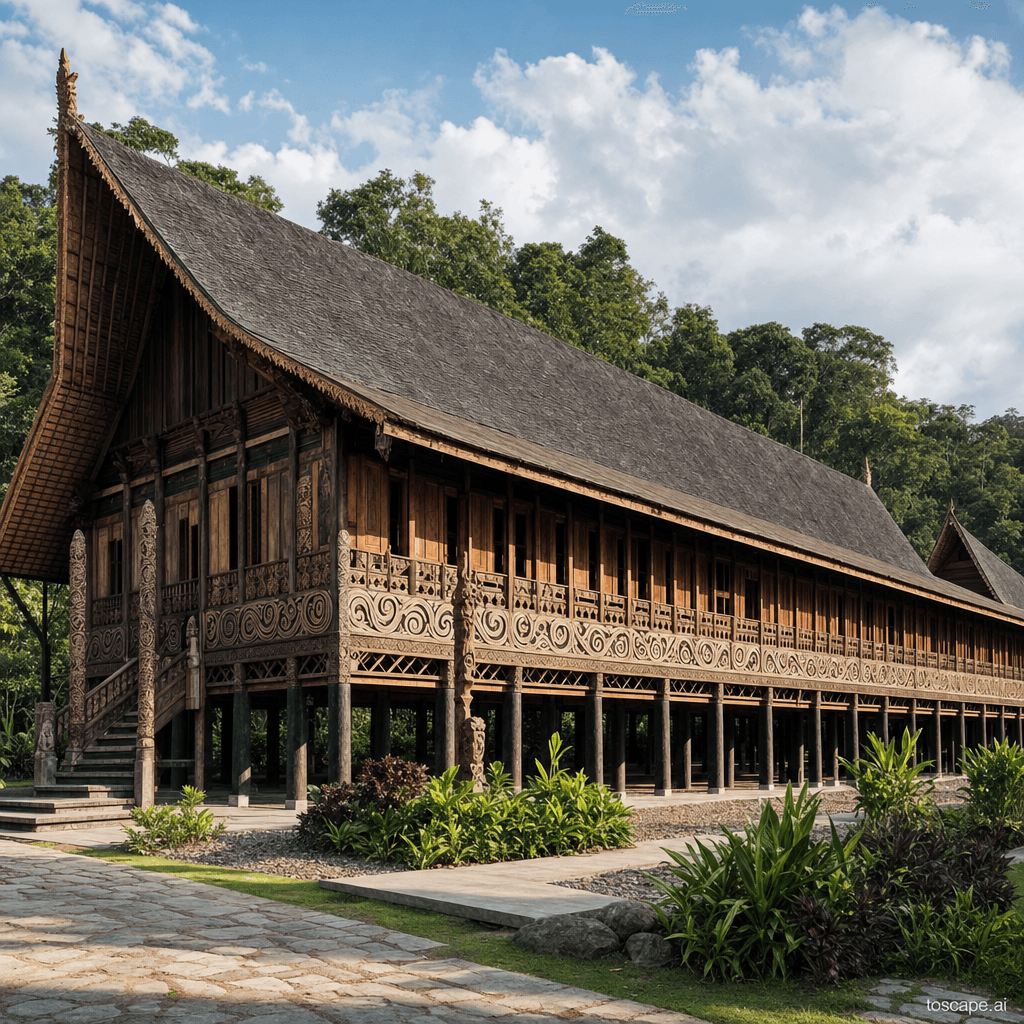
The longhouse is linear — a horizontal bar 50–200 m long, 10–20 m wide, elevated 3–5 m above ground. The gable roof spans the width and runs the full length — a vast brown-black plane above the forest floor.
Facade Language
The long facade (the ruai side) is characterized by: (1) The continuous open verandah — a 3–5 m deep shadow band running the full length, the most distinctive visual feature — from the outside, you see the dark verandah space, the row of posts, and the activities within. (2) The outer posts create a rhythmic vertical b...
Materials & Texture
Materials are entirely from the Borneo rainforest: (1) Ulin/belian (Borneo ironwood, Eusideroxylon zwageri) — the hardest and most durable timber in Southeast Asia, dark brown to black, virtually indestructible — used for posts and main structural members — the material identity of the longhouse. (2) Meranti (Shorea sp...
Color Palette
White, cream, pale sand, warm timber, and shadow-driven dark metal accents define the palette. The facade should stay bright and climate-aware rather than heavy, gray, or over-saturated.
Ornament & Detail
Dayak ornament is concentrated on the gable ends and ceremonial posts: (1) Aso — the mythical dog-dragon figure, a protective spirit carved and painted on the gable ends — stylized with open jaws, scrolling body, and fierce expression — the primary guardian motif. (2) Hornbill (burung enggang) motifs — the rhinoceros h...
Climate Response
The Borneo equatorial rainforest climate defines the longhouse: (1) Annual rainfall 3,000–4,000 mm, no dry season — the elevation on high posts (3–5 m) is essential for flood protection; the deep roof overhangs protect the verandah from rain. (2) Constant high humidity (80–95%) — the open verandah provides maximum cros...
Landscape & Ground
The Dayak longhouse (rumah betang or lamin) of Kalimantan (Indonesian Borneo) — the communal dwelling of the Dayak peoples (Iban, Kenyah, Kayan, Ngaju, and other groups) — a massive elevated timber structure on stilts 3–5 m above ground, 50–200 m long and 10–20 m wide, housing 20–100 families under one continuous roof...
Reference elevation
Dayak Longhouse — characteristic facade composition, Dayak longhouse (rumah betang or lamin) of Kalimantan (Indonesian Borneo).
Context Snapshot
The Dayak longhouse (rumah betang or lamin) of Kalimantan (Indonesian Borneo) — the communal dwelling of the Dayak peoples (Iban, Kenyah, Kayan, Ngaju, and other groups) — a massive elevated timber st... The Borneo equatorial rainforest climate defines the longhouse: (1) Annual rainfall 3,000–4,000 mm, no dry season — the elevation on high posts (3–5 m) is essential for flood protection; the deep roof overhangs protect t...
Contemporary Relevance
Dayak Longhouse is useful today for residential, hospitality, civic, and place-branding work that needs Indonesia-specific character grounded in local massing, material tone, climate response, and settlement logic rather than generic international styling.
Use this style in Toscape
Explore Dayak Longhouse directly inside Toscape using the Facade Re-Style and Design Options workflows.
Open Dayak Longhouse in the galleryFrequently asked questions
What is Dayak Longhouse?
Dayak Longhouse is a regional architectural identity from Indonesia. The communal dwelling of Borneo's Indigenous peoples — a linear elevated village under one continuous roof, the rumah betang (longhouse) stretches 50–200 meters along the great riv.
What materials define Dayak Longhouse?
Materials are entirely from the Borneo rainforest: (1) Ulin/belian (Borneo ironwood, Eusideroxylon zwageri) — the hardest and most durable timber in Southeast Asia, dark brown to black, virtually indestructible — used for posts and main structural members — the material identity of the longhouse. (2) Meranti (Shorea sp.
What is the Dayak Longhouse color palette?
White, cream, pale sand, warm timber, and shadow-driven dark metal accents define the palette. The facade should stay bright and climate-aware rather than heavy, gray, or over-saturated.
Where does Dayak Longhouse come from?
The Dayak longhouse (rumah betang or lamin) of Kalimantan (Indonesian Borneo) — the communal dwelling of the Dayak peoples (Iban, Kenyah, Kayan, Ngaju, and other groups) — a massive elevated timber st.
When should architects use Dayak Longhouse?
Dayak Longhouse is useful today for residential, hospitality, civic, and place-branding work that needs Indonesia-specific character grounded in local massing, material tone, climate response, and settlement logic rather than generic international styling.
How do you render Dayak Longhouse in Toscape?
Open Toscape on Windows, load your own photo, elevation, sketch, or CAD view, then apply the Dayak Longhouse reference from the built-in style library. The Facade Re-Style and Design Options workflows keep your project geometry and camera while shifting materials, proportion, and detailing toward Dayak Longhouse.