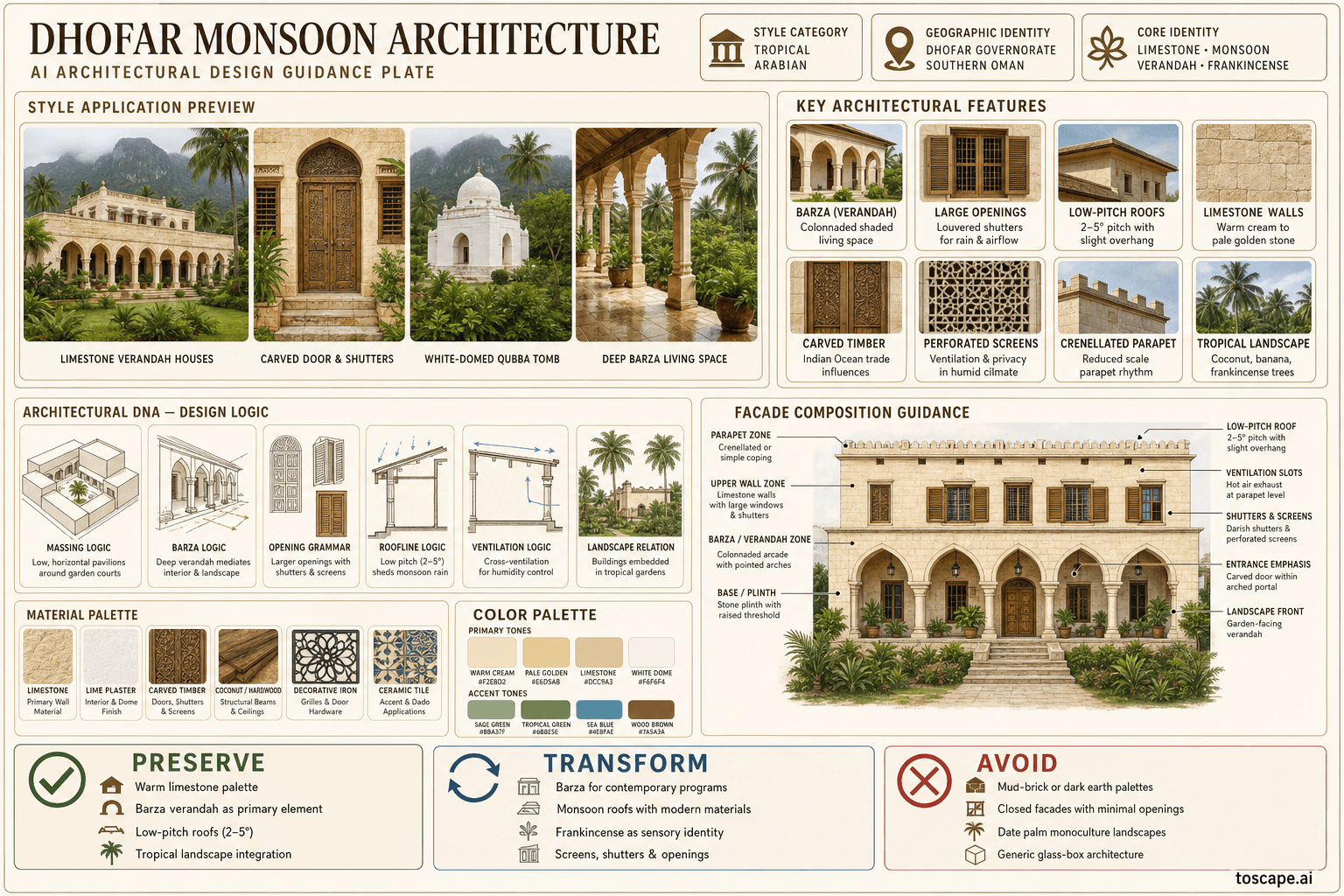
Dhofar Monsoon
Oman · and contemporary architecture of Salalah and the Dhofar Governorate
The limestone monsoon-adapted architecture of southern Oman — Indian Ocean monsoon (khareef) influences, tropical vegetation, frankincense heritage, and a distinct architectural di...
Definition
Dhofar Monsoon is a regional architectural identity from Oman. The limestone monsoon-adapted architecture of southern Oman — Indian Ocean monsoon (khareef) influences, tropical vegetation, frankincense heritage, and a distinct architectural di.
- Country
- Oman
- Region
- and contemporary architecture of Salalah and the Dhofar Governorate.
- Massing
- Dhofari buildings are low-rise (1–3 storeys), horizontally-spread volumes — typically wider and lower than their northern counterparts.
- Materials
- Dhofari limestone — warm cream to pale golden color, smooth dressed finish or natural split face Gypsum-lime plaster — white to cream render.
- Palette
- White, cream, pale sand, warm timber, and shadow-driven dark metal accents define the palette.
- Climate response
- Dhofar's unique monsoon climate drives distinct architectural responses: (1) The barza (verandah) as the primary climate mediator — a deep shaded space that enables outdoor living.
Overview
Dhofar Monsoon is a regional architectural identity in Oman. Traditional and contemporary architecture of Salalah and the Dhofar Governorate — a unique climatic and cultural zone in the Arabian Peninsula. Unlike the rest of Arabia, Dhofar receives the annual Indian Ocean monsoon (khareef) from June to September, transforming the landscape into a lush green tropical environment.
Visual DNA
Massing & Form
Dhofari buildings are low-rise (1–3 storeys), horizontally-spread volumes — typically wider and lower than their northern counterparts. The massing is characterized by a more open, extroverted relationship with the landscape compared to the introverted courtyard houses of interior Oman.
Facade Language
The Dhofari facade is more open and articulated than the fortress-like walls of interior Oman: Verandah / arcade zone (ground floor): The defining Dhofari facade element — a covered, colonnaded verandah (barza) running along the primary facade, facing gardens or the sea. Pointed arches or rectangular columns support th...
Materials & Texture
Dhofari limestone — warm cream to pale golden color, smooth dressed finish or natural split face Gypsum-lime plaster — white to cream render, especially for interior walls and domed tombs Carved timber — local sidr (jujube) wood and imported hardwoods (teak, mango) — showing Indian Ocean trade influences in greater dec...
Color Palette
White, cream, pale sand, warm timber, and shadow-driven dark metal accents define the palette. The facade should stay bright and climate-aware rather than heavy, gray, or over-saturated.
Ornament & Detail
Dhofari ornament reflects the region's Indian Ocean cosmopolitanism: (1) carved door panels — more elaborate than northern equivalents, with floral arabesque and geometric patterns showing Swahili-Zanzibari and Gujarati influences, (2) stucco banding and niche surrounds — gypsum carved with geometric and stylized veget...
Climate Response
Dhofar's unique monsoon climate drives distinct architectural responses: (1) The barza (verandah) as the primary climate mediator — a deep shaded space that enables outdoor living during the humid monsoon season when interior spaces become stifling. (2) Low-pitched roofs to shed monsoon rainfall — the only region in Ar...
Landscape & Ground
Traditional and contemporary architecture of Salalah and the Dhofar Governorate — a unique climatic and cultural zone in the Arabian Peninsula. Unlike the rest of Arabia, Dhofar receives the annual Indian Ocean monsoon (khareef) from June to September, transforming the landscape into a lush green tropical environment.
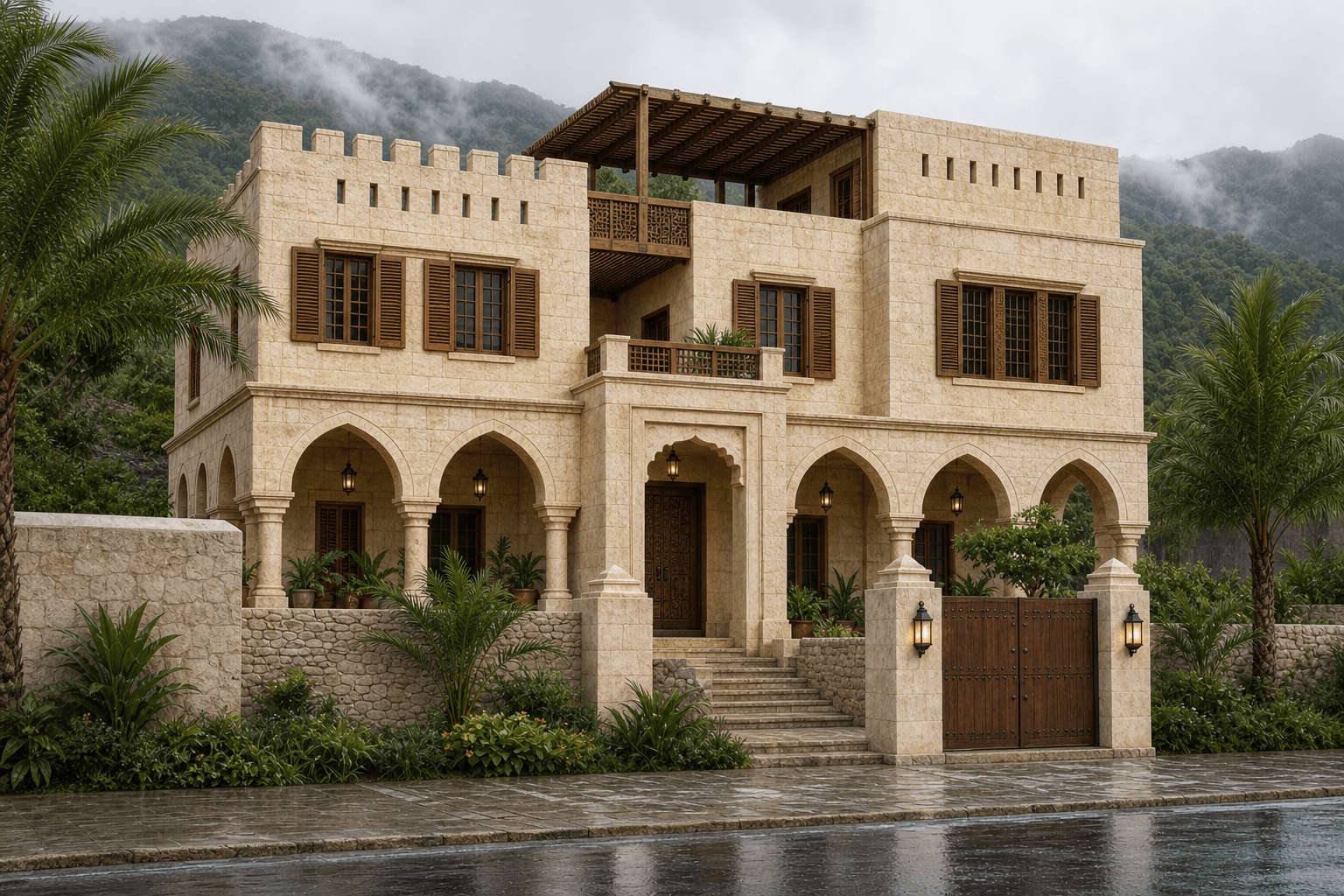
Reference elevation
Dhofar Monsoon — characteristic facade composition, and contemporary architecture of Salalah and the Dhofar Governorate.
Context Snapshot
Traditional and contemporary architecture of Salalah and the Dhofar Governorate — a unique climatic and cultural zone in the Arabian Peninsula. Dhofar's unique monsoon climate drives distinct architectural responses: (1) The barza (verandah) as the primary climate mediator — a deep shaded space that enables outdoor living during the humid monsoon season when int...
Contemporary Relevance
Dhofar Monsoon is useful today for residential, hospitality, civic, and place-branding work that needs Oman-specific character grounded in local massing, material tone, climate response, and settlement logic rather than generic international styling.
Use this style in Toscape
Explore Dhofar Monsoon directly inside Toscape using the Facade Re-Style and Design Options workflows.
Open Dhofar Monsoon in the galleryFrequently asked questions
What is Dhofar Monsoon?
Dhofar Monsoon is a regional architectural identity from Oman. The limestone monsoon-adapted architecture of southern Oman — Indian Ocean monsoon (khareef) influences, tropical vegetation, frankincense heritage, and a distinct architectural di.
What materials define Dhofar Monsoon?
Dhofari limestone — warm cream to pale golden color, smooth dressed finish or natural split face Gypsum-lime plaster — white to cream render, especially for interior walls and domed tombs Carved timber — local sidr (jujube) wood and imported hardwoods (teak, mango) — showing Indian Ocean trade influences in greater dec.
What is the Dhofar Monsoon color palette?
White, cream, pale sand, warm timber, and shadow-driven dark metal accents define the palette. The facade should stay bright and climate-aware rather than heavy, gray, or over-saturated.
Where does Dhofar Monsoon come from?
Traditional and contemporary architecture of Salalah and the Dhofar Governorate — a unique climatic and cultural zone in the Arabian Peninsula. Dhofar's unique monsoon climate drives distinct architectural responses: (1) The barza (verandah) as the primary climate mediator — a deep shaded space that enables outdoor living during the humid monsoon season when int.
When should architects use Dhofar Monsoon?
Dhofar Monsoon is useful today for residential, hospitality, civic, and place-branding work that needs Oman-specific character grounded in local massing, material tone, climate response, and settlement logic rather than generic international styling.
How do you render Dhofar Monsoon in Toscape?
Open Toscape on Windows, load your own photo, elevation, sketch, or CAD view, then apply the Dhofar Monsoon reference from the built-in style library. The Facade Re-Style and Design Options workflows keep your project geometry and camera while shifting materials, proportion, and detailing toward Dhofar Monsoon.