East Coast Contemporary
Saudi Arabia · Eastern Coast / Arabian Gulf
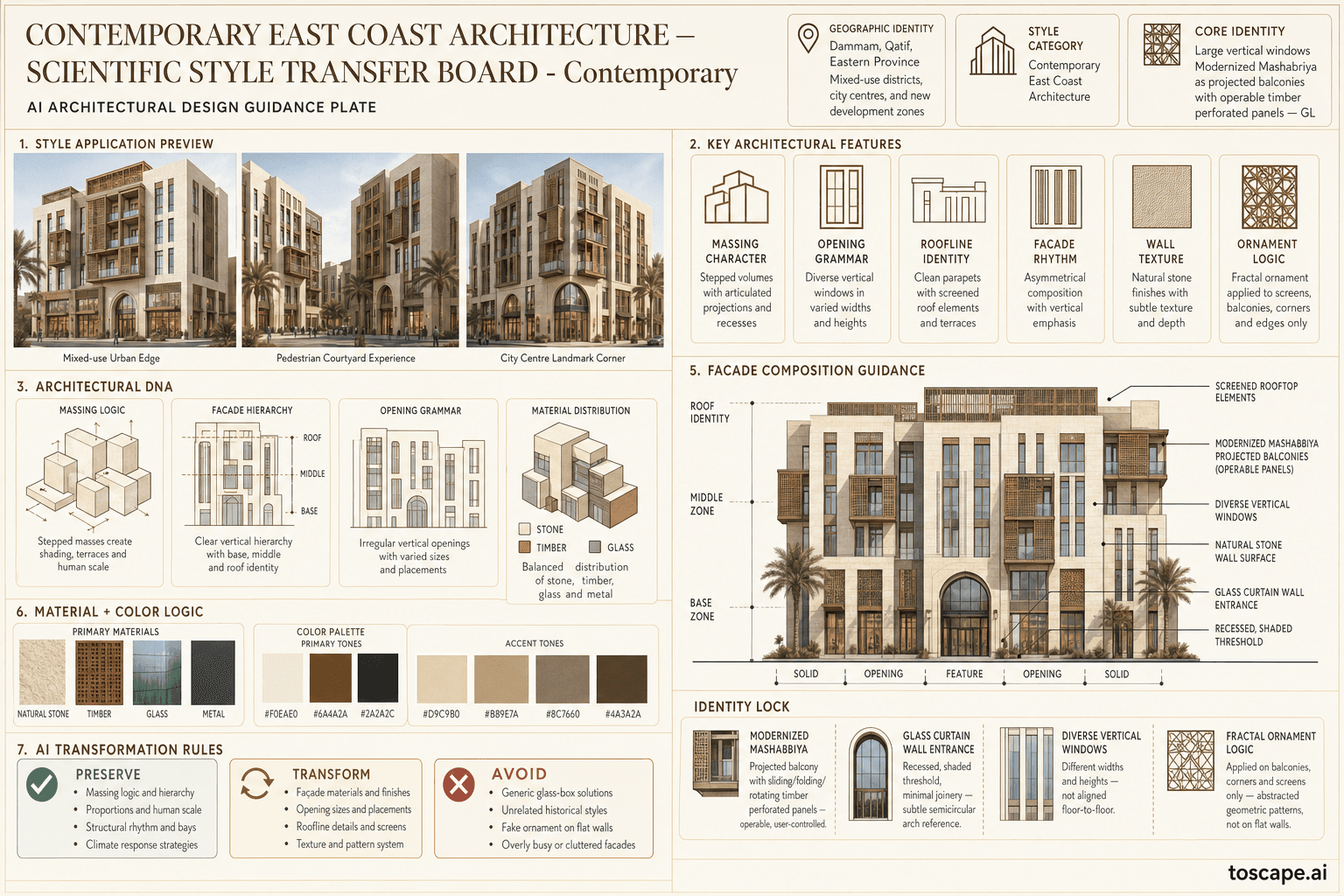
Full contemporary interpretation — abstracted geometric fractal patterning, modernized sliding/folding mashrabiya panels, large glazing, flat angular parapets, glass curtain entran...
Definition
East Coast Contemporary is a regional architectural identity from Saudi Arabia. Full contemporary interpretation — abstracted geometric fractal patterning, modernized sliding/folding mashrabiya panels, large glazing, flat angular parapets, glass curtain entran.
- Country
- Saudi Arabia
- Region
- Eastern Coast / Arabian Gulf.
- Massing
- Contemporary East Coast buildings identify SEPARATE BUILDING MASSES — fractal ornamental design helps differentiate them .
- Materials
- Contemporary materials: smooth contemporary plaster for walls; modern timber-look for windows, doors, and perforated panels; glass for windows and entrance; steel for entrance structure.
- Palette
- Use a light mineral field of sand, shell, coral, and sun-softened white, then introduce timber, bronze, or darker screened shadow as accent.
- Climate response
- Multi-tiered habitable terraces with shaded canopies at each level — the contemporary interpretation of the traditional roof terrace.
Overview
East Coast Contemporary is a Saudi architectural identity rooted in Eastern Coast / Arabian Gulf. East Coast Architecture — the complete Traditional → Transitional → Contemporary progression. Dammam, Qatif, Eastern Province — mixed-use districts, city centres, and new development zones.
Visual DNA
Massing & Form
Contemporary East Coast buildings identify SEPARATE BUILDING MASSES — fractal ornamental design helps differentiate them . Each mass is articulated independently — facades are NOT necessarily strictly symmetric, but the composition is dynamic yet ordered.
Facade Language
Void ratio: 50–60% — the most open of the three variants . Windows are large, vertical, and DIVERSE — different widths and heights across the facade.
Materials & Texture
Contemporary materials: smooth contemporary plaster for walls; modern timber-look for windows, doors, and perforated panels; glass for windows and entrance; steel for entrance structure; dark metal for frames and screens — all materials honestly expressed, no fakery . The material palette is deliberately contemporary —...
Color Palette
Use a light mineral field of sand, shell, coral, and sun-softened white, then introduce timber, bronze, or darker screened shadow as accent. Coastal and oasis palettes should feel bright, breathable, and climate-tempered rather than heavy or monochrome.
Ornament & Detail
FRACTAL DESIGN ELEMENTS inspired by historical motifs — applied to BALCONIES, PROJECTING AREAS, CORNERS, and WINDOW SCREENS ONLY . NOT on flat walls.
Climate Response
Multi-tiered habitable terraces with shaded canopies at each level — the contemporary interpretation of the traditional roof terrace. The sliding/folding/rotating mashrabiya panels allow user-controlled solar shading and privacy.
Landscape & Ground
Dammam, Qatif, Eastern Province — mixed-use districts, city centres, and new development zones. Multi-tiered habitable terraces with shaded canopies at each level — the contemporary interpretation of the traditional roof terrace.
Reference elevation
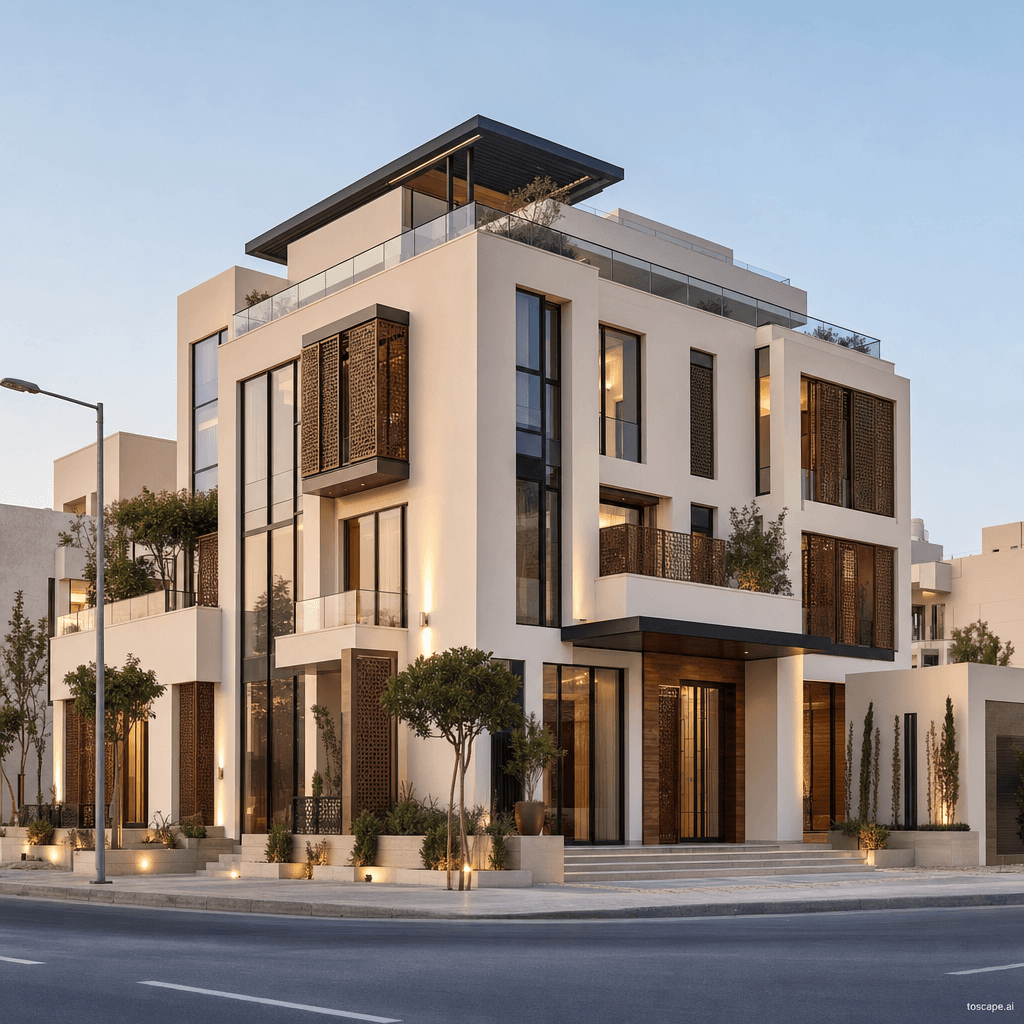
East Coast Contemporary — characteristic facade composition, Eastern Coast / Arabian Gulf.
Context Snapshot
Confident contemporary reinterpretation of East Coast vernacular — the mashrabiya becomes a sliding/folding/rotating timber perforated panel balcony, the portal becomes a glass curtain wall entrance... East Coast Architecture — the complete Traditional → Transitional → Contemporary progression Dammam, Qatif, Eastern Province — mixed-use districts, city centres, and new development zones
Contemporary Relevance
East Coast Contemporary aligns naturally with current Saudi practice, where regional identity is carried by proportion, shading depth, material tone, and controlled abstraction rather than direct historic imitation. It suits present-day residential, hospitality, and mixed-use work that needs strong local character inside a modern planning and construction framework.
Use this style in Toscape
Explore East Coast Contemporary directly inside Toscape using the Facade Re-Style and Design Options workflows.
Open East Coast Contemporary in the galleryFrequently asked questions
What is East Coast Contemporary?
East Coast Contemporary is a regional architectural identity from Saudi Arabia. Full contemporary interpretation — abstracted geometric fractal patterning, modernized sliding/folding mashrabiya panels, large glazing, flat angular parapets, glass curtain entran.
What materials define East Coast Contemporary?
Contemporary materials: smooth contemporary plaster for walls; modern timber-look for windows, doors, and perforated panels; glass for windows and entrance; steel for entrance structure; dark metal for frames and screens — all materials honestly expressed, no fakery . The material palette is deliberately contemporary.
What is the East Coast Contemporary color palette?
Use a light mineral field of sand, shell, coral, and sun-softened white, then introduce timber, bronze, or darker screened shadow as accent. Coastal and oasis palettes should feel bright, breathable, and climate-tempered rather than heavy or monochrome.
Where does East Coast Contemporary come from?
Confident contemporary reinterpretation of East Coast vernacular — the mashrabiya becomes a sliding/folding/rotating timber perforated panel balcony, the portal becomes a glass curtain wall entrance... East Coast Architecture — the complete Traditional → Transitional → Contemporary progression Dammam, Qatif, Eastern Province — mixed-use districts, city centres, and new development zones.
When should architects use East Coast Contemporary?
East Coast Contemporary aligns naturally with current Saudi practice, where regional identity is carried by proportion, shading depth, material tone, and controlled abstraction rather than direct historic imitation. It suits present-day residential, hospitality, and mixed-use work that needs strong local character inside a modern planning and construction framework.
How do you render East Coast Contemporary in Toscape?
Open Toscape on Windows, load your own photo, elevation, sketch, or CAD view, then apply the East Coast Contemporary reference from the built-in style library. The Facade Re-Style and Design Options workflows keep your project geometry and camera while shifting materials, proportion, and detailing toward East Coast Contemporary.