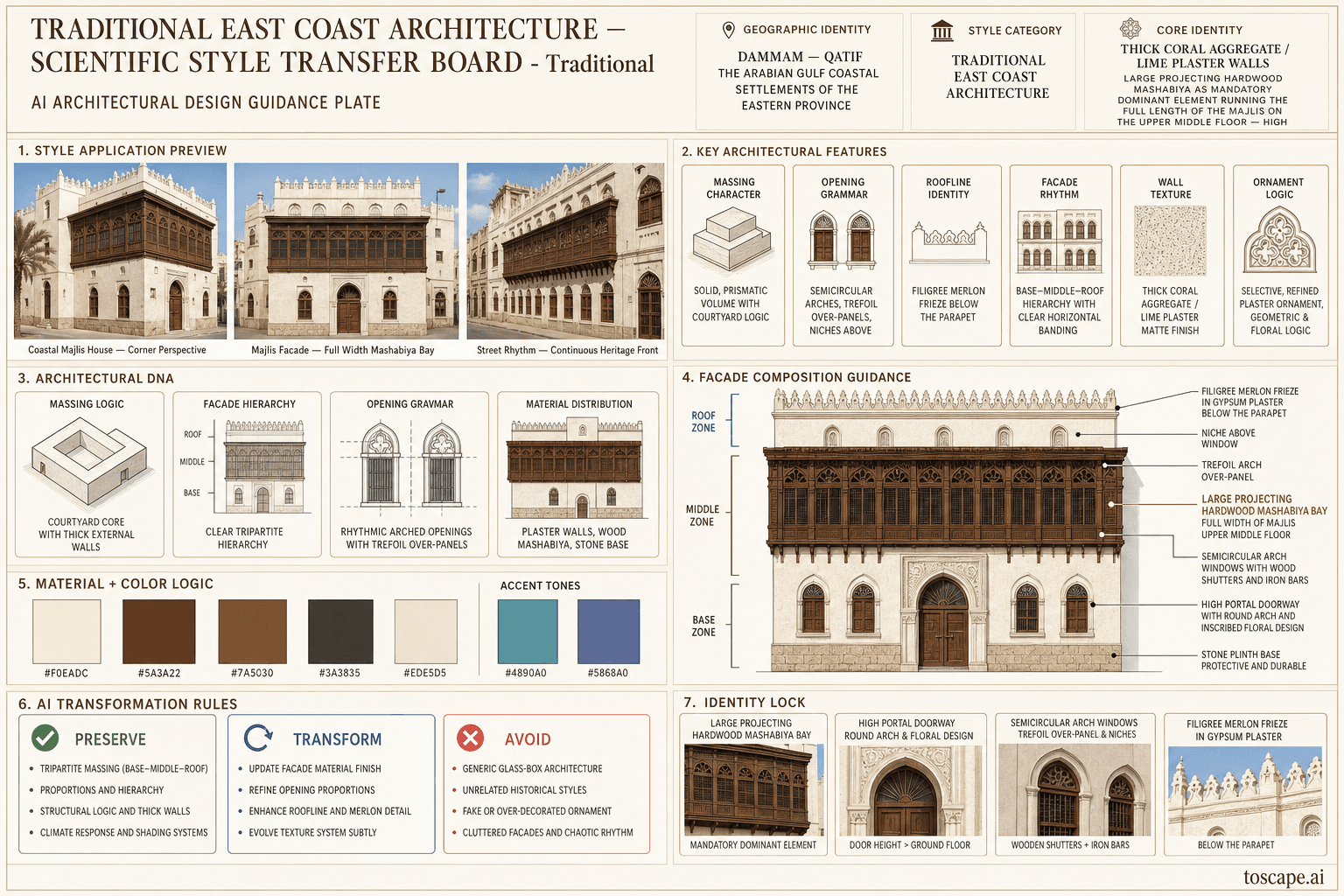
East Coast Traditional
Saudi Arabia · Eastern Coast / Arabian Gulf
The Gulf coastal vernacular of coral aggregate, full mashrabiya, high portal doorways, trefoil arches, and ornamental merlon friezes — the most ornate of Saudi Arabia's eastern lit...
Definition
East Coast Traditional is a regional architectural identity from Saudi Arabia. The Gulf coastal vernacular of coral aggregate, full mashrabiya, high portal doorways, trefoil arches, and ornamental merlon friezes — the most ornate of Saudi Arabia's eastern lit.
- Country
- Saudi Arabia
- Region
- Eastern Coast / Arabian Gulf.
- Massing
- Traditional East Coast buildings are organized around SYMMETRY WITHIN EACH VOLUME — piers create consistent vertical bay rhythm, and windows, mashrabiya.
- Materials
- Materials are coral aggregate stone and lime plaster for walls — off-white, matte finish, continuous from base to parapet .
- Palette
- Use a light mineral field of sand, shell, coral, and sun-softened white, then introduce timber, bronze, or darker screened shadow as accent.
- Climate response
- The East Coast climate is hot humid coastal (Arabian Gulf) — different from the arid interior and Red Sea coast.
Overview
East Coast Traditional is a Saudi architectural identity rooted in Eastern Coast / Arabian Gulf. East Coast Architecture — the Gulf littoral vernacular of Saudi Arabia's Eastern Province, drawing on Arabian Gulf coastal building traditions, coral-stone construction, and Indian Ocean timber trade influences. Dammam — Qatif — the Arabian Gulf coastal settlements of the Eastern Province.
Visual DNA
Massing & Form
Traditional East Coast buildings are organized around SYMMETRY WITHIN EACH VOLUME — piers create consistent vertical bay rhythm, and windows, mashrabiya, and decorative elements align symmetrically within each building mass . The overall composition may feature multiple volumes, each individually symmetrical.
Facade Language
The facade is organized around interior zoning — entrances placed according to interior programs, with remaining elements aligned symmetrically within each mass . Piers create the vertical organization from top to bottom, establishing symmetry and verticality.
Materials & Texture
Materials are coral aggregate stone and lime plaster for walls — off-white, matte finish, continuous from base to parapet . Hardwood timber for the mashrabiya — the finest crafted element of the facade.
Color Palette
Use a light mineral field of sand, shell, coral, and sun-softened white, then introduce timber, bronze, or darker screened shadow as accent. Coastal and oasis palettes should feel bright, breathable, and climate-tempered rather than heavy or monochrome.
Ornament & Detail
Ornament is RICH BUT DISCIPLINED — the most elaborate ornamental system in the Saudi Characters Map . The primary ornamental elements are: (a) the portal doorway with its inscribed round arch and floral design — the most loaded ornamental moment; (b) trefoil arch panels between piers above the mashrabiya — a distinctiv...
Climate Response
The East Coast climate is hot humid coastal (Arabian Gulf) — different from the arid interior and Red Sea coast. The thick coral aggregate walls provide thermal mass.
Landscape & Ground
Dammam — Qatif — the Arabian Gulf coastal settlements of the Eastern Province. The East Coast climate is hot humid coastal (Arabian Gulf) — different from the arid interior and Red Sea coast.
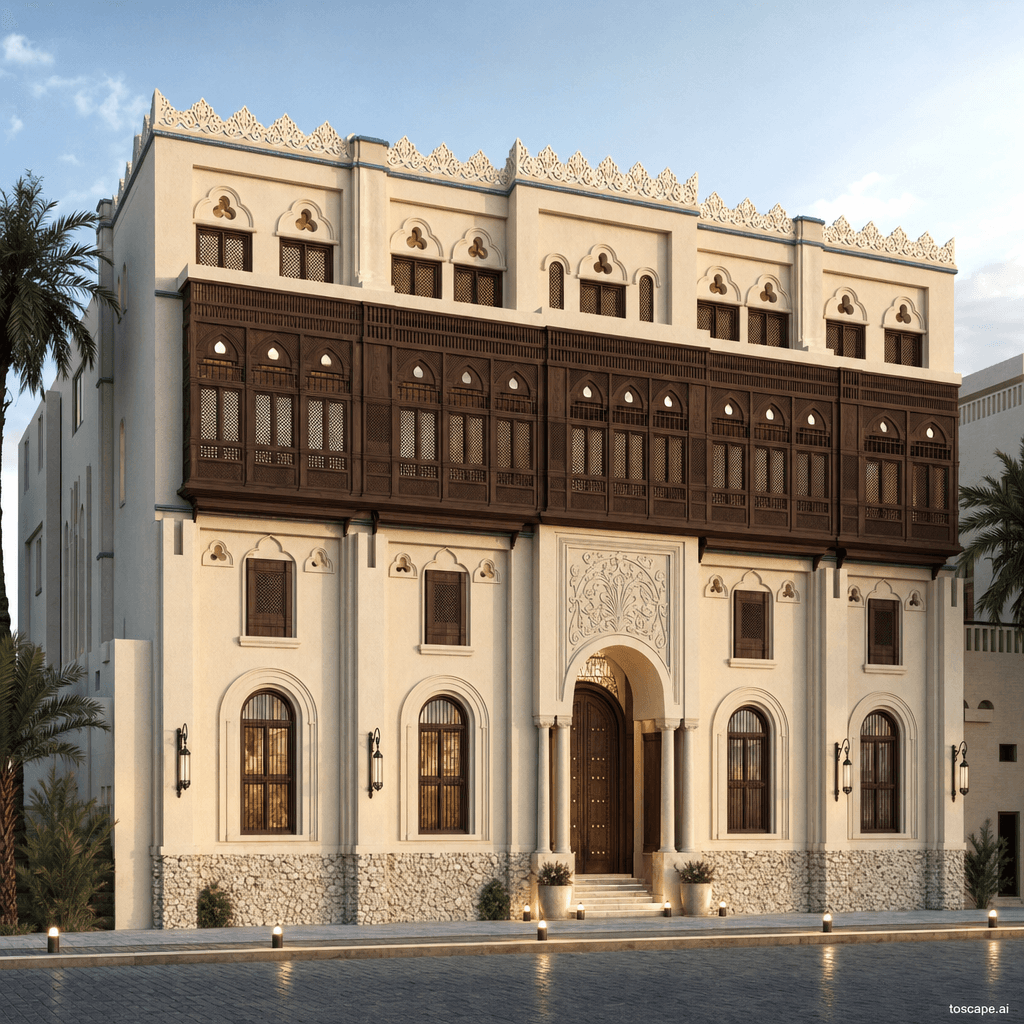
Reference elevation
East Coast Traditional — characteristic facade composition, Eastern Coast / Arabian Gulf.
Context Snapshot
Maximum-fidelity translation of Traditional East Coast architecture — the sophisticated Gulf coastal vernacular centred on Dammam, Qatif, and the Arabian Gulf littoral, where the mashrabiya is the dom... East Coast Architecture — the Gulf littoral vernacular of Saudi Arabia's Eastern Province, drawing on Arabian Gulf coastal building traditions, coral-stone construction, and Indian Ocean timber trade... Dammam — Qatif — the Arabian Gulf coastal settlements of the Eastern Province
Contemporary Relevance
East Coast Traditional operates as the heritage reference layer for Eastern Coast / Arabian Gulf and is most useful today in conservation work, cultural tourism districts, and accurate AI rendering direction. Its value in current practice comes from preserving proportion, material hierarchy, and climate logic without flattening them into generic nostalgia.
Use this style in Toscape
Explore East Coast Traditional directly inside Toscape using the Facade Re-Style and Design Options workflows.
Open East Coast Traditional in the galleryFrequently asked questions
What is East Coast Traditional?
East Coast Traditional is a regional architectural identity from Saudi Arabia. The Gulf coastal vernacular of coral aggregate, full mashrabiya, high portal doorways, trefoil arches, and ornamental merlon friezes — the most ornate of Saudi Arabia's eastern lit.
What materials define East Coast Traditional?
Materials are coral aggregate stone and lime plaster for walls — off-white, matte finish, continuous from base to parapet . Hardwood timber for the mashrabiya — the finest crafted element of the facade.
What is the East Coast Traditional color palette?
Use a light mineral field of sand, shell, coral, and sun-softened white, then introduce timber, bronze, or darker screened shadow as accent. Coastal and oasis palettes should feel bright, breathable, and climate-tempered rather than heavy or monochrome.
Where does East Coast Traditional come from?
Maximum-fidelity translation of Traditional East Coast architecture — the sophisticated Gulf coastal vernacular centred on Dammam, Qatif, and the Arabian Gulf littoral, where the mashrabiya is the dom... East Coast Architecture — the Gulf littoral vernacular of Saudi Arabia's Eastern Province, drawing on Arabian Gulf coastal building traditions, coral-stone construction, and Indian Ocean timber trade.
When should architects use East Coast Traditional?
East Coast Traditional operates as the heritage reference layer for Eastern Coast / Arabian Gulf and is most useful today in conservation work, cultural tourism districts, and accurate AI rendering direction. Its value in current practice comes from preserving proportion, material hierarchy, and climate logic without flattening them into generic nostalgia.
How do you render East Coast Traditional in Toscape?
Open Toscape on Windows, load your own photo, elevation, sketch, or CAD view, then apply the East Coast Traditional reference from the built-in style library. The Facade Re-Style and Design Options workflows keep your project geometry and camera while shifting materials, proportion, and detailing toward East Coast Traditional.