Rapa Nui
Chile · architectural identity of Rapa Nui (Easter Island / Isla de Pascua, Chile, UNESC...
The megalithic architecture of Easter Island — the moai statues and ahu platforms, the hare paenga boat-shaped houses, and the stone hare moa chicken houses of Rapa Nui, the world'...
Definition
Rapa Nui is a regional architectural identity from Chile. The megalithic architecture of Easter Island — the moai statues and ahu platforms, the hare paenga boat-shaped houses, and the stone hare moa chicken houses of Rapa Nui, the world'.
- Country
- Chile
- Region
- architectural identity of Rapa Nui (Easter Island / Isla de Pascua, Chile, UNESC.
- Massing
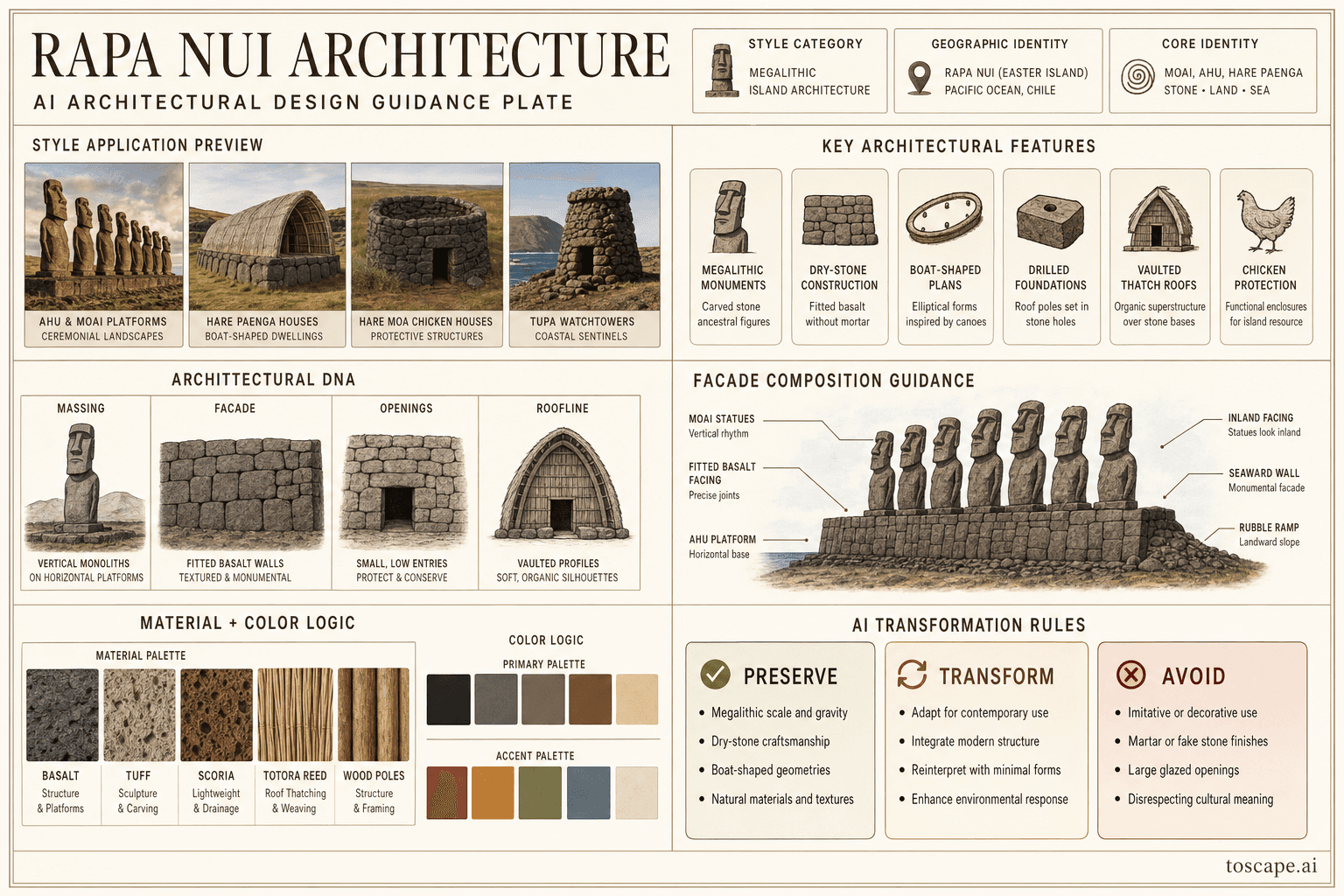
- Rapa Nui architecture is defined by three geometries: (1) The moai — a vertical anthropomorphic monolith.
- Materials
- The palette is entirely volcanic stone: (1) Rano Raraku tuff (ma'ea matariki) — the compressed volcanic ash used for moai, yellow-brown when fresh.
- Palette
- Stone gray, weathered timber brown, mineral white, muted charcoal, and restrained landscape greens define the palette.
- Climate response
- Rapa Nui (27°S, subtropical, mild oceanic climate: 18–26°C, 1,100 mm annual rainfall, persistent trade winds) is a grassland island with no permanent streams.
Overview
Rapa Nui is a regional architectural identity in Chile. The architectural identity of Rapa Nui (Easter Island / Isla de Pascua, Chile, UNESCO World Heritage) — the megalithic ceremonial architecture of the moai and ahu (stone platforms) constructed between c. 1250–1500 CE, alongside the domestic and agricultural stone architecture: the hare paenga (elliptical boat-shaped house foundations), the hare moa (stone chicken houses), the manavai (circular stone-walled garden enc...
Visual DNA
Massing & Form
Rapa Nui architecture is defined by three geometries: (1) The moai — a vertical anthropomorphic monolith, its proportions massively head-dominant (the head is 3/8 of the total height), with a rectangular base block, a heavy brow ridge, elongated nose, thin lips, and stylized arms and hands carved in low relief on the s...
Facade Language
The ahu seaward facade is a dry-stone fitted basalt wall — the dark grey-black stone blocks create a textured, monumental plane, the joints creating an irregular geometric pattern. The moai, when standing, create a rhythmic sequence of vertical anthropomorphic forms along the ahu — the multiple moai of Ahu Tongariki (1...
Materials & Texture
The palette is entirely volcanic stone: (1) Rano Raraku tuff (ma'ea matariki) — the compressed volcanic ash used for moai, yellow-brown when fresh, weathering to dark grey. (2) Basalt (ma'ea toki) — the dense dark volcanic stone for ahu facing blocks, paenga foundation stones, and the toki (adzes) used for carving.
Color Palette
Stone gray, weathered timber brown, mineral white, muted charcoal, and restrained landscape greens define the palette. The building should feel rooted in terrain and craft rather than coated in synthetic contrast.
Ornament & Detail
Rapa Nui ornament is sculptural and petroglyphic: (1) Moai carving — the detailed carving of the face, ears, hands, and loincloth (hami) on the statues — some moai have carved tattoos or designs on their backs (the 'ao, a paddle-shaped ceremonial staff). (2) Petroglyphs — carved into basalt boulders and paenga stones a...
Climate Response
Rapa Nui (27°S, subtropical, mild oceanic climate: 18–26°C, 1,100 mm annual rainfall, persistent trade winds) is a grassland island with no permanent streams. The architecture responds to this environment: (1) Ahu orientation — platforms are built parallel to the coast, with moai facing inland (away from the salt-laden...
Landscape & Ground
The architectural identity of Rapa Nui (Easter Island / Isla de Pascua, Chile, UNESCO World Heritage) — the megalithic ceremonial architecture of the moai and ahu (stone platforms) constructed between c. 1250–1500 CE, alongside the domestic and agricultural stone architecture: the hare paenga (elliptical boat-shaped ho...
Reference elevation
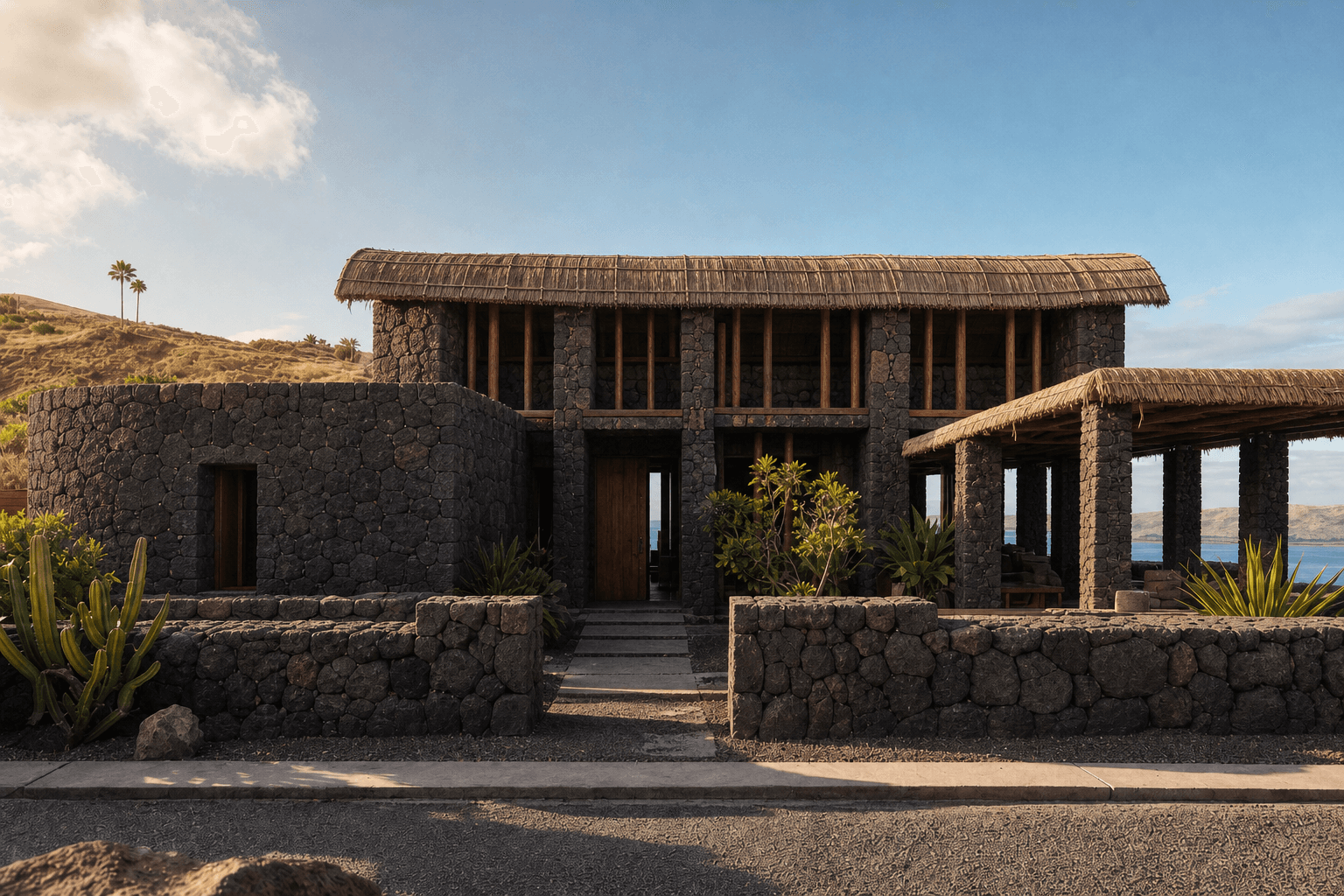
Rapa Nui — characteristic facade composition, architectural identity of Rapa Nui (Easter Island / Isla de Pascua, Chile, UNESC....
Context Snapshot
The architectural identity of Rapa Nui (Easter Island / Isla de Pascua, Chile, UNESCO World Heritage) — the megalithic ceremonial architecture of the moai and ahu (stone platforms) constructed between... Rapa Nui (27°S, subtropical, mild oceanic climate: 18–26°C, 1,100 mm annual rainfall, persistent trade winds) is a grassland island with no permanent streams.
Contemporary Relevance
Rapa Nui is useful today for residential, hospitality, civic, and place-branding work that needs Chile-specific character grounded in local massing, material tone, climate response, and settlement logic rather than generic international styling.
Use this style in Toscape
Explore Rapa Nui directly inside Toscape using the Facade Re-Style and Design Options workflows.
Open Rapa Nui in the galleryFrequently asked questions
What is Rapa Nui?
Rapa Nui is a regional architectural identity from Chile. The megalithic architecture of Easter Island — the moai statues and ahu platforms, the hare paenga boat-shaped houses, and the stone hare moa chicken houses of Rapa Nui, the world'.
What materials define Rapa Nui?
The palette is entirely volcanic stone: (1) Rano Raraku tuff (ma'ea matariki) — the compressed volcanic ash used for moai, yellow-brown when fresh, weathering to dark grey. (2) Basalt (ma'ea toki) — the dense dark volcanic stone for ahu facing blocks, paenga foundation stones, and the toki (adzes) used for carving.
What is the Rapa Nui color palette?
Stone gray, weathered timber brown, mineral white, muted charcoal, and restrained landscape greens define the palette. The building should feel rooted in terrain and craft rather than coated in synthetic contrast.
Where does Rapa Nui come from?
The architectural identity of Rapa Nui (Easter Island / Isla de Pascua, Chile, UNESCO World Heritage) — the megalithic ceremonial architecture of the moai and ahu (stone platforms) constructed between... Rapa Nui (27°S, subtropical, mild oceanic climate: 18–26°C, 1,100 mm annual rainfall, persistent trade winds) is a grassland island with no permanent streams.
When should architects use Rapa Nui?
Rapa Nui is useful today for residential, hospitality, civic, and place-branding work that needs Chile-specific character grounded in local massing, material tone, climate response, and settlement logic rather than generic international styling.
How do you render Rapa Nui in Toscape?
Open Toscape on Windows, load your own photo, elevation, sketch, or CAD view, then apply the Rapa Nui reference from the built-in style library. The Facade Re-Style and Design Options workflows keep your project geometry and camera while shifting materials, proportion, and detailing toward Rapa Nui.