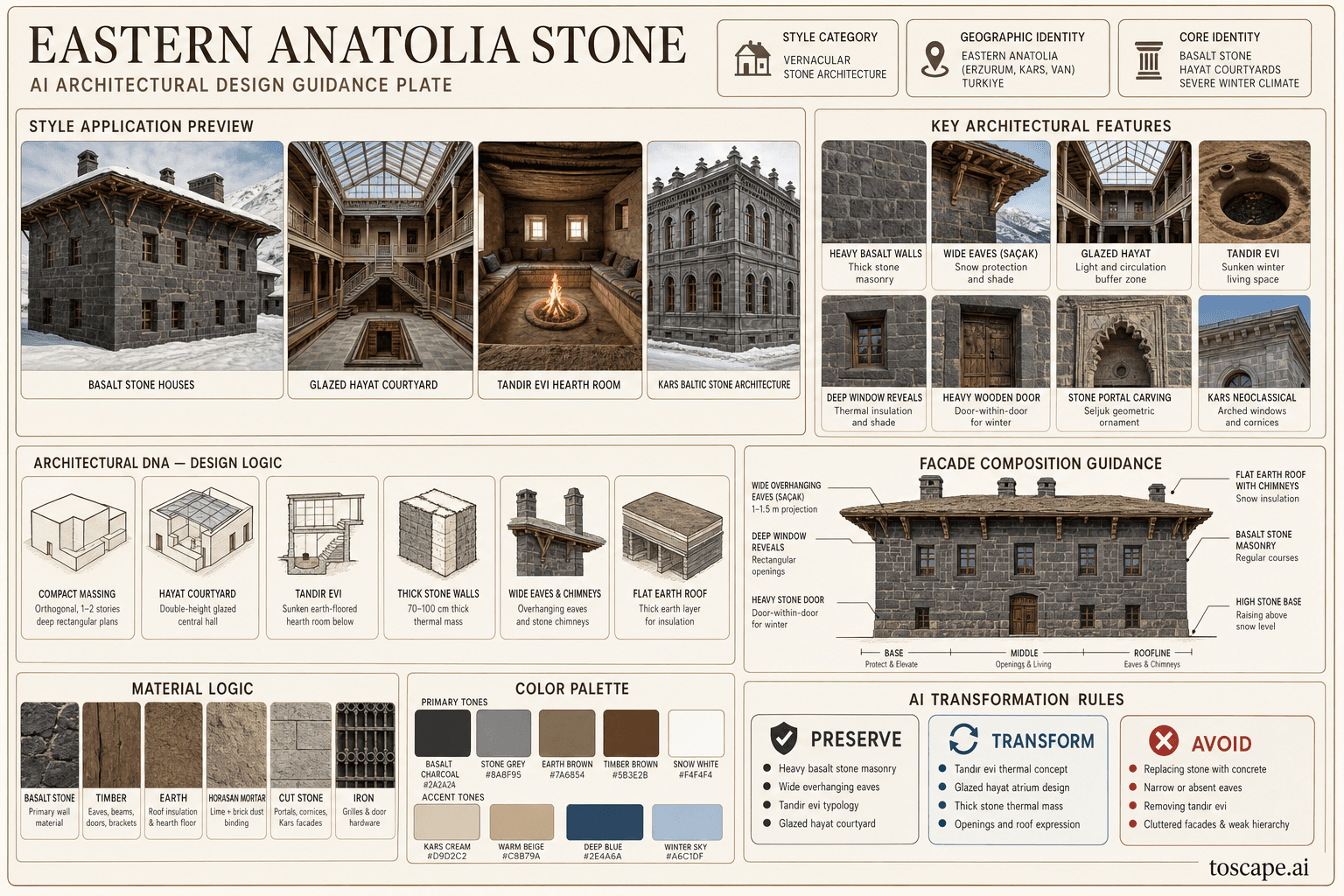
Eastern Anatolia Stone
Turkey · Eastern Anatolia (Erzurum, Kars, Van)
Basalt Masonry, Double-Height Hayat Courtyards & Severe Winter Highland Architecture
Definition
Eastern Anatolia Stone is a regional architectural identity from Turkey. Basalt Masonry, Double-Height Hayat Courtyards & Severe Winter Highland Architecture.
- Country
- Turkey
- Region
- Eastern Anatolia (Erzurum, Kars, Van).
- Massing
- Compact orthogonal masses, 1-2 stories, deep rectangular plans. Double-height central hayat: glazed-roof enclosed courtyard serving as distribution space to rooms around perimeter.
- Materials
- Dark basalt — primary wall stone (Erzurum). Grey volcanic tuff — walls (Kars, Van).
- Palette
- Warm earth, sandy beige, ochre, clay brown, and sun-softened mineral tones should dominate, with palm green or weathered timber as secondary accents.
- Climate response
- Extreme continental highland (1800-2000m): severe winters (-30°C, heavy snow, 6-month heating season), warm summers. Thick stone walls for thermal mass and insulation.
Overview
Eastern Anatolia Stone is a regional architectural identity in Turkey. Eastern Anatolia (Erzurum, Kars, Van) — heavy stone architecture adapted to extreme continental highland climate. Dark basalt and grey volcanic stone load-bearing masonry, double-height enclosed hayat (courtyard with glass roof), wide projecting eaves for snow protection, tandır houses (earth-floored central hearth rooms), Russian Baltic-influenced stone buildings in Kars
Visual DNA
Massing & Form
Compact orthogonal masses, 1-2 stories, deep rectangular plans. Double-height central hayat: glazed-roof enclosed courtyard serving as distribution space to rooms around perimeter.
Facade Language
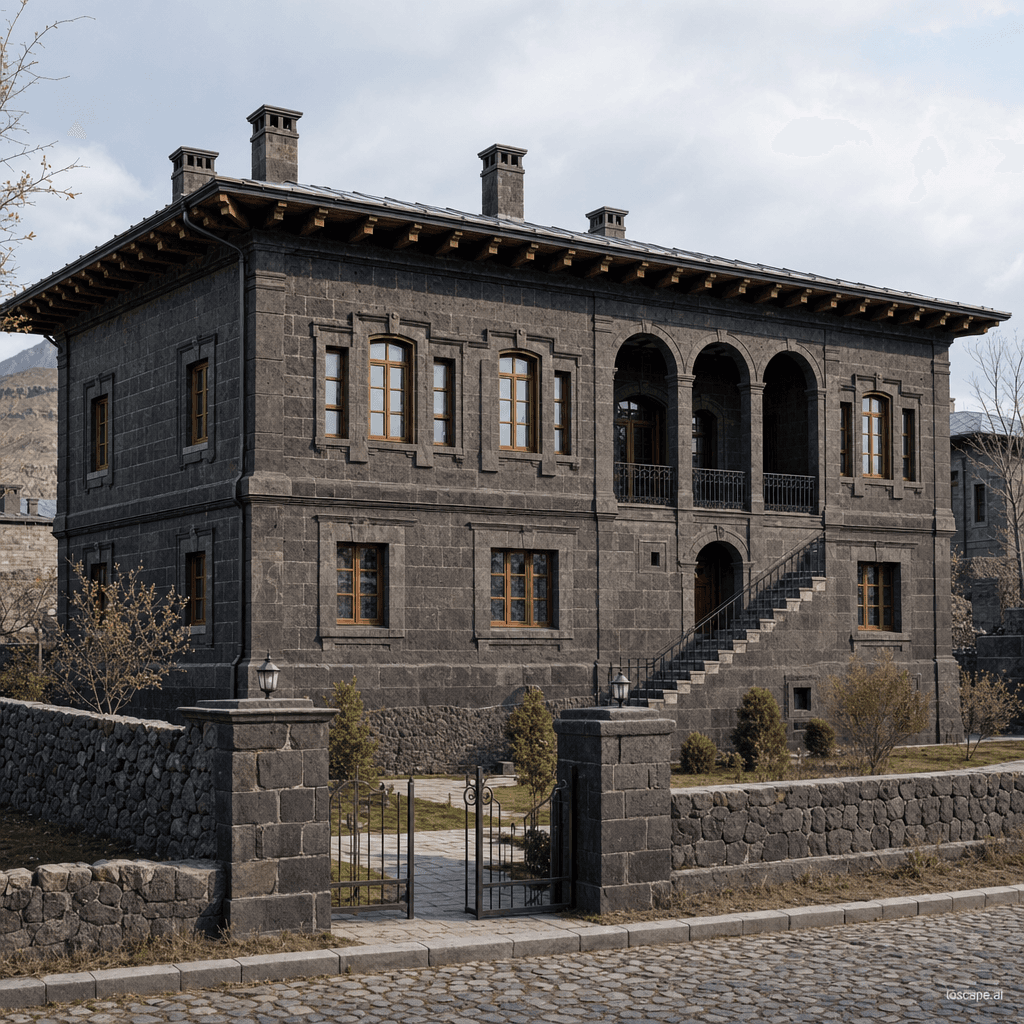
Stone masonry in regular courses — dark basalt somber facade with rhythmic rectangular windows in deep reveals. Kars: Russian neoclassical rhythm — symmetrical facades, rhythmic arched windows, pilaster strips, dentil cornices in cut stone.
Materials & Texture
Dark basalt — primary wall stone (Erzurum). Grey volcanic tuff — walls (Kars, Van).
Color Palette
Warm earth, sandy beige, ochre, clay brown, and sun-softened mineral tones should dominate, with palm green or weathered timber as secondary accents. The palette should read as land-derived rather than polished or urban-generic.
Ornament & Detail
Stone carving: geometric rosettes, muqarnas portal niches (Seljuk legacy), inscription panels on public buildings. Timber eave brackets (payanda): simply carved geometric or plain — structural honesty.
Climate Response
Extreme continental highland (1800-2000m): severe winters (-30°C, heavy snow, 6-month heating season), warm summers. Thick stone walls for thermal mass and insulation.
Landscape & Ground
Eastern Anatolia (Erzurum, Kars, Van) — heavy stone architecture adapted to extreme continental highland climate. Extreme continental highland (1800-2000m): severe winters (-30°C, heavy snow, 6-month heating season), warm summers.
Reference elevation
Eastern Anatolia Stone — characteristic facade composition, Eastern Anatolia (Erzurum, Kars, Van).
Context Snapshot
Eastern Anatolia (Erzurum, Kars, Van) — heavy stone architecture adapted to extreme continental highland climate Extreme continental highland (1800-2000m): severe winters (-30°C, heavy snow, 6-month heating season), warm summers.
Contemporary Relevance
Eastern Anatolia Stone is useful today for residential, hospitality, civic, and place-branding work that needs Turkey-specific character grounded in local massing, material tone, climate response, and settlement logic rather than generic international styling.
Use this style in Toscape
Explore Eastern Anatolia Stone directly inside Toscape using the Facade Re-Style and Design Options workflows.
Open Eastern Anatolia Stone in the galleryFrequently asked questions
What is Eastern Anatolia Stone?
Eastern Anatolia Stone is a regional architectural identity from Turkey. Basalt Masonry, Double-Height Hayat Courtyards & Severe Winter Highland Architecture.
What materials define Eastern Anatolia Stone?
Dark basalt — primary wall stone (Erzurum). Grey volcanic tuff — walls (Kars, Van).
What is the Eastern Anatolia Stone color palette?
Warm earth, sandy beige, ochre, clay brown, and sun-softened mineral tones should dominate, with palm green or weathered timber as secondary accents. The palette should read as land-derived rather than polished or urban-generic.
Where does Eastern Anatolia Stone come from?
Eastern Anatolia (Erzurum, Kars, Van) — heavy stone architecture adapted to extreme continental highland climate Extreme continental highland (1800-2000m): severe winters (-30°C, heavy snow, 6-month heating season), warm summers.
When should architects use Eastern Anatolia Stone?
Eastern Anatolia Stone is useful today for residential, hospitality, civic, and place-branding work that needs Turkey-specific character grounded in local massing, material tone, climate response, and settlement logic rather than generic international styling.
How do you render Eastern Anatolia Stone in Toscape?
Open Toscape on Windows, load your own photo, elevation, sketch, or CAD view, then apply the Eastern Anatolia Stone reference from the built-in style library. The Facade Re-Style and Design Options workflows keep your project geometry and camera while shifting materials, proportion, and detailing toward Eastern Anatolia Stone.