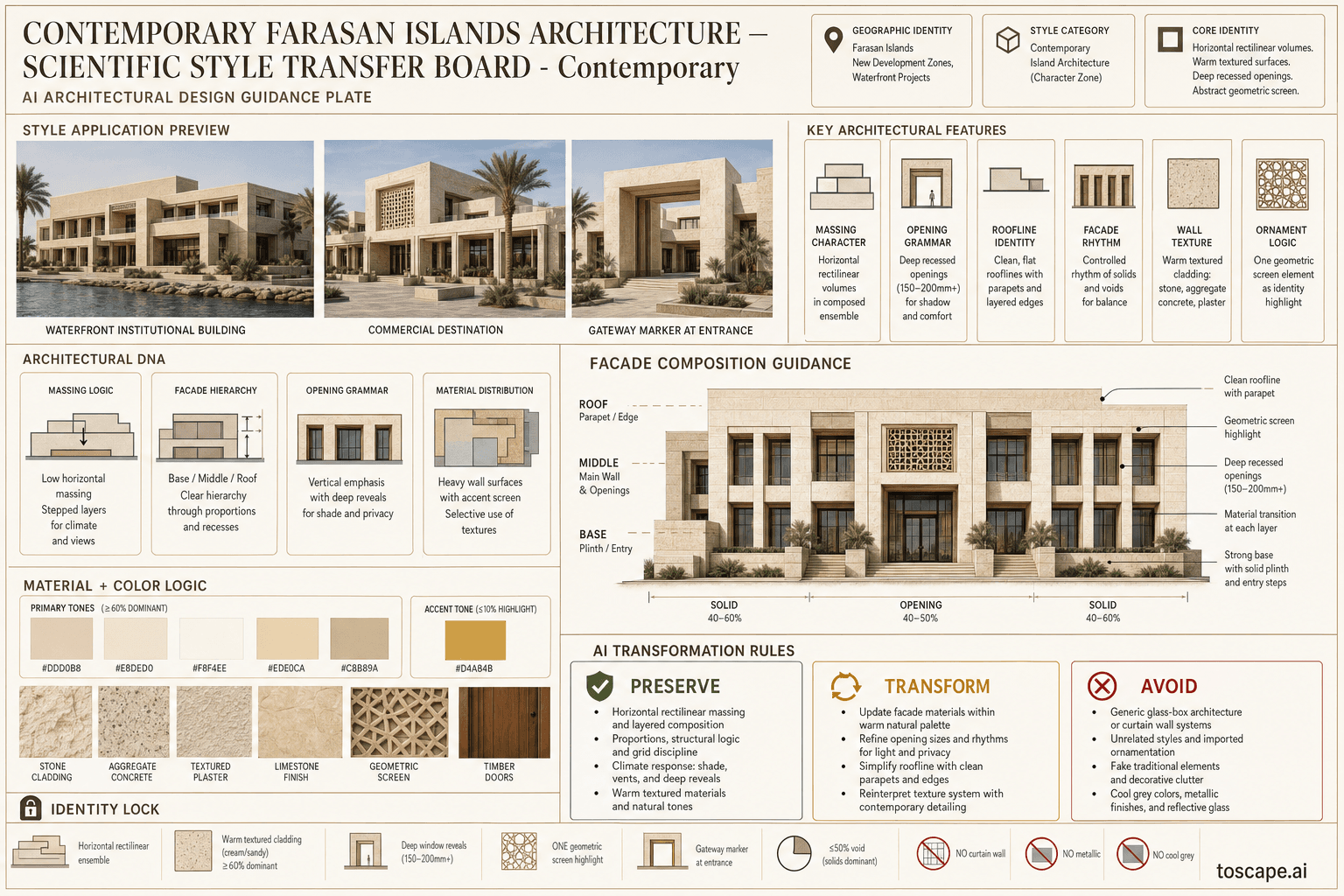
Farasan Islands Contemporary
Saudi Arabia · Farasan Islands / Red Sea
Modern architecture recognizably shaped by Farasan Islands character — abstraction, material texture, and geometric pattern as contemporary craft
Definition
Farasan Islands Contemporary is a regional architectural identity from Saudi Arabia. Modern architecture recognizably shaped by Farasan Islands character — abstraction, material texture, and geometric pattern as contemporary craft.
- Country
- Saudi Arabia
- Region
- Farasan Islands / Red Sea.
- Massing
- Contemporary Farasan buildings retain horizontal proportional discipline but do not reproduce traditional forms.
- Materials
- Contemporary materials are fully appropriate — concrete, steel, precast stone, ceramic, glass — but must create a warm, heavy, earth-toned reading .
- Palette
- Use a light mineral field of sand, shell, coral, and sun-softened white, then introduce timber, bronze, or darker screened shadow as accent.
- Climate response
- Contemporary buildings can use passive climate tools in a contemporary language: deep shading reveals at windows, screen facades that shade the wall behind.
Overview
Farasan Islands Contemporary is a Saudi architectural identity rooted in Farasan Islands / Red Sea. International contemporary architecture informed by Red Sea island heritage — abstract geometry, craft-inspired pattern, horizontal massing, light earth palette. Farasan Islands new development zones, waterfront projects, contemporary institutional and commercial buildings within the character zone.
Visual DNA
Massing & Form
Contemporary Farasan buildings retain horizontal proportional discipline but do not reproduce traditional forms. The building should be organized as a compound of volumes — multiple rectilinear boxes set in composition — rather than a single mass .
Facade Language
Facade rhythm is abstractly bipartite: the base zone (ground floor, active frontage, primary entrance) is distinguished from the upper zone (upper floor windows, screen elements, abstracted parapet) . This does not require visible horizontal banding — it can be achieved through material change, setback, screen placemen...
Materials & Texture
Contemporary materials are fully appropriate — concrete, steel, precast stone, ceramic, glass — but must create a warm, heavy, earth-toned reading . No mirror glass, no silver metallic surfaces, no all-glass curtain wall.
Color Palette
Use a light mineral field of sand, shell, coral, and sun-softened white, then introduce timber, bronze, or darker screened shadow as accent. Coastal and oasis palettes should feel bright, breathable, and climate-tempered rather than heavy or monochrome.
Ornament & Detail
Ornament in the Contemporary level is abstract and minimal — but present as a design commitment. Geometric pattern art as a facade highlight is encouraged: laser-cut metal screen panels in traditional geometric patterns, patterned precast concrete elements, sandblasted or etched glass .
Climate Response
Contemporary buildings can use passive climate tools in a contemporary language: deep shading reveals at windows, screen facades that shade the wall behind, horizontal sun fins over openings, green roof terraces, and courtyard-like recesses. These modern tools directly inherit the climate logic of the Farasan vernacula...
Landscape & Ground
Farasan Islands new development zones, waterfront projects, contemporary institutional and commercial buildings within the character zone. Contemporary buildings can use passive climate tools in a contemporary language: deep shading reveals at windows, screen facades that shade the wall behind, horizontal sun fins over...
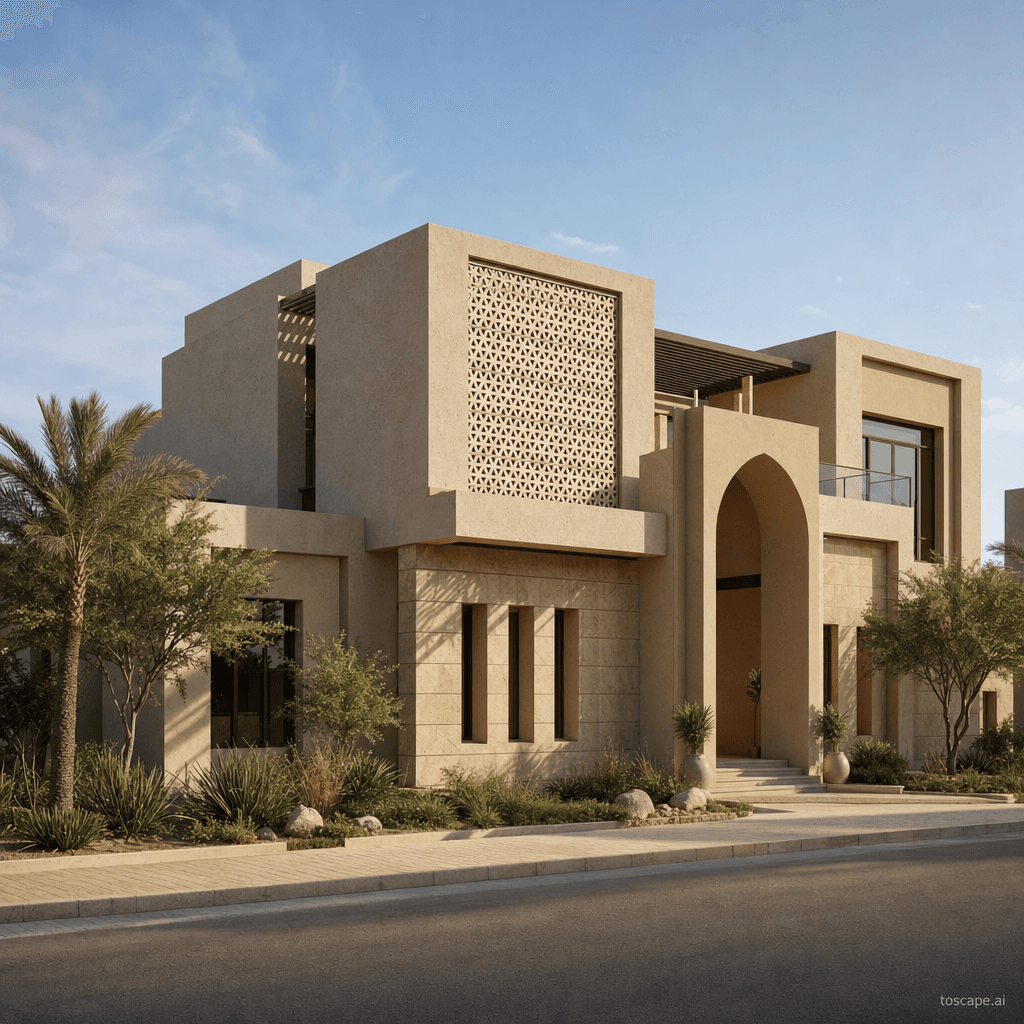
Reference elevation
Farasan Islands Contemporary — characteristic facade composition, Farasan Islands / Red Sea.
Context Snapshot
Light-touch abstracted interpretation of Farasan Islands identity — horizontal massing, deep reveals, geometric screens, warm textured surfaces, gateway markers — in confident contemporary language International contemporary architecture informed by Red Sea island heritage — abstract geometry, craft-inspired pattern, horizontal massing, light earth palette Farasan Islands new development zones, waterfront projects, contemporary institutional and commercial buildings within the character zone
Contemporary Relevance
Farasan Islands Contemporary aligns naturally with current Saudi practice, where regional identity is carried by proportion, shading depth, material tone, and controlled abstraction rather than direct historic imitation. It suits present-day residential, hospitality, and mixed-use work that needs strong local character inside a modern planning and construction framework.
Use this style in Toscape
Explore Farasan Islands Contemporary directly inside Toscape using the Facade Re-Style and Design Options workflows.
Open Farasan Islands Contemporary in the galleryFrequently asked questions
What is Farasan Islands Contemporary?
Farasan Islands Contemporary is a regional architectural identity from Saudi Arabia. Modern architecture recognizably shaped by Farasan Islands character — abstraction, material texture, and geometric pattern as contemporary craft.
What materials define Farasan Islands Contemporary?
Contemporary materials are fully appropriate — concrete, steel, precast stone, ceramic, glass — but must create a warm, heavy, earth-toned reading . No mirror glass, no silver metallic surfaces, no all-glass curtain wall.
What is the Farasan Islands Contemporary color palette?
Use a light mineral field of sand, shell, coral, and sun-softened white, then introduce timber, bronze, or darker screened shadow as accent. Coastal and oasis palettes should feel bright, breathable, and climate-tempered rather than heavy or monochrome.
Where does Farasan Islands Contemporary come from?
Light-touch abstracted interpretation of Farasan Islands identity — horizontal massing, deep reveals, geometric screens, warm textured surfaces, gateway markers — in confident contemporary language International contemporary architecture informed by Red Sea island heritage — abstract geometry, craft-inspired pattern, horizontal massing, light earth palette Farasan Islands new development zones, waterfront projects, contemporary institutional and commercial buildings within the character zone.
When should architects use Farasan Islands Contemporary?
Farasan Islands Contemporary aligns naturally with current Saudi practice, where regional identity is carried by proportion, shading depth, material tone, and controlled abstraction rather than direct historic imitation. It suits present-day residential, hospitality, and mixed-use work that needs strong local character inside a modern planning and construction framework.
How do you render Farasan Islands Contemporary in Toscape?
Open Toscape on Windows, load your own photo, elevation, sketch, or CAD view, then apply the Farasan Islands Contemporary reference from the built-in style library. The Facade Re-Style and Design Options workflows keep your project geometry and camera while shifting materials, proportion, and detailing toward Farasan Islands Contemporary.