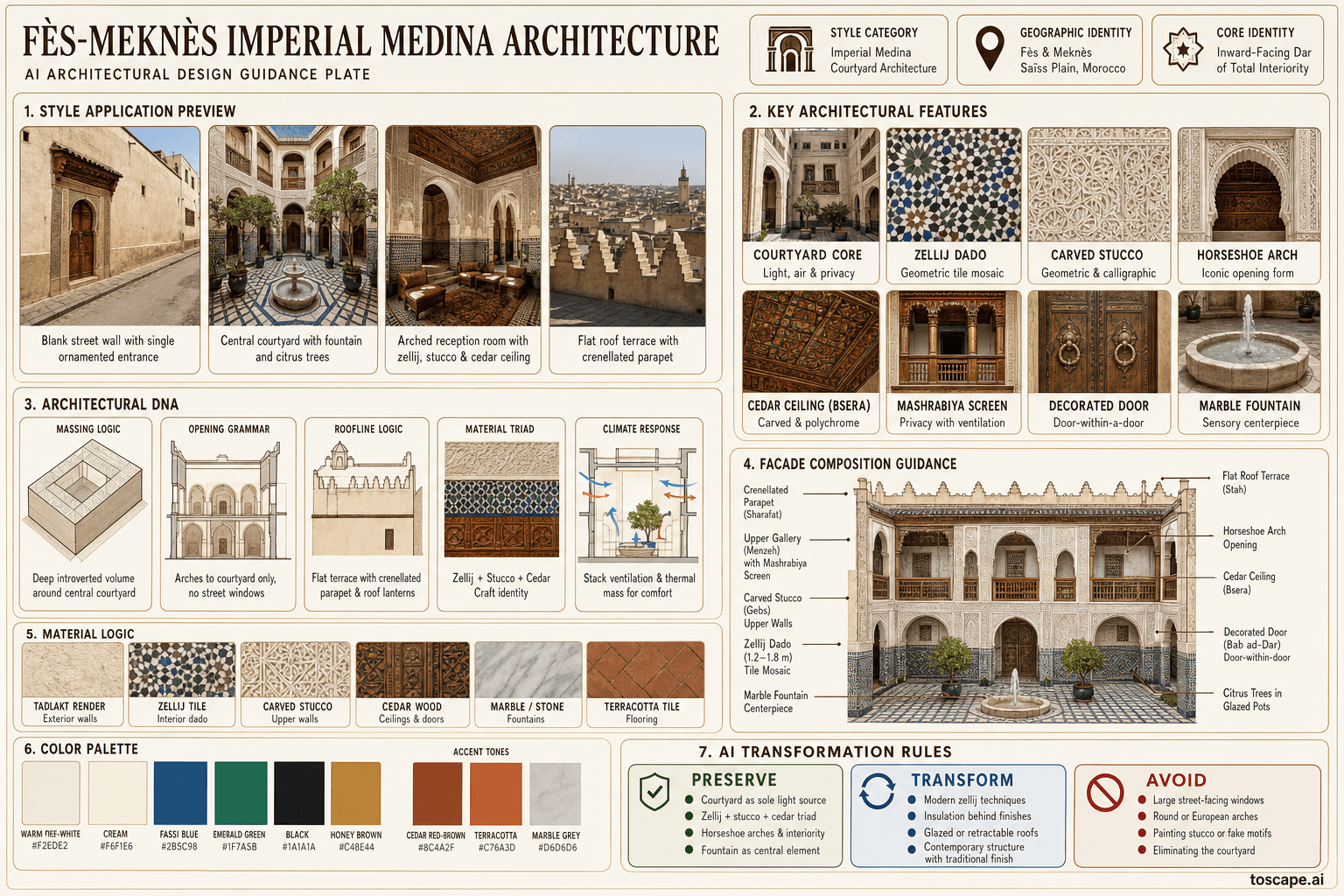
Fès-Meknès Imperial Medina
Morocco · traditional urban courtyard house (dar/riad) of Fès and Meknès medinas
The inland medina courtyard house of Morocco's oldest imperial cities — the spiritual and intellectual heart of Moroccan domestic architecture
Definition
Fès-Meknès Imperial Medina is a regional architectural identity from Morocco. The inland medina courtyard house of Morocco's oldest imperial cities — the spiritual and intellectual heart of Moroccan domestic architecture.
- Country
- Morocco
- Region
- traditional urban courtyard house (dar/riad) of Fès and Meknès medinas.
- Massing
- The Fassi dar is organized around a central rectangular courtyard (wust ad-dar) that is the sole source of light and air for the entire house.
- Materials
- The Fassi material palette is one of the most sophisticated and labor-intensive in world architecture — every surface within the courtyard is treated: Zellij (geometric tile.
- Palette
- White, cream, pale sand, warm timber, and shadow-driven dark metal accents define the palette.
- Climate response
- The Fassi dar is a masterpiece of passive climate control: Thermal mass: The 400–600 mm masonry walls provide thermal lag — the interior remains cool during.
Overview
Fès-Meknès Imperial Medina is a regional architectural identity in Morocco. The traditional urban courtyard house (dar/riad) of Fès and Meknès medinas — the oldest, most conservative, and architecturally richest of Moroccan urban traditions, representing the zenith of Arabo-Andalusian domestic architecture in the Maghreb. Inward-facing courtyard house on a deep, narrow urban plot (typically 8–15 m wide × 20–40 m deep) — central open courtyard (wust ad-dar) with fountain, planted with citrus...
Visual DNA
Massing & Form
The Fassi dar is organized around a central rectangular courtyard (wust ad-dar) that is the sole source of light and air for the entire house. The geometry is strictly introverted — the building presents blank, windowless walls to all street frontages.
Facade Language
The Fassi dar has NO public facade — the entire architecture is internal: Street wall: Blank rendered masonry wall — no windows at street level, only the entrance door. Upper-storey windows are few, small, and set high (above eye level from the street) with turned-wood mashrabiya screens or iron grilles (moucharabieh)...
Materials & Texture
The Fassi material palette is one of the most sophisticated and labor-intensive in world architecture — every surface within the courtyard is treated: Zellij (geometric tile mosaic): Hand-cut glazed ceramic tiles assembled into complex geometric patterns — the lower wall cladding (1.2–1.8 m high). Colors: the Fassi pal...
Color Palette
White, cream, pale sand, warm timber, and shadow-driven dark metal accents define the palette. The facade should stay bright and climate-aware rather than heavy, gray, or over-saturated.
Ornament & Detail
Fassi ornament is systematic, covering every visible interior surface, but strictly disciplined: Geometry first: All ornament is geometric at its foundation — the patterns are generated from the compass and straightedge. Floral arabesque overlays the geometric armature.
Climate Response
The Fassi dar is a masterpiece of passive climate control: Thermal mass: The 400–600 mm masonry walls provide thermal lag — the interior remains cool during the day (heat absorbed by the walls, released at night) and warm during cold winter nights (heat stored from daytime sun). Courtyard microclimate: The courtyard fu...
Landscape & Ground
The traditional urban courtyard house (dar/riad) of Fès and Meknès medinas — the oldest, most conservative, and architecturally richest of Moroccan urban traditions, representing the zenith of Arabo-Andalusian domestic architecture in the Maghreb. The Fassi dar is a masterpiece of passive climate control: Thermal mass...
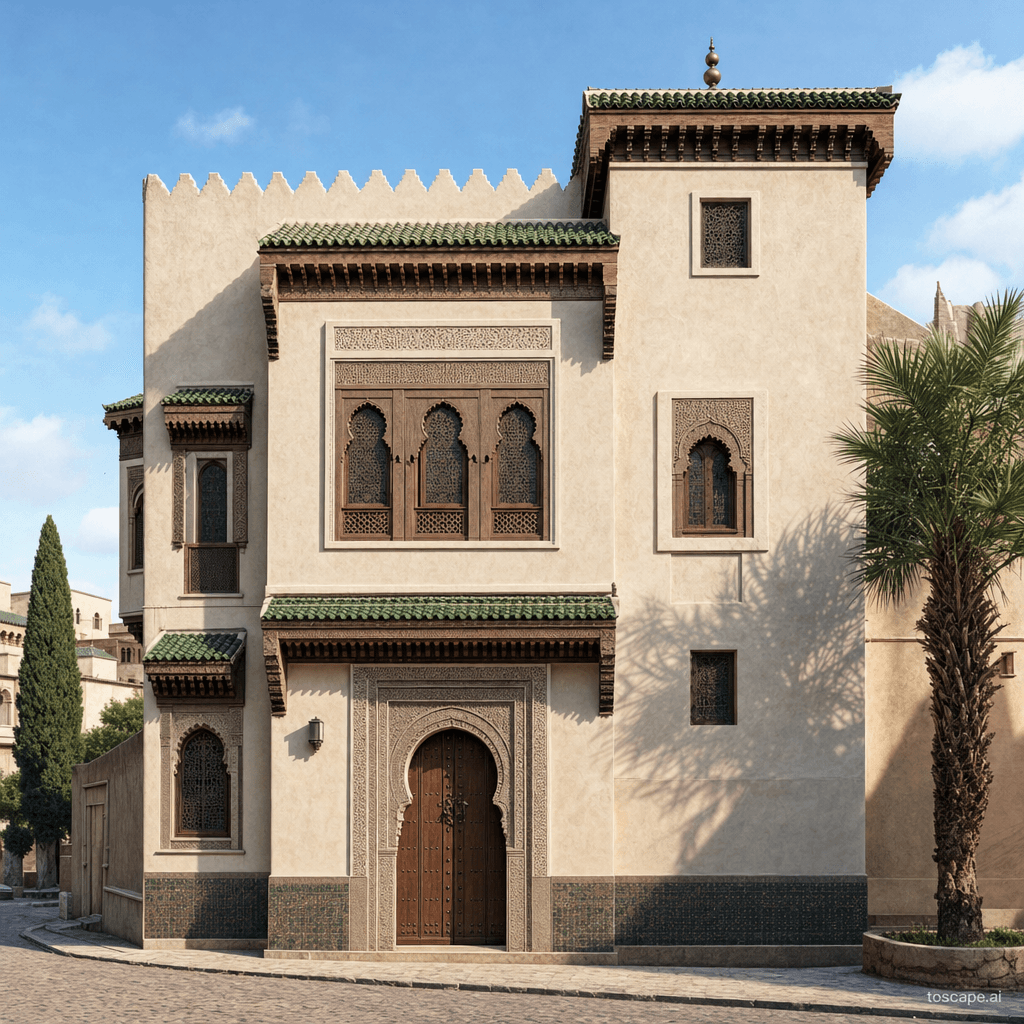
Reference elevation
Fès-Meknès Imperial Medina — characteristic facade composition, traditional urban courtyard house (dar/riad) of Fès and Meknès medinas.
Context Snapshot
The traditional urban courtyard house (dar/riad) of Fès and Meknès medinas — the oldest, most conservative, and architecturally richest of Moroccan urban traditions, representing the zenith of Arabo-A... The Fassi dar is a masterpiece of passive climate control: Thermal mass: The 400–600 mm masonry walls provide thermal lag — the interior remains cool during the day (heat absorbed by the walls, released at night) and war...
Contemporary Relevance
Fès-Meknès Imperial Medina is useful today for residential, hospitality, civic, and place-branding work that needs Morocco-specific character grounded in local massing, material tone, climate response, and settlement logic rather than generic international styling.
Use this style in Toscape
Explore Fès-Meknès Imperial Medina directly inside Toscape using the Facade Re-Style and Design Options workflows.
Open Fès-Meknès Imperial Medina in the galleryFrequently asked questions
What is Fès-Meknès Imperial Medina?
Fès-Meknès Imperial Medina is a regional architectural identity from Morocco. The inland medina courtyard house of Morocco's oldest imperial cities — the spiritual and intellectual heart of Moroccan domestic architecture.
What materials define Fès-Meknès Imperial Medina?
The Fassi material palette is one of the most sophisticated and labor-intensive in world architecture — every surface within the courtyard is treated: Zellij (geometric tile mosaic): Hand-cut glazed ceramic tiles assembled into complex geometric patterns — the lower wall cladding (1. 2–1. 8 m high). Colors: the Fassi pal.
What is the Fès-Meknès Imperial Medina color palette?
White, cream, pale sand, warm timber, and shadow-driven dark metal accents define the palette. The facade should stay bright and climate-aware rather than heavy, gray, or over-saturated.
Where does Fès-Meknès Imperial Medina come from?
The traditional urban courtyard house (dar/riad) of Fès and Meknès medinas — the oldest, most conservative, and architecturally richest of Moroccan urban traditions, representing the zenith of Arabo-A.
When should architects use Fès-Meknès Imperial Medina?
Fès-Meknès Imperial Medina is useful today for residential, hospitality, civic, and place-branding work that needs Morocco-specific character grounded in local massing, material tone, climate response, and settlement logic rather than generic international styling.
How do you render Fès-Meknès Imperial Medina in Toscape?
Open Toscape on Windows, load your own photo, elevation, sketch, or CAD view, then apply the Fès-Meknès Imperial Medina reference from the built-in style library. The Facade Re-Style and Design Options workflows keep your project geometry and camera while shifting materials, proportion, and detailing toward Fès-Meknès Imperial Medina.