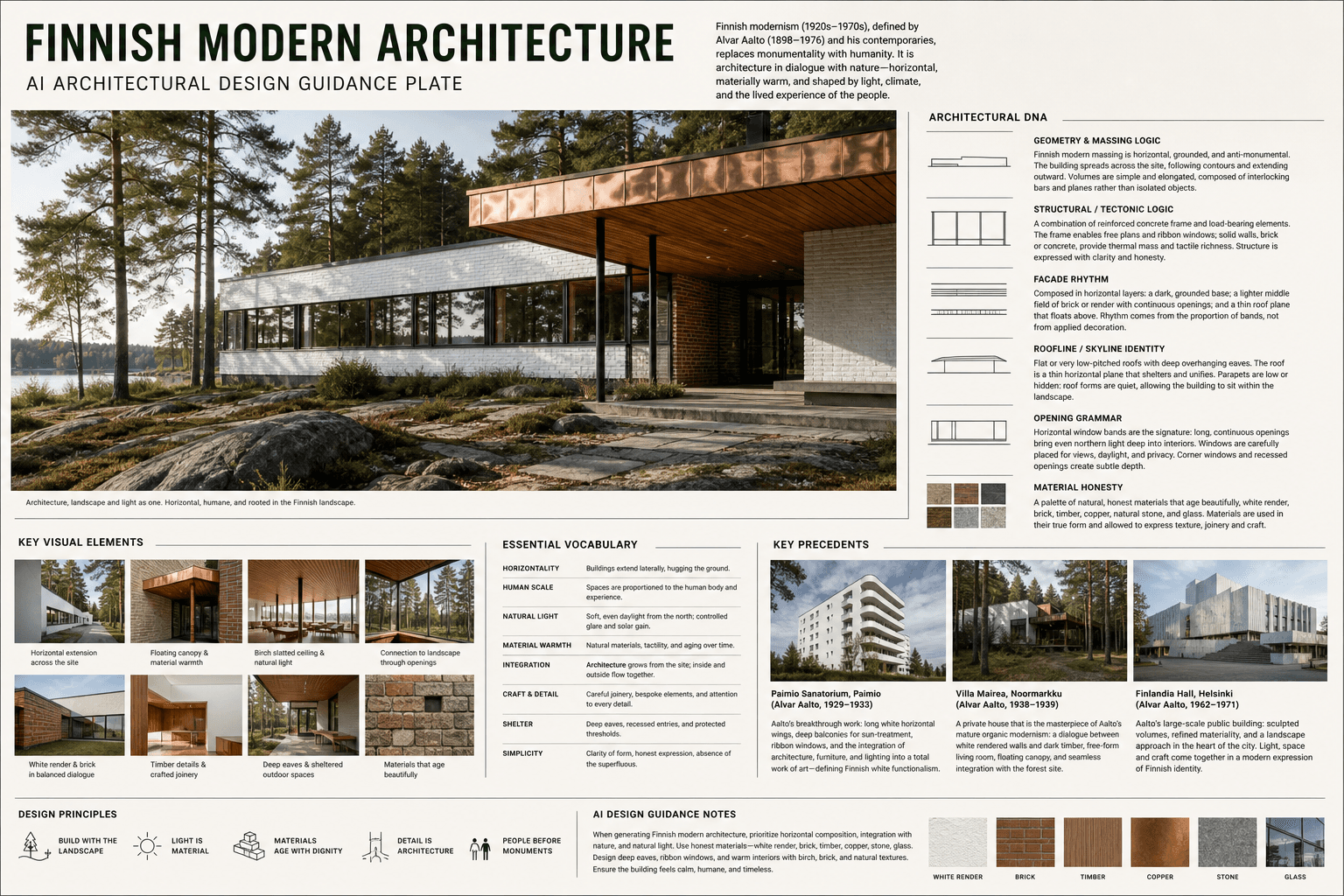
Finnish Modern
Denmark · Finnish modern architecture (1920s–1970s), defined by the work of Alvar Aalto (1...
The organic functionalism of Finland — the architecture of Alvar Aalto, Erik Bryggman, and the Finnish modernist tradition that softened the International Style with natural materi...
Definition
Finnish Modern is a regional architectural identity from Denmark. The organic functionalism of Finland — the architecture of Alvar Aalto, Erik Bryggman, and the Finnish modernist tradition that softened the International Style with natural materi.
- Country
- Denmark
- Region
- Finnish modern architecture (1920s–1970s), defined by the work of Alvar Aalto (1.
- Massing
- Finnish modern massing is horizontal, grounded, and anti-monumental: (1) The building spreads horizontally across the site — long, low volumes (2–4 stories).
- Materials
- Finnish modernism is defined by its material palette — natural, warm, aging gracefully: (1) White render (valkoinen rappaus) — smooth or lightly textured white cement-lime render.
- Palette
- White, cream, pale sand, warm timber, and shadow-driven dark metal accents define the palette.
- Climate response
- Finnish modernism is a response to the extreme Nordic climate and landscape: (1) Winter — long dark winters (6 months), temperatures to -30°C.
Overview
Finnish Modern is a regional architectural identity in Denmark Nordic. Finnish modern architecture (1920s–1970s), defined by the work of Alvar Aalto (1898–1976) and his contemporaries — a distinctively Finnish interpretation of modernism that rejects the cold universalism of the International Style in favor of a human-centered, nature-responsive, materially warm modernism — the architecture is characterized by: (1) White rendered or white-painted brick walls — the Finnish "white functio...
Visual DNA
Massing & Form
Finnish modern massing is horizontal, grounded, and anti-monumental: (1) The building spreads horizontally across the site — long, low volumes (2–4 stories), with wings extending into the landscape. (2) The plan is organic: fan-shaped (Paimio Sanatorium — patient wings radiating from a central core), L-shaped, or free...
Facade Language
The Finnish modern facade is composed in horizontal layers: (1) Base — a dark plinth or recessed ground floor, often of darker brick, stone, or shadow — the building is lifted slightly off the ground. (2) Middle — the main wall plane: white render or red brick, with continuous horizontal window bands — the windows are...
Materials & Texture
Finnish modernism is defined by its material palette — natural, warm, aging gracefully: (1) White render (valkoinen rappaus) — smooth or lightly textured white cement-lime render on concrete or brick — the white surface reflects the precious Finnish light. (2) Red brick (punatiili) — warm red-brown brick, laid in stret...
Color Palette
White, cream, pale sand, warm timber, and shadow-driven dark metal accents define the palette. The facade should stay bright and climate-aware rather than heavy, gray, or over-saturated.
Ornament & Detail
Finnish modernism has no applied ornament — the detailing IS the ornament: (1) The free-form curve — Aalto's undulating walls, ceilings, and furniture forms are the primary aesthetic gesture — the curve is never arbitrary; it serves an acoustic, spatial, or functional purpose. (2) The material joint — the meeting of wh...
Climate Response
Finnish modernism is a response to the extreme Nordic climate and landscape: (1) Winter — long dark winters (6 months), temperatures to -30°C, heavy snow — the horizontal massing minimizes heat loss; deep roof overhangs protect walls from snow and ice; the white surfaces reflect the precious winter light into interiors...
Landscape & Ground
Finnish modern architecture (1920s–1970s), defined by the work of Alvar Aalto (1898–1976) and his contemporaries — a distinctively Finnish interpretation of modernism that rejects the cold universalism of the International Style in favor of a human-centered, nature-responsive, materially warm modernism — the architectu...
Reference elevation
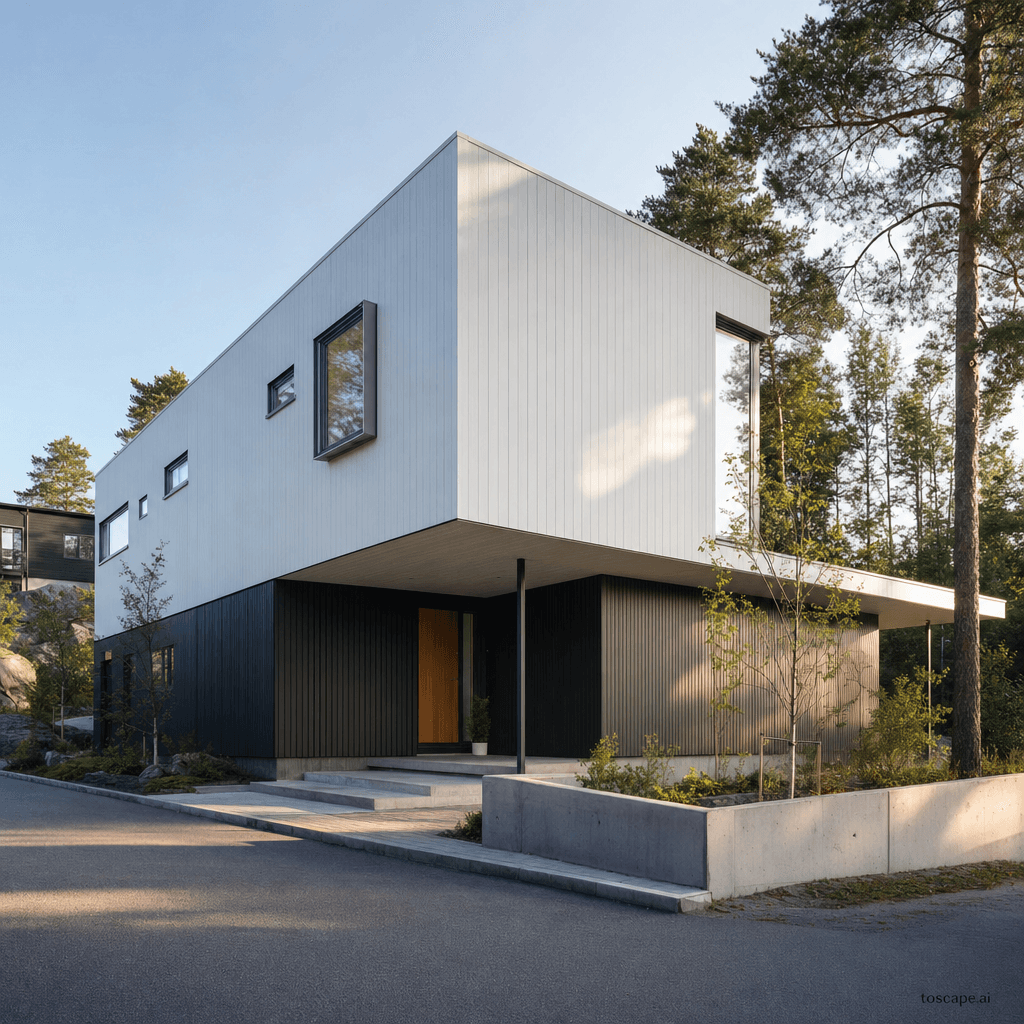
Finnish Modern — characteristic facade composition, Finnish modern architecture (1920s–1970s), defined by the work of Alvar Aalto (1....
Context Snapshot
Finnish modern architecture (1920s–1970s), defined by the work of Alvar Aalto (1898–1976) and his contemporaries — a distinctively Finnish interpretation of modernism that rejects the cold universalis... Finnish modernism is a response to the extreme Nordic climate and landscape: (1) Winter — long dark winters (6 months), temperatures to -30°C, heavy snow — the horizontal massing minimizes heat loss; deep roof overhangs...
Contemporary Relevance
Finnish Modern is useful today for residential, hospitality, civic, and place-branding work that needs Denmark Nordic-specific character grounded in local massing, material tone, climate response, and settlement logic rather than generic international styling.
Use this style in Toscape
Explore Finnish Modern directly inside Toscape using the Facade Re-Style and Design Options workflows.
Open Finnish Modern in the galleryFrequently asked questions
What is Finnish Modern?
Finnish Modern is a regional architectural identity from Denmark. The organic functionalism of Finland — the architecture of Alvar Aalto, Erik Bryggman, and the Finnish modernist tradition that softened the International Style with natural materi.
What materials define Finnish Modern?
Finnish modernism is defined by its material palette — natural, warm, aging gracefully: (1) White render (valkoinen rappaus) — smooth or lightly textured white cement-lime render on concrete or brick — the white surface reflects the precious Finnish light. (2) Red brick (punatiili) — warm red-brown brick, laid in stret.
What is the Finnish Modern color palette?
White, cream, pale sand, warm timber, and shadow-driven dark metal accents define the palette. The facade should stay bright and climate-aware rather than heavy, gray, or over-saturated.
Where does Finnish Modern come from?
Finnish modern architecture (1920s–1970s), defined by the work of Alvar Aalto (1898–1976) and his contemporaries — a distinctively Finnish interpretation of modernism that rejects the cold universalis.
When should architects use Finnish Modern?
Finnish Modern is useful today for residential, hospitality, civic, and place-branding work that needs Denmark Nordic-specific character grounded in local massing, material tone, climate response, and settlement logic rather than generic international styling.
How do you render Finnish Modern in Toscape?
Open Toscape on Windows, load your own photo, elevation, sketch, or CAD view, then apply the Finnish Modern reference from the built-in style library. The Facade Re-Style and Design Options workflows keep your project geometry and camera while shifting materials, proportion, and detailing toward Finnish Modern.