Gangwon Mountain Hanok
South Korea · Mountain-region hanok of Gangwon Province
The high-altitude, snow-country hanok of Korea's northeastern mountains
Definition
Gangwon Mountain Hanok is a regional architectural identity from South Korea. The high-altitude, snow-country hanok of Korea's northeastern mountains.
- Country
- South Korea
- Region
- Mountain-region hanok of Gangwon Province.
- Massing
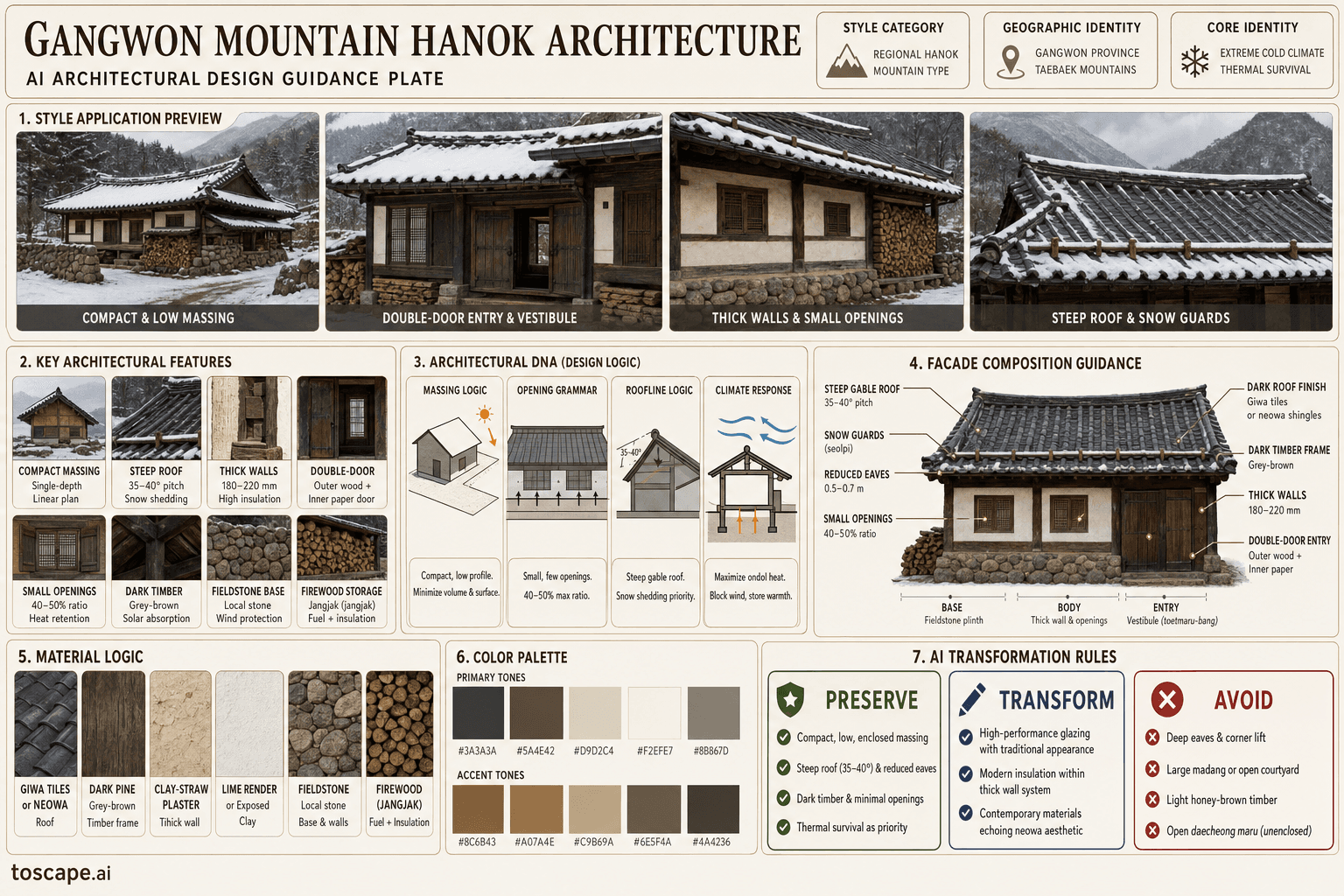
- The Gangwon mountain hanok is the most compact and enclosed of all Korean regional typologies.
- Materials
- The Gangwon material palette adds dark timber, fieldstone, and wooden roofing to the standard Korean repertoire: Dark-stained/weathered pine timber — dark grey-brown (not the warm honey.
- Palette
- White, cream, pale sand, warm timber, and shadow-driven dark metal accents define the palette.
- Climate response
- The Gangwon climate response is the most extreme example of climatic determinism in Korean architecture: Site selection: Sheltered valley locations with south-southeast aspect — maximizing passive.
Overview
Gangwon Mountain Hanok is a regional architectural identity in South Korea. Mountain-region hanok of Gangwon Province — the most rugged, highest-elevation, and coldest inhabited region of South Korea, including the Taebaek Mountain range and the eastern coastal slope. Compact, closed-form plan with minimal madang — the most enclosed and defensive of Korean hanok typologies — thick walls (clay-straw plaster up to 200 mm) for extreme winter insulation — reduced eaves projection to minimize sno...
Visual DNA
Massing & Form
The Gangwon mountain hanok is the most compact and enclosed of all Korean regional typologies. The driving logic is thermal efficiency: minimize surface area, minimize heated volume, maximize insulation.
Facade Language
The Gangwon facade is the most closed and defensive of all Korean regions: Opening ratio: Courtyard-facing opening ratio is 40–50% — the lowest of any region (Seoul: 60–70%, Jeolla: 70–80%). Windows are smaller, fewer, and often double-glazed in the traditional sense (outer solid wooden shutter + inner changhoji paper...
Materials & Texture
The Gangwon material palette adds dark timber, fieldstone, and wooden roofing to the standard Korean repertoire: Dark-stained/weathered pine timber — dark grey-brown (not the warm honey of Seoul) — absorbs solar radiation, resists snow staining Dark grey giwa tiles or dark grey-brown neowa wooden shingles with stone we...
Color Palette
White, cream, pale sand, warm timber, and shadow-driven dark metal accents define the palette. The facade should stay bright and climate-aware rather than heavy, gray, or over-saturated.
Ornament & Detail
Ornament is functionally non-existent in the Gangwon mountain hanok: No dancheong — painting would serve no thermal purpose and would be degraded by the harsh climate No carved gongpo brackets — simple beam-on-column connections, structurally robust but aesthetically plain Simplest sal muni lattice — basic grid pattern...
Climate Response
The Gangwon climate response is the most extreme example of climatic determinism in Korean architecture: Site selection: Sheltered valley locations with south-southeast aspect — maximizing passive solar gain and minimizing exposure to prevailing northwesterly winter winds. The building is often set into a hillside (par...
Landscape & Ground
Mountain-region hanok of Gangwon Province — the most rugged, highest-elevation, and coldest inhabited region of South Korea, including the Taebaek Mountain range and the eastern coastal slope. The Gangwon climate response is the most extreme example of climatic determinism in Korean architecture: Site selection: Shelte...
Reference elevation
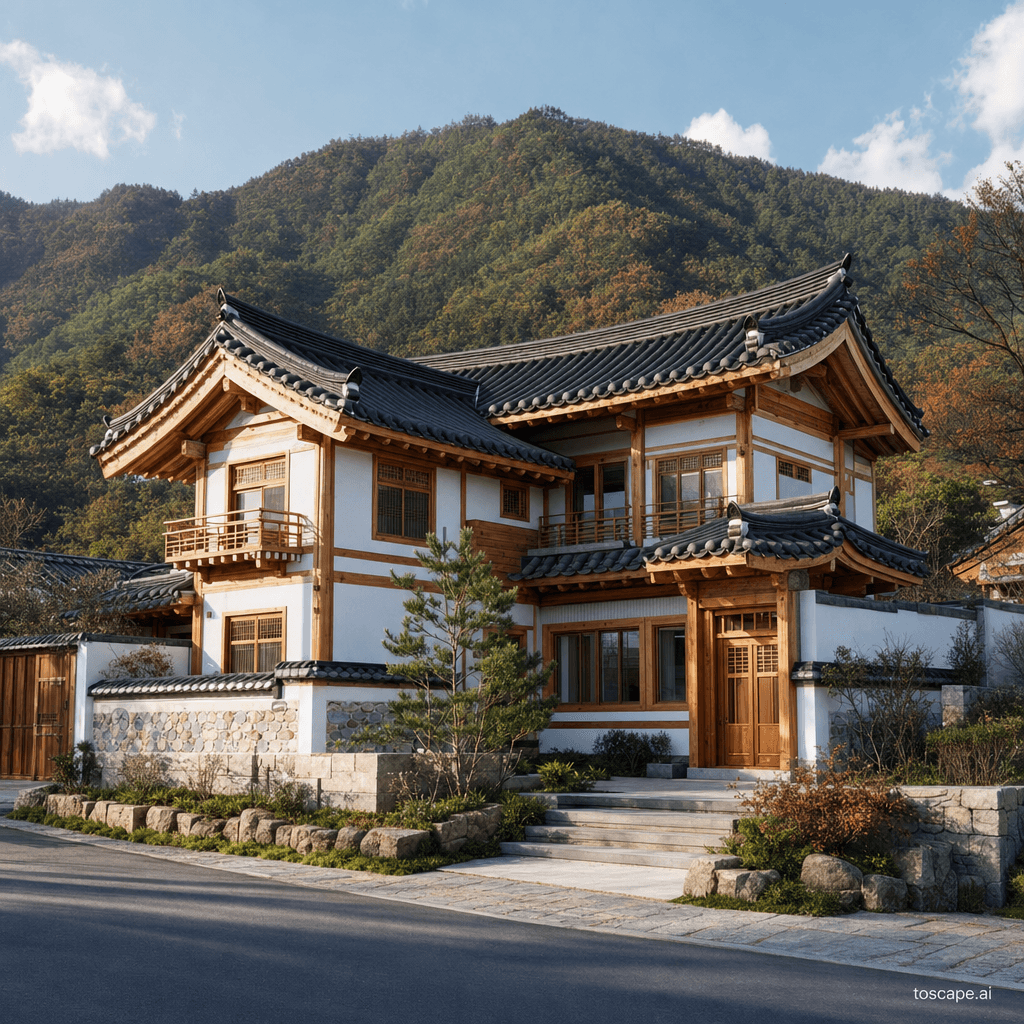
Gangwon Mountain Hanok — characteristic facade composition, Mountain-region hanok of Gangwon Province.
Context Snapshot
Mountain-region hanok of Gangwon Province — the most rugged, highest-elevation, and coldest inhabited region of South Korea, including the Taebaek Mountain range and the eastern coastal slope The Gangwon climate response is the most extreme example of climatic determinism in Korean architecture: Site selection: Sheltered valley locations with south-southeast aspect — maximizing passive solar gain and minimizi...
Contemporary Relevance
Gangwon Mountain Hanok is useful today for residential, hospitality, civic, and place-branding work that needs South Korea-specific character grounded in local massing, material tone, climate response, and settlement logic rather than generic international styling.
Use this style in Toscape
Explore Gangwon Mountain Hanok directly inside Toscape using the Facade Re-Style and Design Options workflows.
Open Gangwon Mountain Hanok in the galleryFrequently asked questions
What is Gangwon Mountain Hanok?
Gangwon Mountain Hanok is a regional architectural identity from South Korea. The high-altitude, snow-country hanok of Korea's northeastern mountains.
What materials define Gangwon Mountain Hanok?
The Gangwon material palette adds dark timber, fieldstone, and wooden roofing to the standard Korean repertoire: Dark-stained/weathered pine timber — dark grey-brown (not the warm honey of Seoul) — absorbs solar radiation, resists snow staining Dark grey giwa tiles or dark grey-brown neowa wooden shingles with stone we.
What is the Gangwon Mountain Hanok color palette?
White, cream, pale sand, warm timber, and shadow-driven dark metal accents define the palette. The facade should stay bright and climate-aware rather than heavy, gray, or over-saturated.
Where does Gangwon Mountain Hanok come from?
Mountain-region hanok of Gangwon Province — the most rugged, highest-elevation, and coldest inhabited region of South Korea, including the Taebaek Mountain range and the eastern coastal slope The Gangwon climate response is the most extreme example of climatic determinism in Korean architecture: Site selection: Sheltered valley locations with south-southeast aspect — maximizing passive solar gain and minimizi.
When should architects use Gangwon Mountain Hanok?
Gangwon Mountain Hanok is useful today for residential, hospitality, civic, and place-branding work that needs South Korea-specific character grounded in local massing, material tone, climate response, and settlement logic rather than generic international styling.
How do you render Gangwon Mountain Hanok in Toscape?
Open Toscape on Windows, load your own photo, elevation, sketch, or CAD view, then apply the Gangwon Mountain Hanok reference from the built-in style library. The Facade Re-Style and Design Options workflows keep your project geometry and camera while shifting materials, proportion, and detailing toward Gangwon Mountain Hanok.