Gauteng Highveld
South Africa · architectural identity of Gauteng province and the Witwatersrand
The mining-town architecture of the Witwatersrand — corrugated iron cottages, the brick-and-iron urban terrace, and the architectural identity of Johannesburg, the city built on go...
Definition
Gauteng Highveld is a regional architectural identity from South Africa. The mining-town architecture of the Witwatersrand — corrugated iron cottages, the brick-and-iron urban terrace, and the architectural identity of Johannesburg, the city built on go.
- Country
- South Africa
- Region
- architectural identity of Gauteng province and the Witwatersrand.
- Massing
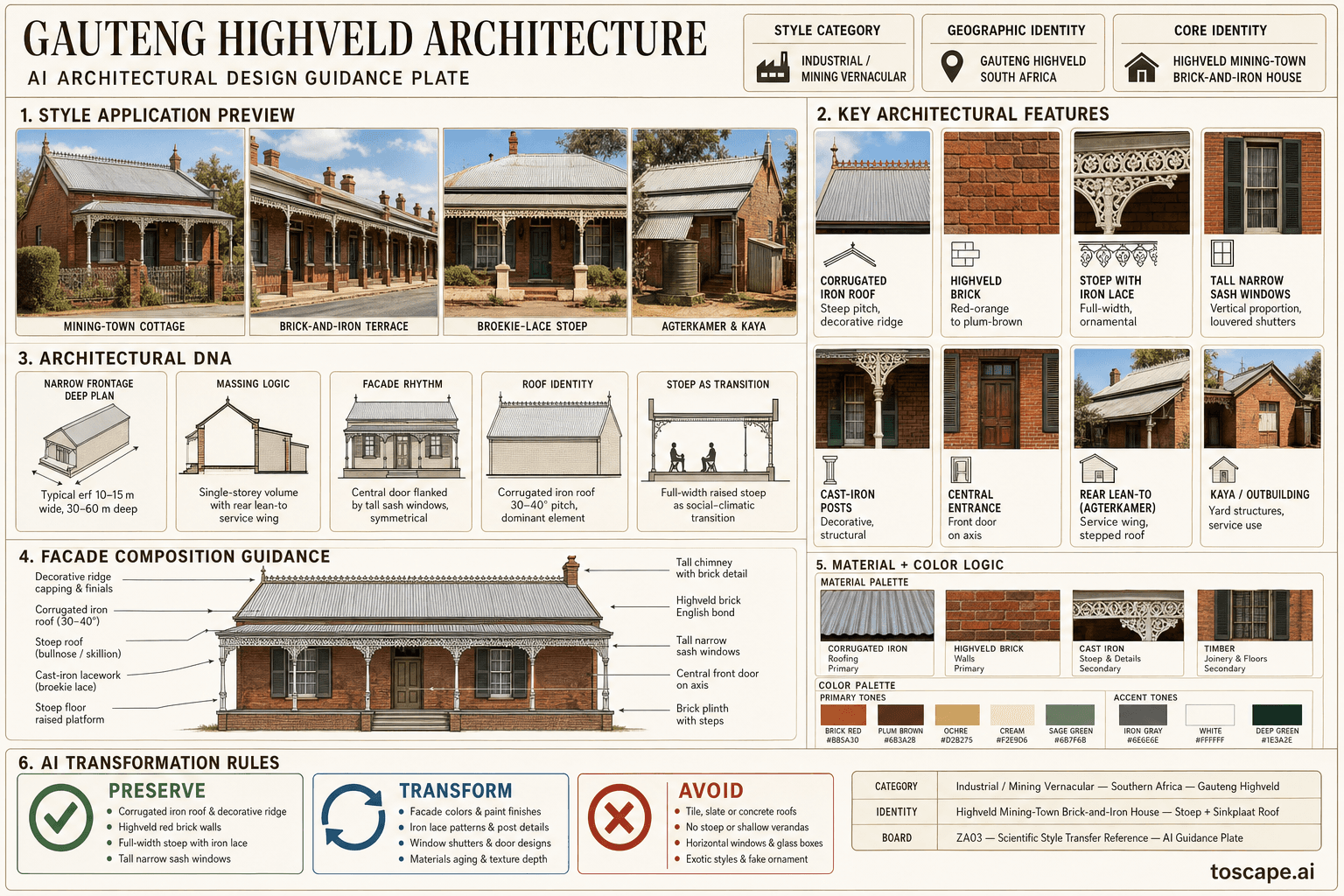
- The Highveld house is a compact, narrow-frontage rectangular volume — a legacy of the mining-stand (erven) subdivision where plots were typically 10–15 m wide × 30–60.
- Materials
- The Highveld mining-town house — a single-storey rectangular volume (6–10 m wide × 10–16 m deep) under a corrugated iron pitched roof (30–40°) — brick walls.
- Palette
- Warm earth, sandy beige, ochre, clay brown, and sun-softened mineral tones should dominate, with palm green or weathered timber as secondary accents.
- Climate response
- The architectural identity of Gauteng province and the Witwatersrand — the world's largest gold-mining conurbation, centered on Johannesburg, Pretoria.
Overview
Gauteng Highveld is a regional architectural identity in South Africa. The architectural identity of Gauteng province and the Witwatersrand — the world's largest gold-mining conurbation, centered on Johannesburg, Pretoria, and the East and West Rand mining towns. Defined by the late 19th-century mining-town building typologies: corrugated iron cottages, brick-and-iron urban terraces, the stoep-and-veranda house adapted to the Highveld plateau, and the distinctive fusion of British colon...
Visual DNA
Massing & Form
The Highveld house is a compact, narrow-frontage rectangular volume — a legacy of the mining-stand (erven) subdivision where plots were typically 10–15 m wide × 30–60 m deep. Houses are single-storey, with a steep corrugated iron roof (30–40°, steeper than the Cape to shed Highveld summer thunderstorms).
Facade Language
Corrugated iron roof with decorative ridge: The roof features ornamental ridge capping (crenellated or scalloped metalwork) and finials at the gable ends — the industrial material elevated to decorative status Stoep (veranda): Full-width raised platform with cast-iron or timber posts, decorative iron lacework frieze (b...
Materials & Texture
The Highveld mining-town house — a single-storey rectangular volume (6–10 m wide × 10–16 m deep) under a corrugated iron pitched roof (30–40°) — brick walls (locally-fired from the rich Highveld clay, deep red-orange to plum-brown) — the steep (raised front veranda) with cast-iron posts and decorative fretwork — corrug...
Color Palette
Warm earth, sandy beige, ochre, clay brown, and sun-softened mineral tones should dominate, with palm green or weathered timber as secondary accents. The palette should read as land-derived rather than polished or urban-generic.
Ornament & Detail
The Highveld mining-town house — a single-storey rectangular volume (6–10 m wide × 10–16 m deep) under a corrugated iron pitched roof (30–40°) — brick walls (locally-fired from the rich Highveld clay, deep red-orange to plum-brown) — the steep (raised front veranda) with cast-iron posts and decorative fretwork — corrug...
Climate Response
The architectural identity of Gauteng province and the Witwatersrand — the world's largest gold-mining conurbation, centered on Johannesburg, Pretoria, and the East and West Rand mining towns. Defined by the late 19th-century mining-town building typologies: corrugated iron cottages, brick-and-iron urban terraces, the...
Landscape & Ground
The architectural identity of Gauteng province and the Witwatersrand — the world's largest gold-mining conurbation, centered on Johannesburg, Pretoria, and the East and West Rand mining towns. Defined by the late 19th-century mining-town building typologies: corrugated iron cottages, brick-and-iron urban terraces, the...
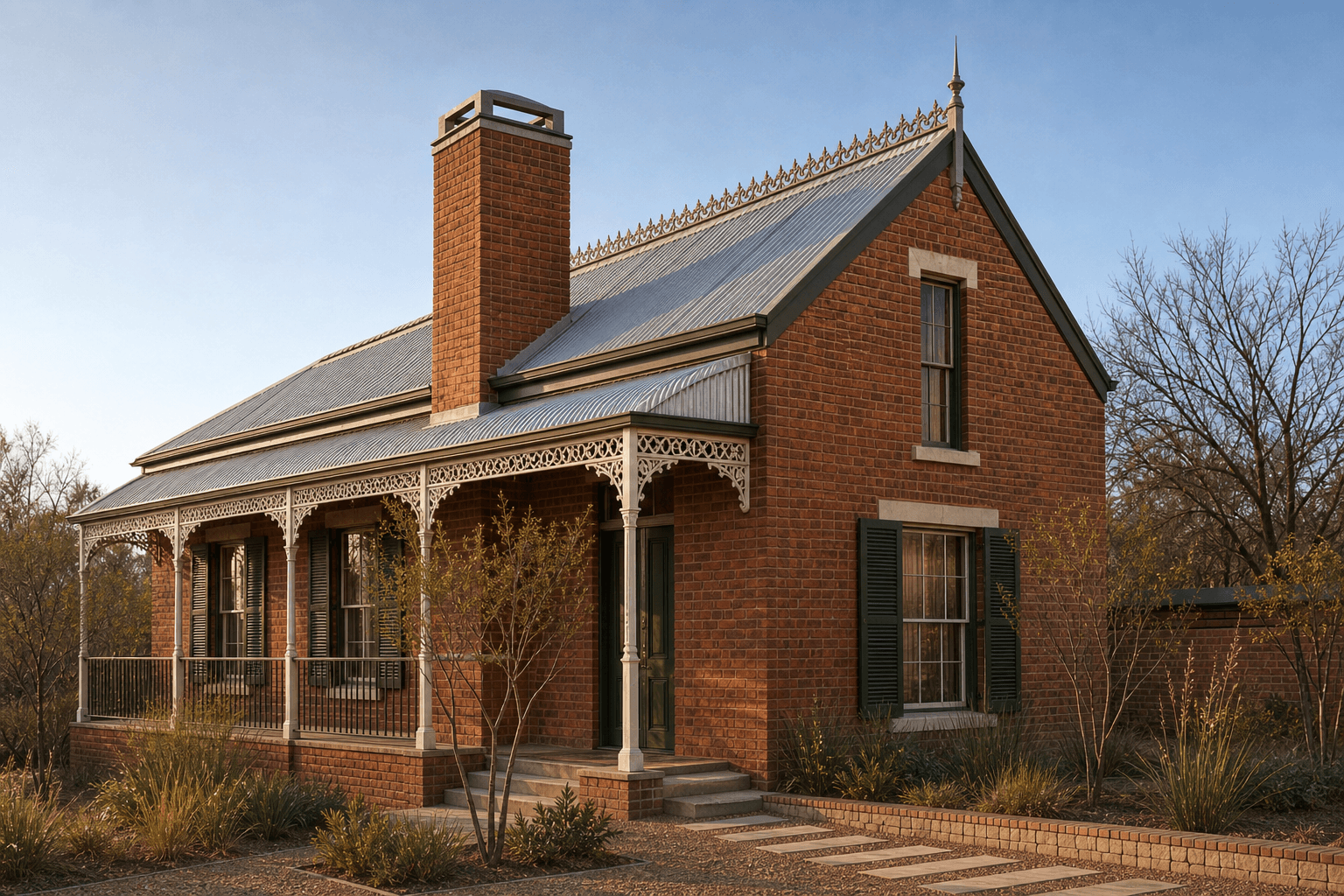
Reference elevation
Gauteng Highveld — characteristic facade composition, architectural identity of Gauteng province and the Witwatersrand.
Context Snapshot
The architectural identity of Gauteng province and the Witwatersrand — the world's largest gold-mining conurbation, centered on Johannesburg, Pretoria, and the East and West Rand mining towns.
Contemporary Relevance
Gauteng Highveld is useful today for residential, hospitality, civic, and place-branding work that needs South Africa-specific character grounded in local massing, material tone, climate response, and settlement logic rather than generic international styling.
Use this style in Toscape
Explore Gauteng Highveld directly inside Toscape using the Facade Re-Style and Design Options workflows.
Open Gauteng Highveld in the galleryFrequently asked questions
What is Gauteng Highveld?
Gauteng Highveld is a regional architectural identity from South Africa. The mining-town architecture of the Witwatersrand — corrugated iron cottages, the brick-and-iron urban terrace, and the architectural identity of Johannesburg, the city built on go.
What materials define Gauteng Highveld?
The Highveld mining-town house — a single-storey rectangular volume (6–10 m wide × 10–16 m deep) under a corrugated iron pitched roof (30–40°) — brick walls (locally-fired from the rich Highveld clay, deep red-orange to plum-brown) — the steep (raised front veranda) with cast-iron posts and decorative fretwork — corrug.
What is the Gauteng Highveld color palette?
Warm earth, sandy beige, ochre, clay brown, and sun-softened mineral tones should dominate, with palm green or weathered timber as secondary accents. The palette should read as land-derived rather than polished or urban-generic.
Where does Gauteng Highveld come from?
The architectural identity of Gauteng province and the Witwatersrand — the world's largest gold-mining conurbation, centered on Johannesburg, Pretoria, and the East and West Rand mining towns.
When should architects use Gauteng Highveld?
Gauteng Highveld is useful today for residential, hospitality, civic, and place-branding work that needs South Africa-specific character grounded in local massing, material tone, climate response, and settlement logic rather than generic international styling.
How do you render Gauteng Highveld in Toscape?
Open Toscape on Windows, load your own photo, elevation, sketch, or CAD view, then apply the Gauteng Highveld reference from the built-in style library. The Facade Re-Style and Design Options workflows keep your project geometry and camera while shifting materials, proportion, and detailing toward Gauteng Highveld.