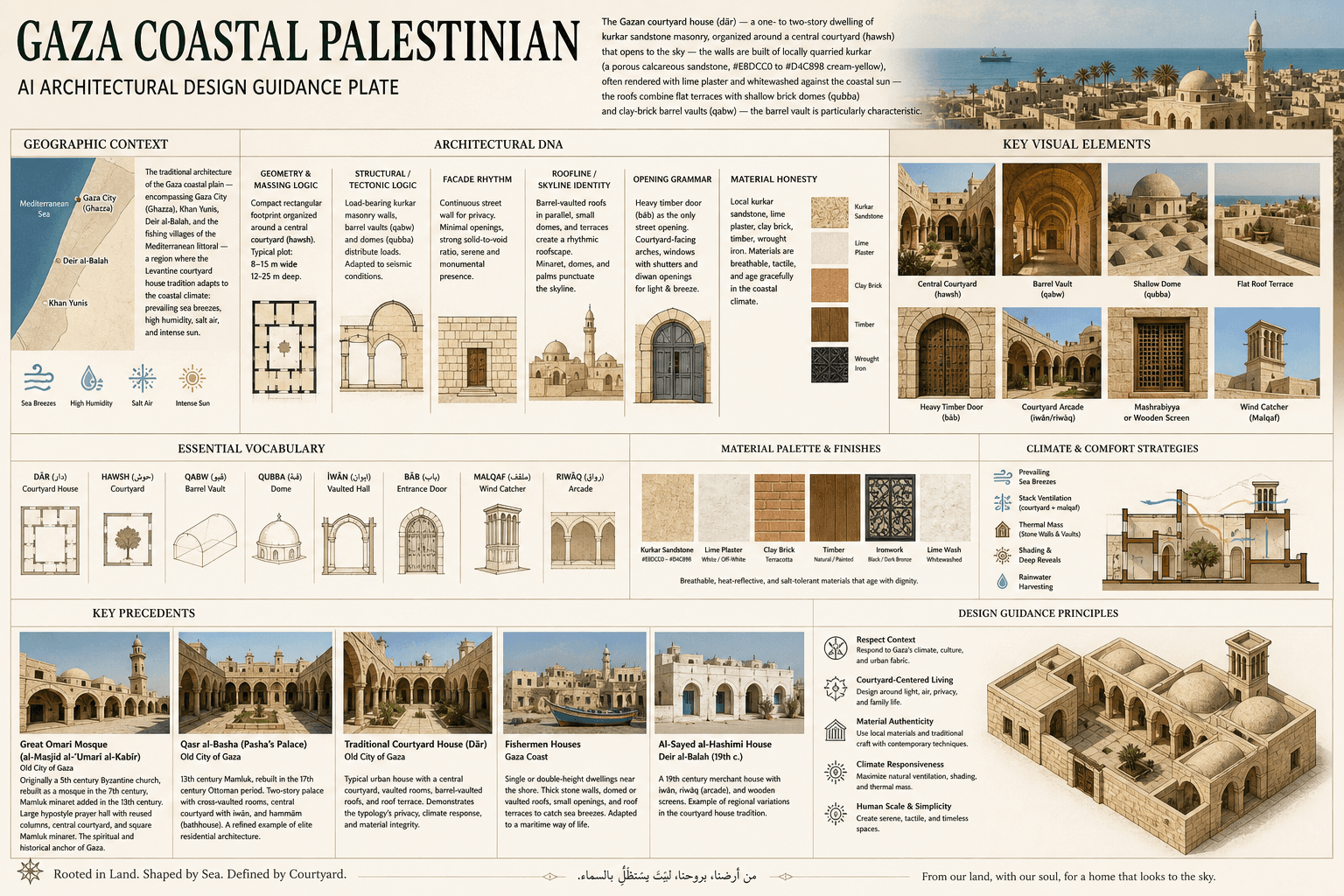
Gaza Coastal Palestinian
Palestine · traditional architecture of the Gaza coastal plain
The Mediterranean coastal architecture of the Gaza Strip — a historic port city (Ghazzat Hāshim) at the crossroads of Africa and Asia, where sandstone courtyard houses with arched...
Definition
Gaza Coastal Palestinian is a regional architectural identity from Palestine. The Mediterranean coastal architecture of the Gaza Strip — a historic port city (Ghazzat Hāshim) at the crossroads of Africa and Asia, where sandstone courtyard houses with arched.
- Country
- Palestine
- Region
- traditional architecture of the Gaza coastal plain.
- Massing
- The Gazan house is a compact urban courtyard dwelling: (1) The house is typically rectangular (8–15 m wide, 12–25 m deep).
- Materials
- Gazan materials are coastal and riverine: (1) Kurkar sandstone — the local building stone: a Quaternary calcareous sandstone formed from lithified coastal dunes — the stone.
- Palette
- White, cream, pale sand, warm timber, and shadow-driven dark metal accents define the palette.
- Climate response
- Gaza has a hot-summer Mediterranean climate (Csa) with coastal humidity: (1) Summer: 30–35°C day, 22–26°C night.
Overview
Gaza Coastal Palestinian is a regional architectural identity in Palestine. The traditional architecture of the Gaza coastal plain — encompassing Gaza City (Ghazza), Khan Yunis, Deir al-Balah, and the fishing villages of the Mediterranean littoral — a region where the Levantine courtyard house tradition adapts to the coastal climate: prevailing sea breezes, high humidity, sandy soils, and the availability of kurkar (calcareous sandstone) as the primary building stone — Gazan architecture sha...
Visual DNA
Massing & Form
The Gazan house is a compact urban courtyard dwelling: (1) The house is typically rectangular (8–15 m wide, 12–25 m deep), with the courtyard placed at the center or side — the courtyard is the primary light and ventilation source, usually 3–6 m per side in urban houses, larger in village houses. (2) The house is one t...
Facade Language
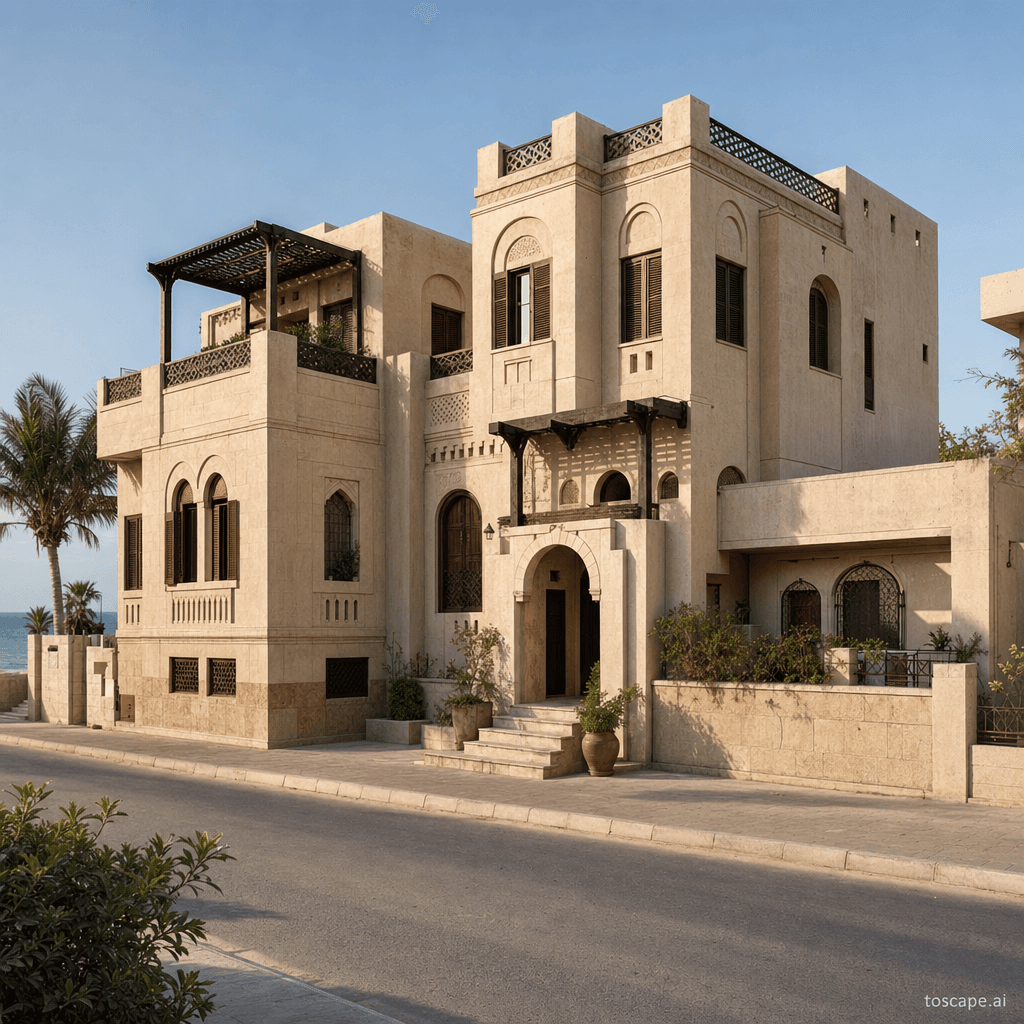
The Gazan street facade follows the Levantine privacy paradigm: (1) The street wall — a continuous plane of kurkar stone masonry, either left exposed (#E8DCC0 to #D4C898) or rendered with lime plaster and whitewashed (#F5F0E8) — the wall is unbroken except for the entrance door and a few small high windows. (2) The ent...
Materials & Texture
Gazan materials are coastal and riverine: (1) Kurkar sandstone — the local building stone: a Quaternary calcareous sandstone formed from lithified coastal dunes — the stone is cream-yellow to pale gold (#E8DCC0 to #D4C898), porous, and relatively soft — quarried from ridges parallel to the coast — the stone hardens on...
Color Palette
White, cream, pale sand, warm timber, and shadow-driven dark metal accents define the palette. The facade should stay bright and climate-aware rather than heavy, gray, or over-saturated.
Ornament & Detail
Gazan ornament reflects the city's position as a Mediterranean trading port: (1) Ceramic tile panels — the most characteristic Gazan decorative element: square painted tiles arranged in geometric compositions on the īwān walls — the patterns include eight-pointed stars, hexagons, and diamond lattice — the color palette...
Climate Response
Gaza has a hot-summer Mediterranean climate (Csa) with coastal humidity: (1) Summer: 30–35°C day, 22–26°C night, with high humidity (70–85%) from the sea — the thick stone walls (50–80 cm) and the courtyard configuration create a microclimate: the courtyard shade and the īwān's north-facing orientation capture the sea...
Landscape & Ground
The traditional architecture of the Gaza coastal plain — encompassing Gaza City (Ghazza), Khan Yunis, Deir al-Balah, and the fishing villages of the Mediterranean littoral — a region where the Levantine courtyard house tradition adapts to the coastal climate: prevailing sea breezes, high humidity, sandy soils, and the...
Reference elevation
Gaza Coastal Palestinian — characteristic facade composition, traditional architecture of the Gaza coastal plain.
Context Snapshot
The traditional architecture of the Gaza coastal plain — encompassing Gaza City (Ghazza), Khan Yunis, Deir al-Balah, and the fishing villages of the Mediterranean littoral — a region where the Levanti... Gaza has a hot-summer Mediterranean climate (Csa) with coastal humidity: (1) Summer: 30–35°C day, 22–26°C night, with high humidity (70–85%) from the sea — the thick stone walls (50–80 cm) and the courtyard configuration...
Contemporary Relevance
Gaza Coastal Palestinian is useful today for residential, hospitality, civic, and place-branding work that needs Palestine-specific character grounded in local massing, material tone, climate response, and settlement logic rather than generic international styling.
Use this style in Toscape
Explore Gaza Coastal Palestinian directly inside Toscape using the Facade Re-Style and Design Options workflows.
Open Gaza Coastal Palestinian in the galleryFrequently asked questions
What is Gaza Coastal Palestinian?
Gaza Coastal Palestinian is a regional architectural identity from Palestine. The Mediterranean coastal architecture of the Gaza Strip — a historic port city (Ghazzat Hāshim) at the crossroads of Africa and Asia, where sandstone courtyard houses with arched.
What materials define Gaza Coastal Palestinian?
Gazan materials are coastal and riverine: (1) Kurkar sandstone — the local building stone: a Quaternary calcareous sandstone formed from lithified coastal dunes — the stone is cream-yellow to pale gold (#E8DCC0 to #D4C898), porous.
What is the Gaza Coastal Palestinian color palette?
White, cream, pale sand, warm timber, and shadow-driven dark metal accents define the palette. The facade should stay bright and climate-aware rather than heavy, gray, or over-saturated.
Where does Gaza Coastal Palestinian come from?
The traditional architecture of the Gaza coastal plain — encompassing Gaza City (Ghazza), Khan Yunis, Deir al-Balah, and the fishing villages of the Mediterranean littoral — a region where the Levanti.
When should architects use Gaza Coastal Palestinian?
Gaza Coastal Palestinian is useful today for residential, hospitality, civic, and place-branding work that needs Palestine-specific character grounded in local massing, material tone, climate response, and settlement logic rather than generic international styling.
How do you render Gaza Coastal Palestinian in Toscape?
Open Toscape on Windows, load your own photo, elevation, sketch, or CAD view, then apply the Gaza Coastal Palestinian reference from the built-in style library. The Facade Re-Style and Design Options workflows keep your project geometry and camera while shifting materials, proportion, and detailing toward Gaza Coastal Palestinian.