Gilan Caspian Timber
Iran · Gilan and Mazandaran Caspian Sea region
Steep-Roofed Forest Houses, Raised Timber Verandahs & Hyrcanian Woodland Architecture
Definition
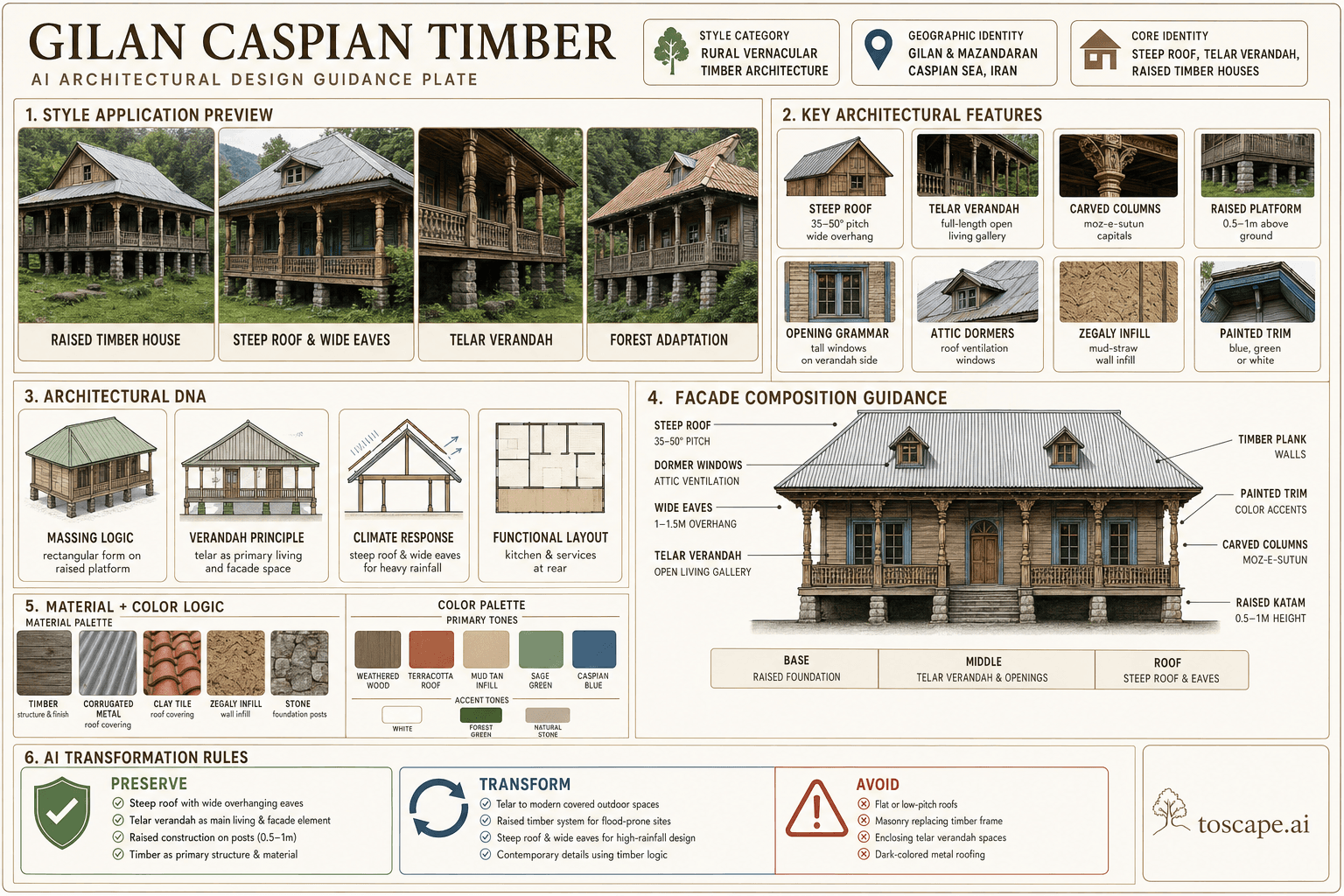
Gilan Caspian Timber is a regional architectural identity from Iran. Steep-Roofed Forest Houses, Raised Timber Verandahs & Hyrcanian Woodland Architecture.
- Country
- Iran
- Region
- Gilan and Mazandaran Caspian Sea region.
- Massing
- Rectangular single or two-story houses with dominant steep roof visible from all sides.
- Materials
- Timber: alder, oak, azad, boxwood — all Hyrcanian forest species, used green and worked locally.
- Palette
- Warm earth, sandy beige, ochre, clay brown, and sun-softened mineral tones should dominate, with palm green or weathered timber as secondary accents.
- Climate response
- Hyrcanian temperate rainforest: annual rainfall 1200-2000mm (highest in Iran), high humidity, mild winters. Steep roof for rapid rain shedding.
Overview
Gilan Caspian Timber is a regional architectural identity in Iran. Gilan and Mazandaran Caspian Sea region — timber architecture in Iran's northern rainforest belt. Steep-pitched corrugated or tile roofs with wide overhanging eaves, timber-frame construction on raised platforms, open verandah (telar) with carved wooden columns, adaptation to extreme rainfall (1200+mm/year)
Visual DNA
Massing & Form
Rectangular single or two-story houses with dominant steep roof visible from all sides. Slightly raised on stone or timber posts (katam / fadan) 50-100cm above ground for humidity and flood protection.
Facade Language
Telar verandah: rhythmic carved timber columns on main elevation, open or semi-open, dominating the house face. Upper floor often slightly projecting over ground floor.
Materials & Texture
Timber: alder, oak, azad, boxwood — all Hyrcanian forest species, used green and worked locally. Thatch (reed — gali, kulam) — traditional roof in rural areas, now largely replaced.
Color Palette
Warm earth, sandy beige, ochre, clay brown, and sun-softened mineral tones should dominate, with palm green or weathered timber as secondary accents. The palette should read as land-derived rather than polished or urban-generic.
Ornament & Detail
Carved timber as primary ornament: column capitals (moz-e-sutun) with geometric patterns, verandah railing balusters with turned profiles, door frame carvings. Restraint: timber structure itself is ornamental — visible framing, joinery details, wood grain.
Climate Response
Hyrcanian temperate rainforest: annual rainfall 1200-2000mm (highest in Iran), high humidity, mild winters. Steep roof for rapid rain shedding.
Landscape & Ground
Gilan and Mazandaran Caspian Sea region — timber architecture in Iran's northern rainforest belt. Hyrcanian temperate rainforest: annual rainfall 1200-2000mm (highest in Iran), high humidity, mild winters.
Reference elevation
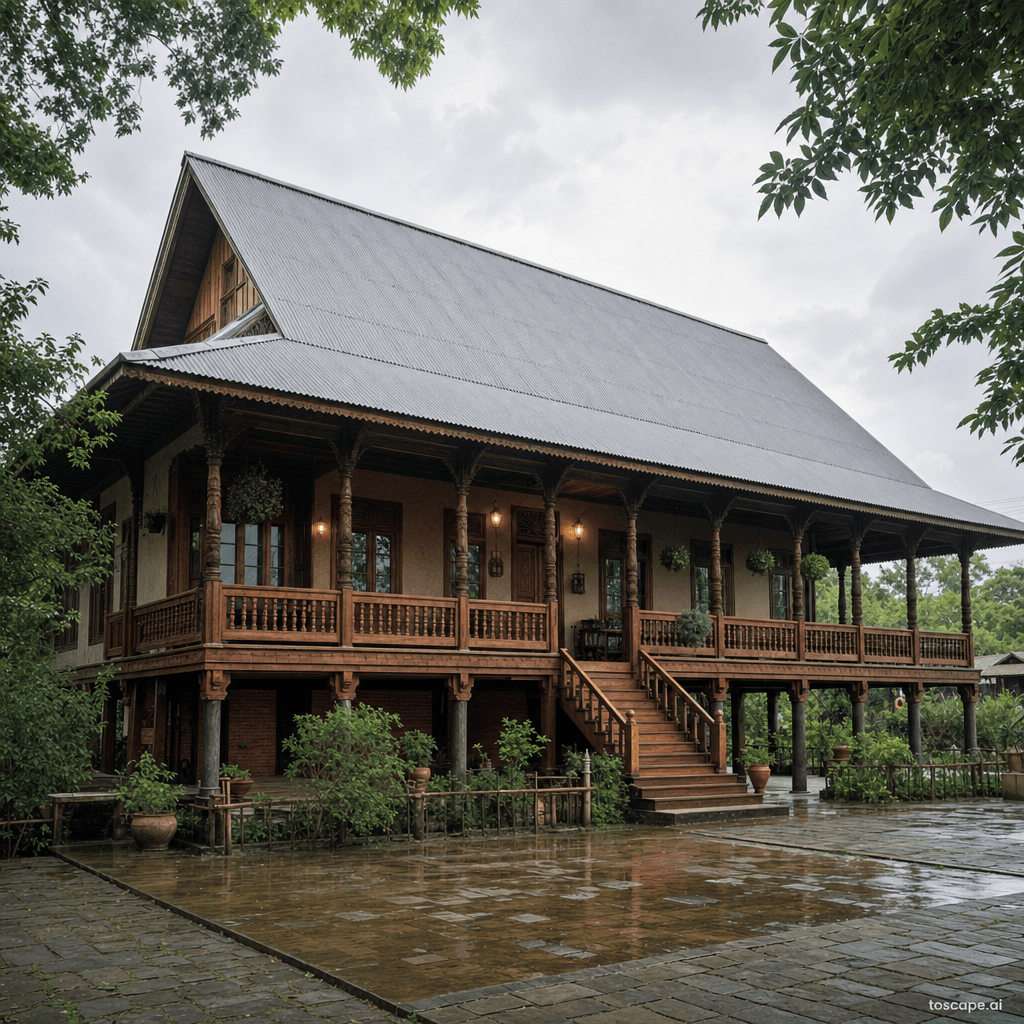
Gilan Caspian Timber — characteristic facade composition, Gilan and Mazandaran Caspian Sea region.
Context Snapshot
Gilan and Mazandaran Caspian Sea region — timber architecture in Iran's northern rainforest belt Hyrcanian temperate rainforest: annual rainfall 1200-2000mm (highest in Iran), high humidity, mild winters.
Contemporary Relevance
Gilan Caspian Timber is useful today for residential, hospitality, civic, and place-branding work that needs Iran-specific character grounded in local massing, material tone, climate response, and settlement logic rather than generic international styling.
Use this style in Toscape
Explore Gilan Caspian Timber directly inside Toscape using the Facade Re-Style and Design Options workflows.
Open Gilan Caspian Timber in the galleryFrequently asked questions
What is Gilan Caspian Timber?
Gilan Caspian Timber is a regional architectural identity from Iran. Steep-Roofed Forest Houses, Raised Timber Verandahs & Hyrcanian Woodland Architecture.
What materials define Gilan Caspian Timber?
Timber: alder, oak, azad, boxwood — all Hyrcanian forest species, used green and worked locally. Thatch (reed — gali, kulam) — traditional roof in rural areas, now largely replaced.
What is the Gilan Caspian Timber color palette?
Warm earth, sandy beige, ochre, clay brown, and sun-softened mineral tones should dominate, with palm green or weathered timber as secondary accents. The palette should read as land-derived rather than polished or urban-generic.
Where does Gilan Caspian Timber come from?
Gilan and Mazandaran Caspian Sea region — timber architecture in Iran's northern rainforest belt Hyrcanian temperate rainforest: annual rainfall 1200-2000mm (highest in Iran), high humidity, mild winters.
When should architects use Gilan Caspian Timber?
Gilan Caspian Timber is useful today for residential, hospitality, civic, and place-branding work that needs Iran-specific character grounded in local massing, material tone, climate response, and settlement logic rather than generic international styling.
How do you render Gilan Caspian Timber in Toscape?
Open Toscape on Windows, load your own photo, elevation, sketch, or CAD view, then apply the Gilan Caspian Timber reference from the built-in style library. The Facade Re-Style and Design Options workflows keep your project geometry and camera while shifting materials, proportion, and detailing toward Gilan Caspian Timber.