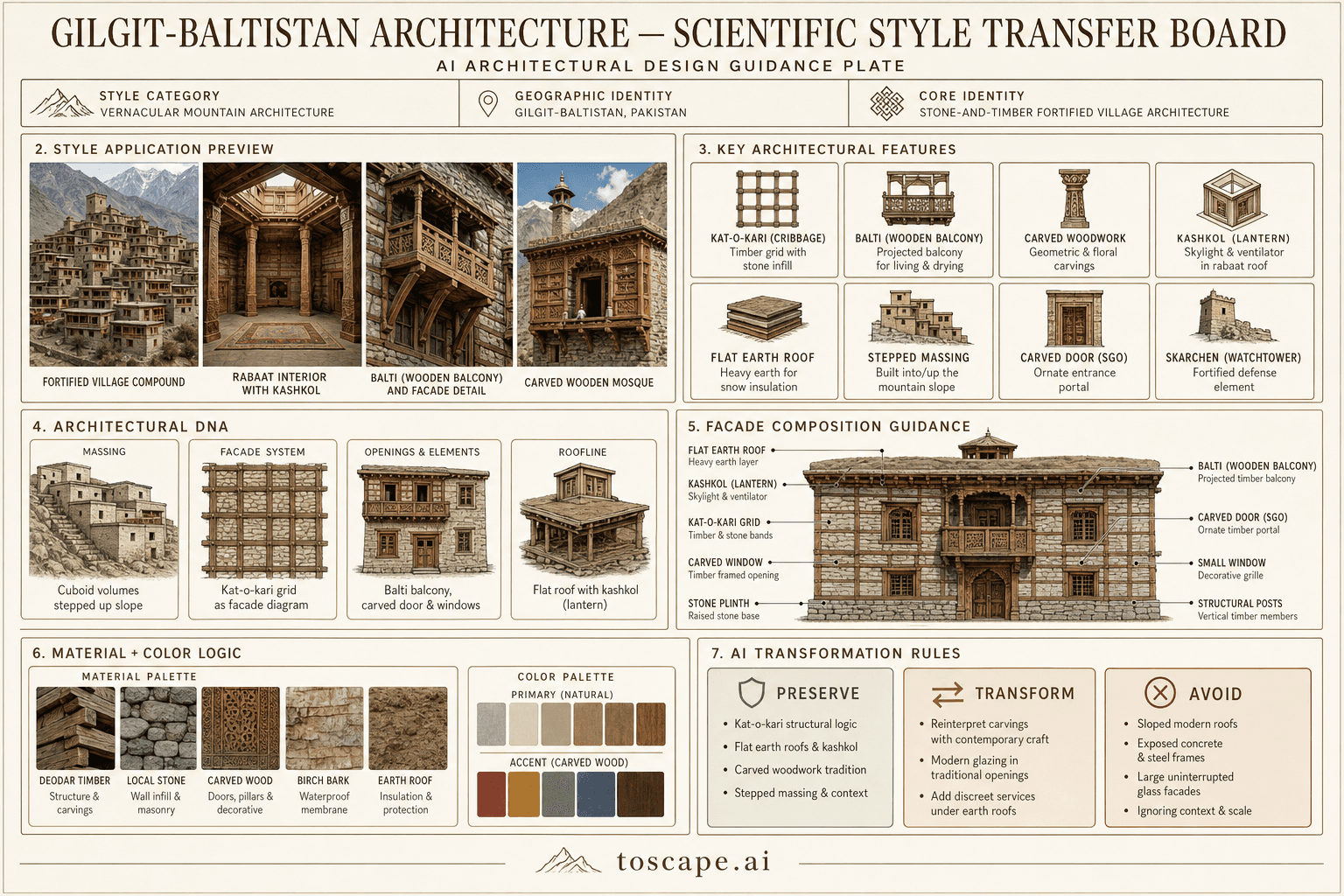
Gilgit-Baltistan
Pakistan · vernacular architecture of Gilgit-Baltistan
The stone-and-timber mountain architecture of the Karakoram — the fortified village compounds, carved wooden mosques, and rooftop terraces of Pakistan's northernmost high-altitude...
Definition
Gilgit-Baltistan is a regional architectural identity from Pakistan. The stone-and-timber mountain architecture of the Karakoram — the fortified village compounds, carved wooden mosques, and rooftop terraces of Pakistan's northernmost high-altitude.
- Country
- Pakistan
- Region
- vernacular architecture of Gilgit-Baltistan.
- Massing
- The Gilgit-Baltistan house is a cuboid volume — 6–12 m wide × 8–14 m deep — two to three storeys.
- Materials
- Mountain stone — granite, gneiss, schist, limestone — gray, silver-gray, warm brown, ochre — locally gathered from moraines and riverbeds Timber (deodar cedar — premium.
- Palette
- Warm earth, sandy beige, ochre, clay brown, and sun-softened mineral tones should dominate, with palm green or weathered timber as secondary accents.
- Climate response
- The extreme high-altitude climate — cold winters (-15 to -25°C, heavy snow 1–3 m accumulation), mild summers (15–25°C).
Overview
Gilgit-Baltistan is a regional architectural identity in Pakistan. Traditional vernacular architecture of Gilgit-Baltistan — Pakistan's northernmost territory in the Karakoram, western Himalaya, and Hindu Kush ranges (1,500–3,500 m elevation). Defined by the distinctive "cribbage-and-stone" (kat-o-kari) construction technique — alternating layers of timber and stone — the elaborately carved wooden elements of mosques and houses, the flat earth roofs adapted to heavy snow, and the pr...
Visual DNA
Massing & Form
The Gilgit-Baltistan house is a cuboid volume — 6–12 m wide × 8–14 m deep — two to three storeys, stepped into or up the mountain slope. Houses are densely clustered in fortified villages (khan) on defensible spurs, south-facing slopes, or alluvial fans above the river gorges.
Facade Language
The Gilgit-Baltistan facade is organized by the kat-o-kari structural grid: Cribbage grid pattern: The visible timber grid — horizontal beams and vertical posts forming square or rectangular panels (0.8–1.5 m per side) infilled with stone rubble. The grid creates a distinctive geometric pattern — the structural diagram...
Materials & Texture
Mountain stone — granite, gneiss, schist, limestone — gray, silver-gray, warm brown, ochre — locally gathered from moraines and riverbeds Timber (deodar cedar — premium; pine — common; walnut — for carved elements; apricot — for small joinery) — the Karakoram forests and orchards Birch bark (bhojpatra) — the traditiona...
Color Palette
Warm earth, sandy beige, ochre, clay brown, and sun-softened mineral tones should dominate, with palm green or weathered timber as secondary accents. The palette should read as land-derived rather than polished or urban-generic.
Ornament & Detail
Gilgit-Baltistan ornament is a unique palimpsest of Buddhist and Islamic traditions in wood: (1) Door carving — the richest ornamental surface: Tibetan endless knot (pal-bheu), lotus rosettes, snow lion figures (in pre-Islamic survivals), and Islamic geometric star patterns — the fusion of two religious artistic tradit...
Climate Response
The extreme high-altitude climate — cold winters (-15 to -25°C, heavy snow 1–3 m accumulation), mild summers (15–25°C), 200–400 mm annual precipitation — produces radical architectural responses: (1) Kat-o-kari for seismic resistance — the Karakoram is one of the most seismically active regions on Earth (India-Asia col...
Landscape & Ground
Traditional vernacular architecture of Gilgit-Baltistan — Pakistan's northernmost territory in the Karakoram, western Himalaya, and Hindu Kush ranges (1,500–3,500 m elevation). Defined by the distinctive "cribbage-and-stone" (kat-o-kari) construction technique — alternating layers of timber and stone — the elaborately...
Reference elevation
Gilgit-Baltistan — characteristic facade composition, vernacular architecture of Gilgit-Baltistan.
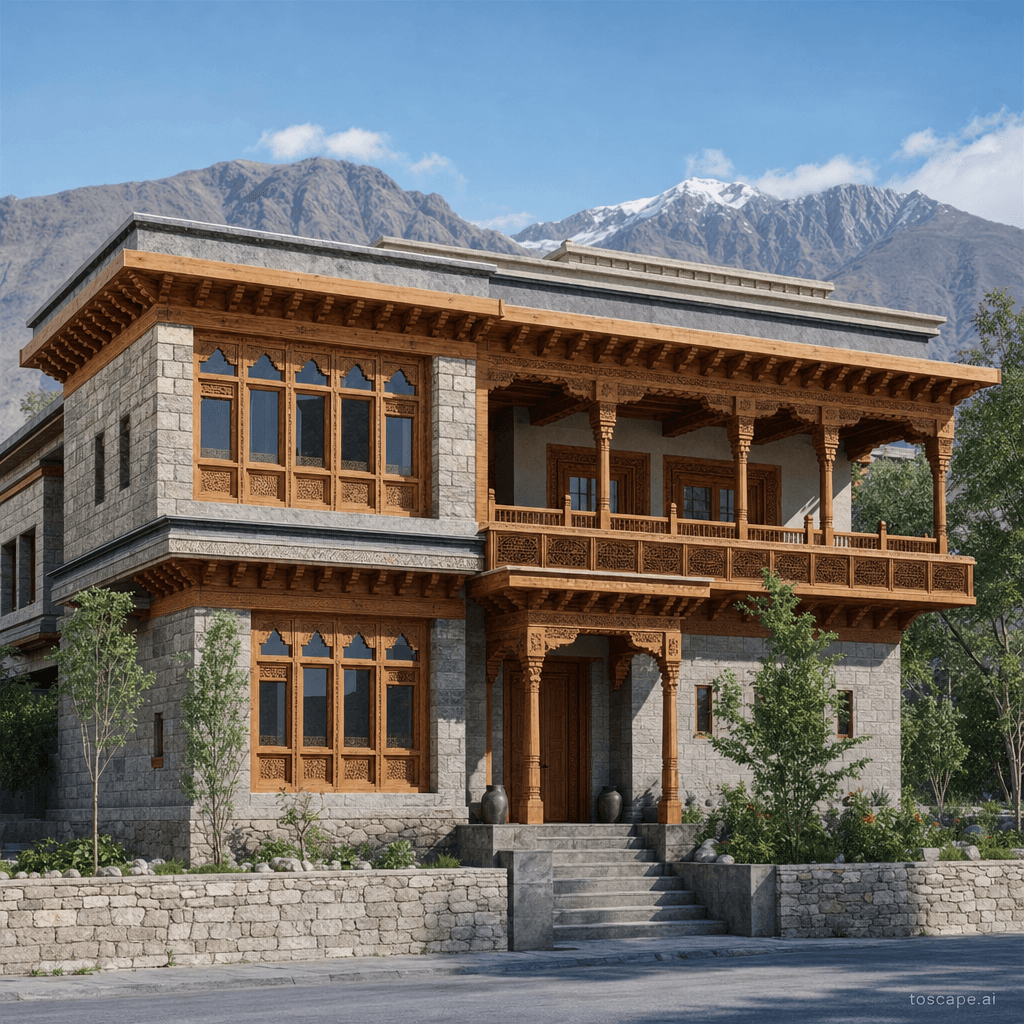
Context Snapshot
Traditional vernacular architecture of Gilgit-Baltistan — Pakistan's northernmost territory in the Karakoram, western Himalaya, and Hindu Kush ranges (1,500–3,500 m elevation). The extreme high-altitude climate — cold winters (-15 to -25°C, heavy snow 1–3 m accumulation), mild summers (15–25°C), 200–400 mm annual precipitation — produces radical architectural responses: (1) Kat-o-kari for seism...
Contemporary Relevance
Gilgit-Baltistan is useful today for residential, hospitality, civic, and place-branding work that needs Pakistan-specific character grounded in local massing, material tone, climate response, and settlement logic rather than generic international styling.
Use this style in Toscape
Explore Gilgit-Baltistan directly inside Toscape using the Facade Re-Style and Design Options workflows.
Open Gilgit-Baltistan in the galleryFrequently asked questions
What is Gilgit-Baltistan?
Gilgit-Baltistan is a regional architectural identity from Pakistan. The stone-and-timber mountain architecture of the Karakoram — the fortified village compounds, carved wooden mosques, and rooftop terraces of Pakistan's northernmost high-altitude.
What materials define Gilgit-Baltistan?
Mountain stone — granite, gneiss, schist, limestone — gray, silver-gray, warm brown, ochre — locally gathered from moraines and riverbeds Timber (deodar cedar — premium; pine — common; walnut — for carved elements; apricot — for small joinery) — the Karakoram forests and orchards Birch bark (bhojpatra) — the traditiona.
What is the Gilgit-Baltistan color palette?
Warm earth, sandy beige, ochre, clay brown, and sun-softened mineral tones should dominate, with palm green or weathered timber as secondary accents. The palette should read as land-derived rather than polished or urban-generic.
Where does Gilgit-Baltistan come from?
Traditional vernacular architecture of Gilgit-Baltistan — Pakistan's northernmost territory in the Karakoram, western Himalaya, and Hindu Kush ranges (1,500–3,500 m elevation). The extreme high-altitude climate — cold winters (-15 to -25°C, heavy snow 1–3 m accumulation), mild summers (15–25°C), 200–400 mm annual precipitation — produces radical architectural responses: (1) Kat-o-kari for seism.
When should architects use Gilgit-Baltistan?
Gilgit-Baltistan is useful today for residential, hospitality, civic, and place-branding work that needs Pakistan-specific character grounded in local massing, material tone, climate response, and settlement logic rather than generic international styling.
How do you render Gilgit-Baltistan in Toscape?
Open Toscape on Windows, load your own photo, elevation, sketch, or CAD view, then apply the Gilgit-Baltistan reference from the built-in style library. The Facade Re-Style and Design Options workflows keep your project geometry and camera while shifting materials, proportion, and detailing toward Gilgit-Baltistan.