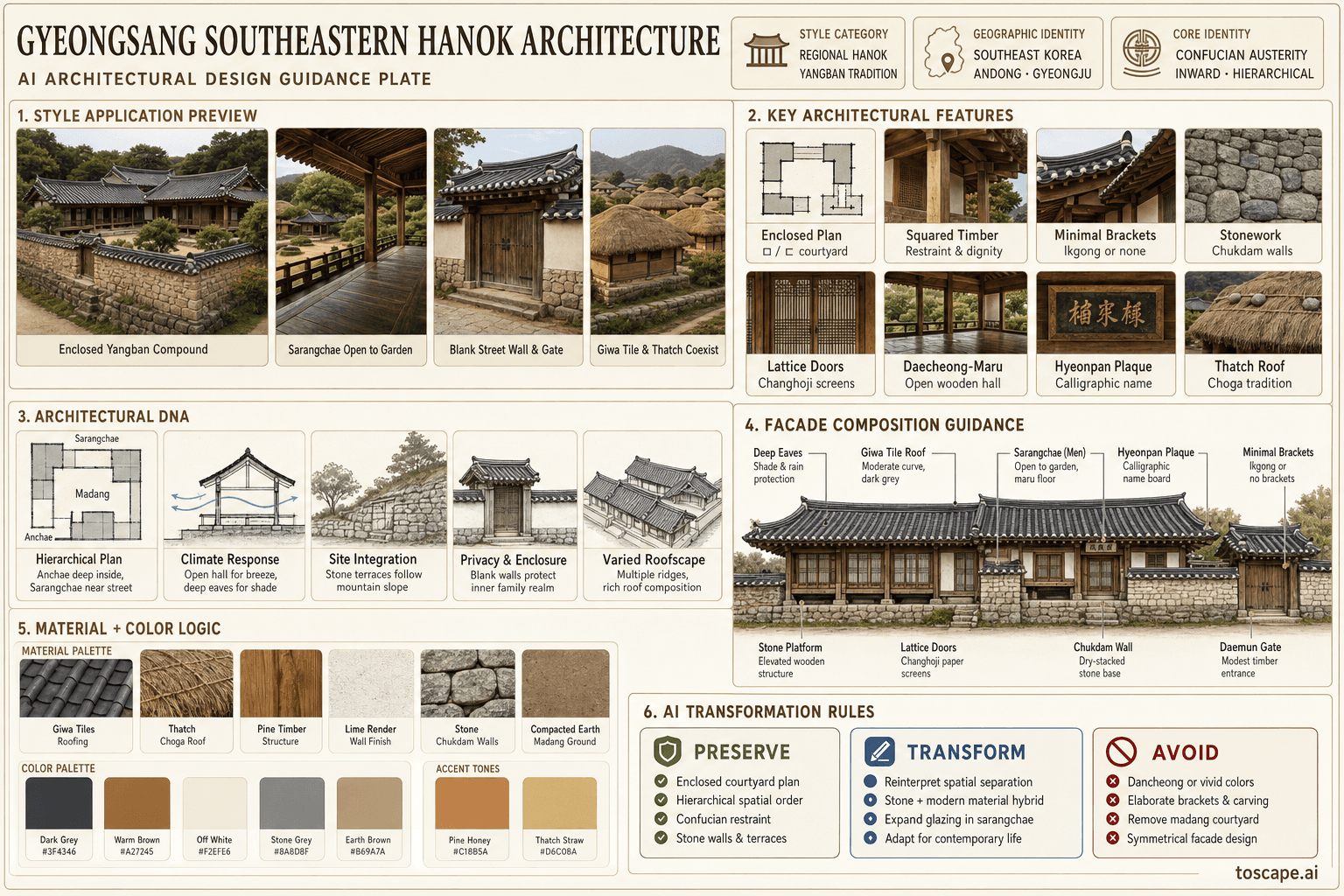
Gyeongsang Southeastern Hanok
South Korea · hanok of Gyeongsang provinces (Gyeongsangbuk-do and Gyeongsangnam-do), anchored...
The noble yangban-class hanok of Korea's southeastern provinces — noble austerity meets practical warmth
Definition
Gyeongsang Southeastern Hanok is a regional architectural identity from South Korea. The noble yangban-class hanok of Korea's southeastern provinces — noble austerity meets practical warmth.
- Country
- South Korea
- Region
- hanok of Gyeongsang provinces (Gyeongsangbuk-do and Gyeongsangnam-do), anchored.
- Massing
- Gyeongsang yangban hanok are the most formally composed of all Korean regional typologies, reflecting the strict spatial hierarchy of Neo-Confucian domestic life.
- Materials
- The Gyeongsang material palette is the most rustic and natural of the Korean regional typologies: Dark grey giwa tiles (yangban) or golden-brown thatch (commoner) — roof.
- Palette
- White, cream, pale sand, warm timber, and shadow-driven dark metal accents define the palette.
- Climate response
- Gyeongsang climate response integrates the region's mountain-valley topography: Site selection (pungsu): Gyeongsang yangban houses are sited according to pungsu (geomancy/feng shui) principles with particular rigor.
Overview
Gyeongsang Southeastern Hanok is a regional architectural identity in South Korea. Regional hanok of Gyeongsang provinces (Gyeongsangbuk-do and Gyeongsangnam-do), anchored by the historic cities of Andong, Gyeongju, and the Hahoe Folk Village (UNESCO World Heritage) — heartland of Korean Confucian scholarly (yangban) culture. Enclosed ㅁ-shaped (mieum-jip) and ㄷ-shaped (digeut-jip) courtyard plans — more formal, enclosed, and inward-looking than Jeolla — distinctive anchae-sarangchae dual-building s...
Visual DNA
Massing & Form
Gyeongsang yangban hanok are the most formally composed of all Korean regional typologies, reflecting the strict spatial hierarchy of Neo-Confucian domestic life. The enclosed courtyard plan (ㅁ-shaped mieum-jip or ㄷ-shaped digeut-jip) is the norm for upper-class houses — the building wraps the madang on three or four s...
Facade Language
The Gyeongsang hanok facade is the most restrained in Korea — the visual language is one of quiet dignity: Enclosure: The street-facing elevation is almost entirely blank — solid rendered walls or stone walls with only the modest daemun (gate) opening. This extreme public-private separation is a visual manifestation of...
Materials & Texture
The Gyeongsang material palette is the most rustic and natural of the Korean regional typologies: Dark grey giwa tiles (yangban) or golden-brown thatch (commoner) — roof Squared pine timber — warm honey-brown, minimal treatment, natural aging White lime render (yangban) or exposed clay-straw plaster (commoner) — walls...
Color Palette
White, cream, pale sand, warm timber, and shadow-driven dark metal accents define the palette. The facade should stay bright and climate-aware rather than heavy, gray, or over-saturated.
Ornament & Detail
Ornament is minimal — the most restrained of all Korean regions: No dancheong on residential buildings — even the most modest painted accents are absent from Gyeongsang yangban houses. This is a deliberate Confucian statement .
Climate Response
Gyeongsang climate response integrates the region's mountain-valley topography: Site selection (pungsu): Gyeongsang yangban houses are sited according to pungsu (geomancy/feng shui) principles with particular rigor — the ideal site has a mountain to the rear (north) and a water feature to the front (south), creating a...
Landscape & Ground
Regional hanok of Gyeongsang provinces (Gyeongsangbuk-do and Gyeongsangnam-do), anchored by the historic cities of Andong, Gyeongju, and the Hahoe Folk Village (UNESCO World Heritage) — heartland of Korean Confucian scholarly (yangban) culture. Gyeongsang climate response integrates the region's mountain-valley topogra...
Reference elevation
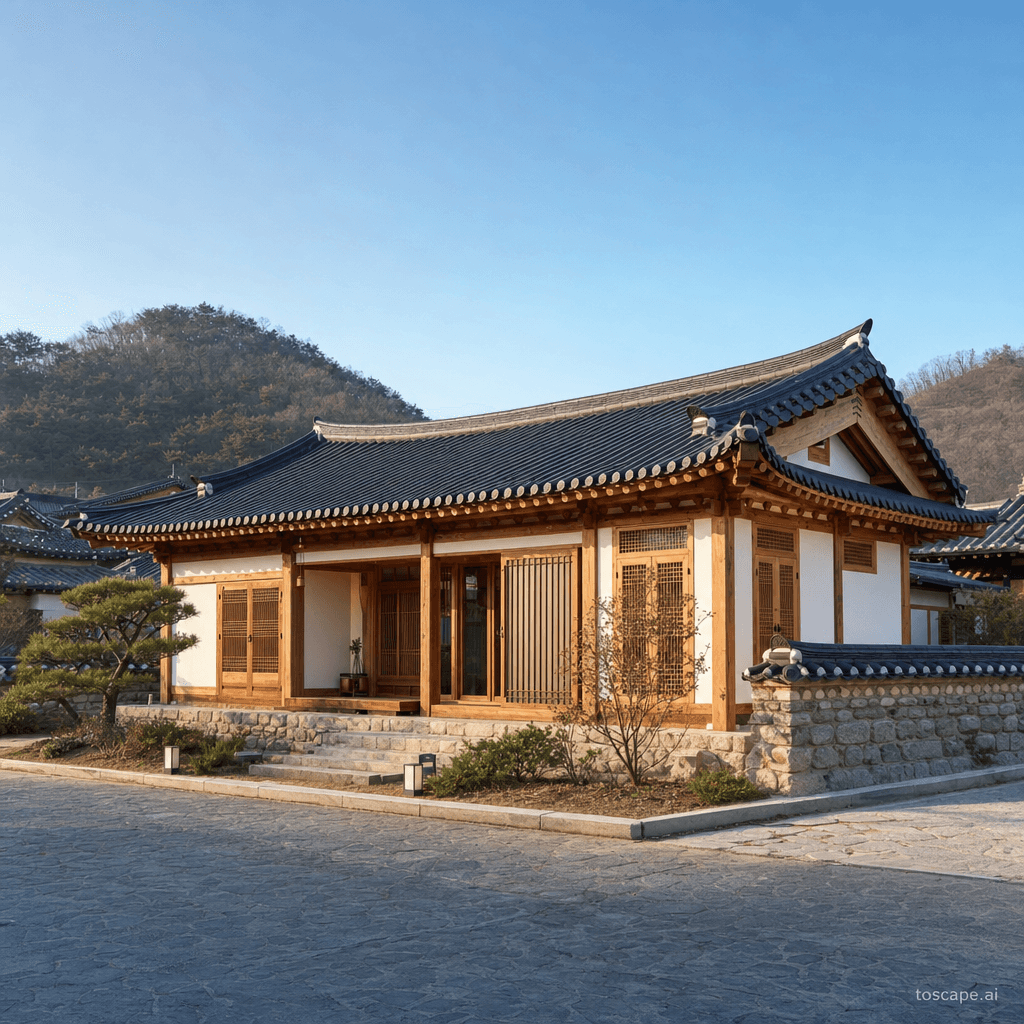
Gyeongsang Southeastern Hanok — characteristic facade composition, hanok of Gyeongsang provinces (Gyeongsangbuk-do and Gyeongsangnam-do), anchored....
Context Snapshot
Regional hanok of Gyeongsang provinces (Gyeongsangbuk-do and Gyeongsangnam-do), anchored by the historic cities of Andong, Gyeongju, and the Hahoe Folk Village (UNESCO World Heritage) — heartland of K... Gyeongsang climate response integrates the region's mountain-valley topography: Site selection (pungsu): Gyeongsang yangban houses are sited according to pungsu (geomancy/feng shui) principles with particular rigor — the...
Contemporary Relevance
Gyeongsang Southeastern Hanok is useful today for residential, hospitality, civic, and place-branding work that needs South Korea-specific character grounded in local massing, material tone, climate response, and settlement logic rather than generic international styling.
Use this style in Toscape
Explore Gyeongsang Southeastern Hanok directly inside Toscape using the Facade Re-Style and Design Options workflows.
Open Gyeongsang Southeastern Hanok in the galleryFrequently asked questions
What is Gyeongsang Southeastern Hanok?
Gyeongsang Southeastern Hanok is a regional architectural identity from South Korea. The noble yangban-class hanok of Korea's southeastern provinces — noble austerity meets practical warmth.
What materials define Gyeongsang Southeastern Hanok?
The Gyeongsang material palette is the most rustic and natural of the Korean regional typologies: Dark grey giwa tiles (yangban) or golden-brown thatch (commoner) — roof Squared pine timber — warm honey-brown, minimal treatment, natural aging White lime render (yangban) or exposed clay-straw plaster (commoner) — walls.
What is the Gyeongsang Southeastern Hanok color palette?
White, cream, pale sand, warm timber, and shadow-driven dark metal accents define the palette. The facade should stay bright and climate-aware rather than heavy, gray, or over-saturated.
Where does Gyeongsang Southeastern Hanok come from?
Regional hanok of Gyeongsang provinces (Gyeongsangbuk-do and Gyeongsangnam-do), anchored by the historic cities of Andong, Gyeongju.
When should architects use Gyeongsang Southeastern Hanok?
Gyeongsang Southeastern Hanok is useful today for residential, hospitality, civic, and place-branding work that needs South Korea-specific character grounded in local massing, material tone, climate response, and settlement logic rather than generic international styling.
How do you render Gyeongsang Southeastern Hanok in Toscape?
Open Toscape on Windows, load your own photo, elevation, sketch, or CAD view, then apply the Gyeongsang Southeastern Hanok reference from the built-in style library. The Facade Re-Style and Design Options workflows keep your project geometry and camera while shifting materials, proportion, and detailing toward Gyeongsang Southeastern Hanok.