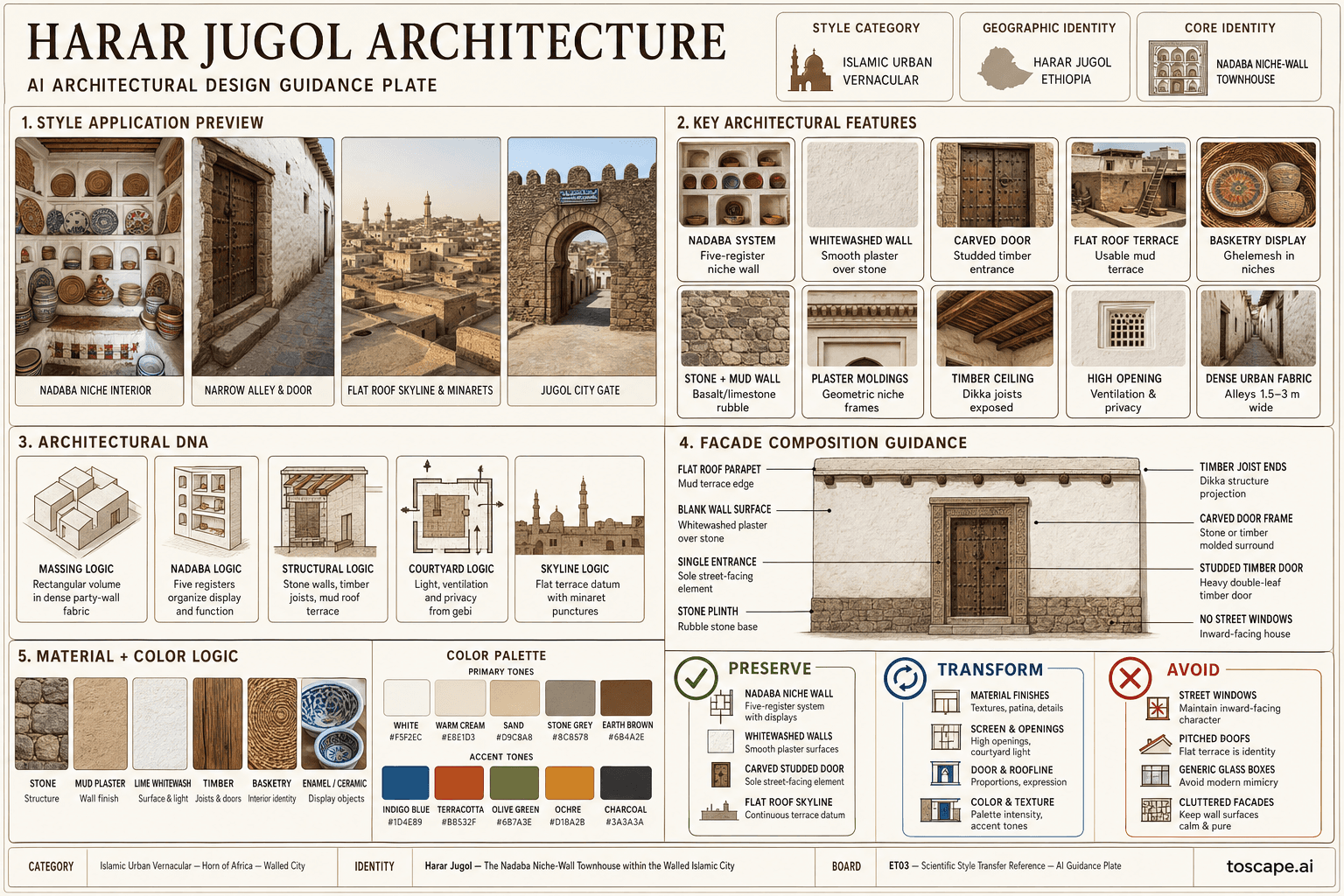
Harar Jugol
Ethiopia · architectural identity of Harar Jugol (UNESCO World Heritage, inscribed 2006)
The walled Islamic city of Harar — the 16th-century Harari townhouse (gey gar) with its elaborate stacked-niche interior wall system, the five historic gates of the Jugol wall, and...
Definition
Harar Jugol is a regional architectural identity from Ethiopia. The walled Islamic city of Harar — the 16th-century Harari townhouse (gey gar) with its elaborate stacked-niche interior wall system.
- Country
- Ethiopia
- Region
- architectural identity of Harar Jugol (UNESCO World Heritage, inscribed 2006).
- Massing
- The gey gar is a rectangular prism inserted into the dense fabric of the walled city — party walls on two or three sides.
- Materials
- Materials are local and modest: (1) Basalt or limestone rubble stone — the structural wall core, quarried from the surrounding hills.
- Palette
- White, cream, pale sand, warm timber, and shadow-driven dark metal accents define the palette.
- Climate response
- Harar (1,885 m elevation, semi-arid highland climate) experiences a mild climate with a dry season (October–February) and a bimodal rainy season.
Overview
Harar Jugol is a regional architectural identity in Ethiopia. The architectural identity of Harar Jugol (UNESCO World Heritage, inscribed 2006) — a 48-hectare walled city at 1,885 m elevation in eastern Ethiopia, founded as an Islamic sultanate in the 16th century — the Harari townhouse (gey gar) with its unique interior organization: a single rectangular room organized around a hierarchy of plaster niches (nadaba) stacked in five registers from floor to ceiling, used for the d...
Visual DNA
Massing & Form
The gey gar is a rectangular prism inserted into the dense fabric of the walled city — party walls on two or three sides, a narrow alley-facing facade, and a small internal courtyard (gebi) for the larger houses. The mass is pure exterior — unadorned stone-and-mud walls with only the carved door as the street presence.
Facade Language
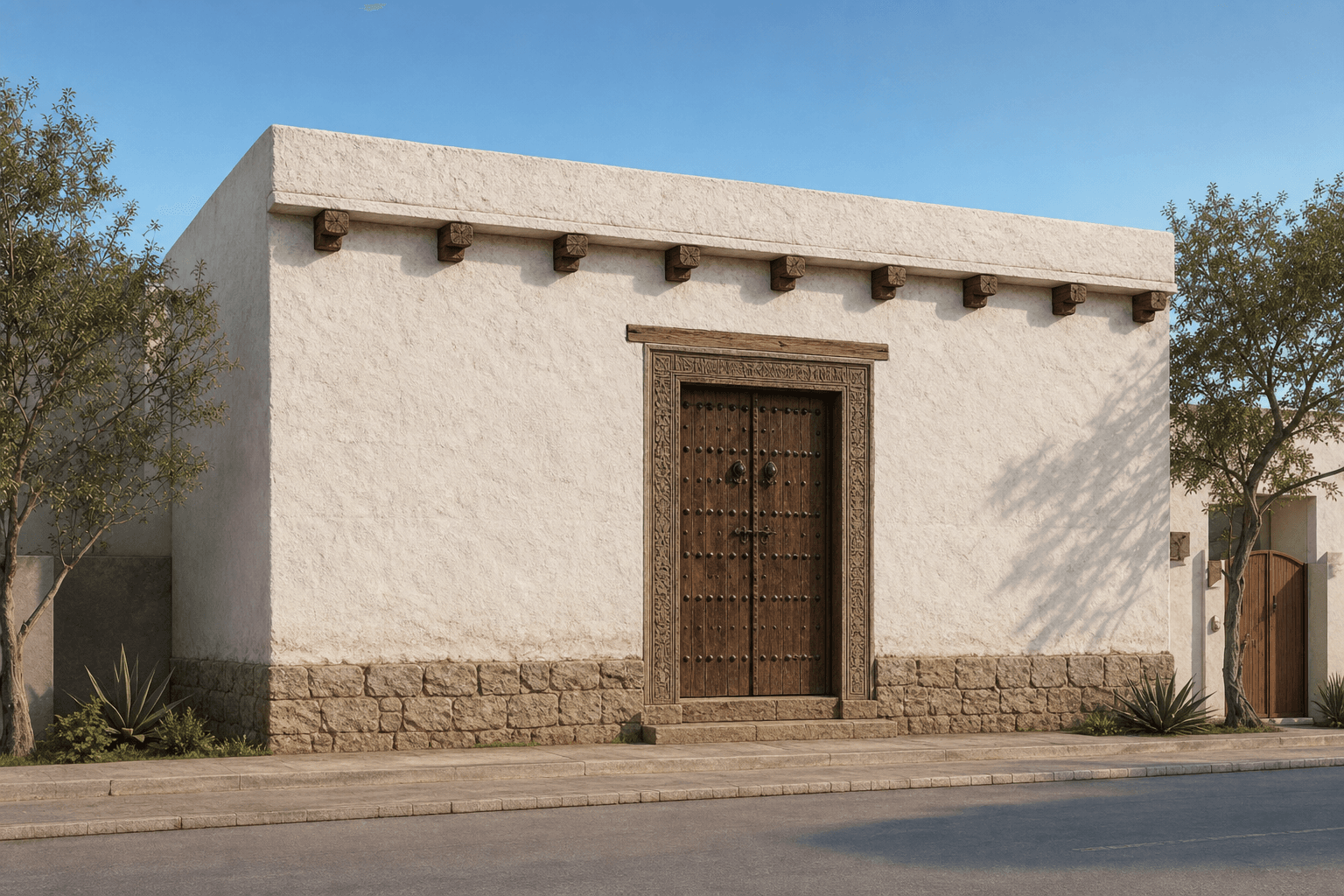
The street facade is intentionally mute — a blank wall of whitewashed or natural stone, interrupted only by the single carved door. The door itself is the sole compositional element: heavy timber (acacia or juniper), often studded with iron nails in geometric patterns, set within a stone arch or timber lintel frame.
Materials & Texture
Materials are local and modest: (1) Basalt or limestone rubble stone — the structural wall core, quarried from the surrounding hills. (2) Mud plaster (chika) — the wall rendering, mixed with straw, applied in multiple coats and smoothed to a hard surface.
Color Palette
White, cream, pale sand, warm timber, and shadow-driven dark metal accents define the palette. The facade should stay bright and climate-aware rather than heavy, gray, or over-saturated.
Ornament & Detail
Harari ornament is interior-focused and object-based: (1) The nadaba niche wall — the primary ornamental surface, where basketry, ceramics, and manuscripts are arranged in a precise aesthetic order (largest bowls at center, graduated sizes outward). (2) Plaster molding — geometric relief bands (rectangular frames, dent...
Climate Response
Harar (1,885 m elevation, semi-arid highland climate) experiences a mild climate with a dry season (October–February) and a bimodal rainy season. The thick stone-and-mud walls (40–60 cm) provide thermal mass, keeping interiors cool during the day and warm at night.
Landscape & Ground
The architectural identity of Harar Jugol (UNESCO World Heritage, inscribed 2006) — a 48-hectare walled city at 1,885 m elevation in eastern Ethiopia, founded as an Islamic sultanate in the 16th century — the Harari townhouse (gey gar) with its unique interior organization: a single rectangular room organized around a...
Reference elevation
Harar Jugol — characteristic facade composition, architectural identity of Harar Jugol (UNESCO World Heritage, inscribed 2006).
Context Snapshot
The architectural identity of Harar Jugol (UNESCO World Heritage, inscribed 2006) — a 48-hectare walled city at 1,885 m elevation in eastern Ethiopia, founded as an Islamic sultanate in the 16th centu... Harar (1,885 m elevation, semi-arid highland climate) experiences a mild climate with a dry season (October–February) and a bimodal rainy season.
Contemporary Relevance
Harar Jugol is useful today for residential, hospitality, civic, and place-branding work that needs Ethiopia-specific character grounded in local massing, material tone, climate response, and settlement logic rather than generic international styling.
Use this style in Toscape
Explore Harar Jugol directly inside Toscape using the Facade Re-Style and Design Options workflows.
Open Harar Jugol in the galleryFrequently asked questions
What is Harar Jugol?
Harar Jugol is a regional architectural identity from Ethiopia. The walled Islamic city of Harar — the 16th-century Harari townhouse (gey gar) with its elaborate stacked-niche interior wall system.
What materials define Harar Jugol?
Materials are local and modest: (1) Basalt or limestone rubble stone — the structural wall core, quarried from the surrounding hills. (2) Mud plaster (chika) — the wall rendering, mixed with straw, applied in multiple coats and smoothed to a hard surface.
What is the Harar Jugol color palette?
White, cream, pale sand, warm timber, and shadow-driven dark metal accents define the palette. The facade should stay bright and climate-aware rather than heavy, gray, or over-saturated.
Where does Harar Jugol come from?
The architectural identity of Harar Jugol (UNESCO World Heritage, inscribed 2006) — a 48-hectare walled city at 1,885 m elevation in eastern Ethiopia, founded as an Islamic sultanate in the 16th centu... Harar (1,885 m elevation, semi-arid highland climate) experiences a mild climate with a dry season (October–February) and a bimodal rainy season.
When should architects use Harar Jugol?
Harar Jugol is useful today for residential, hospitality, civic, and place-branding work that needs Ethiopia-specific character grounded in local massing, material tone, climate response, and settlement logic rather than generic international styling.
How do you render Harar Jugol in Toscape?
Open Toscape on Windows, load your own photo, elevation, sketch, or CAD view, then apply the Harar Jugol reference from the built-in style library. The Facade Re-Style and Design Options workflows keep your project geometry and camera while shifting materials, proportion, and detailing toward Harar Jugol.