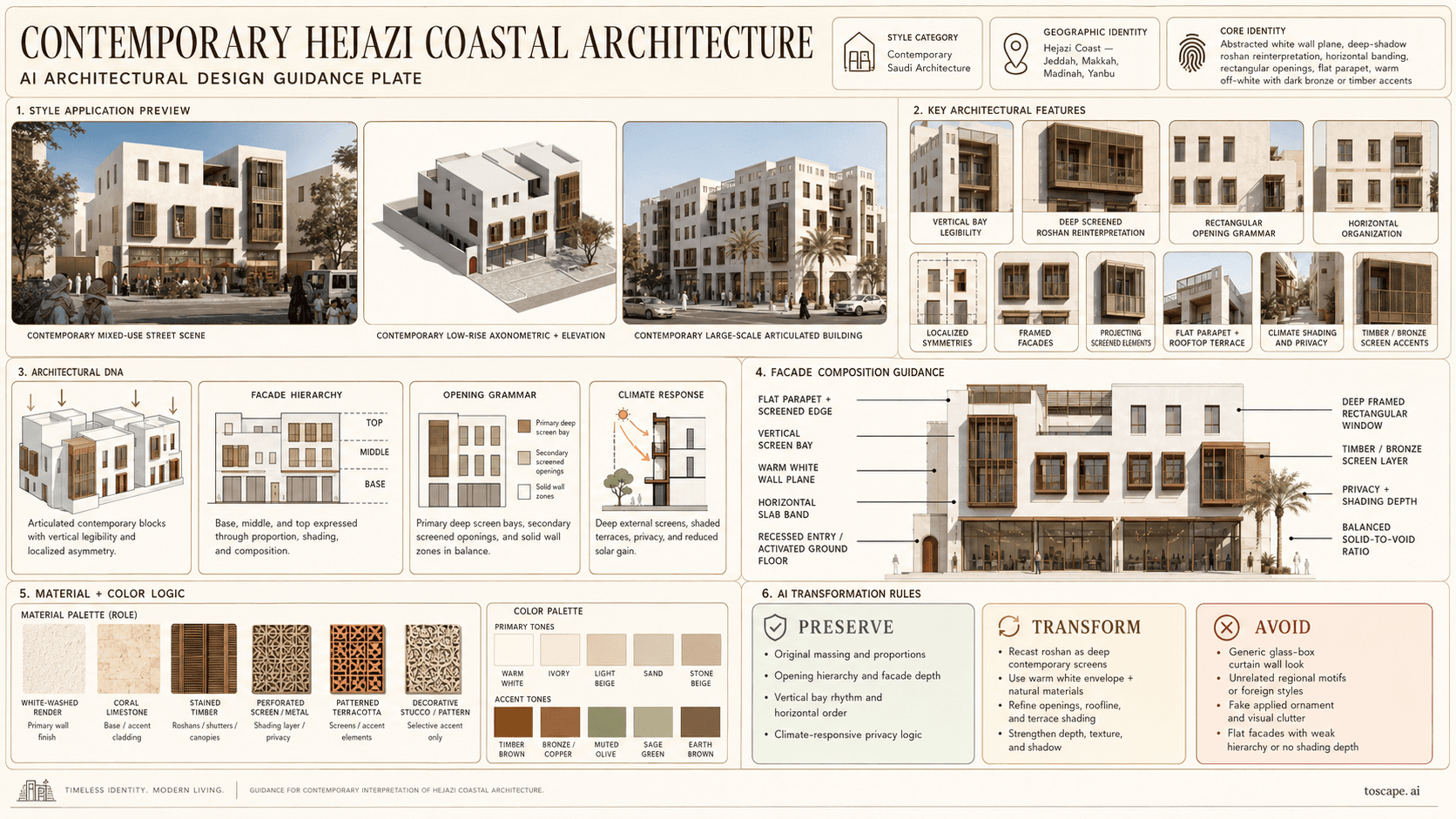
Hejazi Contemporary Coastal
Saudi Arabia · Hejaz / Red Sea Coast
The abstracted, modern-interpretation typology carrying Hejazi coastal DNA into 21st-century architectural expression
Definition
Hejazi Contemporary Coastal is a regional architectural identity from Saudi Arabia. The abstracted, modern-interpretation typology carrying Hejazi coastal DNA into 21st-century architectural expression.
- Country
- Saudi Arabia
- Region
- Hejaz / Red Sea Coast.
- Massing
- Contemporary Hejazi coastal buildings range widely in scale — from 2-storey villas to 20+ storey commercial towers.
- Materials
- The contemporary palette is deliberately expanded but governed by a strict hierarchy: White (warm off-white) wall surface remains the dominant visual element — in modern render.
- Palette
- A clean warm-white envelope carries the facade, while bronze, copper, chestnut, and screened shadow depth provide the accent layer.
- Climate response
- Contemporary Hejazi coastal buildings inherit the climate-responsive DNA and translate it to modern performance standards.
Overview
Hejazi Contemporary Coastal is a Saudi architectural identity rooted in Hejaz / Red Sea Coast. Hejazi Coastal Architecture — Contemporary typology (the third and most permissive of the three design modes). New developments, major projects, government buildings, and commercial structures throughout the Hejazi coastal region — Jeddah, Makkah, Madinah, Yanbu, and expanding urban corridors.
Visual DNA
Massing & Form
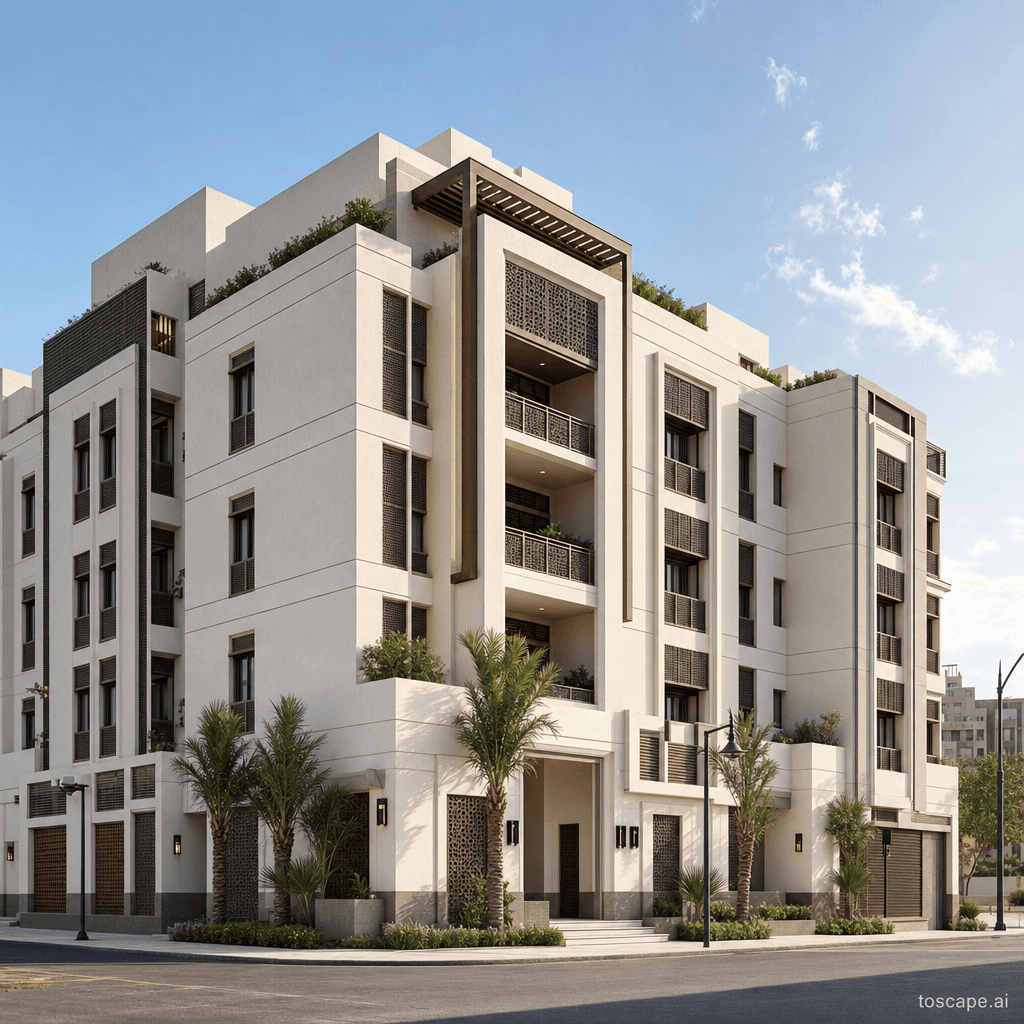
Contemporary Hejazi coastal buildings range widely in scale — from 2-storey villas to 20+ storey commercial towers. The massing is freed from the traditional narrow-fronted rectangular prism: contemporary buildings may employ L-shaped plans, courtyard typologies, stepped massing, tower-on-podium configurations, or arti...
Facade Language
The contemporary facade carries the Hejazi coastal identity through abstraction of the traditional rhythm rather than literal reproduction. The three levels of the traditional opening hierarchy are reinterpreted as: (1) Primary depth event — a major projecting or deeply recessed screen element (the "roshan" of the cont...
Materials & Texture
The contemporary palette is deliberately expanded but governed by a strict hierarchy: White (warm off-white) wall surface remains the dominant visual element — in modern render, pre-cast concrete, painted metal panel, or high-pressure laminate rainscreen. Dark warm-brown or bronze metal elements (powder-coated aluminiu...
Color Palette
A clean warm-white envelope carries the facade, while bronze, copper, chestnut, and screened shadow depth provide the accent layer. Contemporary Hejazi work keeps the traditional white-and-warm-brown binary but translates it into metal, GRC, and shaded glazing.
Ornament & Detail
Contemporary ornament is pattern-as-architecture, not applied decoration. The geometric screen — in perforated metal, cast concrete, CNC-cut panel, or parametrically designed GRC — IS the ornament.
Climate Response
Contemporary Hejazi coastal buildings inherit the climate-responsive DNA and translate it to modern performance standards. The white facade remains the primary solar control — high-albedo render, cool-roof technology, or reflective metal panels achieve the traditional reflectivity with modern efficiency.
Landscape & Ground
New developments, major projects, government buildings, and commercial structures throughout the Hejazi coastal region — Jeddah, Makkah, Madinah, Yanbu, and expanding urban corridors. Contemporary Hejazi coastal buildings inherit the climate-responsive DNA and translate it to modern performance standards.
Reference elevation
Hejazi Contemporary Coastal — characteristic facade composition, Hejaz / Red Sea Coast.
Context Snapshot
Contemporary Hejazi coastal buildings — the most widely used typology under the Saudi Architecture Characters Map — abstracting traditional identity markers into modern architectural language Hejazi Coastal Architecture — Contemporary typology (the third and most permissive of the three design modes) New developments, major projects, government buildings, and commercial structures throughout the Hejazi coastal region — Jeddah, Makkah, Madinah, Yanbu, and expanding urban corridors
Contemporary Relevance
Hejazi Contemporary Coastal aligns naturally with current Saudi practice, where regional identity is carried by proportion, shading depth, material tone, and controlled abstraction rather than direct historic imitation. It suits present-day residential, hospitality, and mixed-use work that needs strong local character inside a modern planning and construction framework.
Use this style in Toscape
Explore Hejazi Contemporary Coastal directly inside Toscape using the Facade Re-Style and Design Options workflows.
Open Hejazi Contemporary Coastal in the galleryFrequently asked questions
What is Hejazi Contemporary Coastal?
Hejazi Contemporary Coastal is a regional architectural identity from Saudi Arabia. The abstracted, modern-interpretation typology carrying Hejazi coastal DNA into 21st-century architectural expression.
What materials define Hejazi Contemporary Coastal?
The contemporary palette is deliberately expanded but governed by a strict hierarchy: White (warm off-white) wall surface remains the dominant visual element — in modern render, pre-cast concrete, painted metal panel, or high-pressure laminate rainscreen. Dark warm-brown or bronze metal elements (powder-coated aluminiu.
What is the Hejazi Contemporary Coastal color palette?
A clean warm-white envelope carries the facade, while bronze, copper, chestnut, and screened shadow depth provide the accent layer. Contemporary Hejazi work keeps the traditional white-and-warm-brown binary but translates it into metal, GRC, and shaded glazing.
Where does Hejazi Contemporary Coastal come from?
Contemporary Hejazi coastal buildings — the most widely used typology under the Saudi Architecture Characters Map — abstracting traditional identity markers into modern architectural language Hejazi Coastal Architecture — Contemporary typology (the third and most permissive of the three design modes) New developments, major projects, government buildings, and commercial structures throughout the Hejazi coastal region — Jeddah, Makkah, Madinah.
When should architects use Hejazi Contemporary Coastal?
Hejazi Contemporary Coastal aligns naturally with current Saudi practice, where regional identity is carried by proportion, shading depth, material tone, and controlled abstraction rather than direct historic imitation. It suits present-day residential, hospitality, and mixed-use work that needs strong local character inside a modern planning and construction framework.
How do you render Hejazi Contemporary Coastal in Toscape?
Open Toscape on Windows, load your own photo, elevation, sketch, or CAD view, then apply the Hejazi Contemporary Coastal reference from the built-in style library. The Facade Re-Style and Design Options workflows keep your project geometry and camera while shifting materials, proportion, and detailing toward Hejazi Contemporary Coastal.