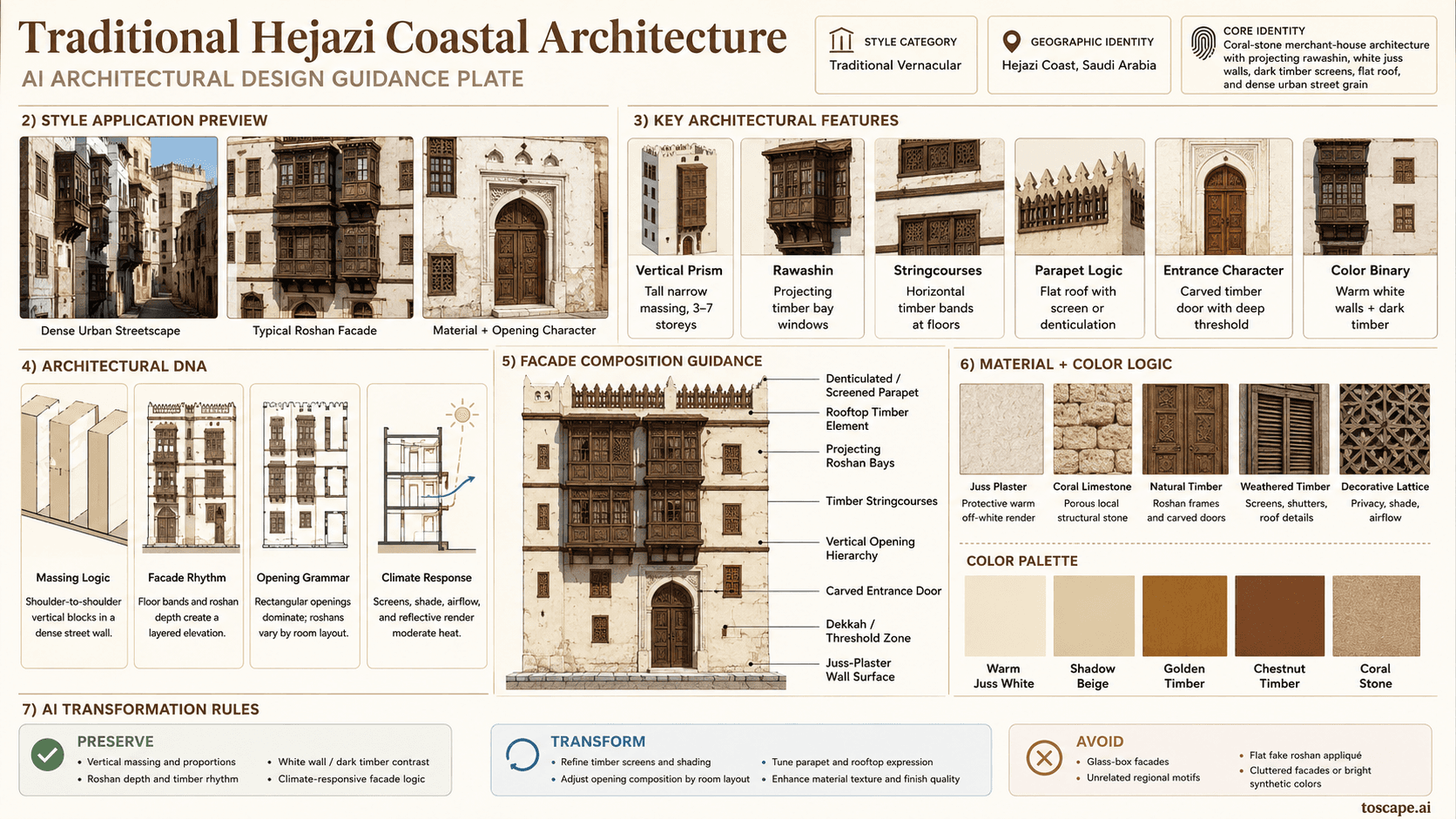
Hejazi Traditional Coastal
Saudi Arabia · Hejaz / Red Sea Coast
The coral-stone merchant house vernacular of the Red Sea littoral, pre-20th century CE
Definition
Hejazi Traditional Coastal is a regional architectural identity from Saudi Arabia. The coral-stone merchant house vernacular of the Red Sea littoral, pre-20th century CE.
- Country
- Saudi Arabia
- Region
- Hejaz / Red Sea Coast.
- Massing
- Traditional Hejazi coastal buildings are simple vertical rectangular prisms — narrow-fronted, flat-roofed, and stacked in a dense shoulder-to-shoulder urban grain.
- Materials
- Traditional Hejazi materials are locally sourced, climate-responsive, and culturally legible.
- Palette
- Warm off-white juss render dominates the wall plane, paired with golden-brown to deep chestnut timber rawasheen, doors, and parapet screens.
- Climate response
- The Hejazi coastal climate is hot and humid — summer temperatures regularly exceed 40°C, combined with high relative humidity from the Red Sea (60–80%).
Overview
Hejazi Traditional Coastal is a Saudi architectural identity rooted in Hejaz / Red Sea Coast. Hejazi Coastal Architecture (one of 19 Saudi Architecture Characters Map styles, ADG-06). The Red Sea coastal plain and adjacent escarpment of the Hejaz region — a narrow littoral zone stretching from the Gulf of Aqaba in the north to the Asir border in the south, anchored by the historic port cities of Jeddah (Al-Balad), Makkah, Madinah, and Yanbu.
Visual DNA
Massing & Form
Traditional Hejazi coastal buildings are simple vertical rectangular prisms — narrow-fronted, flat-roofed, and stacked in a dense shoulder-to-shoulder urban grain. The typical building width is 5–12 m , while heights range from 3 to 7 storeys, creating a distinctly vertical proportion: the building reads as taller than...
Facade Language
The traditional Hejazi facade is characterised by a repeating horizontal rhythm driven by floor levels — each storey is a distinct horizontal band, demarcated by the embedded timber stringcourse (tarma) that runs the full width of the facade. Within each floor band: (a) projecting rawashin timber bay windows create a d...
Materials & Texture
Traditional Hejazi materials are locally sourced, climate-responsive, and culturally legible. Coral limestone (al-manqabi): the primary structural material — porous, lightweight, quarried from the shallow Red Sea reef — provides thermal insulation and humidity regulation .
Color Palette
Warm off-white juss render dominates the wall plane, paired with golden-brown to deep chestnut timber rawasheen, doors, and parapet screens. The palette stays tightly controlled: white wall, warm wood, and shadow as the third visual layer.
Ornament & Detail
Ornament in traditional Hejazi architecture is concentrated in the timberwork — structure IS ornament. The primary ornamental elements are: (a) Roshan shish (lattice screen) — the most intricate element, composed of hundreds of small turned-wood balusters arranged in geometric compositions that read as continuous patte...
Climate Response
The Hejazi coastal climate is hot and humid — summer temperatures regularly exceed 40°C, combined with high relative humidity from the Red Sea (60–80%), creating a physiologically more demanding environment than the dry heat of the Najdi interior. Prevailing winds are north-westerly, bringing slightly cooler sea breeze...
Landscape & Ground
The Red Sea coastal plain and adjacent escarpment of the Hejaz region — a narrow littoral zone stretching from the Gulf of Aqaba in the north to the Asir border in the south, anchored by the historic port cities of Jeddah (Al-Balad), Makkah, Madinah, and Yanbu. Elevation ranges from sea level to ~200 m, with the Hejaz...
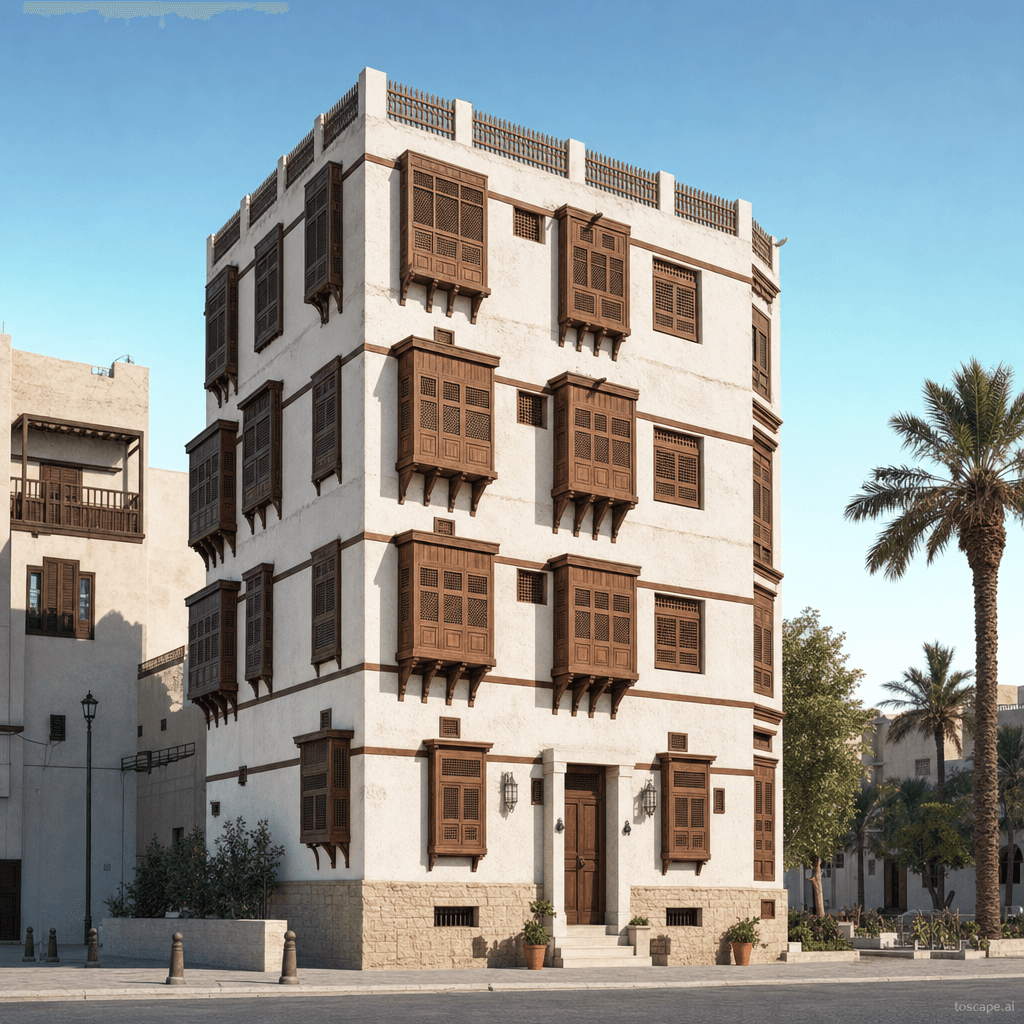
Reference elevation
Hejazi Traditional Coastal — characteristic facade composition, Hejaz / Red Sea Coast.
Context Snapshot
Traditional domestic and commercial vernacular of the Hejazi coastal region (Jeddah, Makkah, Madinah, Yanbu, Al Wajh), pre-1950 Hejazi Coastal Architecture (one of 19 Saudi Architecture Characters Map styles, ADG-06) The Red Sea coastal plain and adjacent escarpment of the Hejaz region — a narrow littoral zone stretching from the Gulf of Aqaba in the north to the Asir border in the south, anchored by the historic port cities of Jedda...
Contemporary Relevance
Hejazi Traditional Coastal operates as the heritage reference layer for Hejaz / Red Sea Coast and is most useful today in conservation work, cultural tourism districts, and accurate AI rendering direction. Its value in current practice comes from preserving proportion, material hierarchy, and climate logic without flattening them into generic nostalgia.
Use this style in Toscape
Explore Hejazi Traditional Coastal directly inside Toscape using the Facade Re-Style and Design Options workflows.
Open Hejazi Traditional Coastal in the galleryFrequently asked questions
What is Hejazi Traditional Coastal?
Hejazi Traditional Coastal is a regional architectural identity from Saudi Arabia. The coral-stone merchant house vernacular of the Red Sea littoral, pre-20th century CE.
What materials define Hejazi Traditional Coastal?
Traditional Hejazi materials are locally sourced, climate-responsive, and culturally legible. Coral limestone (al-manqabi): the primary structural material — porous, lightweight, quarried from the shallow Red Sea reef — provides thermal insulation and humidity regulation .
What is the Hejazi Traditional Coastal color palette?
Warm off-white juss render dominates the wall plane, paired with golden-brown to deep chestnut timber rawasheen, doors, and parapet screens. The palette stays tightly controlled: white wall, warm wood, and shadow as the third visual layer.
Where does Hejazi Traditional Coastal come from?
Traditional domestic and commercial vernacular of the Hejazi coastal region (Jeddah, Makkah, Madinah, Yanbu, Al Wajh), pre-1950 Hejazi Coastal Architecture (one of 19 Saudi Architecture Characters Map styles.
When should architects use Hejazi Traditional Coastal?
Hejazi Traditional Coastal operates as the heritage reference layer for Hejaz / Red Sea Coast and is most useful today in conservation work, cultural tourism districts, and accurate AI rendering direction. Its value in current practice comes from preserving proportion, material hierarchy, and climate logic without flattening them into generic nostalgia.
How do you render Hejazi Traditional Coastal in Toscape?
Open Toscape on Windows, load your own photo, elevation, sketch, or CAD view, then apply the Hejazi Traditional Coastal reference from the built-in style library. The Facade Re-Style and Design Options workflows keep your project geometry and camera while shifting materials, proportion, and detailing toward Hejazi Traditional Coastal.