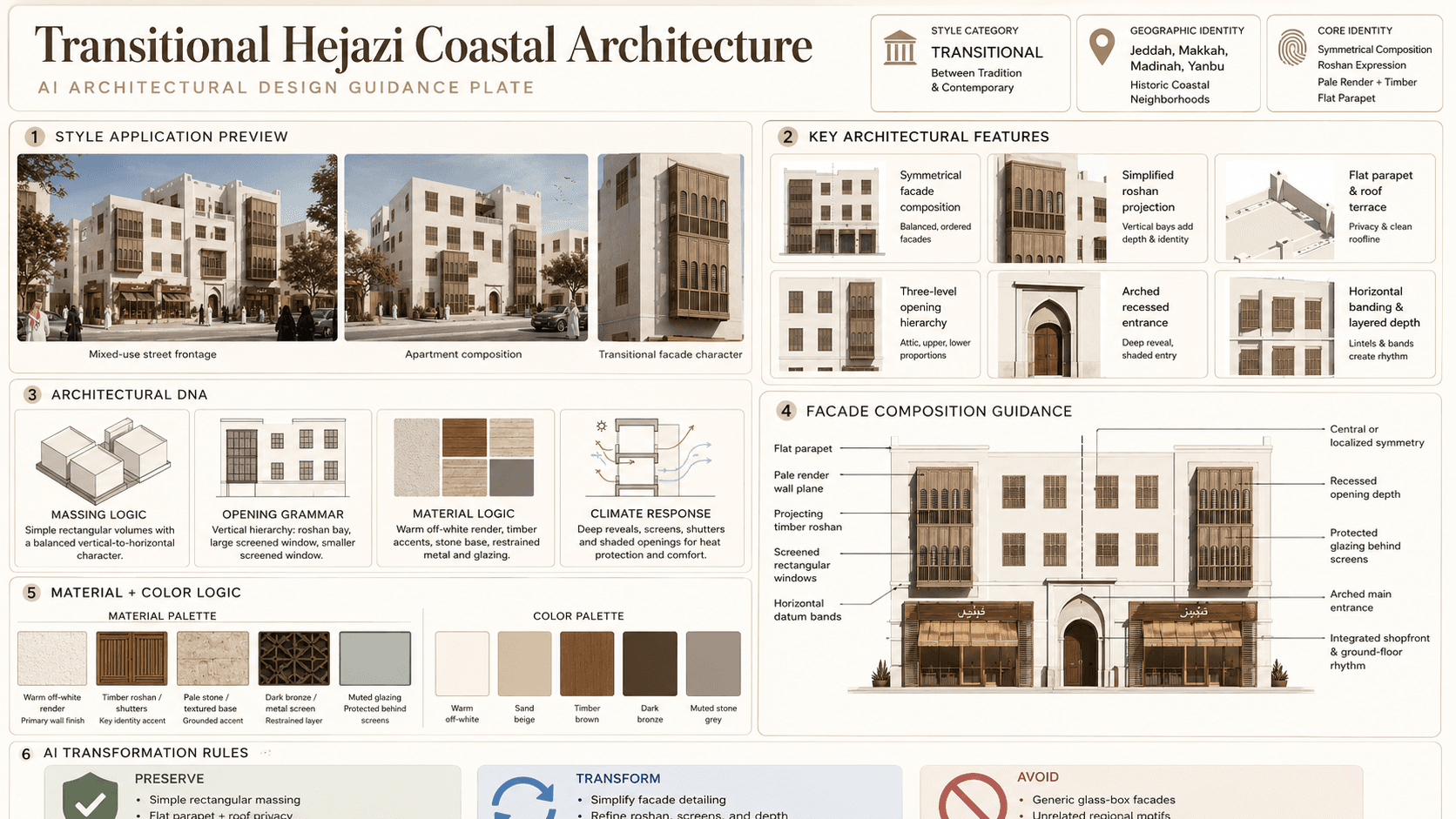
Hejazi Transitional Coastal
Saudi Arabia · Hejaz / Red Sea Coast
The mediating architectural typology bridging historic vernacular and modern expression, early–mid 20th century to present
Definition
Hejazi Transitional Coastal is a regional architectural identity from Saudi Arabia. The mediating architectural typology bridging historic vernacular and modern expression, early–mid 20th century to present.
- Country
- Saudi Arabia
- Region
- Hejaz / Red Sea Coast.
- Massing
- Transitional Hejazi coastal buildings retain the vertical rectangular massing of the traditional typology but moderate the extreme narrow-fronted proportion.
- Materials
- The transitional palette deliberately bridges traditional and modern: white render remains the dominant wall surface (now cement-based plaster or painted render rather than traditional juss.
- Palette
- Warm off-white rendered walls remain dominant, with dark bronze or warm-brown screens, doors, and bay elements carrying the Hejazi identity.
- Climate response
- Transitional buildings inherit the climate logic but adapt it to less dense urban settings.
Overview
Hejazi Transitional Coastal is a Saudi architectural identity rooted in Hejaz / Red Sea Coast. Hejazi Coastal Architecture — Transitional typology (one of three design modes in the Saudi Architecture Characters Map). Areas surrounding historic neighbourhoods in Jeddah, Makkah, Madinah, Yanbu — buffer zones and expansion districts adjacent to traditional cores.
Visual DNA
Massing & Form
Transitional Hejazi coastal buildings retain the vertical rectangular massing of the traditional typology but moderate the extreme narrow-fronted proportion. Building widths increase to accommodate modern plot sizes (typically 12–25 m ), while heights remain in the 3–5 storey range.
Facade Language
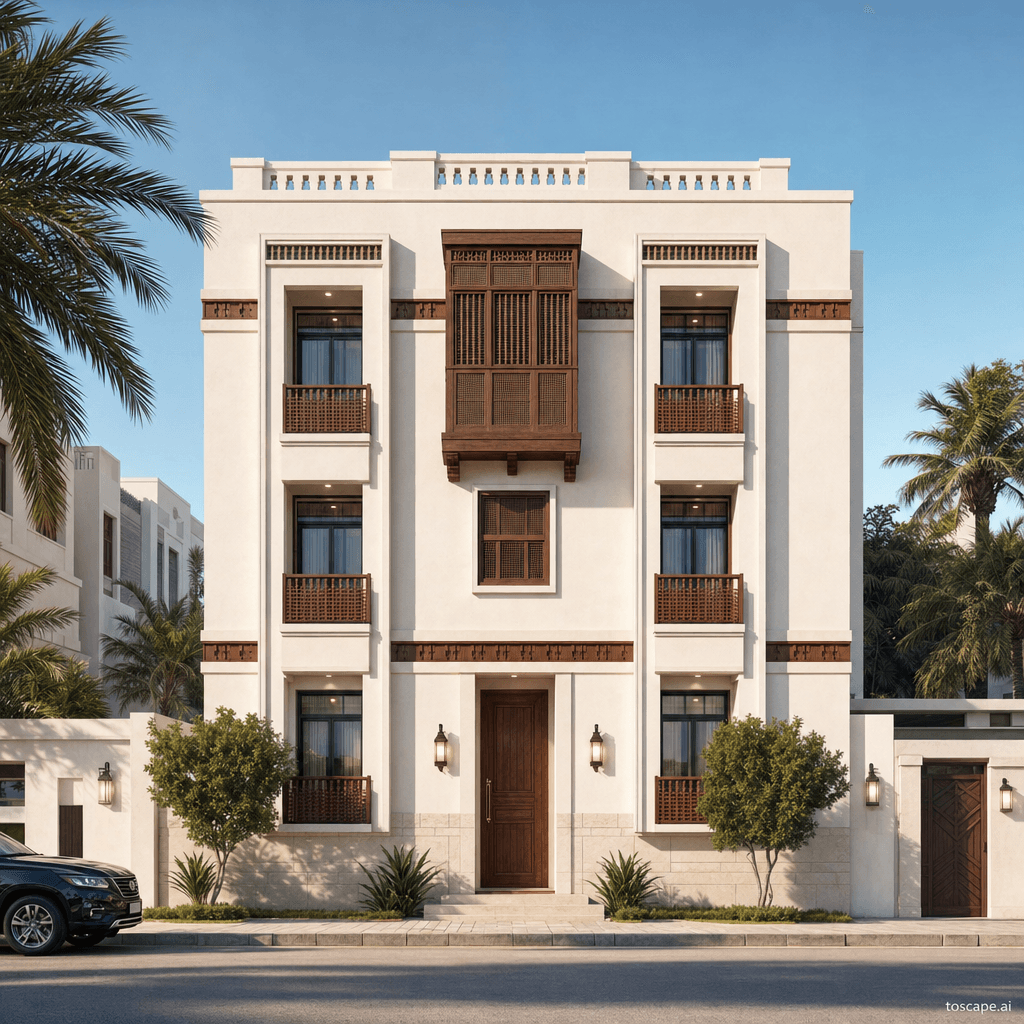
The transitional facade is characterised by strict symmetry — a defining difference from traditional facades which could be asymmetrical based on internal room arrangements . The composition centres on a strong vertical axis: central entrance, central window or roshan element above, and balanced bays on either side.
Materials & Texture
The transitional palette deliberately bridges traditional and modern: white render remains the dominant wall surface (now cement-based plaster or painted render rather than traditional juss, but visually equivalent). Timber is retained as an accent material — reduced in quantity compared to traditional but still presen...
Color Palette
Warm off-white rendered walls remain dominant, with dark bronze or warm-brown screens, doors, and bay elements carrying the Hejazi identity. Avoid cool grey, stark white, and black-heavy contrast so the facade still reads as coastal and sun-softened.
Ornament & Detail
Ornament in the transitional style is geometric abstraction — traditional Islamic star patterns and arabesque motifs are reinterpreted as larger-scale, simpler geometric compositions that read clearly at modern building scale. Perforated metal screens or CNC-cut panels replace hand-assembled timber lattice, but the und...
Climate Response
Transitional buildings inherit the climate logic but adapt it to less dense urban settings. Without the mutual shading of traditional narrow alleyways, transitional buildings must provide self-shading through: (a) retained roshan or screen projections that shade window openings; (b) deeper window reveals in the rendere...
Landscape & Ground
Areas surrounding historic neighbourhoods in Jeddah, Makkah, Madinah, Yanbu — buffer zones and expansion districts adjacent to traditional cores. Transitional buildings inherit the climate logic but adapt it to less dense urban settings.
Reference elevation
Hejazi Transitional Coastal — characteristic facade composition, Hejaz / Red Sea Coast.
Context Snapshot
Transitional Hejazi coastal buildings that blend traditional identity markers with modern construction methods, materials, and spatial organisation Hejazi Coastal Architecture — Transitional typology (one of three design modes in the Saudi Architecture Characters Map) Areas surrounding historic neighbourhoods in Jeddah, Makkah, Madinah, Yanbu — buffer zones and expansion districts adjacent to traditional cores
Contemporary Relevance
Hejazi Transitional Coastal is the bridge between conservation and current construction across Hejaz / Red Sea Coast, allowing contemporary programs to keep regional identity legible while using modern structure, services, and envelope systems. It is the most practical mode for streetscapes that need to feel rooted without becoming literal replicas.
Use this style in Toscape
Explore Hejazi Transitional Coastal directly inside Toscape using the Facade Re-Style and Design Options workflows.
Open Hejazi Transitional Coastal in the galleryFrequently asked questions
What is Hejazi Transitional Coastal?
Hejazi Transitional Coastal is a regional architectural identity from Saudi Arabia. The mediating architectural typology bridging historic vernacular and modern expression, early–mid 20th century to present.
What materials define Hejazi Transitional Coastal?
The transitional palette deliberately bridges traditional and modern: white render remains the dominant wall surface (now cement-based plaster or painted render rather than traditional juss, but visually equivalent). Timber is retained as an accent material — reduced in quantity compared to traditional but still presen.
What is the Hejazi Transitional Coastal color palette?
Warm off-white rendered walls remain dominant, with dark bronze or warm-brown screens, doors, and bay elements carrying the Hejazi identity. Avoid cool grey, stark white, and black-heavy contrast so the facade still reads as coastal and sun-softened.
Where does Hejazi Transitional Coastal come from?
Transitional Hejazi coastal buildings that blend traditional identity markers with modern construction methods, materials, and spatial organisation Hejazi Coastal Architecture — Transitional typology (one of three design modes in the Saudi Architecture Characters Map) Areas surrounding historic neighbourhoods in Jeddah, Makkah, Madinah, Yanbu — buffer zones and expansion districts adjacent to traditional cores.
When should architects use Hejazi Transitional Coastal?
Hejazi Transitional Coastal is the bridge between conservation and current construction across Hejaz / Red Sea Coast, allowing contemporary programs to keep regional identity legible while using modern structure, services, and envelope systems. It is the most practical mode for streetscapes that need to feel rooted without becoming literal replicas.
How do you render Hejazi Transitional Coastal in Toscape?
Open Toscape on Windows, load your own photo, elevation, sketch, or CAD view, then apply the Hejazi Transitional Coastal reference from the built-in style library. The Facade Re-Style and Design Options workflows keep your project geometry and camera while shifting materials, proportion, and detailing toward Hejazi Transitional Coastal.