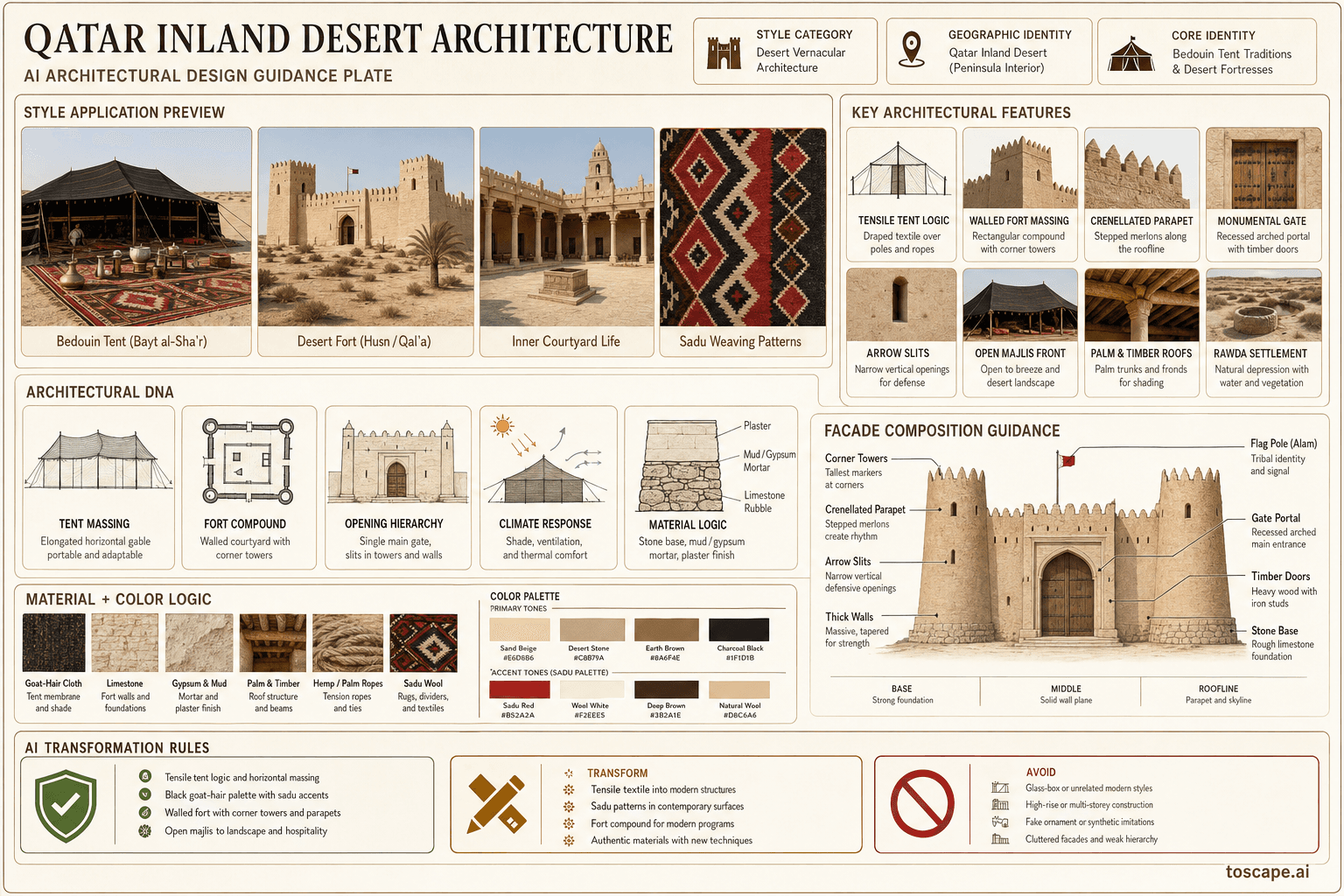
Qatar Inland Desert
Qatar · desert architecture of Qatar's interior
The desert vernacular of Qatar's interior — Bedouin tent traditions, rawashin outposts, desert fortresses, and the architecture of survival in the hyper-arid peninsula interior
Definition
Qatar Inland Desert is a regional architectural identity from Qatar. The desert vernacular of Qatar's interior — Bedouin tent traditions, rawashin outposts, desert fortresses, and the architecture of survival in the hyper-arid peninsula interior.
- Country
- Qatar
- Region
- desert architecture of Qatar's interior.
- Massing
- Qatar's desert architecture operates at two scales: the tent and the fort.
- Materials
- Black goat-hair cloth (sha'r) — the defining tent material, woven from local goat herds, dark brown-black with natural color variations Sheep wool — lighter accent stripes.
- Palette
- White, cream, pale sand, warm timber, and shadow-driven dark metal accents define the palette.
- Climate response
- The desert architecture is a pure climate-survival system: (1) The black goat-hair tent — creates deep shade while allowing hot air to escape through the porous.
Overview
Qatar Inland Desert is a regional architectural identity in Qatar. Traditional desert architecture of Qatar's interior — the Bedouin nomadic heritage, desert fortifications, and the sparse permanent settlements of the inland depressions (rawdat). This architectural tradition represents the pre-sedentary cultural foundation of Qatari identity, where the black goat-hair tent (bayt al-sha'r) and the desert fort (husn / qal'at) defined the built environment of the interior.
Visual DNA
Massing & Form
Qatar's desert architecture operates at two scales: the tent and the fort. The Bedouin tent is a long rectangular volume — typically 3–5 m wide × 6–15 m long (extendable by adding sections), 2–2.5 m height at the ridge.
Facade Language
Tent facade: The front face of the tent is open during the day — the majlis side is open to the prevailing breeze, closed at night and during sandstorms by lowering the side curtain. The back and sides are the black woven cloth walls — uniform dark texture with subtle stripe patterns from the weaving process (alternati...
Materials & Texture
Black goat-hair cloth (sha'r) — the defining tent material, woven from local goat herds, dark brown-black with natural color variations Sheep wool — lighter accent stripes in tent cloth, and for interior rugs and cushions Wooden tent poles (amdan) — acacia or imported timber, simple cylindrical poles Hemp and palm-fibe...
Color Palette
White, cream, pale sand, warm timber, and shadow-driven dark metal accents define the palette. The facade should stay bright and climate-aware rather than heavy, gray, or over-saturated.
Ornament & Detail
Ornament in Qatari desert architecture is concentrated in textile arts rather than building construction: (1) Sadu weaving — the primary decorative tradition. Bedouin women weave wool rugs, tent dividers (gata), camel trappings, and saddle bags with geometric patterns — triangles, diamonds, chevrons, and stylized anima...
Climate Response
The desert architecture is a pure climate-survival system: (1) The black goat-hair tent — creates deep shade while allowing hot air to escape through the porous weave. The color absorbs solar radiation above the occupants' heads while the open front captures cooling breezes.
Landscape & Ground
Traditional desert architecture of Qatar's interior — the Bedouin nomadic heritage, desert fortifications, and the sparse permanent settlements of the inland depressions (rawdat). This architectural tradition represents the pre-sedentary cultural foundation of Qatari identity, where the black goat-hair tent (bayt al-sh...
Reference elevation
Qatar Inland Desert — characteristic facade composition, desert architecture of Qatar's interior.
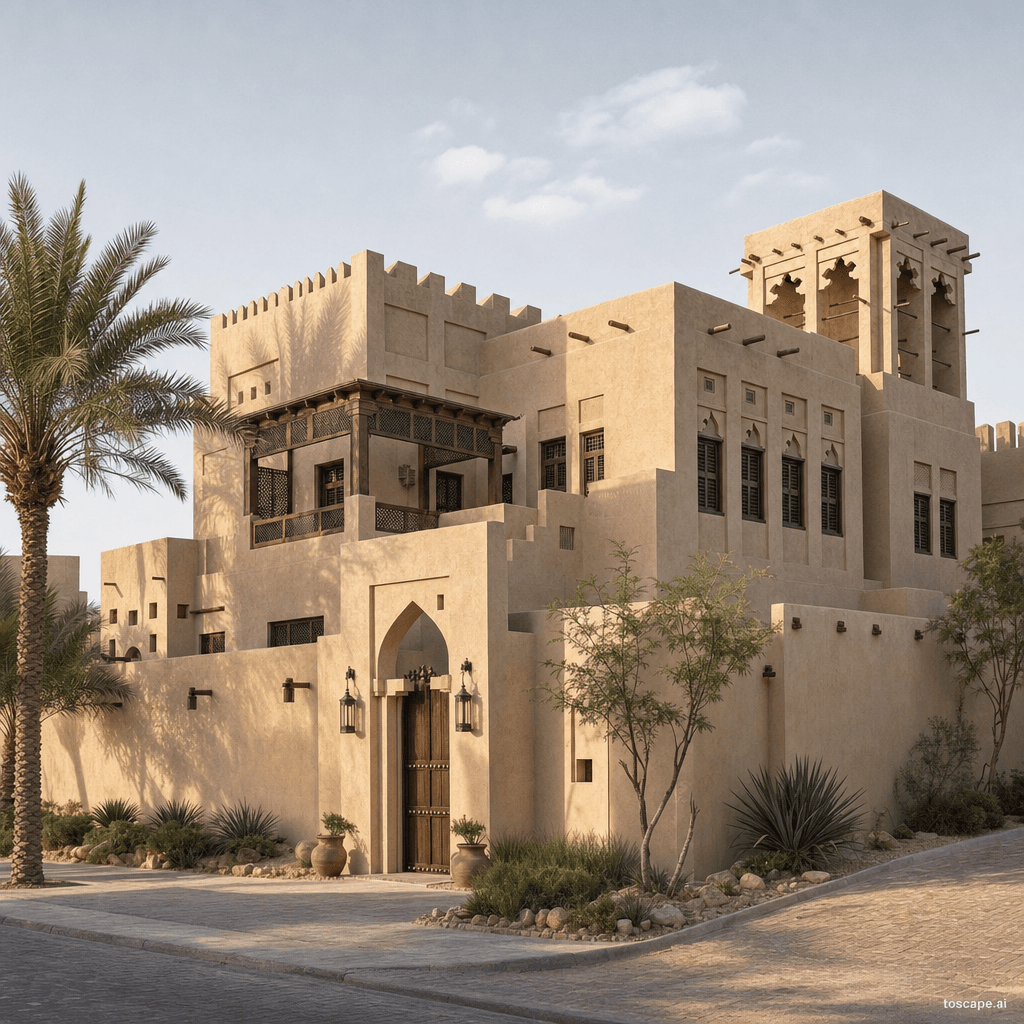
Context Snapshot
Traditional desert architecture of Qatar's interior — the Bedouin nomadic heritage, desert fortifications, and the sparse permanent settlements of the inland depressions (rawdat). The desert architecture is a pure climate-survival system: (1) The black goat-hair tent — creates deep shade while allowing hot air to escape through the porous weave.
Contemporary Relevance
Qatar Inland Desert is useful today for residential, hospitality, civic, and place-branding work that needs Qatar-specific character grounded in local massing, material tone, climate response, and settlement logic rather than generic international styling.
Use this style in Toscape
Explore Qatar Inland Desert directly inside Toscape using the Facade Re-Style and Design Options workflows.
Open Qatar Inland Desert in the galleryFrequently asked questions
What is Qatar Inland Desert?
Qatar Inland Desert is a regional architectural identity from Qatar. The desert vernacular of Qatar's interior — Bedouin tent traditions, rawashin outposts, desert fortresses, and the architecture of survival in the hyper-arid peninsula interior.
What materials define Qatar Inland Desert?
Black goat-hair cloth (sha'r) — the defining tent material, woven from local goat herds, dark brown-black with natural color variations Sheep wool — lighter accent stripes in tent cloth, and for interior rugs and cushions Wooden tent poles (amdan) — acacia or imported timber, simple cylindrical poles Hemp and palm-fibe.
What is the Qatar Inland Desert color palette?
White, cream, pale sand, warm timber, and shadow-driven dark metal accents define the palette. The facade should stay bright and climate-aware rather than heavy, gray, or over-saturated.
Where does Qatar Inland Desert come from?
Traditional desert architecture of Qatar's interior — the Bedouin nomadic heritage, desert fortifications, and the sparse permanent settlements of the inland depressions (rawdat). The desert architecture is a pure climate-survival system: (1) The black goat-hair tent — creates deep shade while allowing hot air to escape through the porous weave.
When should architects use Qatar Inland Desert?
Qatar Inland Desert is useful today for residential, hospitality, civic, and place-branding work that needs Qatar-specific character grounded in local massing, material tone, climate response, and settlement logic rather than generic international styling.
How do you render Qatar Inland Desert in Toscape?
Open Toscape on Windows, load your own photo, elevation, sketch, or CAD view, then apply the Qatar Inland Desert reference from the built-in style library. The Facade Re-Style and Design Options workflows keep your project geometry and camera while shifting materials, proportion, and detailing toward Qatar Inland Desert.