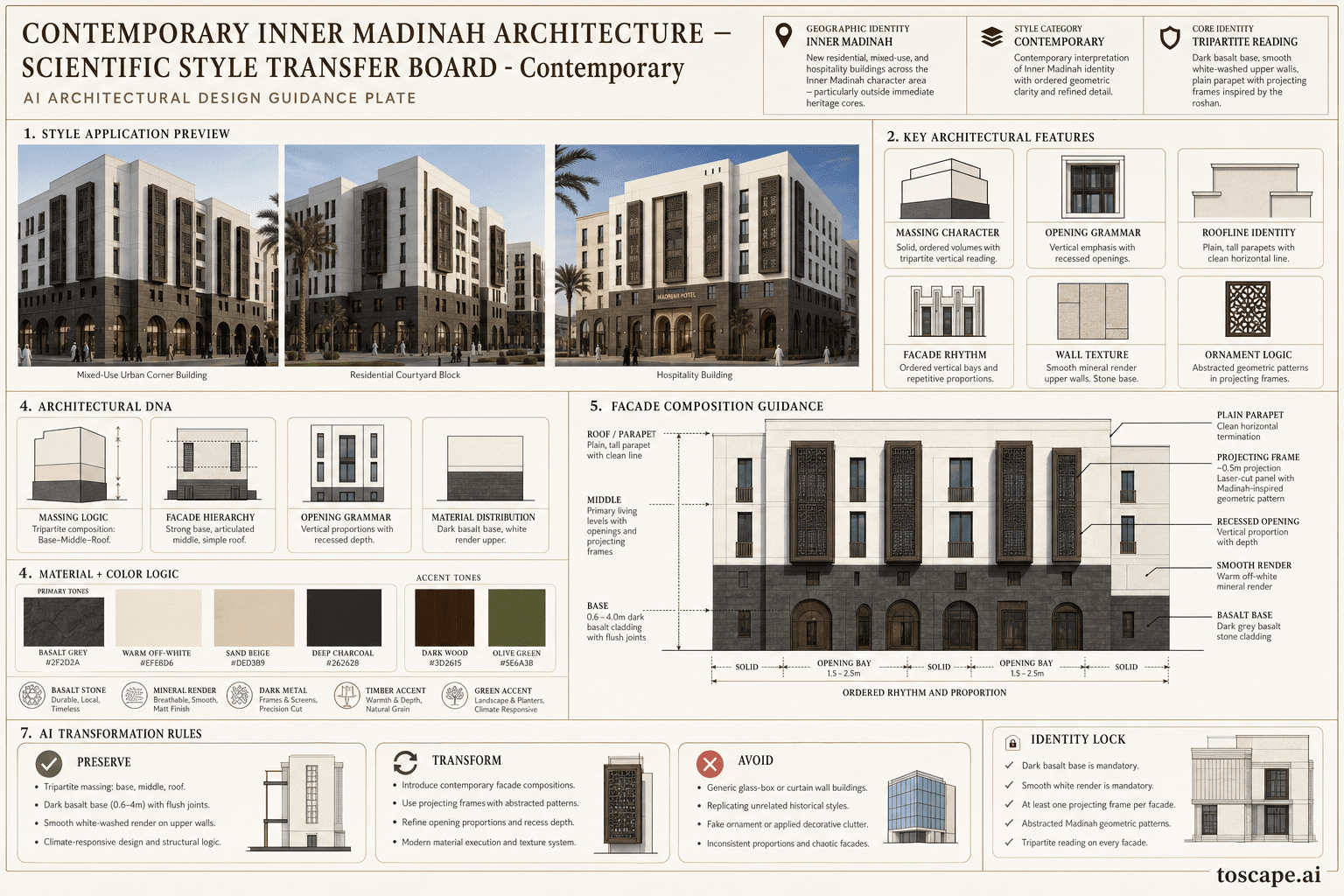
Inner Madinah Contemporary
Saudi Arabia · Inner Madinah
Modern reinterpretation of historic Madinah vernacular — basalt base and white render preserved, roshan abstracted into projecting frames, perforated metal screens replacing mashra...
Definition
Inner Madinah Contemporary is a regional architectural identity from Saudi Arabia. Modern reinterpretation of historic Madinah vernacular — basalt base and white render preserved, roshan abstracted into projecting frames, perforated metal screens replacing mashra.
- Country
- Saudi Arabia
- Region
- Inner Madinah
- Massing
- Contemporary Inner Madinah buildings preserve the overall form and proportions of the vernacular: 2–4 storey conjoined or aligned volumes, broadly square to slightly upright frontages.
- Materials
- Contemporary materials share the language of the traditional palette: smooth white-washed mineral render for upper walls (or high-quality equivalent).
- Palette
- Keep the palette regionally grounded: a dominant mineral wall tone, a lighter plaster or render accent, and a warm timber or bronze detail layer.
- Climate response
- Same Madinah climate logic — dark thermal-mass base, reflective white upper walls, projecting frames shading openings.
Overview
Inner Madinah Contemporary is a Saudi architectural identity rooted in Inner Madinah. Inner Madinah Architecture — the complete Traditional → Transitional → Contemporary progression. New residential, mixed-use, and hospitality buildings across the Inner Madinah character area — particularly outside immediate heritage cores.
Visual DNA
Massing & Form
Contemporary Inner Madinah buildings preserve the overall form and proportions of the vernacular: 2–4 storey conjoined or aligned volumes, broadly square to slightly upright frontages, staggered roofscape with at least one pop-up room . Massing is crisper — deliberate vertical breaks (small setbacks, parapet steps, con...
Facade Language
Bays are strongly aligned and ordered — the grid survives from Traditional through Contemporary . Window-to-wall opening proportion is capped around 50% of the front facade.
Materials & Texture
Contemporary materials share the language of the traditional palette: smooth white-washed mineral render for upper walls (or high-quality equivalent); real basalt or closely matching stone CLADDING for the base; dark powder-coated metal and/or dark timber for shutters, doors, screens, and roshan-abstract frames; clear...
Color Palette
Keep the palette regionally grounded: a dominant mineral wall tone, a lighter plaster or render accent, and a warm timber or bronze detail layer. The building should read as place-specific before any decorative element is noticed.
Ornament & Detail
Ornament is STRONGLY REDUCED. Mashrabiya patterns become ABSTRACTED GEOMETRIC PERFORATIONS in dark metal or laser-cut timber panels — the eight-point star and interlocking polygon become squares-within-squares, offset dots, and clean geometric grids.
Climate Response
Same Madinah climate logic — dark thermal-mass base, reflective white upper walls, projecting frames shading openings, occupiable parapeted roof terraces — but layered with contemporary insulation, glazing performance, and shaded balconies . Boundary walls of villas are encouraged to use abstracted patterns inspired by...
Landscape & Ground
New residential, mixed-use, and hospitality buildings across the Inner Madinah character area — particularly outside immediate heritage cores. Same Madinah climate logic — dark thermal-mass base, reflective white upper walls, projecting frames shading openings, occupiable parapeted roof terraces — but layered with cont...
Reference elevation
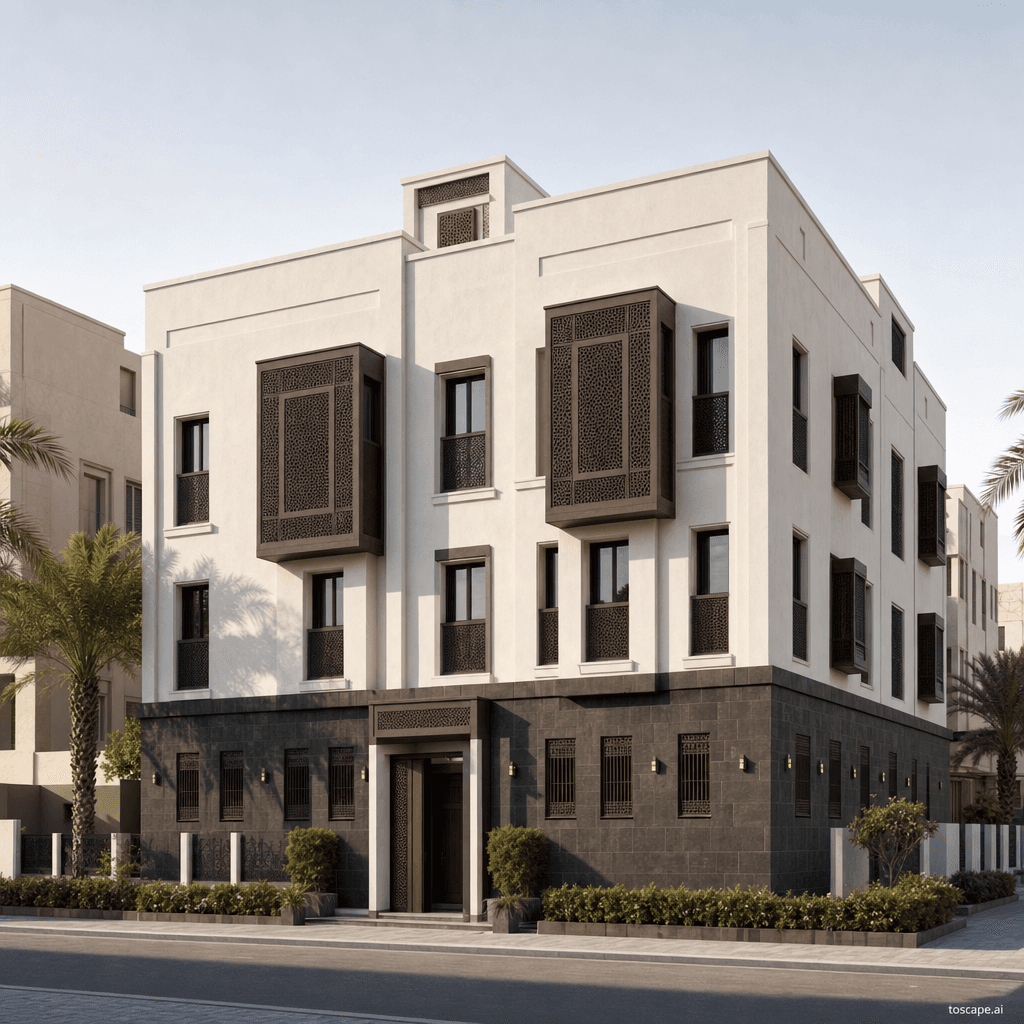
Inner Madinah Contemporary — characteristic facade composition, Inner Madinah.
Context Snapshot
Confident contemporary reinterpretation of Inner Madinah identity — preserving the essential massing, tripartite reading, basalt-render contrast, and arched entrance while abstracting the roshan into... Inner Madinah Architecture — the complete Traditional → Transitional → Contemporary progression New residential, mixed-use, and hospitality buildings across the Inner Madinah character area — particularly outside immediate heritage cores
Contemporary Relevance
Inner Madinah Contemporary aligns naturally with current Saudi practice, where regional identity is carried by proportion, shading depth, material tone, and controlled abstraction rather than direct historic imitation. It suits present-day residential, hospitality, and mixed-use work that needs strong local character inside a modern planning and construction framework.
Use this style in Toscape
Explore Inner Madinah Contemporary directly inside Toscape using the Facade Re-Style and Design Options workflows.
Open Inner Madinah Contemporary in the galleryFrequently asked questions
What is Inner Madinah Contemporary?
Inner Madinah Contemporary is a regional architectural identity from Saudi Arabia. Modern reinterpretation of historic Madinah vernacular — basalt base and white render preserved, roshan abstracted into projecting frames, perforated metal screens replacing mashra.
What materials define Inner Madinah Contemporary?
Contemporary materials share the language of the traditional palette: smooth white-washed mineral render for upper walls (or high-quality equivalent); real basalt or closely matching stone CLADDING for the base; dark powder-coated metal and/or dark timber for shutters, doors, screens, and roshan-abstract frames; clear.
What is the Inner Madinah Contemporary color palette?
Keep the palette regionally grounded: a dominant mineral wall tone, a lighter plaster or render accent, and a warm timber or bronze detail layer. The building should read as place-specific before any decorative element is noticed.
Where does Inner Madinah Contemporary come from?
Confident contemporary reinterpretation of Inner Madinah identity — preserving the essential massing, tripartite reading, basalt-render contrast, and arched entrance while abstracting the roshan into... Inner Madinah Architecture — the complete Traditional → Transitional → Contemporary progression New residential, mixed-use, and hospitality buildings across the Inner Madinah character area — particularly outside immediate heritage cores.
When should architects use Inner Madinah Contemporary?
Inner Madinah Contemporary aligns naturally with current Saudi practice, where regional identity is carried by proportion, shading depth, material tone, and controlled abstraction rather than direct historic imitation. It suits present-day residential, hospitality, and mixed-use work that needs strong local character inside a modern planning and construction framework.
How do you render Inner Madinah Contemporary in Toscape?
Open Toscape on Windows, load your own photo, elevation, sketch, or CAD view, then apply the Inner Madinah Contemporary reference from the built-in style library. The Facade Re-Style and Design Options workflows keep your project geometry and camera while shifting materials, proportion, and detailing toward Inner Madinah Contemporary.