Inner Madinah Transitional
Saudi Arabia · Inner Madinah
The hybrid bridge between Old Madinah vernacular and contemporary construction — basalt-and-render duality retained, roshans simplified and spaced with deliberate horizontal gaps...
Definition
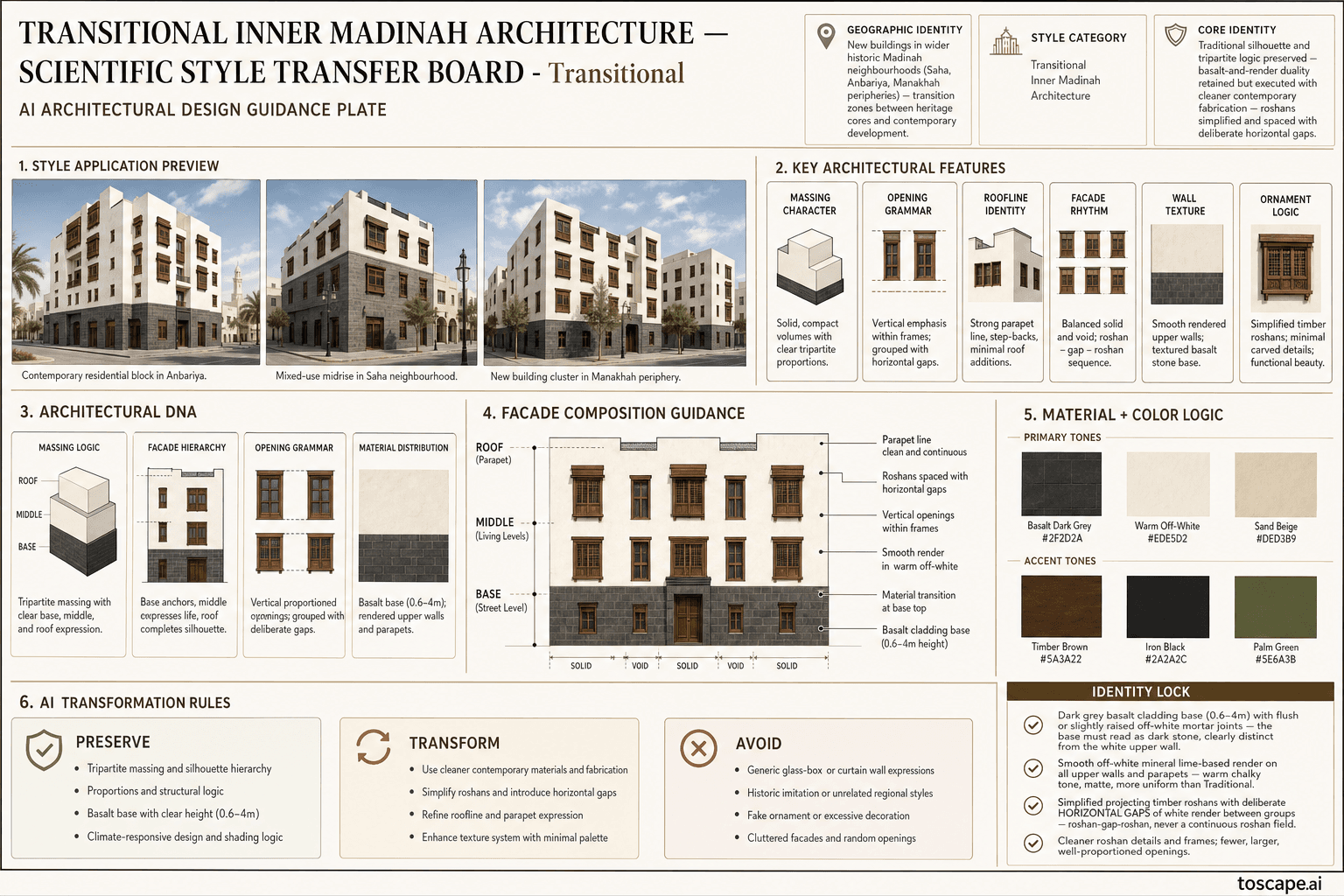
Inner Madinah Transitional is a regional architectural identity from Saudi Arabia. The hybrid bridge between Old Madinah vernacular and contemporary construction — basalt-and-render duality retained, roshans simplified and spaced with deliberate horizontal gaps.
- Country
- Saudi Arabia
- Region
- Inner Madinah
- Massing
- Transitional Inner Madinah maintains the broadly square to slightly upright proportions (width-to-height ~1:1. 2 to 1:1. 5) and the conjoined/aligned street wall urban typology .
- Materials
- Traditional and modern materials are mixed honestly: real basalt or high-quality reconstituted stone closely matching it for the base.
- Palette
- Keep the palette regionally grounded: a dominant mineral wall tone, a lighter plaster or render accent, and a warm timber or bronze detail layer.
- Climate response
- Same climatic logic as Traditional: dark base absorbs and stores heat, white reflective render above rejects solar radiation, projecting roshans shade openings.
Overview
Inner Madinah Transitional is a Saudi architectural identity rooted in Inner Madinah. Inner Madinah Architecture — the Traditional → Transitional → Contemporary progression of the historic walled-city vernacular. New buildings in wider historic Madinah neighbourhoods (Saha, Anbariya, Manakhah peripheries) — transition zones between heritage cores and contemporary districts.
Visual DNA
Massing & Form
Transitional Inner Madinah maintains the broadly square to slightly upright proportions (width-to-height ~1:1.2 to 1:1.5) and the conjoined/aligned street wall urban typology . 2–4 storey volumes are still preferred, with a mandatory step-up pop-up roof room of at least 1.2m height difference above the main parapet.
Facade Language
Bays remain clearly legible and uniformly spaced — the grid is maintained. Void ratio relaxes slightly upward to ~45% of front facade .
Materials & Texture
Traditional and modern materials are mixed honestly: real basalt or high-quality reconstituted stone closely matching it for the base; mineral lime-based render or smooth white-washed render for upper walls; dark timber for primary roshan bodies and entrance doors; dark powder-coated metal for window sub-frames, slim b...
Color Palette
Keep the palette regionally grounded: a dominant mineral wall tone, a lighter plaster or render accent, and a warm timber or bronze detail layer. The building should read as place-specific before any decorative element is noticed.
Ornament & Detail
Ornament is SIMPLIFIED but recognisable. Mashrabiya patterns are retained on roshans and doors but executed with cleaner machine joinery — the geometric complexity survives but the hand-carved irregularity is gone .
Climate Response
Same climatic logic as Traditional: dark base absorbs and stores heat, white reflective render above rejects solar radiation, projecting roshans shade openings, occupiable roof terraces for evening use. Boundary walls of villas are now part of the architectural composition and must match the basalt-and-render vocabular...
Landscape & Ground
New buildings in wider historic Madinah neighbourhoods (Saha, Anbariya, Manakhah peripheries) — transition zones between heritage cores and contemporary districts. Same climatic logic as Traditional: dark base absorbs and stores heat, white reflective render above rejects solar radiation, projecting roshans shade openi...
Reference elevation
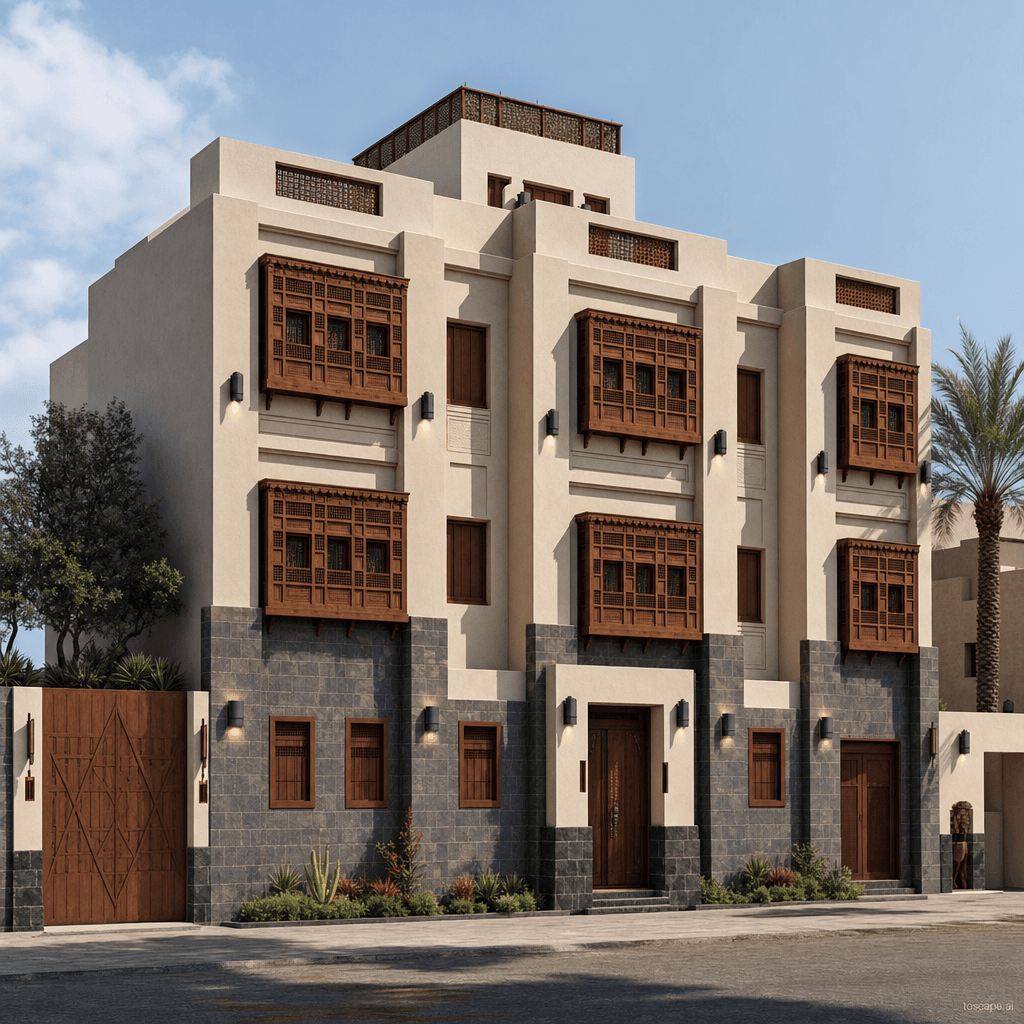
Inner Madinah Transitional — characteristic facade composition, Inner Madinah.
Context Snapshot
Faithful adaptation of Traditional Inner Madinah identity for transitional contemporary contexts — preserving the tripartite logic, basalt-render contrast, projecting roshan presence, arched entrance... Inner Madinah Architecture — the Traditional → Transitional → Contemporary progression of the historic walled-city vernacular New buildings in wider historic Madinah neighbourhoods (Saha, Anbariya, Manakhah peripheries) — transition zones between heritage cores and contemporary districts
Contemporary Relevance
Inner Madinah Transitional is the bridge between conservation and current construction across Inner Madinah, allowing contemporary programs to keep regional identity legible while using modern structure, services, and envelope systems. It is the most practical mode for streetscapes that need to feel rooted without becoming literal replicas.
Use this style in Toscape
Explore Inner Madinah Transitional directly inside Toscape using the Facade Re-Style and Design Options workflows.
Open Inner Madinah Transitional in the galleryFrequently asked questions
What is Inner Madinah Transitional?
Inner Madinah Transitional is a regional architectural identity from Saudi Arabia. The hybrid bridge between Old Madinah vernacular and contemporary construction — basalt-and-render duality retained, roshans simplified and spaced with deliberate horizontal gaps.
What materials define Inner Madinah Transitional?
Traditional and modern materials are mixed honestly: real basalt or high-quality reconstituted stone closely matching it for the base; mineral lime-based render or smooth white-washed render for upper walls; dark timber for primary roshan bodies and entrance doors; dark powder-coated metal for window sub-frames, slim b.
What is the Inner Madinah Transitional color palette?
Keep the palette regionally grounded: a dominant mineral wall tone, a lighter plaster or render accent, and a warm timber or bronze detail layer. The building should read as place-specific before any decorative element is noticed.
Where does Inner Madinah Transitional come from?
Faithful adaptation of Traditional Inner Madinah identity for transitional contemporary contexts — preserving the tripartite logic, basalt-render contrast, projecting roshan presence, arched entrance... Inner Madinah Architecture — the Traditional → Transitional → Contemporary progression of the historic walled-city vernacular New buildings in wider historic Madinah neighbourhoods (Saha, Anbariya, Manakhah peripheries) — transition zones between heritage cores and contemporary districts.
When should architects use Inner Madinah Transitional?
Inner Madinah Transitional is the bridge between conservation and current construction across Inner Madinah, allowing contemporary programs to keep regional identity legible while using modern structure, services, and envelope systems. It is the most practical mode for streetscapes that need to feel rooted without becoming literal replicas.
How do you render Inner Madinah Transitional in Toscape?
Open Toscape on Windows, load your own photo, elevation, sketch, or CAD view, then apply the Inner Madinah Transitional reference from the built-in style library. The Facade Re-Style and Design Options workflows keep your project geometry and camera while shifting materials, proportion, and detailing toward Inner Madinah Transitional.