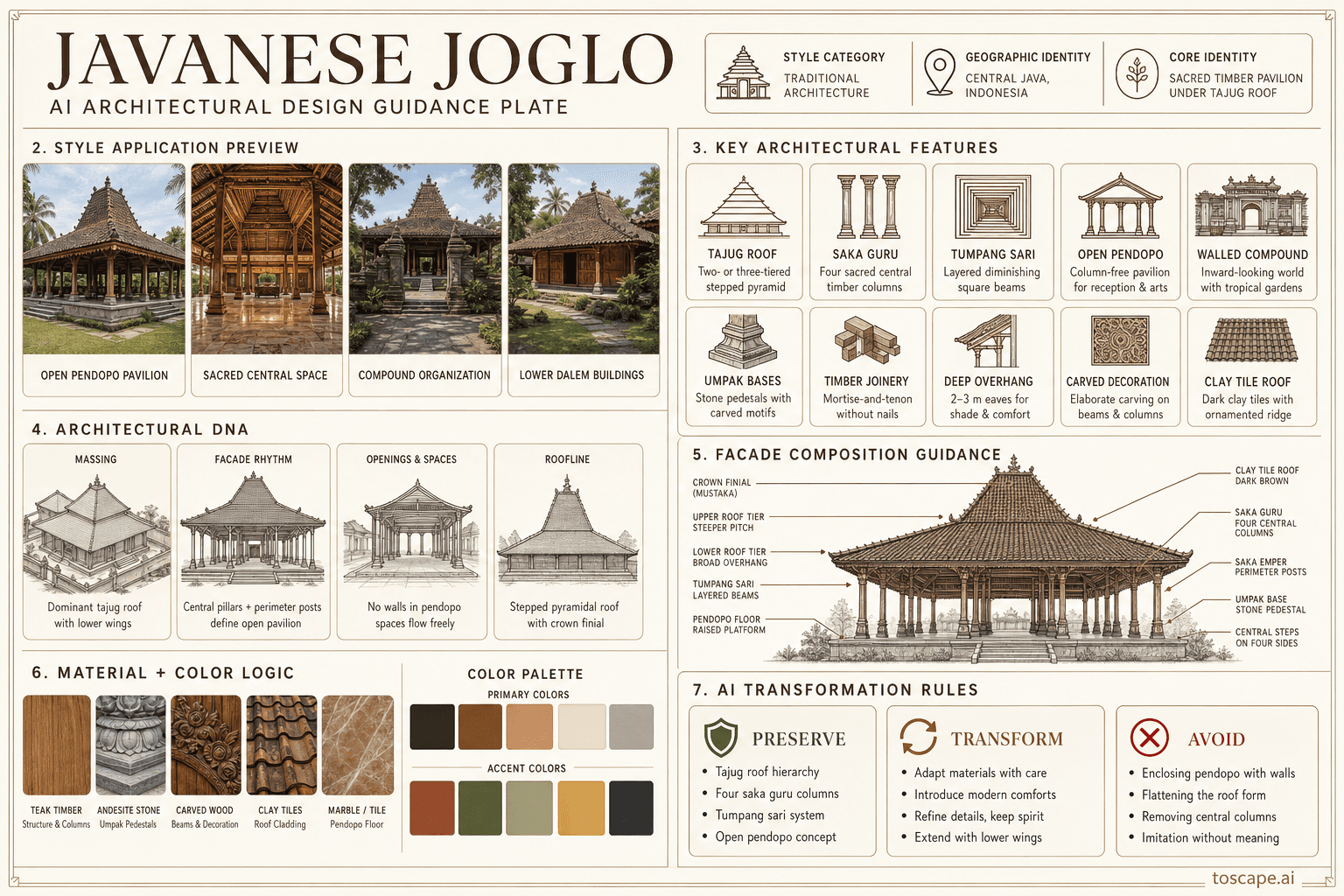
Javanese Joglo
Indonesia · Joglo house of the Javanese aristocracy
The aristocratic house of Central Java — a soaring pyramidal timber roof (tajug) supported by four sacred central columns (saka guru), the Joglo is the architectural embodiment of...
Definition
Javanese Joglo is a regional architectural identity from Indonesia. The aristocratic house of Central Java — a soaring pyramidal timber roof (tajug) supported by four sacred central columns (saka guru).
- Country
- Indonesia
- Region
- Joglo house of the Javanese aristocracy.
- Massing
- The Joglo is a compound, not a single building. The pendopo is a square (8–16 m per side), open-sided pavilion under the tajug roof.
- Materials
- Materials are local, durable, and hierarchically deployed: (1) Jati (teak, Tectona grandis) — the premier Javanese timber, golden-brown, extremely durable.
- Palette
- White, cream, pale sand, warm timber, and shadow-driven dark metal accents define the palette.
- Climate response
- Central Java has a tropical monsoon climate: (1) Heavy rainfall (2,000–3,000 mm/year) — the steep Joglo roof sheds water efficiently.
Overview
Javanese Joglo is a regional architectural identity in Indonesia. The Joglo house of the Javanese aristocracy — the highest-status traditional dwelling type of Central Java, Indonesia — defined by the tajug (stepped pyramidal roof) supported on four massive central timber columns (saka guru, meaning "teacher pillars") that create a column-free central space (the krobongan or senthong) — the house is organized as a series of pavilions within a walled compound: the pendopo (open fron...
Visual DNA
Massing & Form
The Joglo is a compound, not a single building. The pendopo is a square (8–16 m per side), open-sided pavilion under the tajug roof.
Facade Language
The pendopo has no walls — the facade is the rhythm of columns and the layered ceiling visible through the shadow: (1) The saka guru (four central columns) form a square inner core — they are the most massive and most decorated. (2) The saka emper (12–20 peripheral columns) define the outer square — slender posts with...
Materials & Texture
Materials are local, durable, and hierarchically deployed: (1) Jati (teak, Tectona grandis) — the premier Javanese timber, golden-brown, extremely durable, termite-resistant — used for the saka guru, tumpang sari beams, and carved panels — the most prestigious material in Javanese architecture. (2) Genteng (clay roof t...
Color Palette
White, cream, pale sand, warm timber, and shadow-driven dark metal accents define the palette. The facade should stay bright and climate-aware rather than heavy, gray, or over-saturated.
Ornament & Detail
Javanese ornament is rich, symbolic, and hierarchically deployed: (1) The tumpang sari beams are carved with lung-lungan (floral vine scrolls), geometric patterns, and occasionally kala-makara motifs (mythical beast heads, Hindu-Buddhist legacy). (2) Column capitals (umpak) are carved with lotus (padma) motifs — the Bu...
Climate Response
Central Java has a tropical monsoon climate: (1) Heavy rainfall (2,000–3,000 mm/year) — the steep Joglo roof sheds water efficiently; the deep overhangs protect the open pendopo floor. (2) High humidity and temperatures (25–35°C) — the open pendopo provides maximum cross-ventilation; the high roof creates a thermal chi...
Landscape & Ground
The Joglo house of the Javanese aristocracy — the highest-status traditional dwelling type of Central Java, Indonesia — defined by the tajug (stepped pyramidal roof) supported on four massive central timber columns (saka guru, meaning "teacher pillars") that create a column-free central space (the krobongan or senthong...
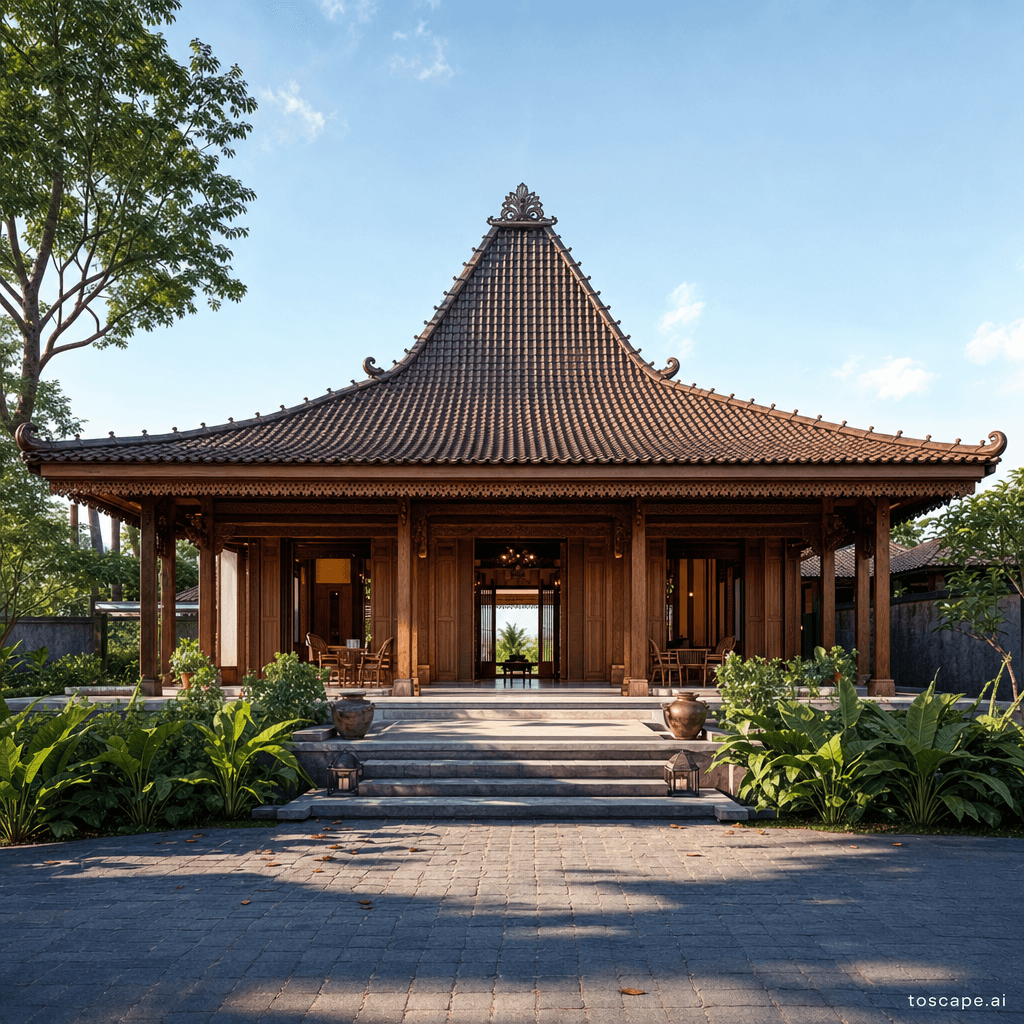
Reference elevation
Javanese Joglo — characteristic facade composition, Joglo house of the Javanese aristocracy.
Context Snapshot
The Joglo house of the Javanese aristocracy — the highest-status traditional dwelling type of Central Java, Indonesia — defined by the tajug (stepped pyramidal roof) supported on four massive central... Central Java has a tropical monsoon climate: (1) Heavy rainfall (2,000–3,000 mm/year) — the steep Joglo roof sheds water efficiently; the deep overhangs protect the open pendopo floor.
Contemporary Relevance
Javanese Joglo is useful today for residential, hospitality, civic, and place-branding work that needs Indonesia-specific character grounded in local massing, material tone, climate response, and settlement logic rather than generic international styling.
Use this style in Toscape
Explore Javanese Joglo directly inside Toscape using the Facade Re-Style and Design Options workflows.
Open Javanese Joglo in the galleryFrequently asked questions
What is Javanese Joglo?
Javanese Joglo is a regional architectural identity from Indonesia. The aristocratic house of Central Java — a soaring pyramidal timber roof (tajug) supported by four sacred central columns (saka guru).
What materials define Javanese Joglo?
Materials are local, durable, and hierarchically deployed: (1) Jati (teak, Tectona grandis) — the premier Javanese timber, golden-brown, extremely durable, termite-resistant — used for the saka guru, tumpang sari beams, and carved panels — the most prestigious material in Javanese architecture. (2) Genteng (clay roof t.
What is the Javanese Joglo color palette?
White, cream, pale sand, warm timber, and shadow-driven dark metal accents define the palette. The facade should stay bright and climate-aware rather than heavy, gray, or over-saturated.
Where does Javanese Joglo come from?
The Joglo house of the Javanese aristocracy — the highest-status traditional dwelling type of Central Java, Indonesia — defined by the tajug (stepped pyramidal roof) supported on four massive central... Central Java has a tropical monsoon climate: (1) Heavy rainfall (2,000–3,000 mm/year) — the steep Joglo roof sheds water efficiently; the deep overhangs protect the open pendopo floor.
When should architects use Javanese Joglo?
Javanese Joglo is useful today for residential, hospitality, civic, and place-branding work that needs Indonesia-specific character grounded in local massing, material tone, climate response, and settlement logic rather than generic international styling.
How do you render Javanese Joglo in Toscape?
Open Toscape on Windows, load your own photo, elevation, sketch, or CAD view, then apply the Javanese Joglo reference from the built-in style library. The Facade Re-Style and Design Options workflows keep your project geometry and camera while shifting materials, proportion, and detailing toward Javanese Joglo.