Jerusalem Highlands Palestinian
Palestine · traditional architecture of the Palestinian Central Highlands
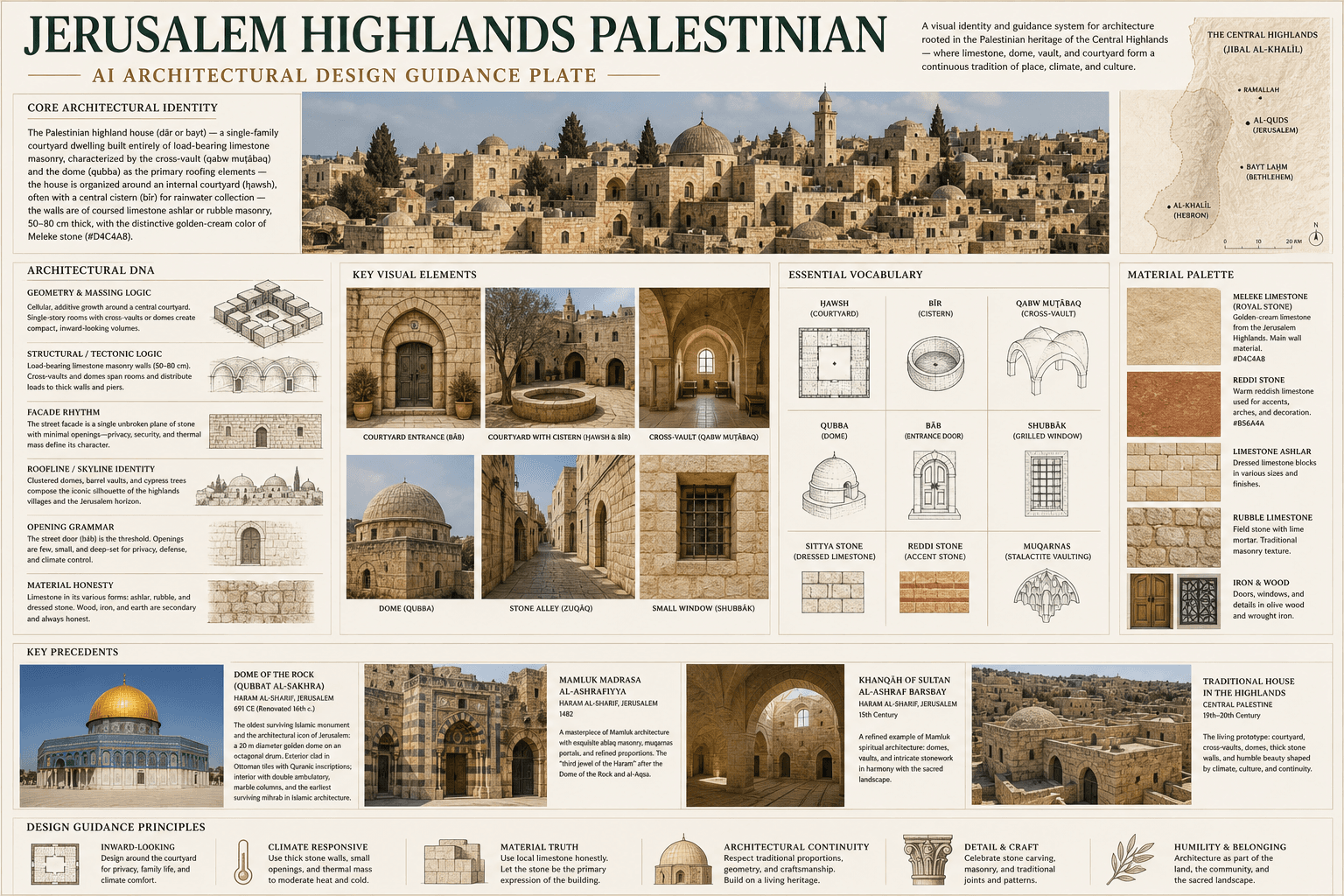
The limestone architecture of the Palestinian Central Highlands — the golden Jerusalem stone (ḥajar al-Quds) that defines the city's sacred and vernacular fabric, from the clustere...
Definition
Jerusalem Highlands Palestinian is a regional architectural identity from Palestine. The limestone architecture of the Palestinian Central Highlands — the golden Jerusalem stone (ḥajar al-Quds) that defines the city's sacred and vernacular fabric, from the clustere.
- Country
- Palestine
- Region
- traditional architecture of the Palestinian Central Highlands.
- Massing
- The Palestinian highland house is a cellular, additive composition built over generations: (1) The basic unit is a single domed or cross-vaulted room (3–5 m square).
- Materials
- Materials are essentially one: limestone in its various forms: (1) Meleke limestone ("royal stone") — the classic Jerusalem building stone: a creamy-white to golden-cream Cretaceous limestone.
- Palette
- White, cream, pale sand, warm timber, and shadow-driven dark metal accents define the palette.
- Climate response
- The Central Highlands have a Mediterranean mountain climate (Csa/Csb): (1) Elevation: 700–1,000 m above sea level — Jerusalem sits at ~754 m — the climate is.
Overview
Jerusalem Highlands Palestinian is a regional architectural identity in Palestine. The traditional architecture of the Palestinian Central Highlands — encompassing Jerusalem (al-Quds), Ramallah, Bethlehem (Bayt Laḥm), Hebron (al-Khalīl), and the villages of the Judean Hills (Jibal al-Khalīl) — a region unified by its geology: the creamy-golden Meleke limestone and the harder reddish Mizzi limestone that underlie the entire highland landscape, providing the universal building material for over 3,000...
Visual DNA
Massing & Form
The Palestinian highland house is a cellular, additive composition built over generations: (1) The basic unit is a single domed or cross-vaulted room (3–5 m square), constructed as a self-contained structural bay — the house grows by adding adjacent bays, each with its own dome or vault — the result is an organic clust...
Facade Language
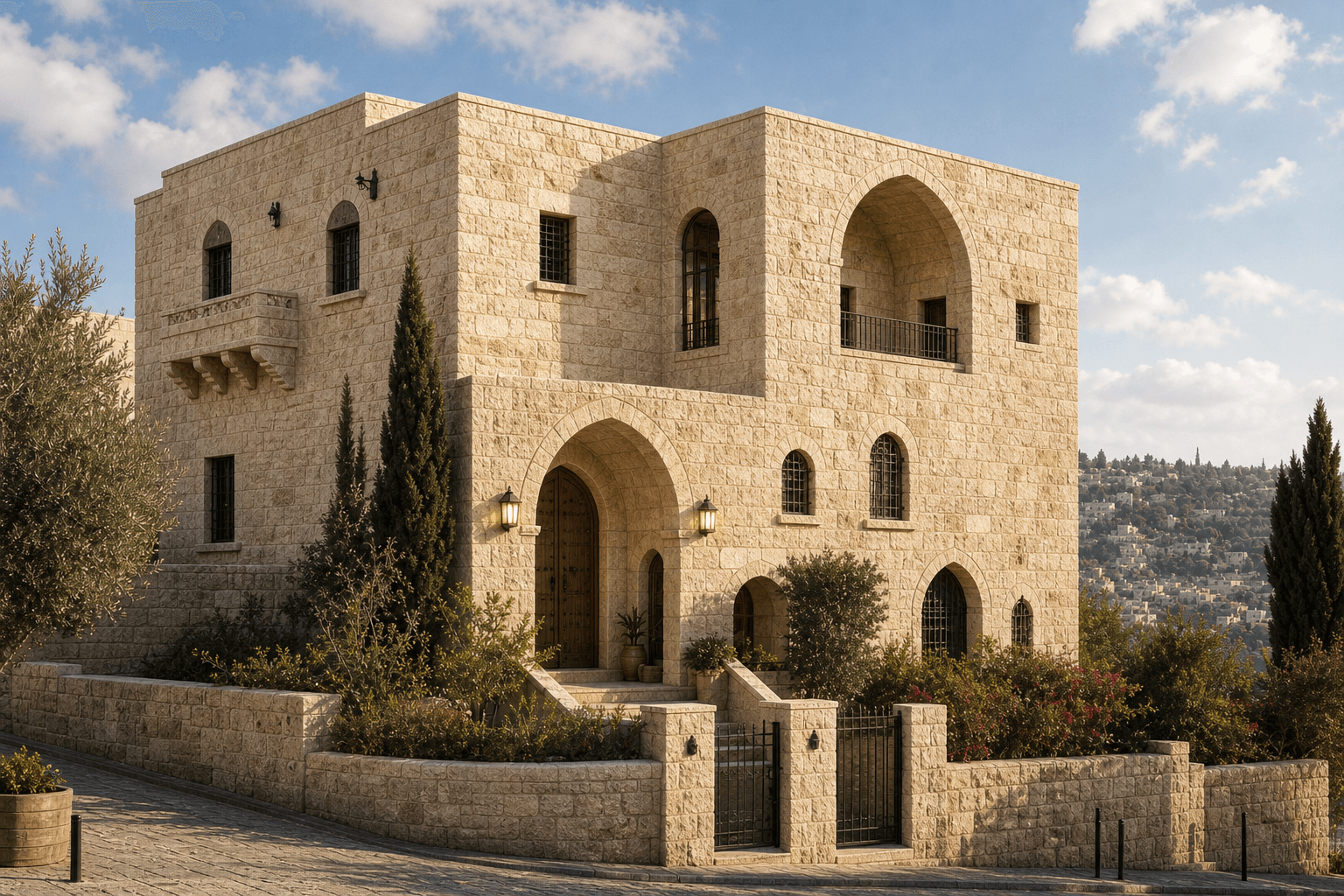
The Palestinian highland facade is a study in stone mass and minimal openings: (1) The street facade — a single unbroken plane of golden-cream limestone, the stone courses visible (30–50 cm course heights for ashlar, irregular for rubble), the wall rising 4–8 m above the alley — the single door (bāb) is the primary com...
Materials & Texture
Materials are essentially one: limestone in its various forms: (1) Meleke limestone ("royal stone") — the classic Jerusalem building stone: a creamy-white to golden-cream Cretaceous limestone (#D4C4A8 to #E8DCC8 when fresh cut, weathering to #C4B890 and eventually #B0A880) — the stone is soft enough to be easily quarri...
Color Palette
White, cream, pale sand, warm timber, and shadow-driven dark metal accents define the palette. The facade should stay bright and climate-aware rather than heavy, gray, or over-saturated.
Ornament & Detail
Palestinian highland ornament is stone-carving and the discipline of the wall: (1) Ablaq masonry — alternating courses of cream Meleke and red Mizzi stone, creating a striped facade — an Ayyubid-Mamluk technique adopted as a pan-Islamic prestige style — used on religious buildings, city gates, and the finest houses — t...
Climate Response
The Central Highlands have a Mediterranean mountain climate (Csa/Csb): (1) Elevation: 700–1,000 m above sea level — Jerusalem sits at ~754 m — the climate is characterized by hot dry summers (30–35°C day, 15–20°C night) and cool wet winters (5–12°C, with occasional snow in Jerusalem) — the thick stone walls (50–80 cm)...
Landscape & Ground
The traditional architecture of the Palestinian Central Highlands — encompassing Jerusalem (al-Quds), Ramallah, Bethlehem (Bayt Laḥm), Hebron (al-Khalīl), and the villages of the Judean Hills (Jibal al-Khalīl) — a region unified by its geology: the creamy-golden Meleke limestone and the harder reddish Mizzi limestone t...
Reference elevation
Jerusalem Highlands Palestinian — characteristic facade composition, traditional architecture of the Palestinian Central Highlands.
Context Snapshot
The traditional architecture of the Palestinian Central Highlands — encompassing Jerusalem (al-Quds), Ramallah, Bethlehem (Bayt Laḥm), Hebron (al-Khalīl), and the villages of the Judean Hills (Jibal a... The Central Highlands have a Mediterranean mountain climate (Csa/Csb): (1) Elevation: 700–1,000 m above sea level — Jerusalem sits at ~754 m — the climate is characterized by hot dry summers (30–35°C day, 15–20°C night)...
Contemporary Relevance
Jerusalem Highlands Palestinian is useful today for residential, hospitality, civic, and place-branding work that needs Palestine-specific character grounded in local massing, material tone, climate response, and settlement logic rather than generic international styling.
Use this style in Toscape
Explore Jerusalem Highlands Palestinian directly inside Toscape using the Facade Re-Style and Design Options workflows.
Open Jerusalem Highlands Palestinian in the galleryFrequently asked questions
What is Jerusalem Highlands Palestinian?
Jerusalem Highlands Palestinian is a regional architectural identity from Palestine. The limestone architecture of the Palestinian Central Highlands — the golden Jerusalem stone (ḥajar al-Quds) that defines the city's sacred and vernacular fabric, from the clustere.
What materials define Jerusalem Highlands Palestinian?
Materials are essentially one: limestone in its various forms: (1) Meleke limestone ("royal stone") — the classic Jerusalem building stone: a creamy-white to golden-cream Cretaceous limestone (#D4C4A8 to #E8DCC8 when fresh cut, weathering to #C4B890 and eventually #B0A880) — the stone is soft enough to be easily quarri.
What is the Jerusalem Highlands Palestinian color palette?
White, cream, pale sand, warm timber, and shadow-driven dark metal accents define the palette. The facade should stay bright and climate-aware rather than heavy, gray, or over-saturated.
Where does Jerusalem Highlands Palestinian come from?
The traditional architecture of the Palestinian Central Highlands — encompassing Jerusalem (al-Quds), Ramallah, Bethlehem (Bayt Laḥm), Hebron (al-Khalīl).
When should architects use Jerusalem Highlands Palestinian?
Jerusalem Highlands Palestinian is useful today for residential, hospitality, civic, and place-branding work that needs Palestine-specific character grounded in local massing, material tone, climate response, and settlement logic rather than generic international styling.
How do you render Jerusalem Highlands Palestinian in Toscape?
Open Toscape on Windows, load your own photo, elevation, sketch, or CAD view, then apply the Jerusalem Highlands Palestinian reference from the built-in style library. The Facade Re-Style and Design Options workflows keep your project geometry and camera while shifting materials, proportion, and detailing toward Jerusalem Highlands Palestinian.