Jiangnan Water Town
China · Jiangnan region (Suzhou, Hangzhou, Tongli, Zhouzhuang)
Whitewashed Walls, Black Tile Roofs & Canal-Pavilion Garden Architecture
Definition
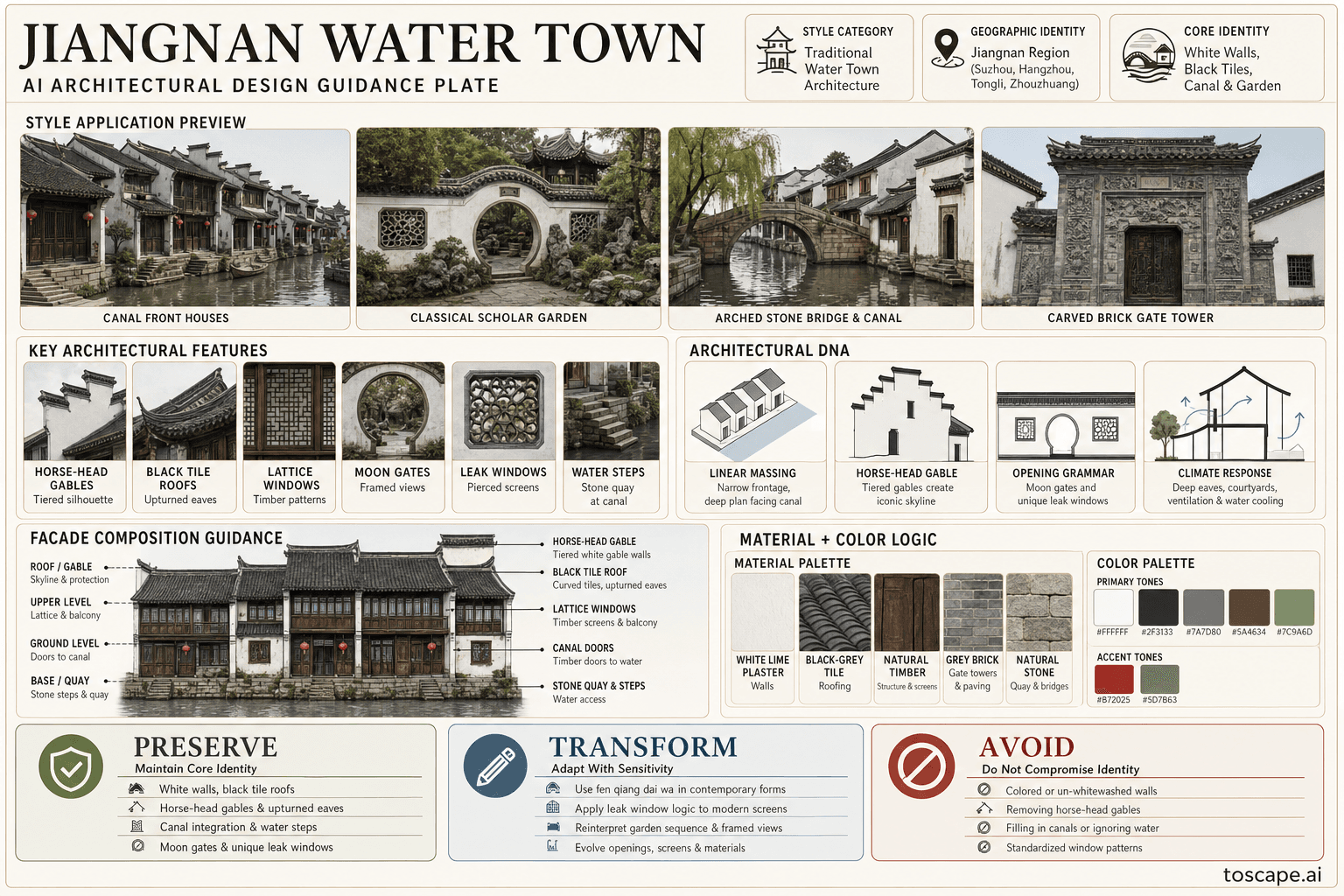
Jiangnan Water Town is a regional architectural identity from China. Whitewashed Walls, Black Tile Roofs & Canal-Pavilion Garden Architecture.
- Country
- China
- Region
- Jiangnan region (Suzhou, Hangzhou, Tongli, Zhouzhuang).
- Massing
- Linear canal-front houses: narrow frontage (1-2 bays), deep plan (3-5 jian deep), 1-2 stories.
- Materials
- Lime whitewash over grey brick — the defining wall finish (fen qiang dai wa: white walls, black tiles). Black-grey tile (xiao qing wa) — roofing.
- Palette
- White, cream, pale sand, warm timber, and shadow-driven dark metal accents define the palette.
- Climate response
- Subtropical monsoon: hot humid summers, moderate winters, abundant rain. Canals for drainage, transport, and microclimate cooling.
Overview
Jiangnan Water Town is a regional architectural identity in China. Jiangnan region (Suzhou, Hangzhou, Tongli, Zhouzhuang) — the classical water-town architecture of the Yangtze Delta. Whitewashed lime plaster over brick walls (fen qiang), black-grey curved tile roofs (dai wa), canal-front houses with stone quays and arched bridges, classical scholar gardens (yuan lin) with rockery, pavilions, and moon gates, carved brick gate towers (men lou)
Visual DNA
Massing & Form
Linear canal-front houses: narrow frontage (1-2 bays), deep plan (3-5 jian deep), 1-2 stories. Canal-side orientation: front door on canal with stone quay, rear door on street.
Facade Language
Canal facade: whitewashed wall with rhythmic timber doors and lattice windows at ground level, upper floor with projecting timber balcony or lattice windows. Black tile roof with horse-head gable walls (ma tou qiang) stepping up in tiers — the defining Jiangnan silhouette.
Materials & Texture
Lime whitewash over grey brick — the defining wall finish (fen qiang dai wa: white walls, black tiles). Black-grey tile (xiao qing wa) — roofing.
Color Palette
White, cream, pale sand, warm timber, and shadow-driven dark metal accents define the palette. The facade should stay bright and climate-aware rather than heavy, gray, or over-saturated.
Ornament & Detail
Carved brick gate tower (men lou): elaborate brick bas-relief with floral, figural, and auspicious motifs — the concentration of ornament at the entry. Leak windows (lou chuang): geometric, floral, and animal-form pierced screens in garden walls.
Climate Response
Subtropical monsoon: hot humid summers, moderate winters, abundant rain. Canals for drainage, transport, and microclimate cooling.
Landscape & Ground
Jiangnan region (Suzhou, Hangzhou, Tongli, Zhouzhuang) — the classical water-town architecture of the Yangtze Delta. Subtropical monsoon: hot humid summers, moderate winters, abundant rain.
Reference elevation
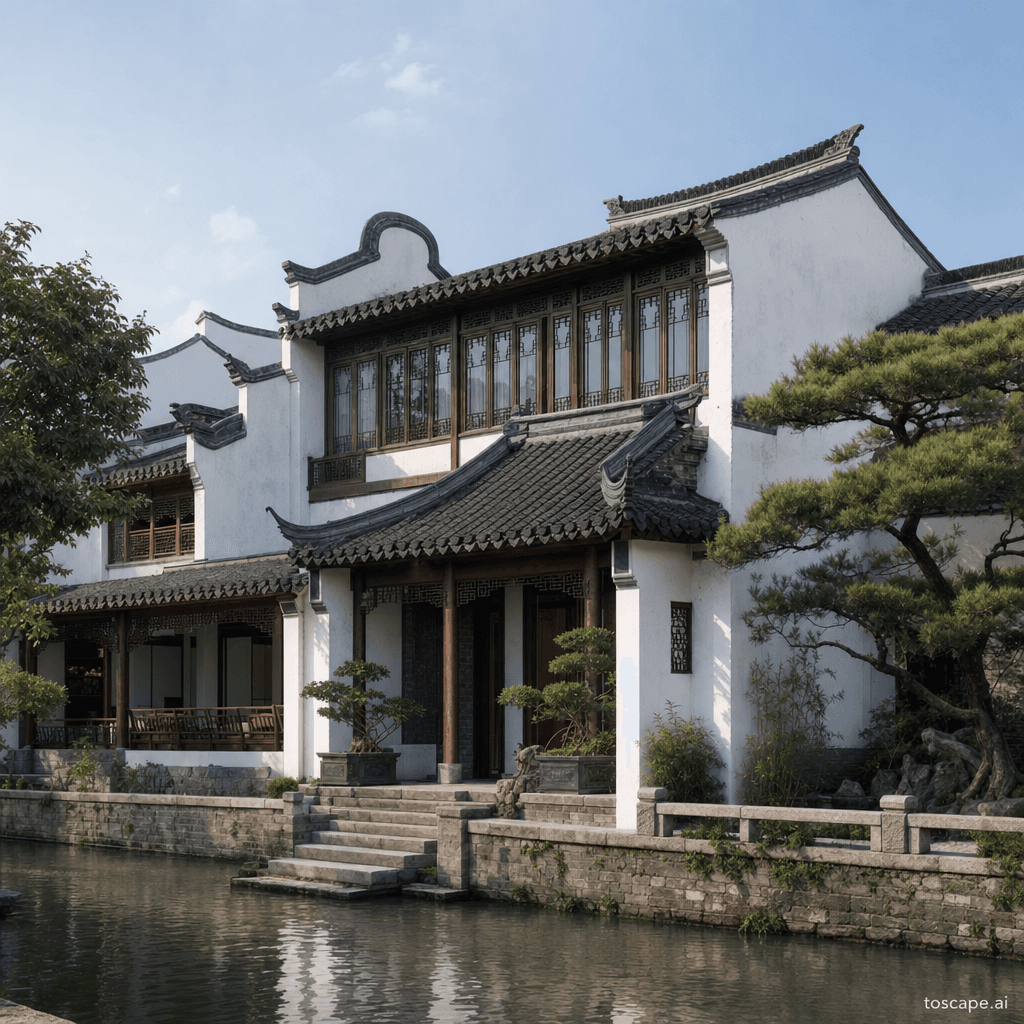
Jiangnan Water Town — characteristic facade composition, Jiangnan region (Suzhou, Hangzhou, Tongli, Zhouzhuang).
Context Snapshot
Jiangnan region (Suzhou, Hangzhou, Tongli, Zhouzhuang) — the classical water-town architecture of the Yangtze Delta Subtropical monsoon: hot humid summers, moderate winters, abundant rain.
Contemporary Relevance
Jiangnan Water Town is useful today for residential, hospitality, civic, and place-branding work that needs China-specific character grounded in local massing, material tone, climate response, and settlement logic rather than generic international styling.
Use this style in Toscape
Explore Jiangnan Water Town directly inside Toscape using the Facade Re-Style and Design Options workflows.
Open Jiangnan Water Town in the galleryFrequently asked questions
What is Jiangnan Water Town?
Jiangnan Water Town is a regional architectural identity from China. Whitewashed Walls, Black Tile Roofs & Canal-Pavilion Garden Architecture.
What materials define Jiangnan Water Town?
Lime whitewash over grey brick — the defining wall finish (fen qiang dai wa: white walls, black tiles). Black-grey tile (xiao qing wa) — roofing.
What is the Jiangnan Water Town color palette?
White, cream, pale sand, warm timber, and shadow-driven dark metal accents define the palette. The facade should stay bright and climate-aware rather than heavy, gray, or over-saturated.
Where does Jiangnan Water Town come from?
Jiangnan region (Suzhou, Hangzhou, Tongli, Zhouzhuang) — the classical water-town architecture of the Yangtze Delta Subtropical monsoon: hot humid summers, moderate winters, abundant rain.
When should architects use Jiangnan Water Town?
Jiangnan Water Town is useful today for residential, hospitality, civic, and place-branding work that needs China-specific character grounded in local massing, material tone, climate response, and settlement logic rather than generic international styling.
How do you render Jiangnan Water Town in Toscape?
Open Toscape on Windows, load your own photo, elevation, sketch, or CAD view, then apply the Jiangnan Water Town reference from the built-in style library. The Facade Re-Style and Design Options workflows keep your project geometry and camera while shifting materials, proportion, and detailing toward Jiangnan Water Town.