Kabul Central Highland
Afghanistan · traditional architecture of Kabul (Kābul)
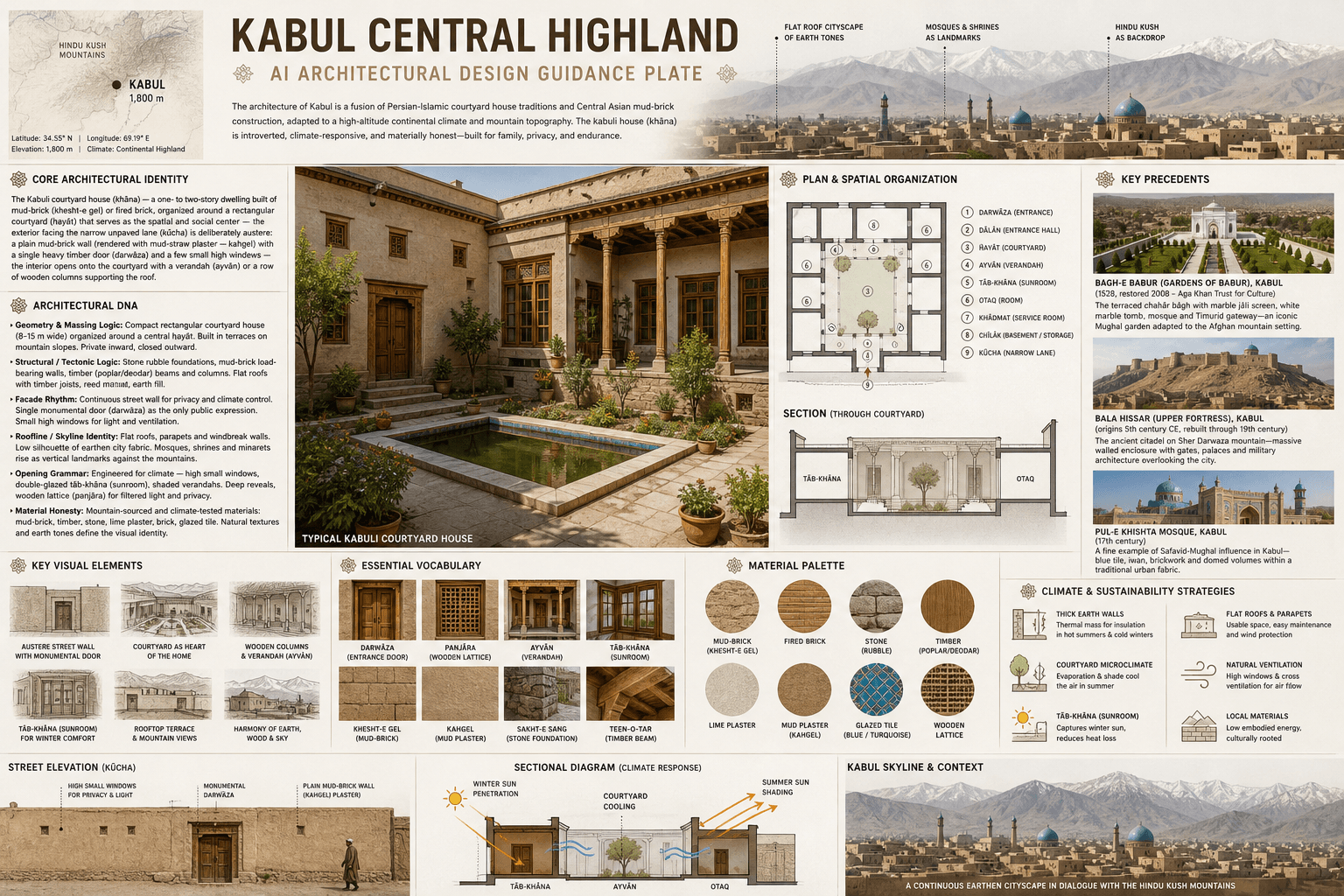
The mountain capital of Afghanistan in the Hindu Kush foothills — a city of mud-brick courtyard houses with flat timber-and-earth roofs, ornate carved wooden balconies (panjara), t...
Definition
Kabul Central Highland is a regional architectural identity from Afghanistan. The mountain capital of Afghanistan in the Hindu Kush foothills — a city of mud-brick courtyard houses with flat timber-and-earth roofs, ornate carved wooden balconies (panjara), t.
- Country
- Afghanistan
- Region
- traditional architecture of Kabul (Kābul).
- Massing
- The Kabul house is a compact courtyard dwelling adapted to mountain topography: (1) The house is rectangular (8–15 m wide, 12–25 m deep).
- Materials
- Kabul's materials are mountain-sourced and climate-tested: (1) Mud-brick (khesht-e gel) — the universal construction material: loess soil from the Kabul valley (a wind-deposited silt-clay.
- Palette
- White, cream, pale sand, warm timber, and shadow-driven dark metal accents define the palette.
- Climate response
- Kabul has a cold semi-arid climate (BSk) at high altitude: (1) Winter: -10°C to -20°C at night.
Overview
Kabul Central Highland is a regional architectural identity in Afghanistan. The traditional architecture of Kabul (Kābul) — the capital of Afghanistan, situated in a high-altitude valley (1,800 m) surrounded by the Hindu Kush mountains — Kabul's architectural identity is defined by the fusion of Persian-Islamic courtyard house traditions with Central Asian mud-brick construction and the decorative vocabulary of the Timurid and Mughal periods — the city sits astride the historic Silk Road rou...
Visual DNA
Massing & Form
The Kabul house is a compact courtyard dwelling adapted to mountain topography: (1) The house is rectangular (8–15 m wide, 12–25 m deep), with the courtyard (ḥayāt) located at the center or side — the courtyard is smaller than lowland equivalents (3–6 m per side) due to the cold climate — the house typically sits direc...
Facade Language
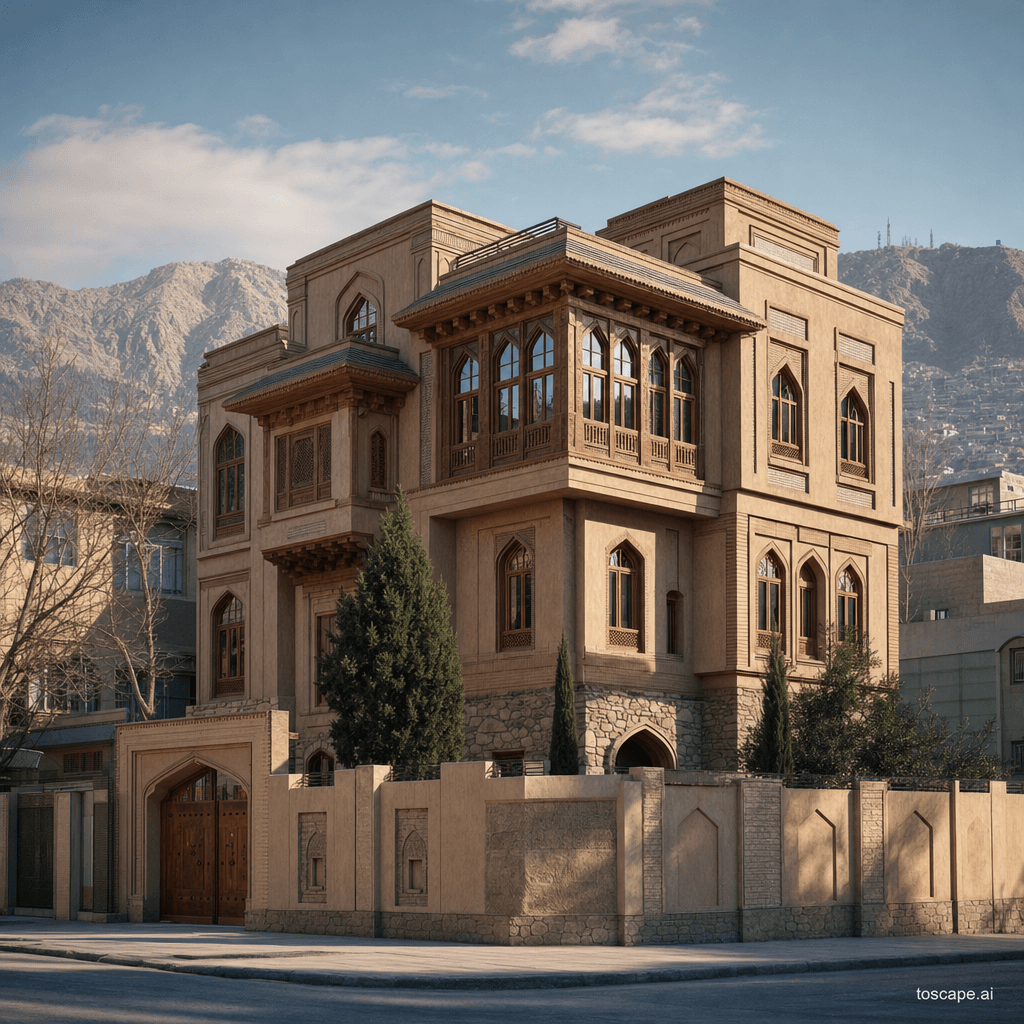
The Kabul street facade reflects the extreme climate and cultural privacy norms: (1) The street wall — a continuous plane of kahgel-rendered mud-brick, beige-brown in color (#C4B090 to #A89878), uninterrupted except for the entrance door — the wall is 3–7 m high — the render is renewed every few years, giving the walls...
Materials & Texture
Kabul's materials are mountain-sourced and climate-tested: (1) Mud-brick (khesht-e gel) — the universal construction material: loess soil from the Kabul valley (a wind-deposited silt-clay, excellent for brick-making) mixed with chopped straw and water, formed in wooden molds, sun-dried — the bricks are beige-brown (#C4...
Color Palette
White, cream, pale sand, warm timber, and shadow-driven dark metal accents define the palette. The facade should stay bright and climate-aware rather than heavy, gray, or over-saturated.
Ornament & Detail
Kabul's ornament synthesizes Persian, Central Asian, and Indian traditions: (1) Carved timber (kandakārī-e chūb) — the most characteristic Afghan domestic ornament: door lintels, panjara screens, ayvān posts and brackets, and ceiling beams are carved with geometric patterns (eight-pointed stars, hexagons, interlocking...
Climate Response
Kabul has a cold semi-arid climate (BSk) at high altitude: (1) Winter: -10°C to -20°C at night, 0–5°C during the day — snow cover for 2–4 months — the mud-brick walls and thick earth roof provide thermal mass that retains daytime heat — the tāb-khāna (sunroom) is the key passive solar strategy: south-facing glazing cap...
Landscape & Ground
The traditional architecture of Kabul (Kābul) — the capital of Afghanistan, situated in a high-altitude valley (1,800 m) surrounded by the Hindu Kush mountains — Kabul's architectural identity is defined by the fusion of Persian-Islamic courtyard house traditions with Central Asian mud-brick construction and the decora...
Reference elevation
Kabul Central Highland — characteristic facade composition, traditional architecture of Kabul (Kābul).
Context Snapshot
The traditional architecture of Kabul (Kābul) — the capital of Afghanistan, situated in a high-altitude valley (1,800 m) surrounded by the Hindu Kush mountains — Kabul's architectural identity is defi... Kabul has a cold semi-arid climate (BSk) at high altitude: (1) Winter: -10°C to -20°C at night, 0–5°C during the day — snow cover for 2–4 months — the mud-brick walls and thick earth roof provide thermal mass that retain...
Contemporary Relevance
Kabul Central Highland is useful today for residential, hospitality, civic, and place-branding work that needs Afghanistan-specific character grounded in local massing, material tone, climate response, and settlement logic rather than generic international styling.
Use this style in Toscape
Explore Kabul Central Highland directly inside Toscape using the Facade Re-Style and Design Options workflows.
Open Kabul Central Highland in the galleryFrequently asked questions
What is Kabul Central Highland?
Kabul Central Highland is a regional architectural identity from Afghanistan. The mountain capital of Afghanistan in the Hindu Kush foothills — a city of mud-brick courtyard houses with flat timber-and-earth roofs, ornate carved wooden balconies (panjara), t.
What materials define Kabul Central Highland?
Kabul's materials are mountain-sourced and climate-tested: (1) Mud-brick (khesht-e gel) — the universal construction material: loess soil from the Kabul valley (a wind-deposited silt-clay, excellent for brick-making) mixed with chopped straw and water, formed in wooden molds, sun-dried — the bricks are beige-brown (#C4.
What is the Kabul Central Highland color palette?
White, cream, pale sand, warm timber, and shadow-driven dark metal accents define the palette. The facade should stay bright and climate-aware rather than heavy, gray, or over-saturated.
Where does Kabul Central Highland come from?
The traditional architecture of Kabul (Kābul) — the capital of Afghanistan, situated in a high-altitude valley (1,800 m) surrounded by the Hindu Kush mountains — Kabul's architectural identity is defi.
When should architects use Kabul Central Highland?
Kabul Central Highland is useful today for residential, hospitality, civic, and place-branding work that needs Afghanistan-specific character grounded in local massing, material tone, climate response, and settlement logic rather than generic international styling.
How do you render Kabul Central Highland in Toscape?
Open Toscape on Windows, load your own photo, elevation, sketch, or CAD view, then apply the Kabul Central Highland reference from the built-in style library. The Facade Re-Style and Design Options workflows keep your project geometry and camera while shifting materials, proportion, and detailing toward Kabul Central Highland.