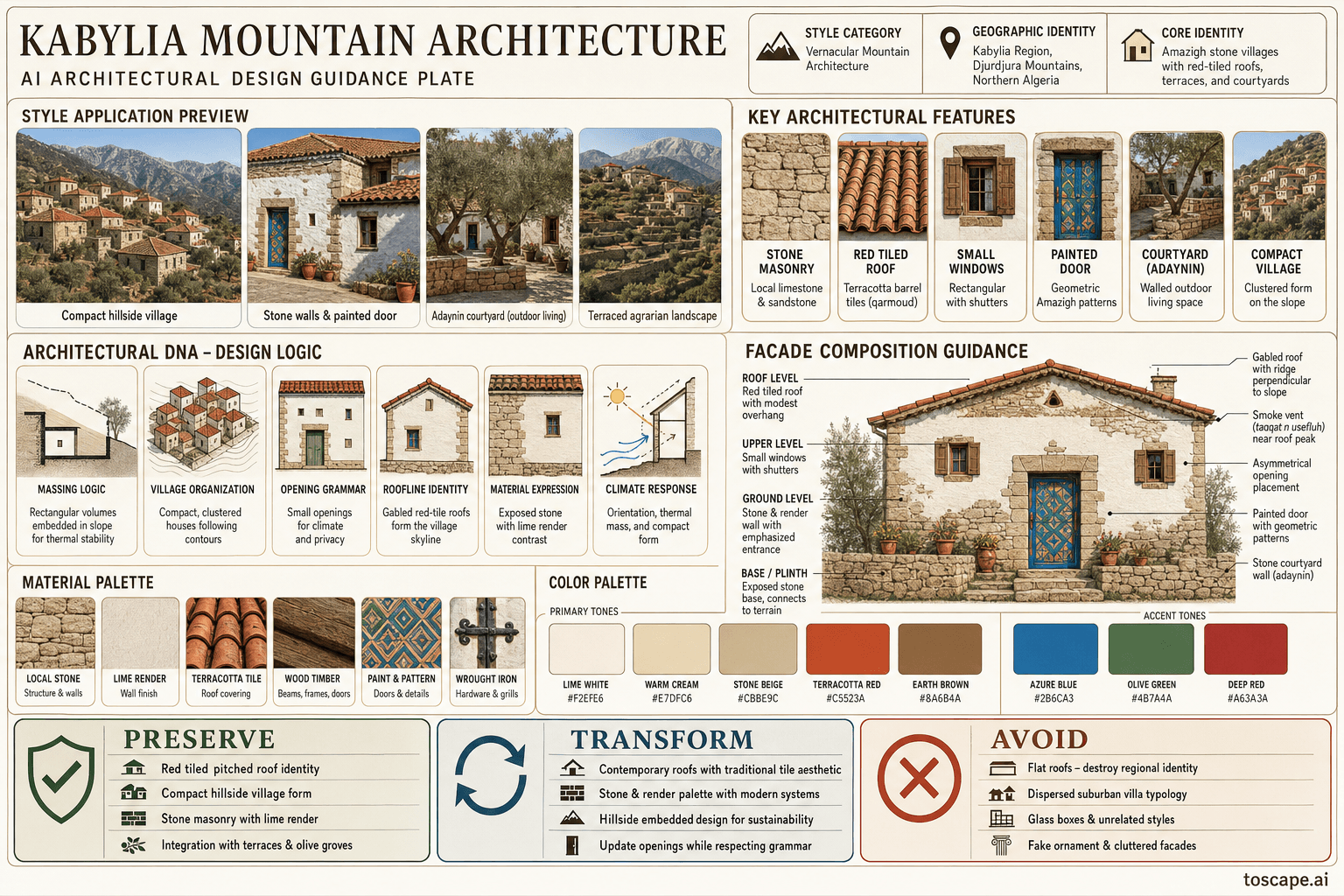
Kabylia Mountain
Algeria · Amazigh (Berber) vernacular architecture of the Kabylia region (Tamurt n Leqbaye...
The Amazigh stone-built mountain villages of Kabylia — tiled roofs, hillside terracing, and the architectural identity of the Djurdjura massif
Definition
Kabylia Mountain is a regional architectural identity from Algeria. The Amazigh stone-built mountain villages of Kabylia — tiled roofs, hillside terracing, and the architectural identity of the Djurdjura massif.
- Country
- Algeria
- Region
- Amazigh (Berber) vernacular architecture of the Kabylia region (Tamurt n Leqbaye.
- Massing
- The Kabyle house (taddart or axxam) is a rectangular single-storey or two-storey volume — typically 5–8 m wide × 6–12 m deep.
- Materials
- Limestone and sandstone — primary construction material, quarried from local mountains Earth mortar — clay-based mortar for stone masonry Lime plaster — white or cream render.
- Palette
- White, cream, pale sand, warm timber, and shadow-driven dark metal accents define the palette.
- Climate response
- Kabyle architecture responds to the mountain Mediterranean climate — cold snowy winters, hot dry summers: (1) Hillside embedding — the semi-excavated ground floor provides thermal stability.
Overview
Kabylia Mountain is a regional architectural identity in Algeria. Traditional Amazigh (Berber) vernacular architecture of the Kabylia region (Tamurt n Leqbayel) in northern Algeria — defined by stone construction, red-tiled pitched roofs, compact hillside village clusters, and the agrarian architectural culture of the Kabyle people in the Djurdjura Mountains. Stone masonry construction (local limestone and sandstone) — pitched roofs with red terracotta barrel tiles (qarmoud) — comp...
Visual DNA
Massing & Form
The Kabyle house (taddart or axxam) is a rectangular single-storey or two-storey volume — typically 5–8 m wide × 6–12 m deep. The plan is simple: two to four rooms arranged around a central corridor or directly accessed from the exterior.
Facade Language
The Kabyle house facade is characterized by simplicity and functional clarity: Wall surface: Stone masonry with lime render — typically white or cream, with areas of exposed stone (particularly at corners, around openings, and at the base). The contrast between rendered wall planes and exposed stone accents creates a d...
Materials & Texture
Limestone and sandstone — primary construction material, quarried from local mountains Earth mortar — clay-based mortar for stone masonry Lime plaster — white or cream render for external and internal walls Terracotta barrel tiles (qarmoud) — the defining roof material, locally produced Oak, cedar, and olive timber — f...
Color Palette
White, cream, pale sand, warm timber, and shadow-driven dark metal accents define the palette. The facade should stay bright and climate-aware rather than heavy, gray, or over-saturated.
Ornament & Detail
Kabyle architectural ornament is concentrated at specific entry points rather than applied to whole facades: (1) Painted door panels — geometric patterns (diamonds, triangles, chevrons) in blue, green, and red — women's painting tradition, (2) carved stone lintels — simple geometric or floral motifs above the entrance...
Climate Response
Kabyle architecture responds to the mountain Mediterranean climate — cold snowy winters, hot dry summers: (1) Hillside embedding — the semi-excavated ground floor provides thermal stability, warm in winter and cool in summer. (2) Pitched tile roof — sheds winter snow and heavy rain, the terracotta tiles providing good...
Landscape & Ground
Traditional Amazigh (Berber) vernacular architecture of the Kabylia region (Tamurt n Leqbayel) in northern Algeria — defined by stone construction, red-tiled pitched roofs, compact hillside village clusters, and the agrarian architectural culture of the Kabyle people in the Djurdjura Mountains. Kabyle architecture resp...
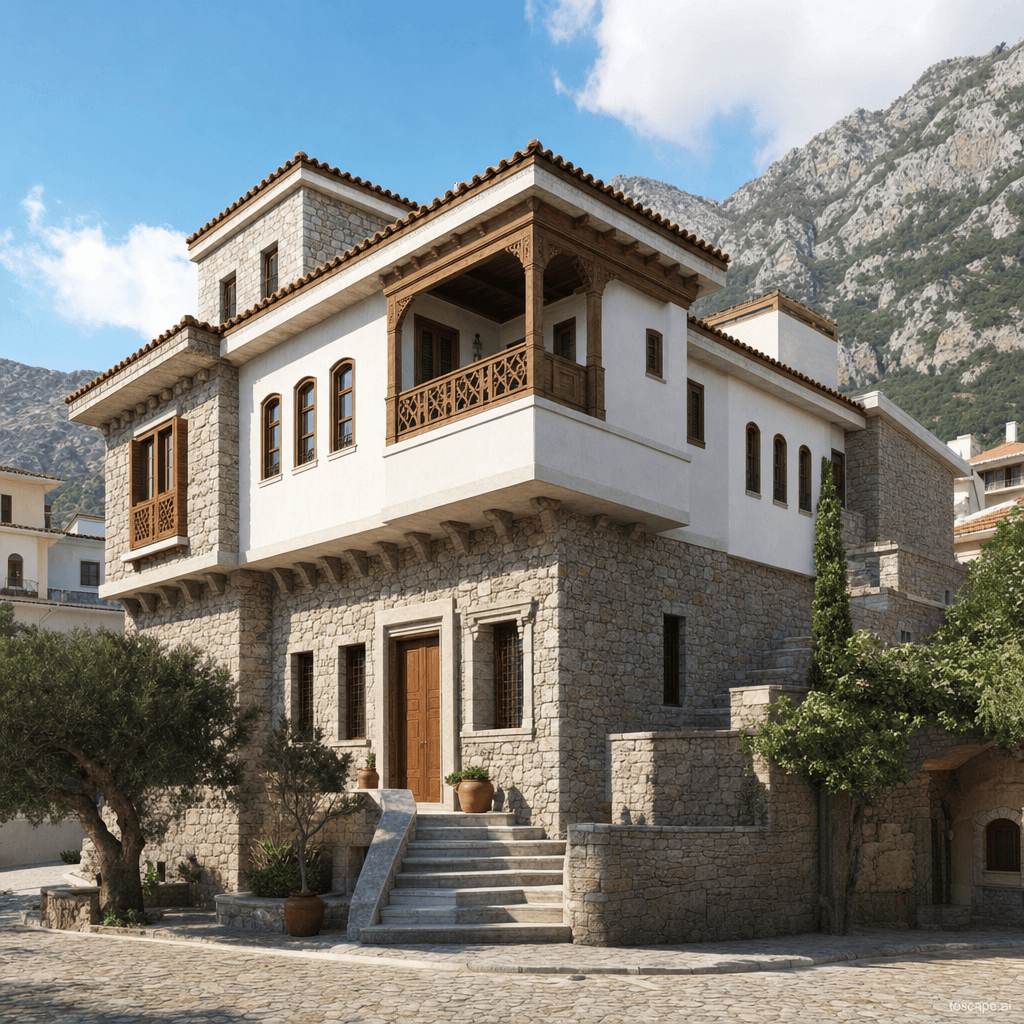
Reference elevation
Kabylia Mountain — characteristic facade composition, Amazigh (Berber) vernacular architecture of the Kabylia region (Tamurt n Leqbaye....
Context Snapshot
Traditional Amazigh (Berber) vernacular architecture of the Kabylia region (Tamurt n Leqbayel) in northern Algeria — defined by stone construction, red-tiled pitched roofs, compact hillside village cl... Kabyle architecture responds to the mountain Mediterranean climate — cold snowy winters, hot dry summers: (1) Hillside embedding — the semi-excavated ground floor provides thermal stability, warm in winter and cool in su...
Contemporary Relevance
Kabylia Mountain is useful today for residential, hospitality, civic, and place-branding work that needs Algeria-specific character grounded in local massing, material tone, climate response, and settlement logic rather than generic international styling.
Use this style in Toscape
Explore Kabylia Mountain directly inside Toscape using the Facade Re-Style and Design Options workflows.
Open Kabylia Mountain in the galleryFrequently asked questions
What is Kabylia Mountain?
Kabylia Mountain is a regional architectural identity from Algeria. The Amazigh stone-built mountain villages of Kabylia — tiled roofs, hillside terracing, and the architectural identity of the Djurdjura massif.
What materials define Kabylia Mountain?
Limestone and sandstone — primary construction material, quarried from local mountains Earth mortar — clay-based mortar for stone masonry Lime plaster — white or cream render for external and internal walls Terracotta barrel tiles (qarmoud) — the defining roof material, locally produced Oak, cedar, and olive timber — f.
What is the Kabylia Mountain color palette?
White, cream, pale sand, warm timber, and shadow-driven dark metal accents define the palette. The facade should stay bright and climate-aware rather than heavy, gray, or over-saturated.
Where does Kabylia Mountain come from?
Traditional Amazigh (Berber) vernacular architecture of the Kabylia region (Tamurt n Leqbayel) in northern Algeria — defined by stone construction, red-tiled pitched roofs, compact hillside village cl... Kabyle architecture responds to the mountain Mediterranean climate — cold snowy winters, hot dry summers: (1) Hillside embedding — the semi-excavated ground floor provides thermal stability, warm in winter and cool in su.
When should architects use Kabylia Mountain?
Kabylia Mountain is useful today for residential, hospitality, civic, and place-branding work that needs Algeria-specific character grounded in local massing, material tone, climate response, and settlement logic rather than generic international styling.
How do you render Kabylia Mountain in Toscape?
Open Toscape on Windows, load your own photo, elevation, sketch, or CAD view, then apply the Kabylia Mountain reference from the built-in style library. The Facade Re-Style and Design Options workflows keep your project geometry and camera while shifting materials, proportion, and detailing toward Kabylia Mountain.