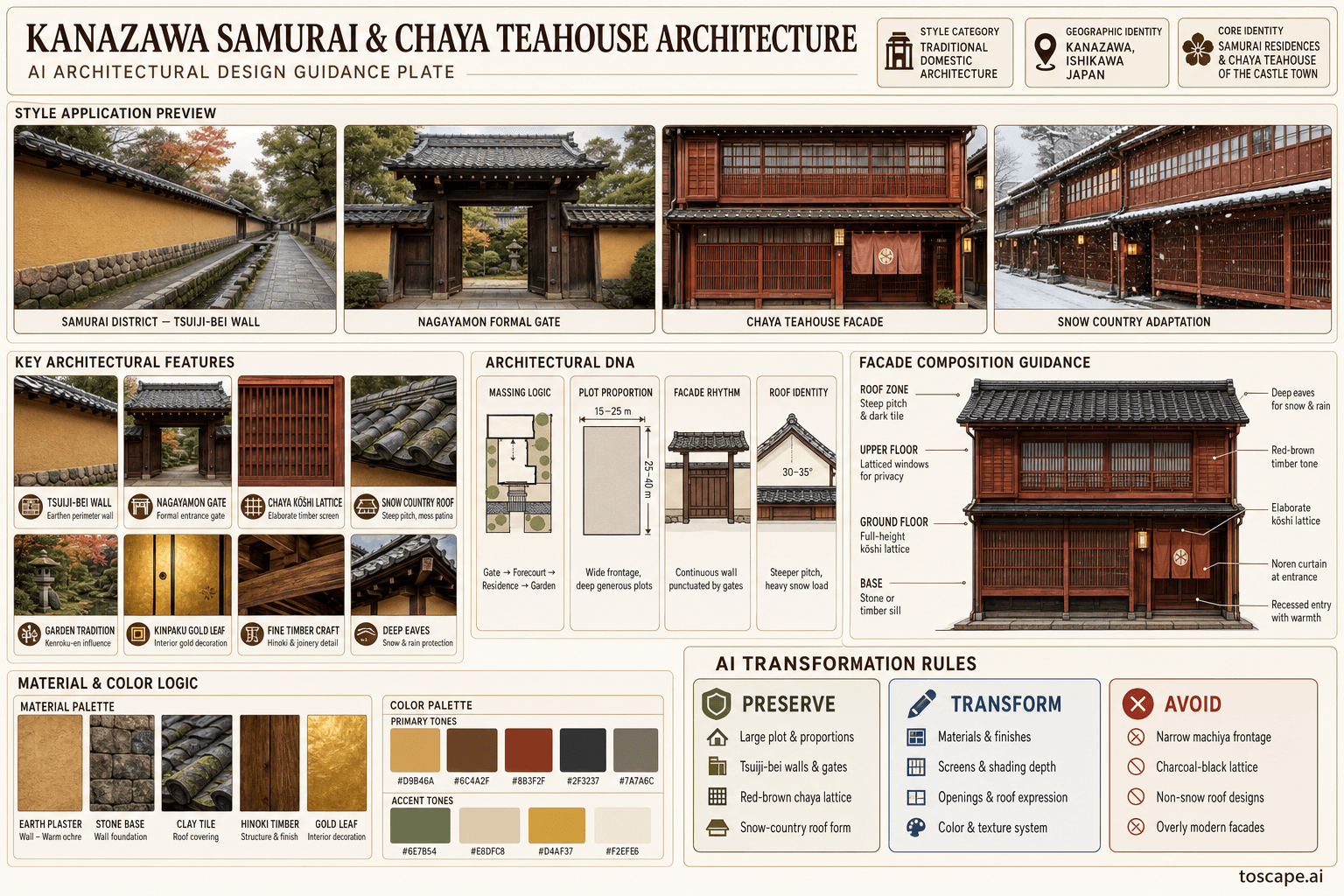
Kanazawa Samurai & Chaya Teahouse
Japan · domestic architecture of Kanazawa, Ishikawa Prefecture
The castle-town samurai residences and entertainment district — the "Little Kyoto" of the Japan Sea coast
Definition
Kanazawa Samurai & Chaya Teahouse is a regional architectural identity from Japan. The castle-town samurai residences and entertainment district — the "Little Kyoto" of the Japan Sea coast.
- Country
- Japan
- Region
- domestic architecture of Kanazawa, Ishikawa Prefecture.
- Massing
- The Kanazawa samurai residence (bukeyashiki) is organized on a much larger plot than the Kyoto machiya — the samurai class was not subject to frontage taxation.
- Materials
- Samurai bukeyashiki (warrior residences) with earthen perimeter walls (tsuiji-bei) and formal entrance gates — larger plots (15–25 m frontage vs.
- Palette
- Warm earth, sandy beige, ochre, clay brown, and sun-softened mineral tones should dominate, with palm green or weathered timber as secondary accents.
- Climate response
- Traditional domestic architecture of Kanazawa, Ishikawa Prefecture — the best-preserved samurai district (Nagamachi) and geisha entertainment districts (Higashi Chaya, Kazuemachi) in Japan.
Overview
Kanazawa Samurai & Chaya Teahouse is a regional architectural identity in Japan. Traditional domestic architecture of Kanazawa, Ishikawa Prefecture — the best-preserved samurai district (Nagamachi) and geisha entertainment districts (Higashi Chaya, Kazuemachi) in Japan, representing the warrior-class and pleasaure-quarter domestic typologies distinct from Kyoto's merchant machiya. Samurai bukeyashiki (warrior residences) with earthen perimeter walls (tsuiji-bei) and formal entrance gates — larger...
Visual DNA
Massing & Form
The Kanazawa samurai residence (bukeyashiki) is organized on a much larger plot than the Kyoto machiya — the samurai class was not subject to frontage taxation. Plot frontages of 15–25 m are typical, with depths of 25–40 m — the total site area being 5–10 times larger than a merchant machiya .
Facade Language
The Nagamachi samurai district street elevation is dominated by the continuous yellow-ochre tsuiji-bei earthen wall with tiled ridge caps — a uniform, rhythmic streetscape of earth walls punctuated by formal gateways: Tsuiji-bei (earthen wall): A continuous wall 2.0–2.5 m high — the lower portion is a stone base (0.5–0...
Materials & Texture
Samurai bukeyashiki (warrior residences) with earthen perimeter walls (tsuiji-bei) and formal entrance gates — larger plots (15–25 m frontage vs. machiya's 3–5 m) — chaya (teahouse) architecture with elaborate street-facing lattice (kōshi) in warm red-brown timber — Kanazawa gold leaf (kinpaku) as decorative interior f...
Color Palette
Warm earth, sandy beige, ochre, clay brown, and sun-softened mineral tones should dominate, with palm green or weathered timber as secondary accents. The palette should read as land-derived rather than polished or urban-generic.
Ornament & Detail
Samurai bukeyashiki (warrior residences) with earthen perimeter walls (tsuiji-bei) and formal entrance gates — larger plots (15–25 m frontage vs. machiya's 3–5 m) — chaya (teahouse) architecture with elaborate street-facing lattice (kōshi) in warm red-brown timber — Kanazawa gold leaf (kinpaku) as decorative interior f...
Climate Response
Traditional domestic architecture of Kanazawa, Ishikawa Prefecture — the best-preserved samurai district (Nagamachi) and geisha entertainment districts (Higashi Chaya, Kazuemachi) in Japan, representing the warrior-class and pleasaure-quarter domestic typologies distinct from Kyoto's merchant machiya
Landscape & Ground
Traditional domestic architecture of Kanazawa, Ishikawa Prefecture — the best-preserved samurai district (Nagamachi) and geisha entertainment districts (Higashi Chaya, Kazuemachi) in Japan, representing the warrior-class and pleasaure-quarter domestic typologies distinct from Kyoto's merchant machiya
Reference elevation
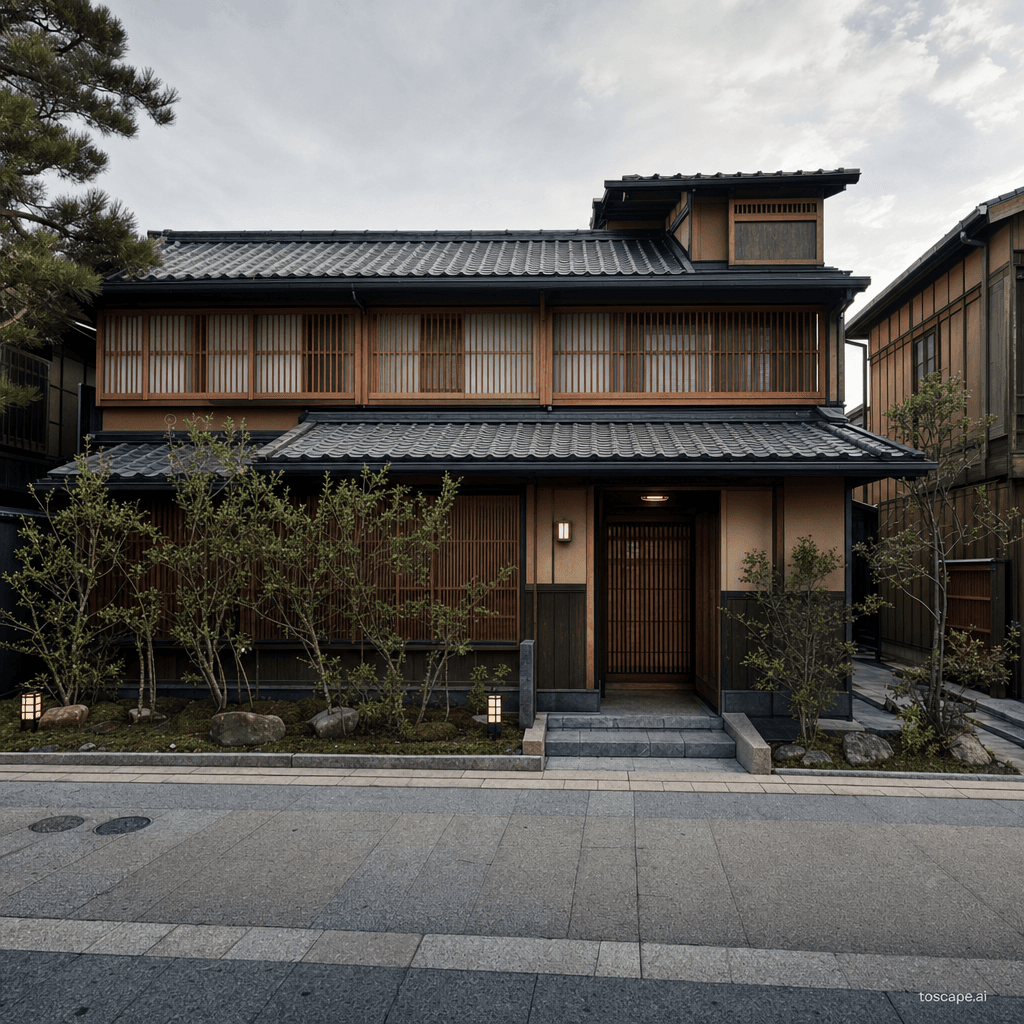
Kanazawa Samurai & Chaya Teahouse — characteristic facade composition, domestic architecture of Kanazawa, Ishikawa Prefecture.
Context Snapshot
Traditional domestic architecture of Kanazawa, Ishikawa Prefecture — the best-preserved samurai district (Nagamachi) and geisha entertainment districts (Higashi Chaya, Kazuemachi) in Japan, representi...
Contemporary Relevance
Kanazawa Samurai & Chaya Teahouse is useful today for residential, hospitality, civic, and place-branding work that needs Japan-specific character grounded in local massing, material tone, climate response, and settlement logic rather than generic international styling.
Use this style in Toscape
Explore Kanazawa Samurai & Chaya Teahouse directly inside Toscape using the Facade Re-Style and Design Options workflows.
Open Kanazawa Samurai & Chaya Teahouse in the galleryFrequently asked questions
What is Kanazawa Samurai & Chaya Teahouse?
Kanazawa Samurai & Chaya Teahouse is a regional architectural identity from Japan. The castle-town samurai residences and entertainment district — the "Little Kyoto" of the Japan Sea coast.
What materials define Kanazawa Samurai & Chaya Teahouse?
Samurai bukeyashiki (warrior residences) with earthen perimeter walls (tsuiji-bei) and formal entrance gates — larger plots (15–25 m frontage vs. Machiya's 3–5 m) — chaya (teahouse) architecture with elaborate street-facing lattice (kōshi) in warm red-brown timber — Kanazawa gold leaf (kinpaku) as decorative interior f.
What is the Kanazawa Samurai & Chaya Teahouse color palette?
Warm earth, sandy beige, ochre, clay brown, and sun-softened mineral tones should dominate, with palm green or weathered timber as secondary accents. The palette should read as land-derived rather than polished or urban-generic.
Where does Kanazawa Samurai & Chaya Teahouse come from?
Traditional domestic architecture of Kanazawa, Ishikawa Prefecture — the best-preserved samurai district (Nagamachi) and geisha entertainment districts (Higashi Chaya, Kazuemachi) in Japan, representi.
When should architects use Kanazawa Samurai & Chaya Teahouse?
Kanazawa Samurai & Chaya Teahouse is useful today for residential, hospitality, civic, and place-branding work that needs Japan-specific character grounded in local massing, material tone, climate response, and settlement logic rather than generic international styling.
How do you render Kanazawa Samurai & Chaya Teahouse in Toscape?
Open Toscape on Windows, load your own photo, elevation, sketch, or CAD view, then apply the Kanazawa Samurai & Chaya Teahouse reference from the built-in style library. The Facade Re-Style and Design Options workflows keep your project geometry and camera while shifting materials, proportion, and detailing toward Kanazawa Samurai & Chaya Teahouse.