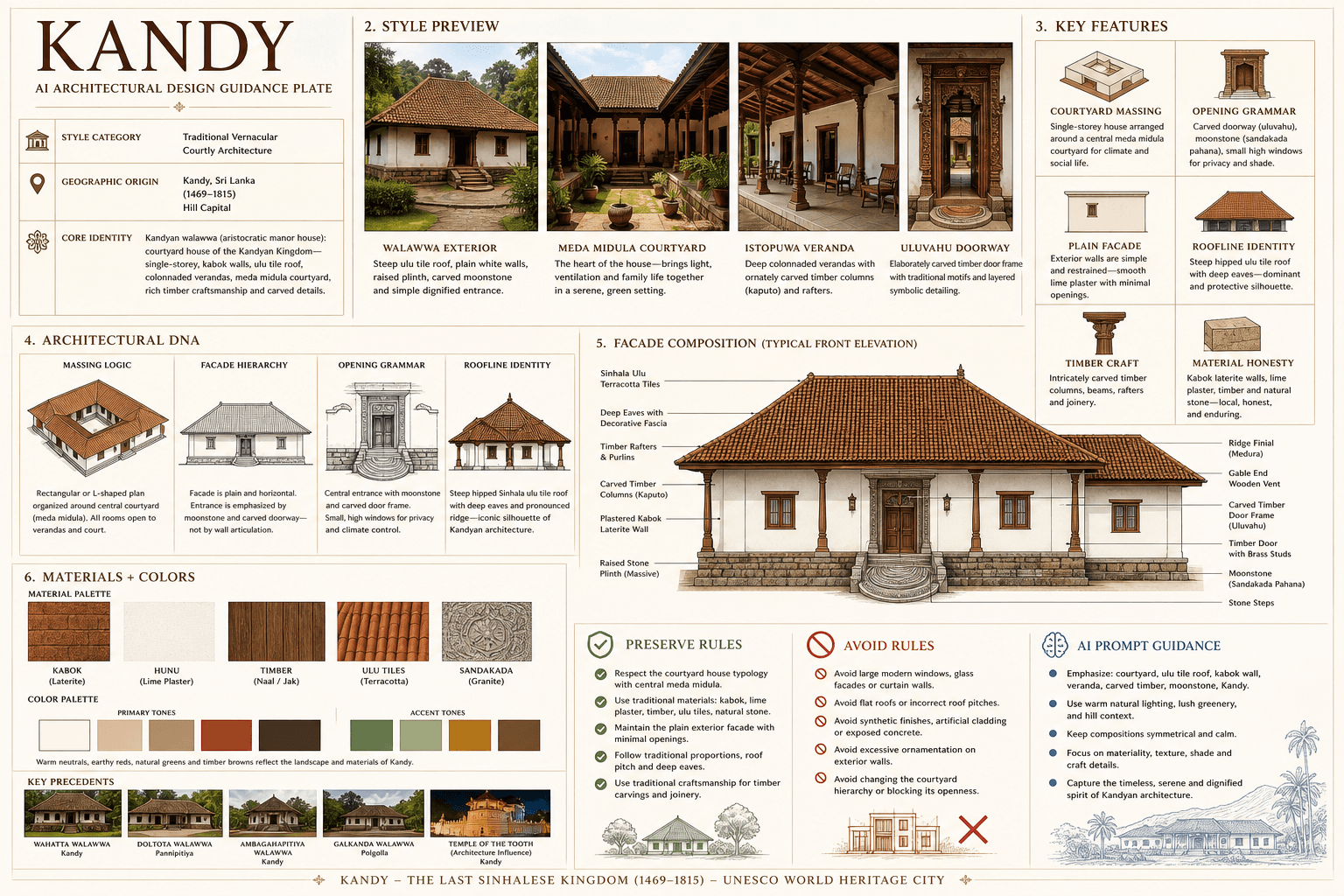
Kandy
Sri Lanka · Kandy
Kandyan Walawwa Manor Houses, Temple Architecture & Hill Capital Heritage
Definition
Kandy is a regional architectural identity from Sri Lanka. Kandyan Walawwa Manor Houses, Temple Architecture & Hill Capital Heritage.
- Country
- Sri Lanka
- Region
- Kandy
- Massing
- Kandyan walawwa: courtyard house typology — single-storey rectangular or L-shaped plan, arranged around a central meda midula (open courtyard).
- Materials
- Kabok (laterite): red-brown block — the universal wall material, typically rendered with lime plaster.
- Palette
- White, cream, pale sand, warm timber, and shadow-driven dark metal accents define the palette.
- Climate response
- Tropical highland (Cfb) — elevation 500m, cooler than lowlands (20-28°C year-round), high rainfall (2,500mm), misty mornings, surrounding forested hills (Hantana, Udawattakele).
Overview
Kandy is a regional architectural identity in Sri Lanka. Kandy — the last Sinhalese kingdom (1469-1815), hill capital, UNESCO World Heritage. Kandyan walawwa (aristocratic manor house) — the refined domestic architecture of the Kandyan Kingdom: single-storey courtyard house with steep hipped roof of Sinhala ulu half-round terracotta tiles, white lime-plastered kabok laterite walls, deep colonnaded verandas (istopuwa) with carved timber columns (kaputo), decorated timber do...
Visual DNA
Massing & Form
Kandyan walawwa: courtyard house typology — single-storey rectangular or L-shaped plan, arranged around a central meda midula (open courtyard). Rooms radiate from courtyard: sitting hall (visiting room), dining hall (bhojana shalawa), sleeping rooms, shrine room (budu geya).
Facade Language
Walawwa exterior facade is deliberately plain: white rendered kabok wall, minimal windows (small, high), simple entrance door with carved door frame (uluvahu) and moonstone step. All ornament faces inward to the courtyard.
Materials & Texture
Kabok (laterite): red-brown block — the universal wall material, typically rendered with lime plaster. Hunu (lime plaster): white to cream — the Kandyan wall finish, made from burnt coral or limestone.
Color Palette
White, cream, pale sand, warm timber, and shadow-driven dark metal accents define the palette. The facade should stay bright and climate-aware rather than heavy, gray, or over-saturated.
Ornament & Detail
Kandyan ornament reaches its highest expression in carved timber: door frames (uluvahu), column capitals (kaputo), brackets (kombuwa), and ceiling panels. Motifs: liya vela (continuous floral vine), nari lata (dancing figure vine), hansaputtuwa (entwined swans), kindura (mythical bird-human), panchavarna (five-color mo...
Climate Response
Tropical highland (Cfb) — elevation 500m, cooler than lowlands (20-28°C year-round), high rainfall (2,500mm), misty mornings, surrounding forested hills (Hantana, Udawattakele). Courtyard (meda midula): primary climate device — brings light, air, rain, and greenery into the center of the house, creates microclimate (co...
Landscape & Ground
Kandy — the last Sinhalese kingdom (1469-1815), hill capital, UNESCO World Heritage. Tropical highland (Cfb) — elevation 500m, cooler than lowlands (20-28°C year-round), high rainfall (2,500mm), misty mornings, surrounding forested hills (Hantana, Udawattakele).
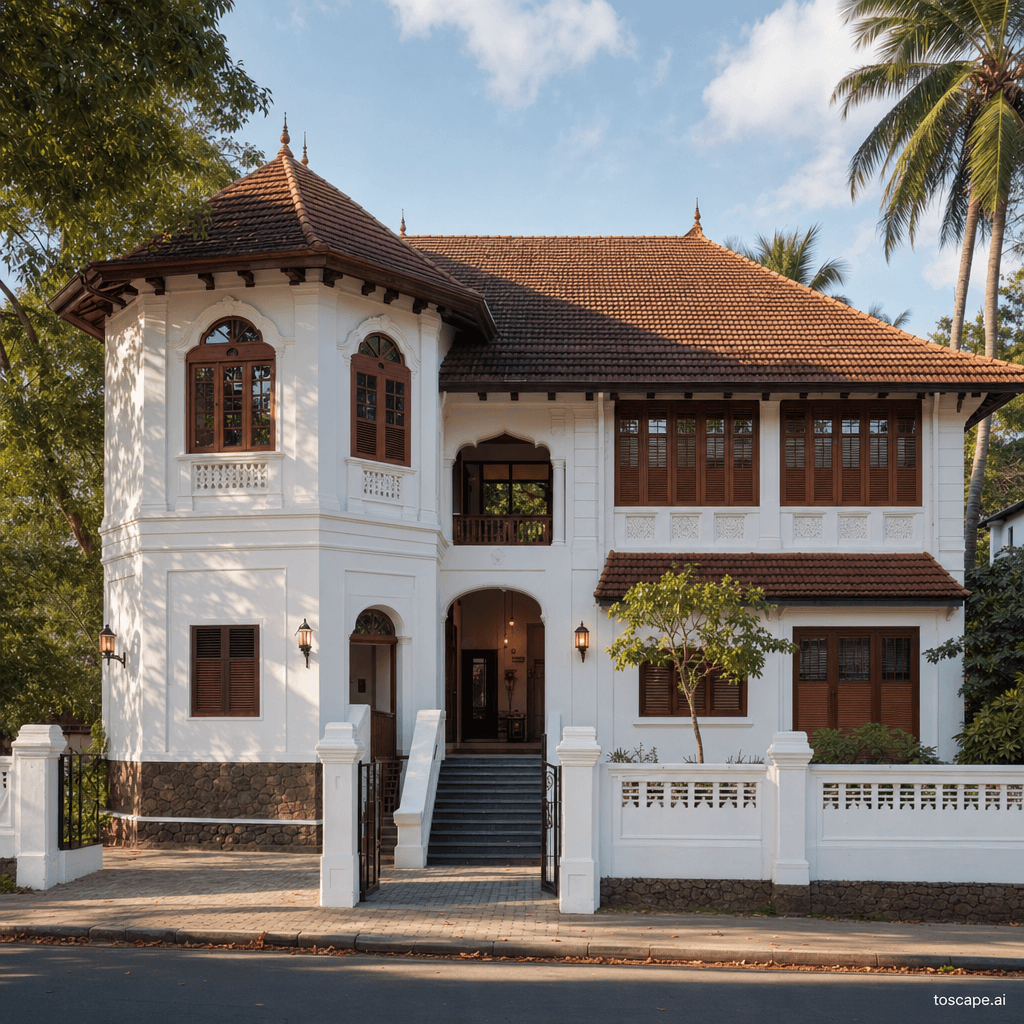
Reference elevation
Kandy — characteristic facade composition, Kandy.
Context Snapshot
Kandy — the last Sinhalese kingdom (1469-1815), hill capital, UNESCO World Heritage Tropical highland (Cfb) — elevation 500m, cooler than lowlands (20-28°C year-round), high rainfall (2,500mm), misty mornings, surrounding forested hills (Hantana, Udawattakele).
Contemporary Relevance
Kandy is useful today for residential, hospitality, civic, and place-branding work that needs Sri Lanka-specific character grounded in local massing, material tone, climate response, and settlement logic rather than generic international styling.
Use this style in Toscape
Explore Kandy directly inside Toscape using the Facade Re-Style and Design Options workflows.
Open Kandy in the galleryFrequently asked questions
What is Kandy?
Kandy is a regional architectural identity from Sri Lanka. Kandyan Walawwa Manor Houses, Temple Architecture & Hill Capital Heritage.
What materials define Kandy?
Kabok (laterite): red-brown block — the universal wall material, typically rendered with lime plaster. Hunu (lime plaster): white to cream — the Kandyan wall finish, made from burnt coral or limestone.
What is the Kandy color palette?
White, cream, pale sand, warm timber, and shadow-driven dark metal accents define the palette. The facade should stay bright and climate-aware rather than heavy, gray, or over-saturated.
Where does Kandy come from?
Kandy — the last Sinhalese kingdom (1469-1815), hill capital, UNESCO World Heritage Tropical highland (Cfb) — elevation 500m, cooler than lowlands (20-28°C year-round), high rainfall (2,500mm), misty mornings, surrounding forested hills (Hantana, Udawattakele).
When should architects use Kandy?
Kandy is useful today for residential, hospitality, civic, and place-branding work that needs Sri Lanka-specific character grounded in local massing, material tone, climate response, and settlement logic rather than generic international styling.
How do you render Kandy in Toscape?
Open Toscape on Windows, load your own photo, elevation, sketch, or CAD view, then apply the Kandy reference from the built-in style library. The Facade Re-Style and Design Options workflows keep your project geometry and camera while shifting materials, proportion, and detailing toward Kandy.