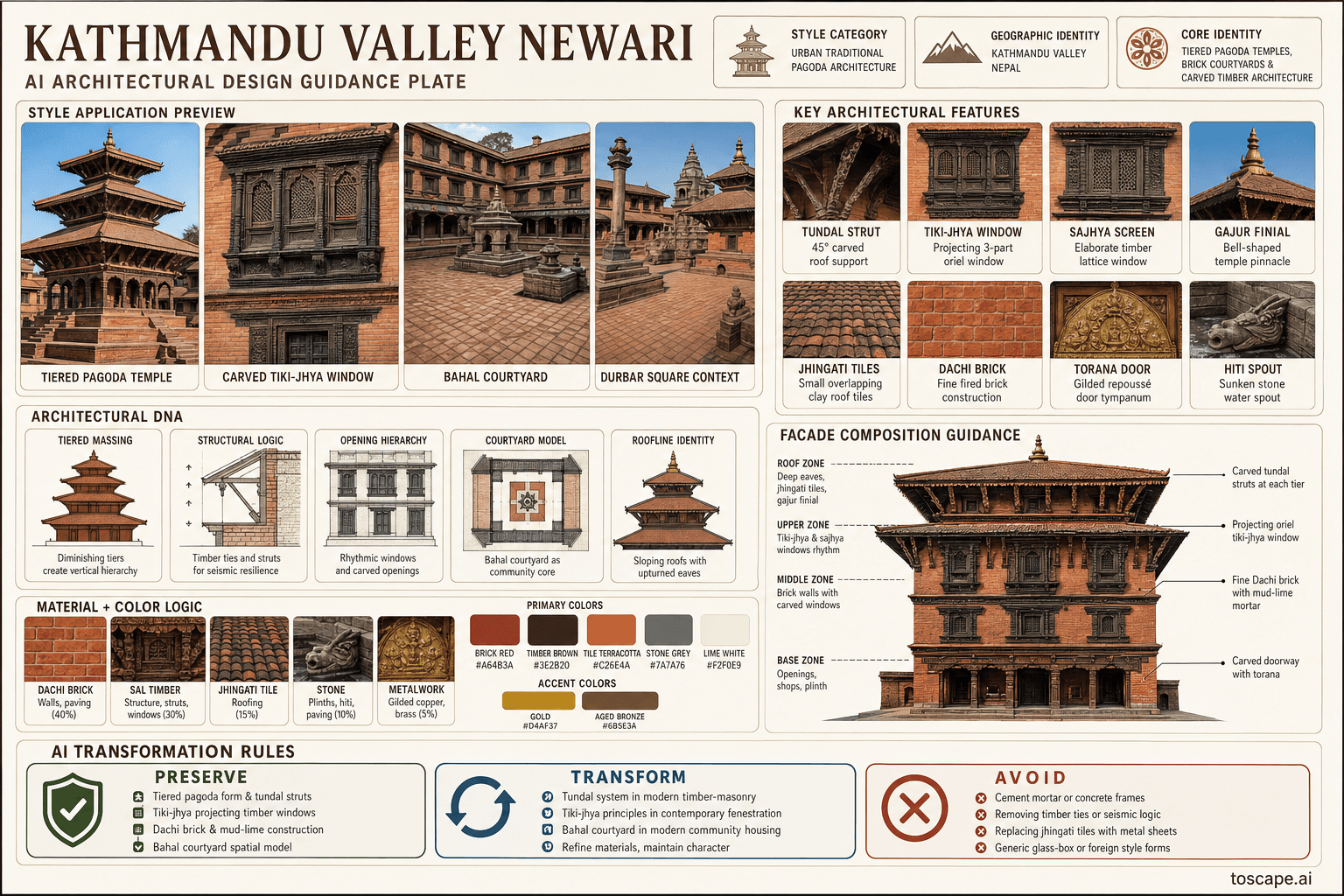
Kathmandu Valley Newari
Nepal · Kathmandu Valley Newari
Tiered Pagoda Temples, Brick Courtyards & Carved Timber Strut Architecture
Definition
Kathmandu Valley Newari is a regional architectural identity from Nepal. Tiered Pagoda Temples, Brick Courtyards & Carved Timber Strut Architecture.
- Country
- Nepal
- Region
- Kathmandu Valley Newari
- Massing
- Tiered temple: square or rectangular plan, diminishing stacked stories (1-5 tiers), each with sloping roof on carved wooden struts (tundal).
- Materials
- Fired brick (dachi appa — the fine 'Dachi' brick of Kathmandu) — walls, paving. Sal wood (Shorea robusta) — carved struts, windows, doors, beams, pegs.
- Palette
- Warm earth, sandy beige, ochre, clay brown, and sun-softened mineral tones should dominate, with palm green or weathered timber as secondary accents.
- Climate response
- Subtropical valley (1400m), monsoon rainfall (1400mm/year), cool winters. Sloping jhingati tile roofs for rain shedding.
Overview
Kathmandu Valley Newari is a regional architectural identity in Nepal. Kathmandu Valley Newari architecture — the most sophisticated urban medieval civilization of the Himalayas. Tiered pagoda temples with strut-supported sloping roofs, fired brick with carved timber windows (tiki-jhya / sajhya), brick-paved courtyard neighborhoods (bahal / chowk), jhingati clay tiles, hiti stone water spouts
Visual DNA
Massing & Form
Tiered temple: square or rectangular plan, diminishing stacked stories (1-5 tiers), each with sloping roof on carved wooden struts (tundal). Residential: rectangular multi-story brick courtyard buildings around shared brick-paved bahal, ground-floor shops/work rooms, upper living with projecting windows.
Facade Language
Palace/residential: rhythmic projecting timber windows — tiki-jhya (oriel bay window, 3-part), sajhya (lattice/screen window), pasukha-jhya (5-part grand window). Ground floor: open shop fronts or carved doors.
Materials & Texture
Fired brick (dachi appa — the fine 'Dachi' brick of Kathmandu) — walls, paving. Sal wood (Shorea robusta) — carved struts, windows, doors, beams, pegs.
Color Palette
Warm earth, sandy beige, ochre, clay brown, and sun-softened mineral tones should dominate, with palm green or weathered timber as secondary accents. The palette should read as land-derived rather than polished or urban-generic.
Ornament & Detail
Carved timber struts (tundal) as primary ornamental element: deity figures, mythical beasts (kirtimukha, makara), floral and geometric — each strut a sculptural artwork. Windows: tiki-jhya and sajhya represent the world's most elaborate wooden window tradition — lattice geometric (jaali), figurative, and composite.
Climate Response
Subtropical valley (1400m), monsoon rainfall (1400mm/year), cool winters. Sloping jhingati tile roofs for rain shedding.
Landscape & Ground
Kathmandu Valley Newari architecture — the most sophisticated urban medieval civilization of the Himalayas. Subtropical valley (1400m), monsoon rainfall (1400mm/year), cool winters.
Reference elevation
Kathmandu Valley Newari — characteristic facade composition, Kathmandu Valley Newari.
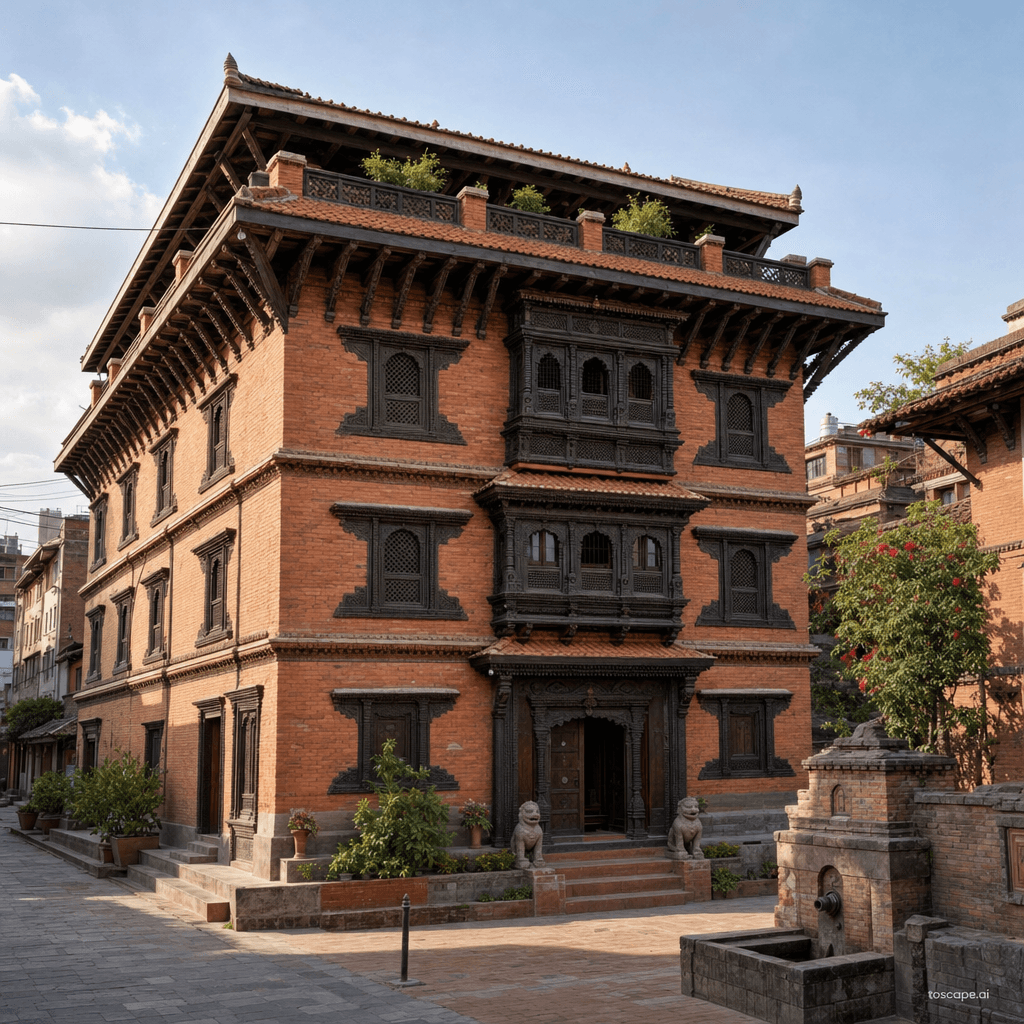
Context Snapshot
Kathmandu Valley Newari architecture — the most sophisticated urban medieval civilization of the Himalayas Subtropical valley (1400m), monsoon rainfall (1400mm/year), cool winters.
Contemporary Relevance
Kathmandu Valley Newari is useful today for residential, hospitality, civic, and place-branding work that needs Nepal-specific character grounded in local massing, material tone, climate response, and settlement logic rather than generic international styling.
Use this style in Toscape
Explore Kathmandu Valley Newari directly inside Toscape using the Facade Re-Style and Design Options workflows.
Open Kathmandu Valley Newari in the galleryFrequently asked questions
What is Kathmandu Valley Newari?
Kathmandu Valley Newari is a regional architectural identity from Nepal. Tiered Pagoda Temples, Brick Courtyards & Carved Timber Strut Architecture.
What materials define Kathmandu Valley Newari?
Fired brick (dachi appa — the fine 'Dachi' brick of Kathmandu) — walls, paving. Sal wood (Shorea robusta) — carved struts, windows, doors, beams, pegs.
What is the Kathmandu Valley Newari color palette?
Warm earth, sandy beige, ochre, clay brown, and sun-softened mineral tones should dominate, with palm green or weathered timber as secondary accents. The palette should read as land-derived rather than polished or urban-generic.
Where does Kathmandu Valley Newari come from?
Kathmandu Valley Newari architecture — the most sophisticated urban medieval civilization of the Himalayas Subtropical valley (1400m), monsoon rainfall (1400mm/year), cool winters.
When should architects use Kathmandu Valley Newari?
Kathmandu Valley Newari is useful today for residential, hospitality, civic, and place-branding work that needs Nepal-specific character grounded in local massing, material tone, climate response, and settlement logic rather than generic international styling.
How do you render Kathmandu Valley Newari in Toscape?
Open Toscape on Windows, load your own photo, elevation, sketch, or CAD view, then apply the Kathmandu Valley Newari reference from the built-in style library. The Facade Re-Style and Design Options workflows keep your project geometry and camera while shifting materials, proportion, and detailing toward Kathmandu Valley Newari.