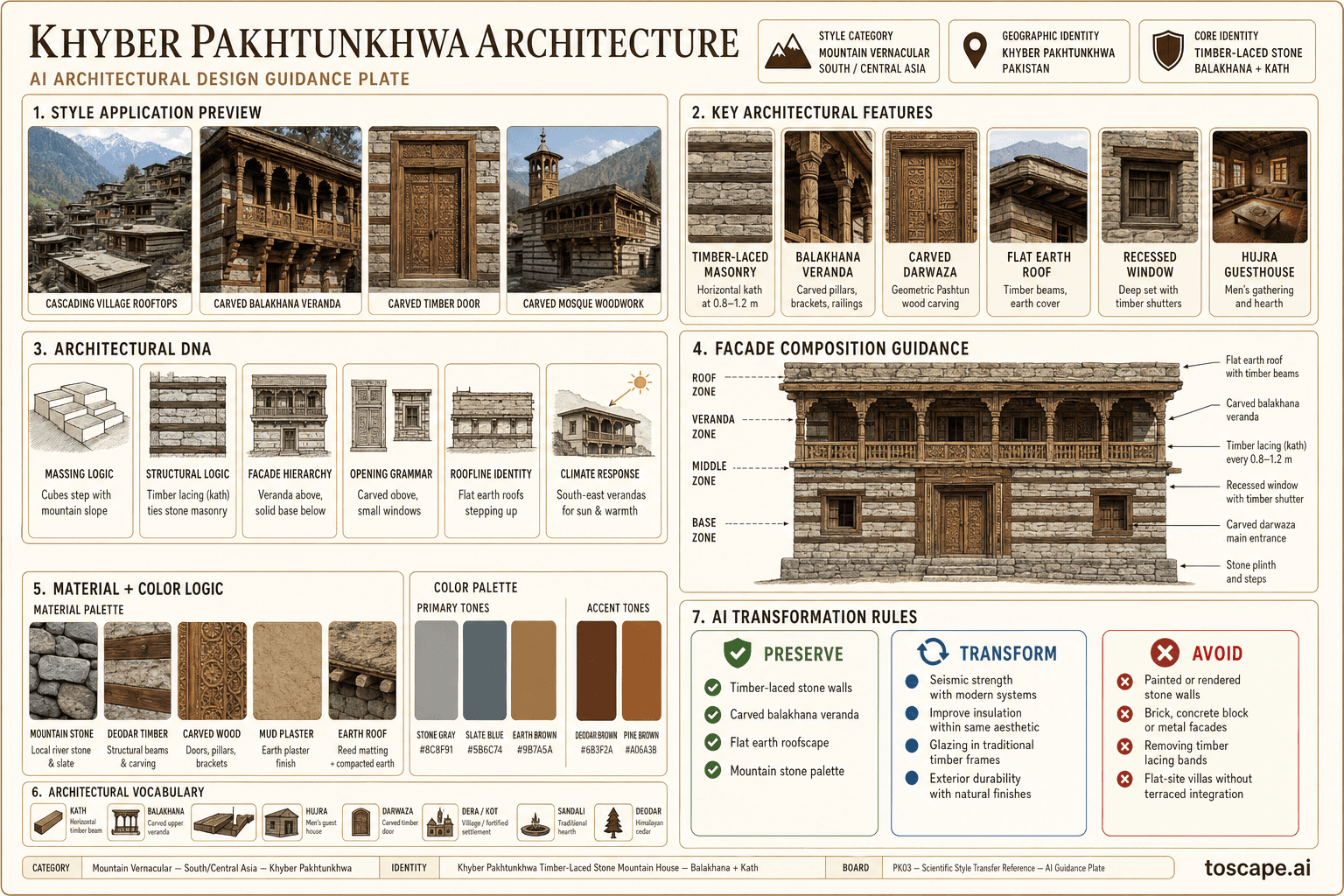
Khyber Pakhtunkhwa
Pakistan · vernacular architecture of Khyber Pakhtunkhwa (formerly NWFP)
The timber-and-stone mountain architecture of the Pashtun frontier — carved wooden mosques and houses of the Swat and Indus valleys, the towering mud-plastered forts of the tribal...
Definition
Khyber Pakhtunkhwa is a regional architectural identity from Pakistan. The timber-and-stone mountain architecture of the Pashtun frontier — carved wooden mosques and houses of the Swat and Indus valleys, the towering mud-plastered forts of the tribal.
- Country
- Pakistan
- Region
- vernacular architecture of Khyber Pakhtunkhwa (formerly NWFP).
- Massing
- The Khyber Pakhtunkhwa house is a cuboid volume — 8–15 m wide × 8–15 m deep — two to three storeys.
- Materials
- Mountain stone — river boulders, slate, schist, or metamorphic rock — gray, blue-gray, greenish-gray, warm brown depending on local geology.
- Palette
- Warm earth, sandy beige, ochre, clay brown, and sun-softened mineral tones should dominate, with palm green or weathered timber as secondary accents.
- Climate response
- The mountain climate — cold snowy winters (0 to -15°C at upper elevations), mild summers (20–30°C).
Overview
Khyber Pakhtunkhwa is a regional architectural identity in Pakistan. Traditional vernacular architecture of Khyber Pakhtunkhwa (formerly NWFP) — the mountain valleys of Swat, Dir, Chitral, and the Indus Kohistan region. Defined by the distinctive "timber-laced" masonry construction (stone rubble walls with horizontal timber reinforcing bands), intricately carved wooden elements (doors, pillars, balconies, mosque mihrabs), flat earth-and-timber roofs, and the profound adaptation to ste...
Visual DNA
Massing & Form
The Khyber Pakhtunkhwa house is a cuboid volume — 8–15 m wide × 8–15 m deep — two to three storeys, stepping up or cut into the mountain slope. Houses are clustered in dense terraced villages (dera / kot) where each house's roof serves as the terrace/courtyard of the house above.
Facade Language
The Khyber Pakhtunkhwa facade is organized by the horizontal timber lacing: Horizontal timber stripe rhythm: Dark brown timber beams creating continuous horizontal lines across the stone wall at 0.8–1.2 m intervals — the most distinctive visual feature of the region's architecture. Beams also frame windows, doors, and...
Materials & Texture
Mountain stone — river boulders, slate, schist, or metamorphic rock — gray, blue-gray, greenish-gray, warm brown depending on local geology. Collected from riverbeds and mountain slopes — no quarrying, just gathering.
Color Palette
Warm earth, sandy beige, ochre, clay brown, and sun-softened mineral tones should dominate, with palm green or weathered timber as secondary accents. The palette should read as land-derived rather than polished or urban-generic.
Ornament & Detail
Khyber Pakhtunkhwa ornament is concentrated in wood carving — the stone walls are deliberately plain, creating a powerful contrast with the intricately carved timber elements: (1) Door carving — geometric patterns (Islamic star interlace, concentric polygons, herringbone) — the primary ornamental surface. (2) Pillar ca...
Climate Response
The mountain climate — cold snowy winters (0 to -15°C at upper elevations), mild summers (20–30°C), 600–1,200 mm annual precipitation — shapes the architecture: (1) Timber-laced masonry provides excellent seismic resistance — critical in the India-Asia collision zone (2005 Kashmir earthquake demonstrated the superiorit...
Landscape & Ground
Traditional vernacular architecture of Khyber Pakhtunkhwa (formerly NWFP) — the mountain valleys of Swat, Dir, Chitral, and the Indus Kohistan region. Defined by the distinctive "timber-laced" masonry construction (stone rubble walls with horizontal timber reinforcing bands), intricately carved wooden elements (doors...
Reference elevation
Khyber Pakhtunkhwa — characteristic facade composition, vernacular architecture of Khyber Pakhtunkhwa (formerly NWFP).
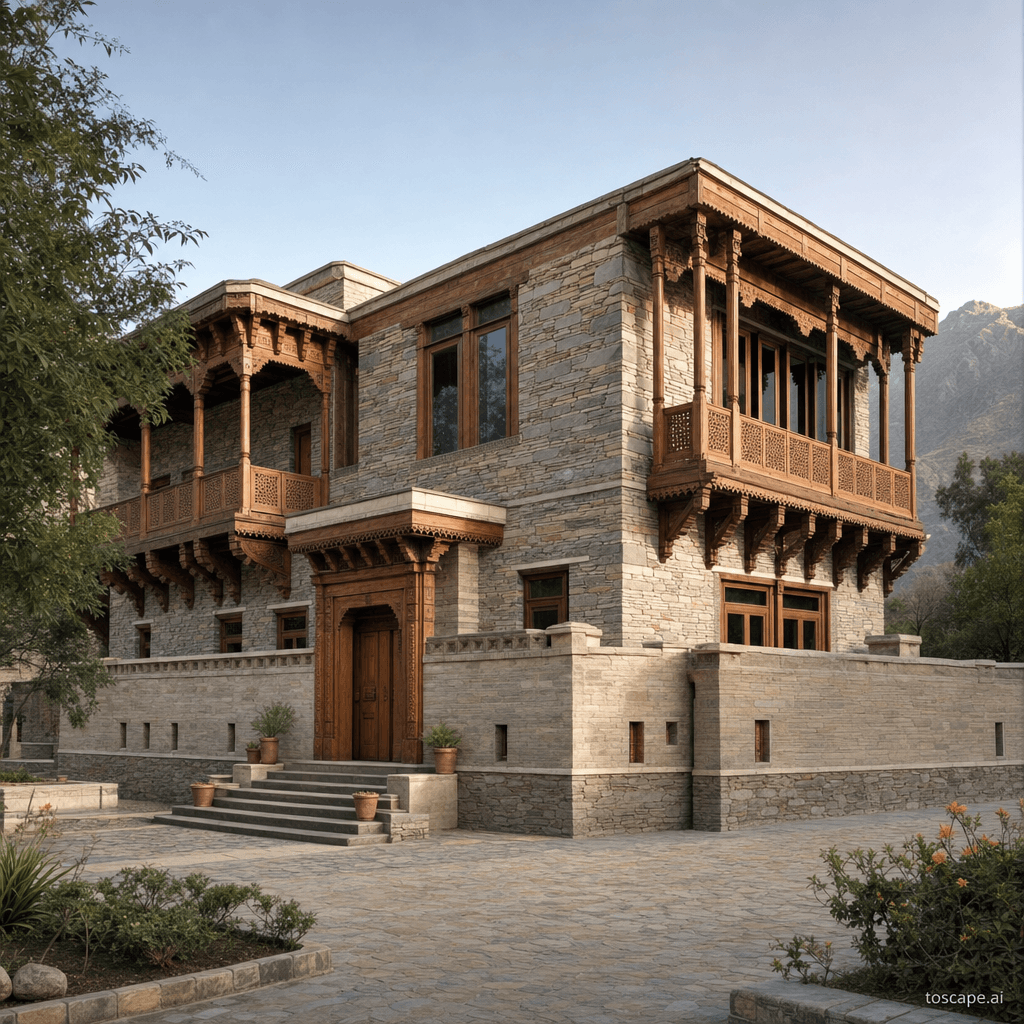
Context Snapshot
Traditional vernacular architecture of Khyber Pakhtunkhwa (formerly NWFP) — the mountain valleys of Swat, Dir, Chitral, and the Indus Kohistan region. The mountain climate — cold snowy winters (0 to -15°C at upper elevations), mild summers (20–30°C), 600–1,200 mm annual precipitation — shapes the architecture: (1) Timber-laced masonry provides excellent seismic resista...
Contemporary Relevance
Khyber Pakhtunkhwa is useful today for residential, hospitality, civic, and place-branding work that needs Pakistan-specific character grounded in local massing, material tone, climate response, and settlement logic rather than generic international styling.
Use this style in Toscape
Explore Khyber Pakhtunkhwa directly inside Toscape using the Facade Re-Style and Design Options workflows.
Open Khyber Pakhtunkhwa in the galleryFrequently asked questions
What is Khyber Pakhtunkhwa?
Khyber Pakhtunkhwa is a regional architectural identity from Pakistan. The timber-and-stone mountain architecture of the Pashtun frontier — carved wooden mosques and houses of the Swat and Indus valleys, the towering mud-plastered forts of the tribal.
What materials define Khyber Pakhtunkhwa?
Mountain stone — river boulders, slate, schist, or metamorphic rock — gray, blue-gray, greenish-gray, warm brown depending on local geology. Collected from riverbeds and mountain slopes — no quarrying, just gathering.
What is the Khyber Pakhtunkhwa color palette?
Warm earth, sandy beige, ochre, clay brown, and sun-softened mineral tones should dominate, with palm green or weathered timber as secondary accents. The palette should read as land-derived rather than polished or urban-generic.
Where does Khyber Pakhtunkhwa come from?
Traditional vernacular architecture of Khyber Pakhtunkhwa (formerly NWFP) — the mountain valleys of Swat, Dir, Chitral, and the Indus Kohistan region. The mountain climate — cold snowy winters (0 to -15°C at upper elevations), mild summers (20–30°C), 600–1,200 mm annual precipitation — shapes the architecture: (1) Timber-laced masonry provides excellent seismic resista.
When should architects use Khyber Pakhtunkhwa?
Khyber Pakhtunkhwa is useful today for residential, hospitality, civic, and place-branding work that needs Pakistan-specific character grounded in local massing, material tone, climate response, and settlement logic rather than generic international styling.
How do you render Khyber Pakhtunkhwa in Toscape?
Open Toscape on Windows, load your own photo, elevation, sketch, or CAD view, then apply the Khyber Pakhtunkhwa reference from the built-in style library. The Facade Re-Style and Design Options workflows keep your project geometry and camera while shifting materials, proportion, and detailing toward Khyber Pakhtunkhwa.