Konso
Ethiopia · architectural identity of the Konso cultural landscape (UNESCO World Heritage, i...
The dry-stone walled hilltop settlements of the Konso people — the UNESCO-listed cultural landscape of southern Ethiopia where villages are stone fortresses on hilltops, the surrou...
Definition
Konso is a regional architectural identity from Ethiopia. The dry-stone walled hilltop settlements of the Konso people — the UNESCO-listed cultural landscape of southern Ethiopia where villages are stone fortresses on hilltops, the surrou.
- Country
- Ethiopia
- Region
- architectural identity of the Konso cultural landscape (UNESCO World Heritage, i.
- Massing
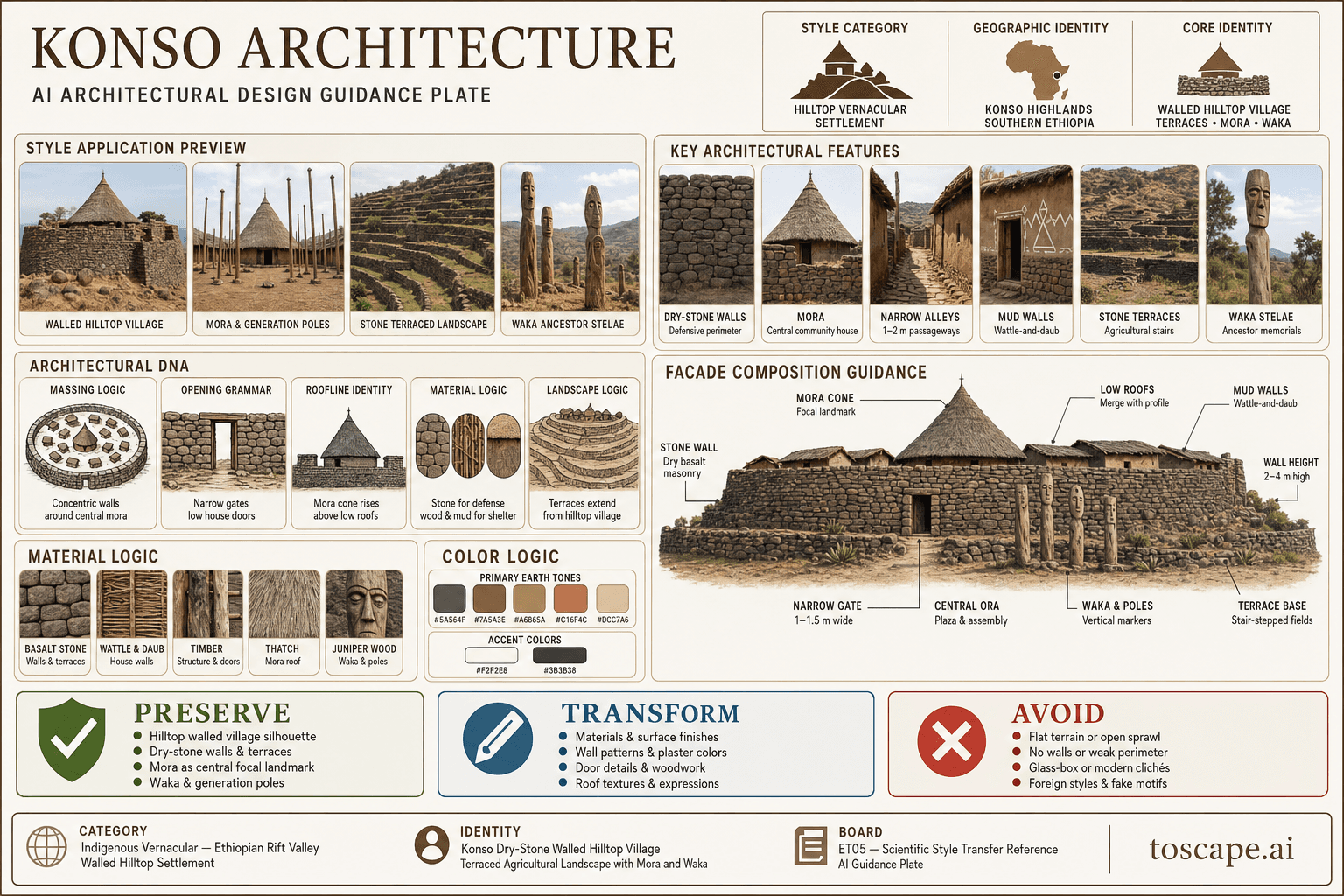
- The Konso settlement is a centripetal composition: the village occupies a hilltop, its irregular oval or circular plan defined by the outermost defensive wall.
- Materials
- Materials are entirely local: (1) Basalt stone — the volcanic bedrock of the Rift Valley escarpment, used for defensive walls, terrace retaining walls, house foundations.
- Palette
- Warm earth, sandy beige, ochre, clay brown, and sun-softened mineral tones should dominate, with palm green or weathered timber as secondary accents.
- Climate response
- The Konso Highlands (1,400–1,800 m) have a semi-arid to sub-humid climate with bimodal rainfall (400–800 mm/year).
Overview
Konso is a regional architectural identity in Ethiopia. The architectural identity of the Konso cultural landscape (UNESCO World Heritage, inscribed 2011) — the paleta (walled hilltop village) of the Konso Highlands (1,400–1,800 m) in the southern Rift Valley — a settlement type defined by concentric dry-stone defensive walls (2–4 m high, 1–1.5 m thick), accessed through narrow stone gateways, containing clusters of rectangular thatch-roofed houses within the enclosure —...
Visual DNA
Massing & Form
The Konso settlement is a centripetal composition: the village occupies a hilltop, its irregular oval or circular plan defined by the outermost defensive wall. Within the walls, the mora (central community house) occupies the highest point or the central plaza — a large circular form contrasting with the rectangular ho...
Facade Language
The village facade — seen from below on the terraced slopes — is the dry-stone wall banding the hilltop, with the thatched roof of the mora rising above it as the focal point. The stone walls are textured grey-brown basalt surfaces, their irregular block coursing creating a horizontal rhythm.
Materials & Texture
Materials are entirely local: (1) Basalt stone — the volcanic bedrock of the Rift Valley escarpment, used for defensive walls, terrace retaining walls, house foundations, and paving. (2) Timber — acacia, juniper, eucalyptus for house frames, door planks, and roof joists.
Color Palette
Warm earth, sandy beige, ochre, clay brown, and sun-softened mineral tones should dominate, with palm green or weathered timber as secondary accents. The palette should read as land-derived rather than polished or urban-generic.
Ornament & Detail
Konso ornament is sculptural and spatial rather than applied: (1) The waka — carved juniper-wood ancestor figures, typically 1–2 m tall, depicting the deceased with stylized features, erect posture, and often with a raised arm or holding a spear — erected in fields and at village entrances as memorial markers. (2) The...
Climate Response
The Konso Highlands (1,400–1,800 m) have a semi-arid to sub-humid climate with bimodal rainfall (400–800 mm/year). The stone terracing is the fundamental climate adaptation: the dry-stone retaining walls reduce soil erosion on steep slopes (20–40° gradients), create level planting surfaces, and trap moisture.
Landscape & Ground
The architectural identity of the Konso cultural landscape (UNESCO World Heritage, inscribed 2011) — the paleta (walled hilltop village) of the Konso Highlands (1,400–1,800 m) in the southern Rift Valley — a settlement type defined by concentric dry-stone defensive walls (2–4 m high, 1–1.5 m thick), accessed through na...
Reference elevation
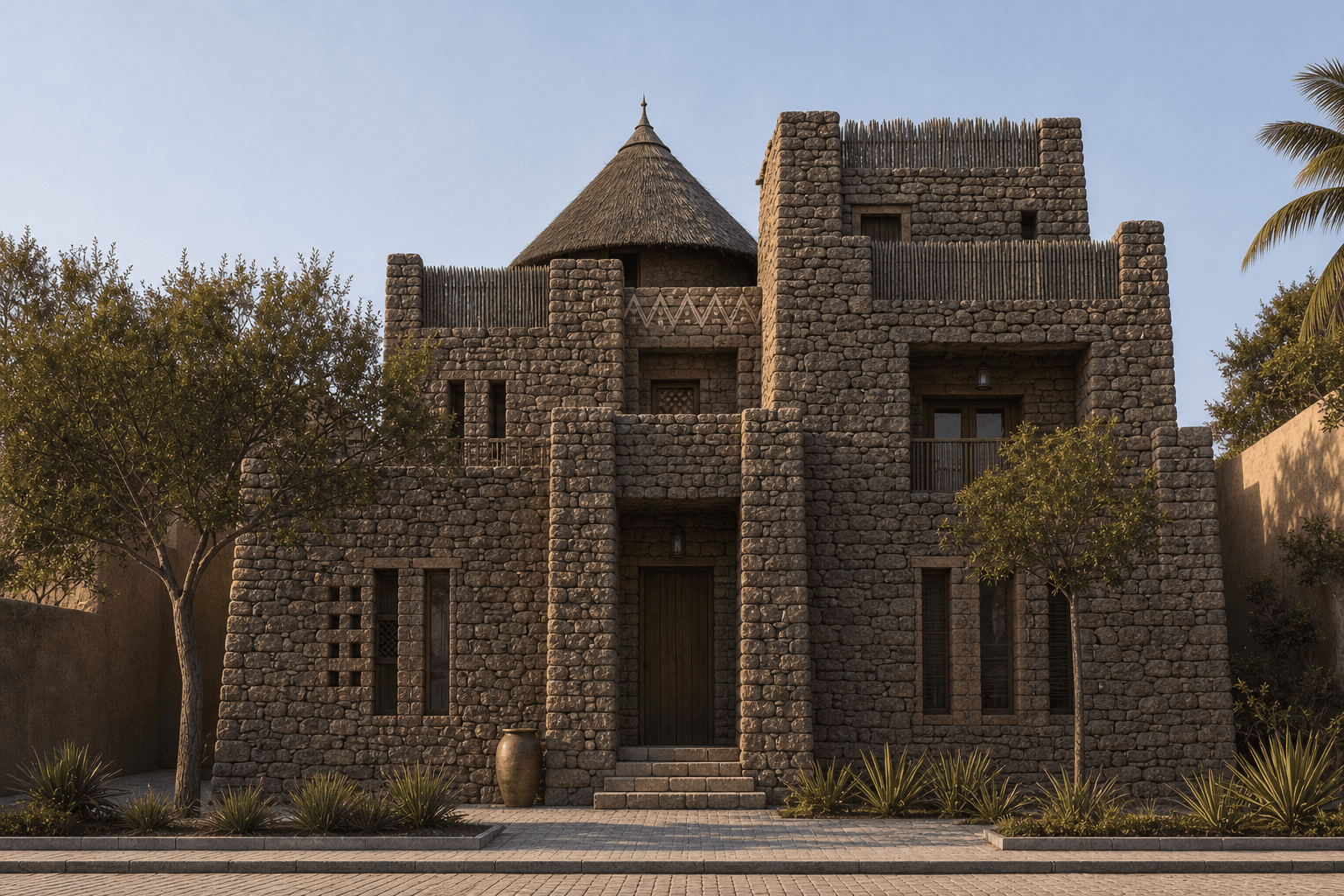
Konso — characteristic facade composition, architectural identity of the Konso cultural landscape (UNESCO World Heritage, i....
Context Snapshot
The architectural identity of the Konso cultural landscape (UNESCO World Heritage, inscribed 2011) — the paleta (walled hilltop village) of the Konso Highlands (1,400–1,800 m) in the southern Rift Val... The Konso Highlands (1,400–1,800 m) have a semi-arid to sub-humid climate with bimodal rainfall (400–800 mm/year).
Contemporary Relevance
Konso is useful today for residential, hospitality, civic, and place-branding work that needs Ethiopia-specific character grounded in local massing, material tone, climate response, and settlement logic rather than generic international styling.
Use this style in Toscape
Explore Konso directly inside Toscape using the Facade Re-Style and Design Options workflows.
Open Konso in the galleryFrequently asked questions
What is Konso?
Konso is a regional architectural identity from Ethiopia. The dry-stone walled hilltop settlements of the Konso people — the UNESCO-listed cultural landscape of southern Ethiopia where villages are stone fortresses on hilltops, the surrou.
What materials define Konso?
Materials are entirely local: (1) Basalt stone — the volcanic bedrock of the Rift Valley escarpment, used for defensive walls, terrace retaining walls, house foundations, and paving. (2) Timber — acacia, juniper, eucalyptus for house frames, door planks, and roof joists.
What is the Konso color palette?
Warm earth, sandy beige, ochre, clay brown, and sun-softened mineral tones should dominate, with palm green or weathered timber as secondary accents. The palette should read as land-derived rather than polished or urban-generic.
Where does Konso come from?
The architectural identity of the Konso cultural landscape (UNESCO World Heritage, inscribed 2011) — the paleta (walled hilltop village) of the Konso Highlands (1,400–1,800 m) in the southern Rift Val... The Konso Highlands (1,400–1,800 m) have a semi-arid to sub-humid climate with bimodal rainfall (400–800 mm/year).
When should architects use Konso?
Konso is useful today for residential, hospitality, civic, and place-branding work that needs Ethiopia-specific character grounded in local massing, material tone, climate response, and settlement logic rather than generic international styling.
How do you render Konso in Toscape?
Open Toscape on Windows, load your own photo, elevation, sketch, or CAD view, then apply the Konso reference from the built-in style library. The Facade Re-Style and Design Options workflows keep your project geometry and camera while shifting materials, proportion, and detailing toward Konso.