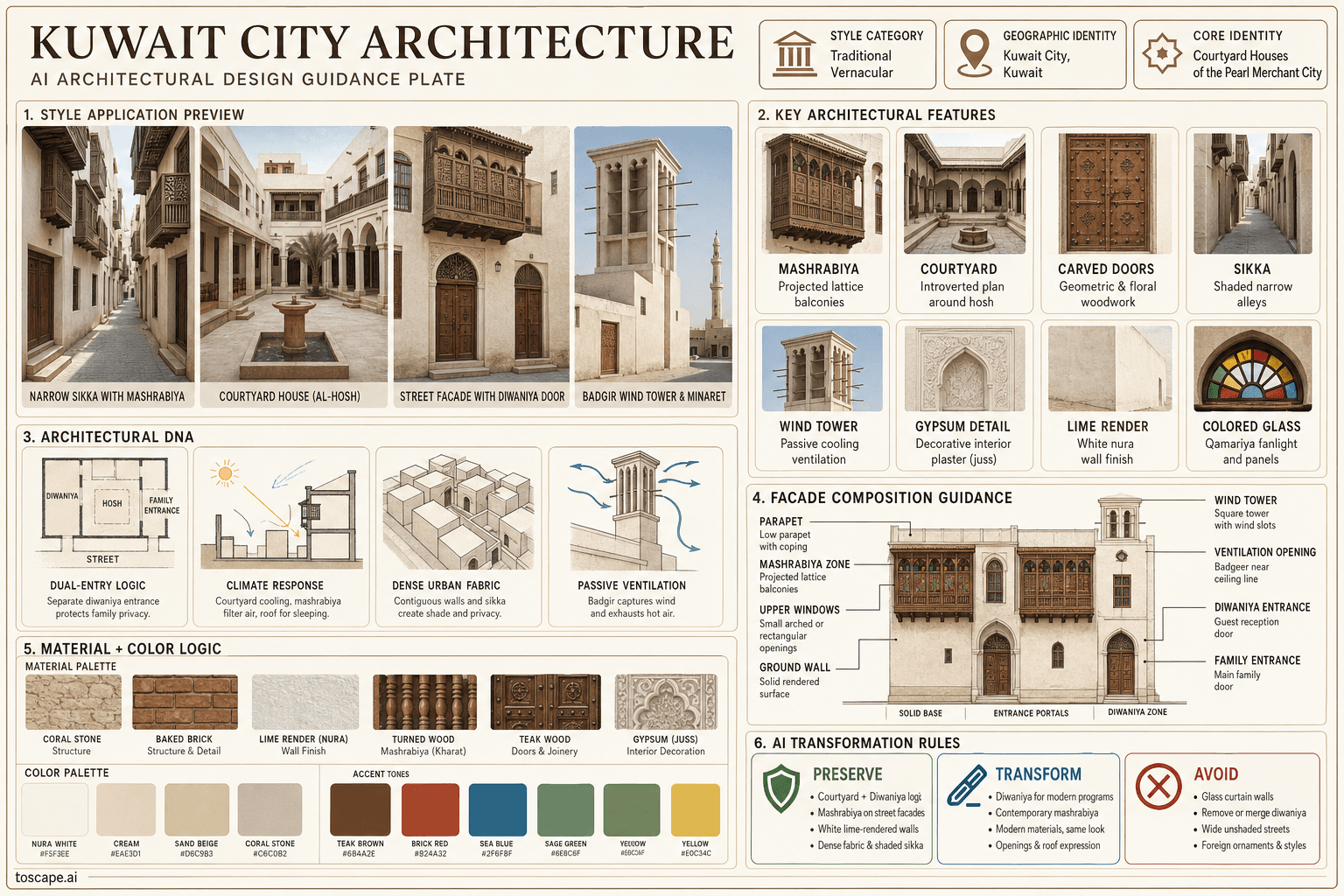
Kuwait City
Kuwait · Kuwait City's pre-oil urban core
The pearl-merchant courtyard houses of old Kuwait — mashrabiya balconies, narrow alleyways (sikka), wind towers, and the architectural heritage of the Gulf's historic trading port
Definition
Kuwait City is a regional architectural identity from Kuwait. The pearl-merchant courtyard houses of old Kuwait — mashrabiya balconies, narrow alleyways (sikka), wind towers, and the architectural heritage of the Gulf's historic trading port.
- Country
- Kuwait
- Region
- Kuwait City's pre-oil urban core.
- Massing
- Traditional Kuwaiti courtyard houses are rectangular, 1–2 storey volumes — typically 12–20 m wide × 15–30 m deep — organized around a central courtyard.
- Materials
- Coral stone (farrush) — pale cream to gray-beige, quarried from coastal seabed — the primary traditional wall material Baked brick (ajur) — reddish-brown fired clay brick.
- Palette
- White, cream, pale sand, warm timber, and shadow-driven dark metal accents define the palette.
- Climate response
- Kuwait City's extreme climate — hot, humid summers with shamal dust storms — drives architectural responses: (1) Courtyard as microclimate — the hosh with central fountain.
Overview
Kuwait City is a regional architectural identity in Kuwait. Traditional architecture of Kuwait City's pre-oil urban core — the courtyard houses (al-hosh) of the merchant families in the old walled city (within the historic gates: Dasman, Naif, Jahra, Shamiya). Kuwait's architectural heritage combines Gulf coastal vernacular with distinctive pearl-merchant typologies, Ottoman-influenced mashrabiya traditions, and the unique spatial organization of a city that was the Gulf's pr...
Visual DNA
Massing & Form
Traditional Kuwaiti courtyard houses are rectangular, 1–2 storey volumes — typically 12–20 m wide × 15–30 m deep — organized around a central courtyard. The massing is introverted: high external walls (4–7 m) with minimal ground-floor openings, all major rooms opening onto the courtyard.
Facade Language
The Kuwaiti street facade is characterized by controlled austerity at ground level and decorative projection at upper levels: Ground floor: Solid rendered wall — cream to white — with minimal openings. The only articulation is the entrance door(s) — deeply recessed within a pointed or round-arch portal.
Materials & Texture
Coral stone (farrush) — pale cream to gray-beige, quarried from coastal seabed — the primary traditional wall material Baked brick (ajur) — reddish-brown fired clay brick, used in later pre-oil construction and for decorative courses Lime render (nura) — white to cream waterproof plaster made from burnt limestone and s...
Color Palette
White, cream, pale sand, warm timber, and shadow-driven dark metal accents define the palette. The facade should stay bright and climate-aware rather than heavy, gray, or over-saturated.
Ornament & Detail
Kuwaiti ornament is concentrated at the courtyard and the entrance: (1) Carved wooden doors — the most decorated element. Kuwaiti doors feature geometric paneling, central medallions with star patterns, and brass/iron studwork.
Climate Response
Kuwait City's extreme climate — hot, humid summers with shamal dust storms — drives architectural responses: (1) Courtyard as microclimate — the hosh with central fountain or well creates evaporative cooling. (2) Narrow alleyways (sikka) — the urban fabric is designed for maximum mutual shading — building heights calcu...
Landscape & Ground
Traditional architecture of Kuwait City's pre-oil urban core — the courtyard houses (al-hosh) of the merchant families in the old walled city (within the historic gates: Dasman, Naif, Jahra, Shamiya). Kuwait's architectural heritage combines Gulf coastal vernacular with distinctive pearl-merchant typologies, Ottoman-in...
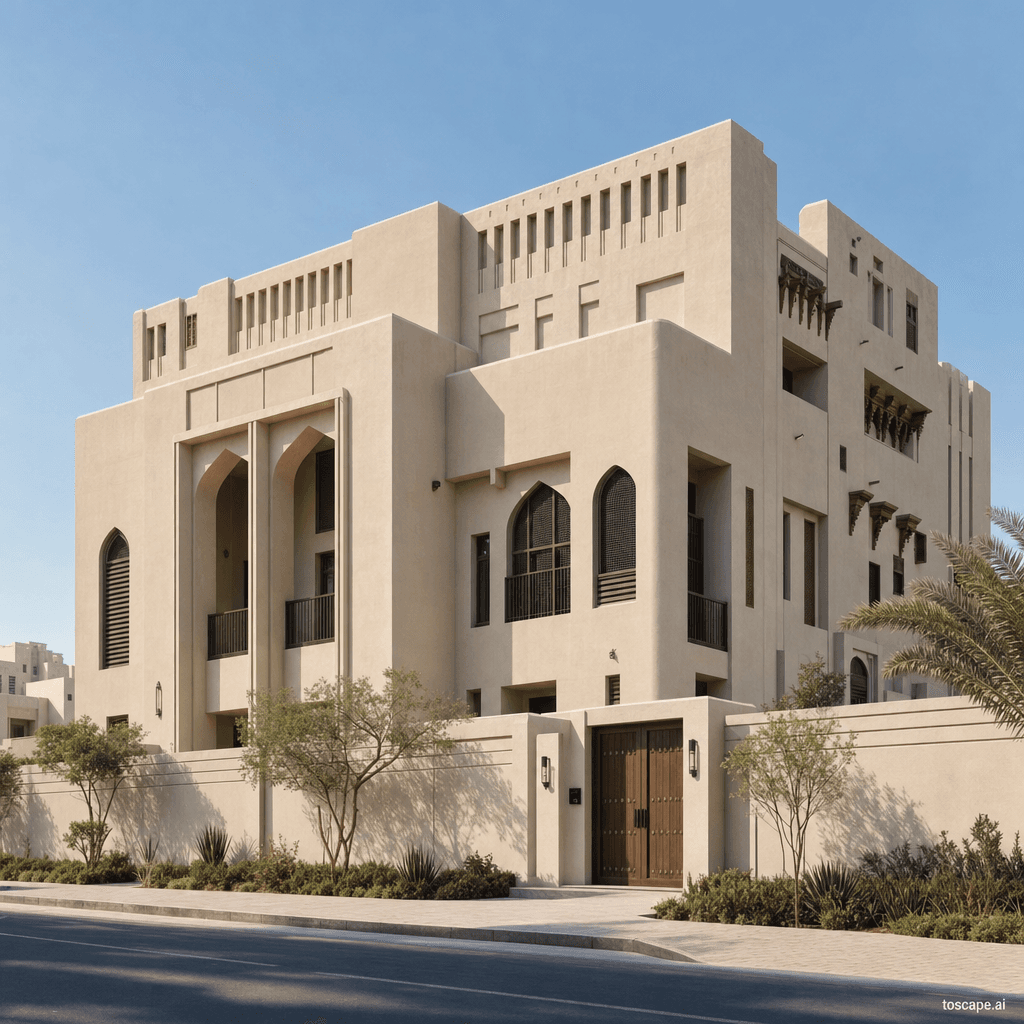
Reference elevation
Kuwait City — characteristic facade composition, Kuwait City's pre-oil urban core.
Context Snapshot
Traditional architecture of Kuwait City's pre-oil urban core — the courtyard houses (al-hosh) of the merchant families in the old walled city (within the historic gates: Dasman, Naif, Jahra, Shamiya). Kuwait City's extreme climate — hot, humid summers with shamal dust storms — drives architectural responses: (1) Courtyard as microclimate — the hosh with central fountain or well creates evaporative cooling.
Contemporary Relevance
Kuwait City is useful today for residential, hospitality, civic, and place-branding work that needs Kuwait-specific character grounded in local massing, material tone, climate response, and settlement logic rather than generic international styling.
Use this style in Toscape
Explore Kuwait City directly inside Toscape using the Facade Re-Style and Design Options workflows.
Open Kuwait City in the galleryFrequently asked questions
What is Kuwait City?
Kuwait City is a regional architectural identity from Kuwait. The pearl-merchant courtyard houses of old Kuwait — mashrabiya balconies, narrow alleyways (sikka), wind towers, and the architectural heritage of the Gulf's historic trading port.
What materials define Kuwait City?
Coral stone (farrush) — pale cream to gray-beige, quarried from coastal seabed — the primary traditional wall material Baked brick (ajur) — reddish-brown fired clay brick, used in later pre-oil construction and for decorative courses Lime render (nura) — white to cream waterproof plaster made from burnt limestone and s.
What is the Kuwait City color palette?
White, cream, pale sand, warm timber, and shadow-driven dark metal accents define the palette. The facade should stay bright and climate-aware rather than heavy, gray, or over-saturated.
Where does Kuwait City come from?
Traditional architecture of Kuwait City's pre-oil urban core — the courtyard houses (al-hosh) of the merchant families in the old walled city (within the historic gates: Dasman, Naif, Jahra, Shamiya).
When should architects use Kuwait City?
Kuwait City is useful today for residential, hospitality, civic, and place-branding work that needs Kuwait-specific character grounded in local massing, material tone, climate response, and settlement logic rather than generic international styling.
How do you render Kuwait City in Toscape?
Open Toscape on Windows, load your own photo, elevation, sketch, or CAD view, then apply the Kuwait City reference from the built-in style library. The Facade Re-Style and Design Options workflows keep your project geometry and camera while shifting materials, proportion, and detailing toward Kuwait City.