Ladakh Tibetan Buddhist
India · Ladakhi Tibetan Buddhist
Mud-Brick Mountain Monasteries, Poplar-Beam Flat Roofs & Whitewashed Stupas
Definition
Ladakh Tibetan Buddhist is a regional architectural identity from India. Mud-Brick Mountain Monasteries, Poplar-Beam Flat Roofs & Whitewashed Stupas.
- Country
- India
- Region
- Ladakhi Tibetan Buddhist
- Massing
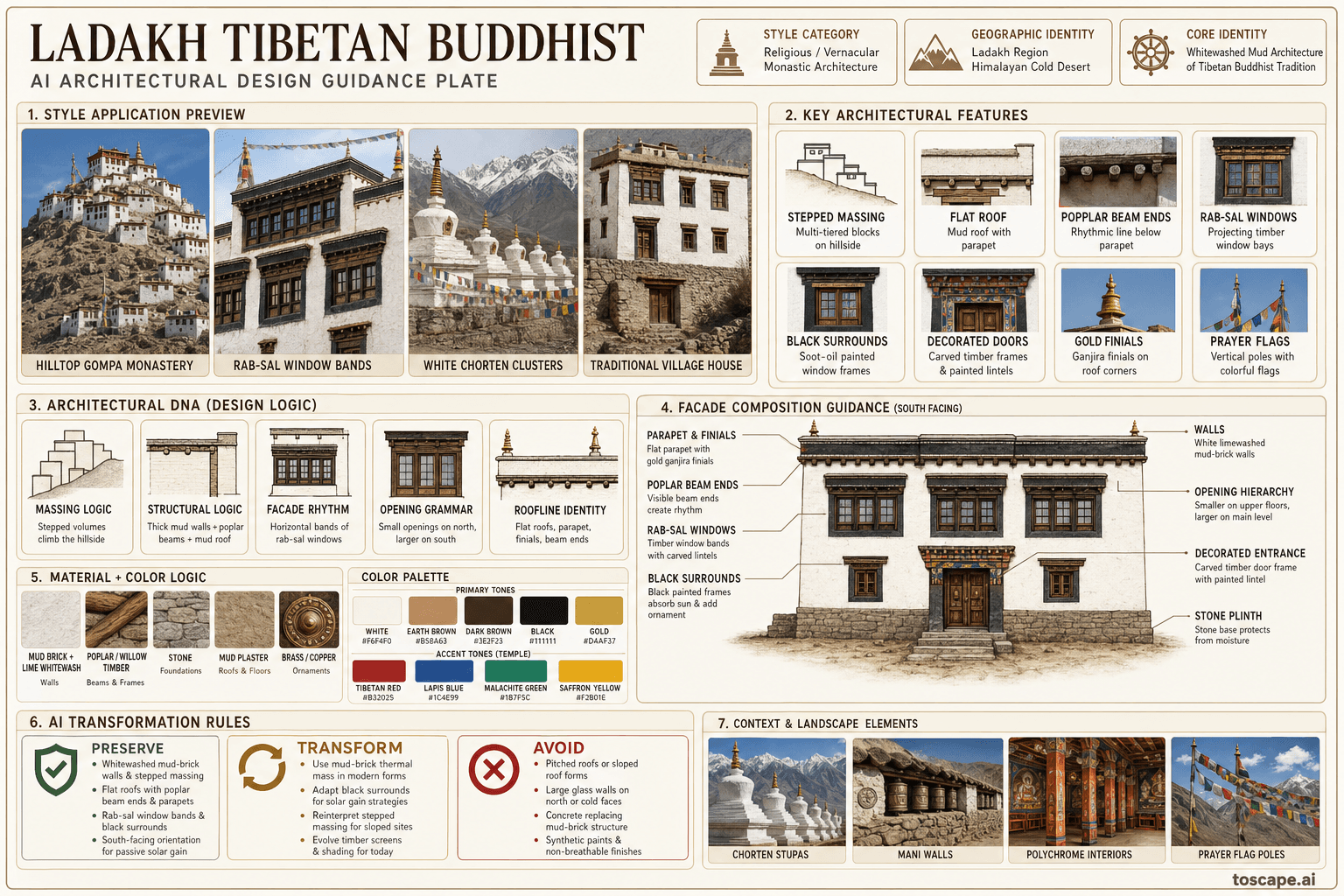
- Gompa: multi-tiered whitewashed blocks climbing hillside, flat roofs stepped at receding levels, assembly hall (dukhang) as largest volume, temples (lhakhang) as subordinate blocks.
- Materials
- Mud brick (sun-dried earth + straw). Poplar and willow timber (local, fast-growing).
- Palette
- White, cream, pale sand, warm timber, and shadow-driven dark metal accents define the palette.
- Climate response
- High-altitude cold desert (3000-4500m): extreme diurnal temperature range, minimal precipitation, intense solar radiation. South-facing orientation for passive solar gain.
Overview
Ladakh Tibetan Buddhist is a regional architectural identity in India. Ladakhi Tibetan Buddhist architecture — gompa monasteries, mud-brick village houses, chorten stupas. Whitewashed mud-brick walls with dark timber window bands, flat poplar-beam roofs, Buddhist gompa fortress-monasteries on hilltops, rows of white chorten stupas, prayer flags as landscape color
Visual DNA
Massing & Form
Gompa: multi-tiered whitewashed blocks climbing hillside, flat roofs stepped at receding levels, assembly hall (dukhang) as largest volume, temples (lhakhang) as subordinate blocks. Village houses: 2-3 story rectangular block, flat roof, attached animal shelter at ground.
Facade Language
Gompa: horizontal whitewashed mass punctuated by dark timber-framed window bands (rab-sal) at upper levels, black-painted window surrounds (triglyph motif). Village houses: whitewashed facade, dark timber lintels and window frames, minimal openings on north face, sun-facing (south) with larger windows.
Materials & Texture
Mud brick (sun-dried earth + straw). Poplar and willow timber (local, fast-growing).
Color Palette
White, cream, pale sand, warm timber, and shadow-driven dark metal accents define the palette. The facade should stay bright and climate-aware rather than heavy, gray, or over-saturated.
Ornament & Detail
Gompa: painted timber — vibrant polychrome (red, gold, blue, green) on door frames, column capitals, ceiling panels. Wall paintings: Tibetan Buddhist iconography (mandalas, deities, narrative scenes).
Climate Response
High-altitude cold desert (3000-4500m): extreme diurnal temperature range, minimal precipitation, intense solar radiation. South-facing orientation for passive solar gain.
Landscape & Ground
Ladakhi Tibetan Buddhist architecture — gompa monasteries, mud-brick village houses, chorten stupas. High-altitude cold desert (3000-4500m): extreme diurnal temperature range, minimal precipitation, intense solar radiation.
Reference elevation
Ladakh Tibetan Buddhist — characteristic facade composition, Ladakhi Tibetan Buddhist.
Context Snapshot
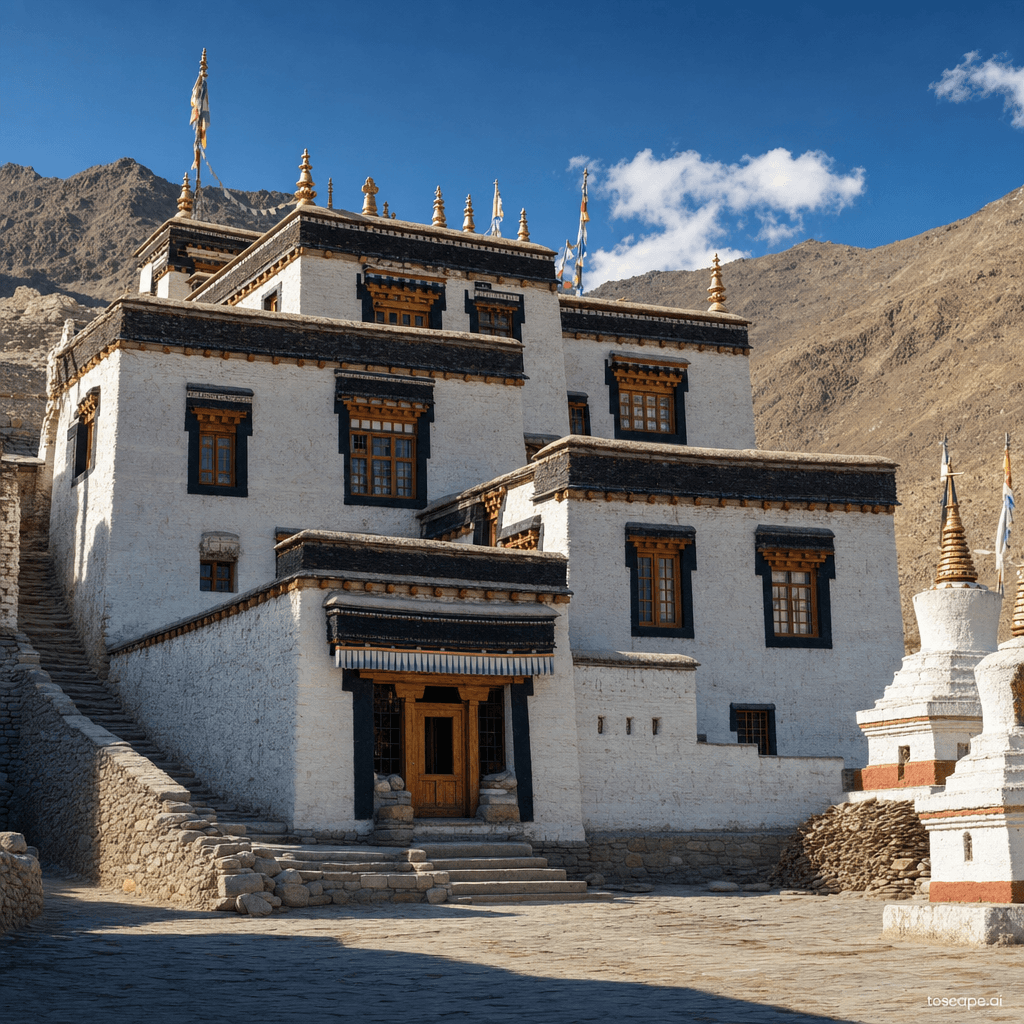
Ladakhi Tibetan Buddhist architecture — gompa monasteries, mud-brick village houses, chorten stupas High-altitude cold desert (3000-4500m): extreme diurnal temperature range, minimal precipitation, intense solar radiation.
Contemporary Relevance
Ladakh Tibetan Buddhist is useful today for residential, hospitality, civic, and place-branding work that needs India-specific character grounded in local massing, material tone, climate response, and settlement logic rather than generic international styling.
Use this style in Toscape
Explore Ladakh Tibetan Buddhist directly inside Toscape using the Facade Re-Style and Design Options workflows.
Open Ladakh Tibetan Buddhist in the galleryFrequently asked questions
What is Ladakh Tibetan Buddhist?
Ladakh Tibetan Buddhist is a regional architectural identity from India. Mud-Brick Mountain Monasteries, Poplar-Beam Flat Roofs & Whitewashed Stupas.
What materials define Ladakh Tibetan Buddhist?
Mud brick (sun-dried earth + straw). Poplar and willow timber (local, fast-growing).
What is the Ladakh Tibetan Buddhist color palette?
White, cream, pale sand, warm timber, and shadow-driven dark metal accents define the palette. The facade should stay bright and climate-aware rather than heavy, gray, or over-saturated.
Where does Ladakh Tibetan Buddhist come from?
Ladakhi Tibetan Buddhist architecture — gompa monasteries, mud-brick village houses, chorten stupas High-altitude cold desert (3000-4500m): extreme diurnal temperature range, minimal precipitation, intense solar radiation.
When should architects use Ladakh Tibetan Buddhist?
Ladakh Tibetan Buddhist is useful today for residential, hospitality, civic, and place-branding work that needs India-specific character grounded in local massing, material tone, climate response, and settlement logic rather than generic international styling.
How do you render Ladakh Tibetan Buddhist in Toscape?
Open Toscape on Windows, load your own photo, elevation, sketch, or CAD view, then apply the Ladakh Tibetan Buddhist reference from the built-in style library. The Facade Re-Style and Design Options workflows keep your project geometry and camera while shifting materials, proportion, and detailing toward Ladakh Tibetan Buddhist.