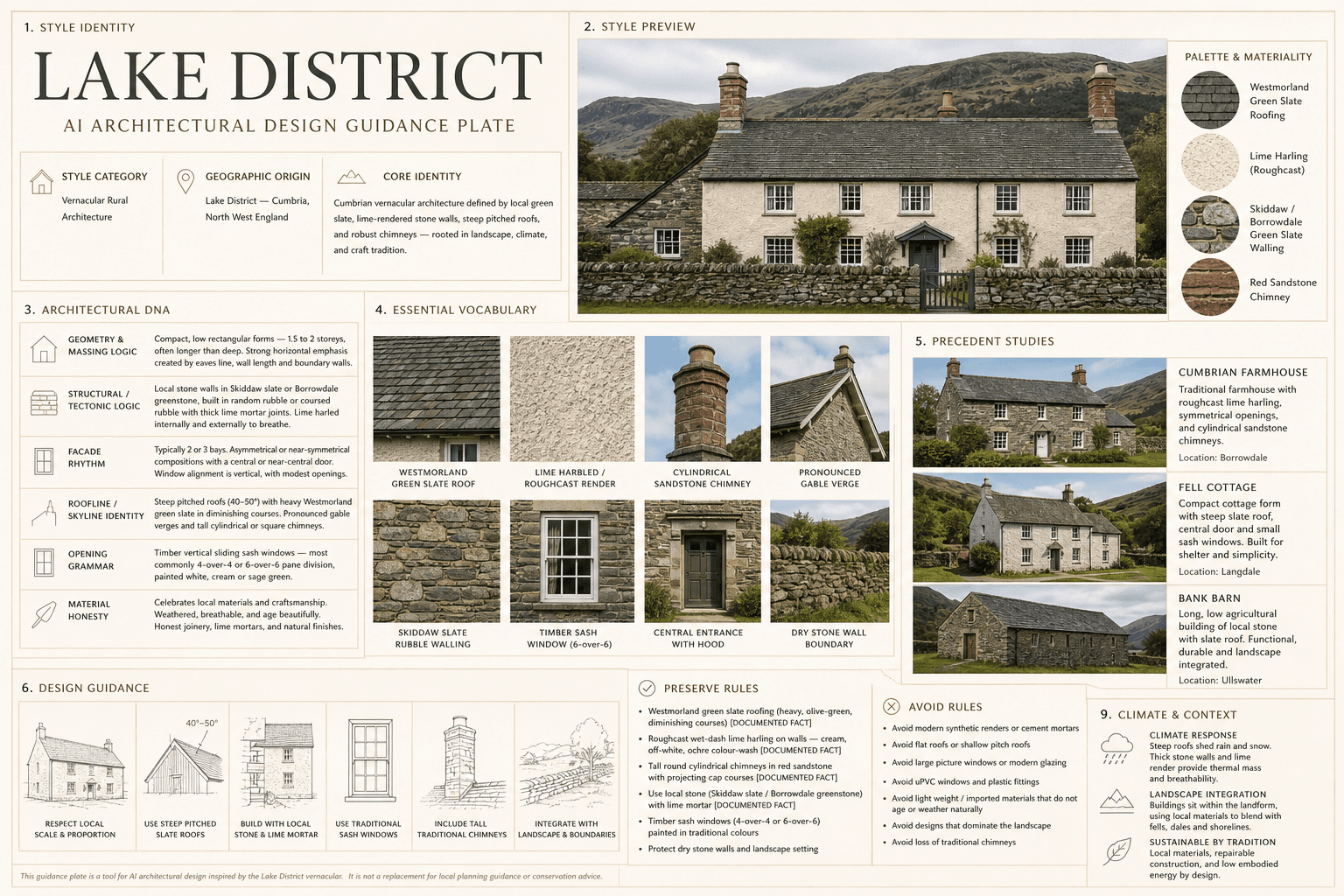
Lake District
United Kingdom · Lake District
Lakeland Slate Vernacular, Roughcast Cottages & Wordsworthian Pastoral Architecture
Definition
Lake District is a regional architectural identity from United Kingdom. Lakeland Slate Vernacular, Roughcast Cottages & Wordsworthian Pastoral Architecture.
- Country
- United Kingdom
- Region
- Lake District
- Massing
- Compact, low rectangular forms — 1.
- Materials
- Westmorland green slate: olive-green-grey, dark blue-green — quarried from the Borrowdale Volcanic Group (Elterwater, Burlington, Kirkstone, Honister quarries). The slate is thick, heavy, and very durable.
- Palette
- White, cream, pale sand, warm timber, and shadow-driven dark metal accents define the palette.
- Climate response
- Montane maritime — the wettest region of England (annual rainfall 2000-4000mm on fells, 1000-1500mm in valleys), mild summers, cold wet winters.
Overview
Lake District is a regional architectural identity in United Kingdom. Lake District — Cumbrian vernacular farmhouses, cottages, and bank barns across the fells and dales. Green-grey Westmorland and Borrowdale volcanic slate walls (local green slate — Skiddaw slate, Borrowdale volcanic greenstone) laid as random rubble or coursed with thick lime mortar joints, roughcast (wet-dash) lime harling render in cream, off-white, or soft grey over stone walls — often colour-washed pink or ochre...
Visual DNA
Massing & Form
Compact, low rectangular forms — 1.5 to 2 stories, often longer than deep, with a strong horizontal emphasis created by the continuous eaves line and elongated plan. Cottages: simple rectangular block, sometimes with an outshut (lean-to) extension at rear under a catslide roof.
Facade Language
Farmhouse and cottage facade: typically 2 or 3 bays, not rigidly symmetrical. Central or near-central entrance door of vertical board-and-batten timber, flanked by small deep-set sash or casement windows.
Materials & Texture
Westmorland green slate: olive-green-grey, dark blue-green — quarried from the Borrowdale Volcanic Group (Elterwater, Burlington, Kirkstone, Honister quarries). The slate is thick, heavy, and very durable.
Color Palette
White, cream, pale sand, warm timber, and shadow-driven dark metal accents define the palette. The facade should stay bright and climate-aware rather than heavy, gray, or over-saturated.
Ornament & Detail
Lakeland ornament is tectonic and minimal: through-stones projecting on the wall face — functional tie-stones that become a decorative rhythm, chimney cap courses projecting in 2-3 stepped stone corbels, round chimney stacks in red sandstone — the shaped stone of the circular chimney, carved slate date-stones or initia...
Climate Response
Montane maritime — the wettest region of England (annual rainfall 2000-4000mm on fells, 1000-1500mm in valleys), mild summers, cold wet winters, very high wind exposure at altitude. Low massing: buildings huddle into valleys and on lower slopes (below 300m), rarely on high fells — the landscape scale dwarfs the archite...
Landscape & Ground
Lake District — Cumbrian vernacular farmhouses, cottages, and bank barns across the fells and dales. Montane maritime — the wettest region of England (annual rainfall 2000-4000mm on fells, 1000-1500mm in valleys), mild summers, cold wet winters, very high wind exposure at altitude.
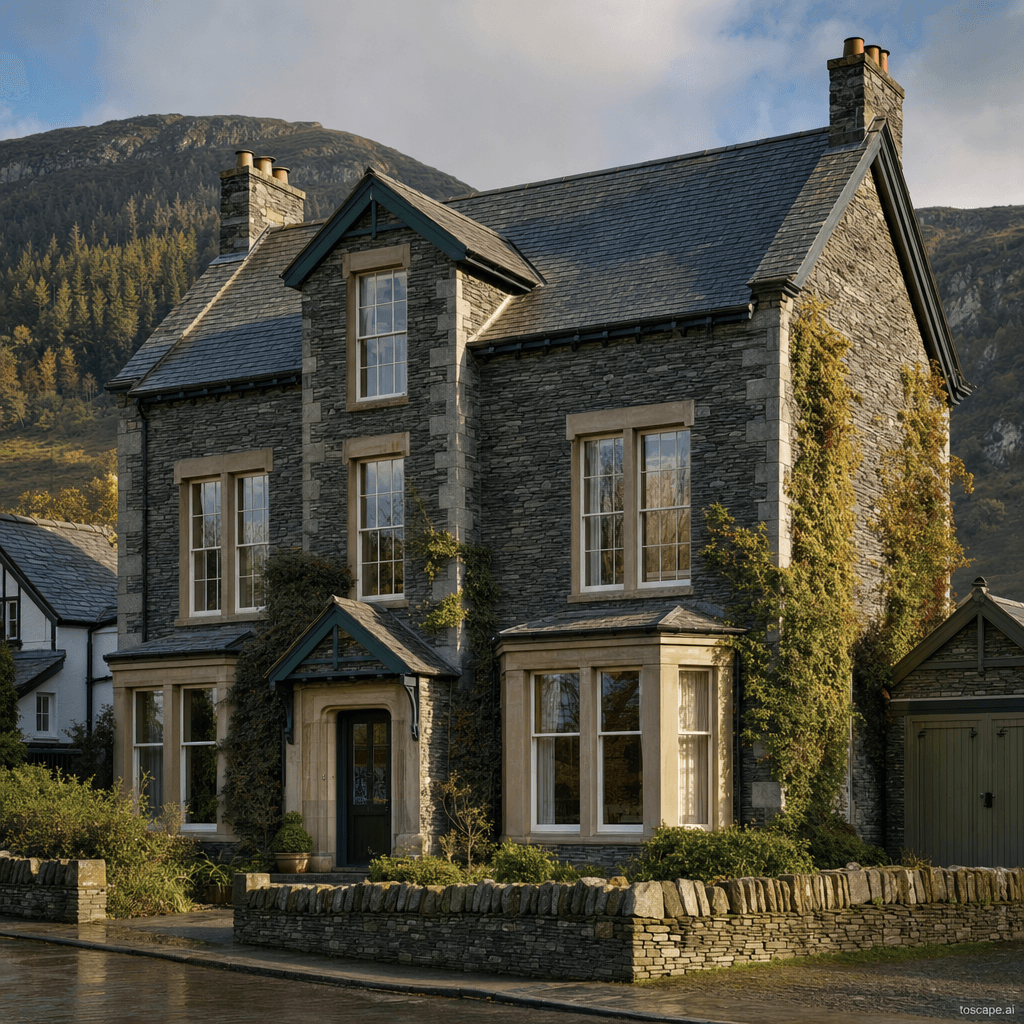
Reference elevation
Lake District — characteristic facade composition, Lake District.
Context Snapshot
Lake District — Cumbrian vernacular farmhouses, cottages, and bank barns across the fells and dales Montane maritime — the wettest region of England (annual rainfall 2000-4000mm on fells, 1000-1500mm in valleys), mild summers, cold wet winters, very high wind exposure at altitude.
Contemporary Relevance
Lake District is useful today for residential, hospitality, civic, and place-branding work that needs United Kingdom-specific character grounded in local massing, material tone, climate response, and settlement logic rather than generic international styling.
Use this style in Toscape
Explore Lake District directly inside Toscape using the Facade Re-Style and Design Options workflows.
Open Lake District in the galleryFrequently asked questions
What is Lake District?
Lake District is a regional architectural identity from United Kingdom. Lakeland Slate Vernacular, Roughcast Cottages & Wordsworthian Pastoral Architecture.
What materials define Lake District?
Westmorland green slate: olive-green-grey, dark blue-green — quarried from the Borrowdale Volcanic Group (Elterwater, Burlington, Kirkstone, Honister quarries). The slate is thick, heavy, and very durable.
What is the Lake District color palette?
White, cream, pale sand, warm timber, and shadow-driven dark metal accents define the palette. The facade should stay bright and climate-aware rather than heavy, gray, or over-saturated.
Where does Lake District come from?
Lake District — Cumbrian vernacular farmhouses, cottages, and bank barns across the fells and dales Montane maritime — the wettest region of England (annual rainfall 2000-4000mm on fells, 1000-1500mm in valleys), mild summers, cold wet winters, very high wind exposure at altitude.
When should architects use Lake District?
Lake District is useful today for residential, hospitality, civic, and place-branding work that needs United Kingdom-specific character grounded in local massing, material tone, climate response, and settlement logic rather than generic international styling.
How do you render Lake District in Toscape?
Open Toscape on Windows, load your own photo, elevation, sketch, or CAD view, then apply the Lake District reference from the built-in style library. The Facade Re-Style and Design Options workflows keep your project geometry and camera while shifting materials, proportion, and detailing toward Lake District.