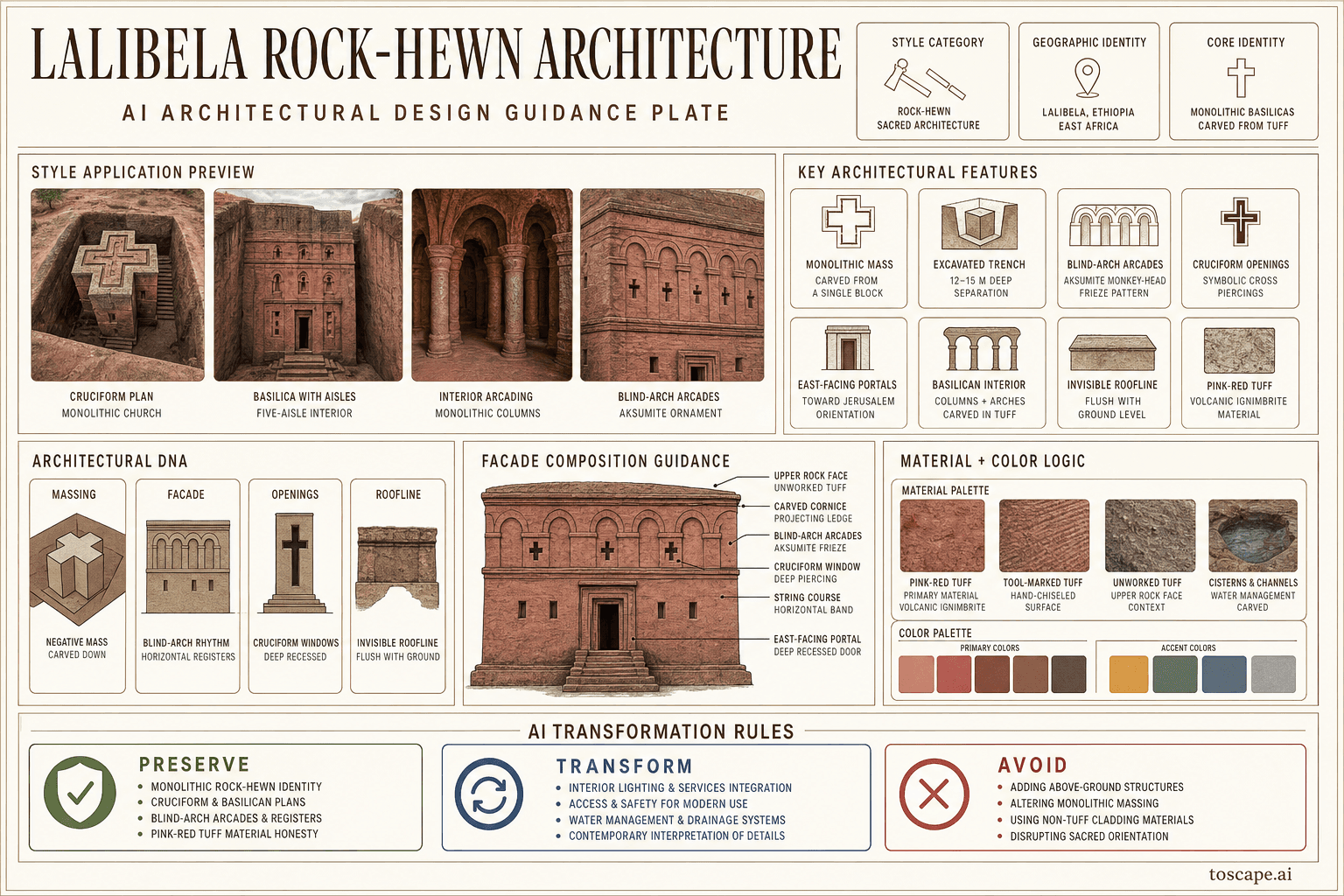
Lalibela Rock-Hewn
Ethiopia · architectural identity of Lalibela
The monolithic rock-cut churches of Lalibela — the 12th–13th century subterranean basilicas carved from living volcanic tuff, the cross-shaped cruciform plans, and the Aksumite-der...
Definition
Lalibela Rock-Hewn is a regional architectural identity from Ethiopia. The monolithic rock-cut churches of Lalibela — the 12th–13th century subterranean basilicas carved from living volcanic tuff, the cross-shaped cruciform plans, and the Aksumite-der.
- Country
- Ethiopia
- Region
- architectural identity of Lalibela.
- Massing
- The church is NOT built up — it is carved down. The mass is the negative space left after excavation.
- Materials
- The single material is pink-red volcanic tuff (ignimbrite), varying in hue from pale rose to deep russet depending on oxidation and exposure.
- Palette
- Stone gray, weathered timber brown, mineral white, muted charcoal, and restrained landscape greens define the palette.
- Climate response
- Lalibela sits at ~2,500 m elevation in the Ethiopian Highlands.
Overview
Lalibela Rock-Hewn is a regional architectural identity in Ethiopia. The architectural identity of Lalibela — the eleven monolithic rock-hewn churches of Roha (now Lalibela), carved downward into the pink-red volcanic tuff bedrock during the Zagwe dynasty (c. 1181–1221 CE) under King Gebre Mesqel Lalibela — a UNESCO World Heritage site representing the most extraordinary expression of Ethiopian Orthodox Christian architecture, where entire basilicas were excavated from solid rock in-s...
Visual DNA
Massing & Form
The church is NOT built up — it is carved down. The mass is the negative space left after excavation.
Facade Language
The exterior walls — the trench-facing surfaces of the carved block — feature blind-arch arcading (Aksumite monkey-head frieze pattern): alternating recessed rectangular panels topped by horseshoe or monolithic arch motifs carved in low relief. This Aksumite-derived decorative system links Lalibela to the earlier Kingd...
Materials & Texture
The single material is pink-red volcanic tuff (ignimbrite), varying in hue from pale rose to deep russet depending on oxidation and exposure. No applied finishes — the carved surface IS the finish.
Color Palette
Stone gray, weathered timber brown, mineral white, muted charcoal, and restrained landscape greens define the palette. The building should feel rooted in terrain and craft rather than coated in synthetic contrast.
Ornament & Detail
The ornament is entirely carved in-situ and derived from Aksumite precedents: (1) Blind-arch frieze — the continuous arcaded band, the most prominent decorative motif. (2) Aksumite "monkey-head" frames — square panels with a projecting central boss at the corners of window and door surrounds.
Climate Response
Lalibela sits at ~2,500 m elevation in the Ethiopian Highlands. The rock-hewn churches are naturally climate-moderated: the massive tuff walls provide thermal inertia (interior temperatures remain 15–18°C year-round despite external ranges of 5–28°C).
Landscape & Ground
The architectural identity of Lalibela — the eleven monolithic rock-hewn churches of Roha (now Lalibela), carved downward into the pink-red volcanic tuff bedrock during the Zagwe dynasty (c. 1181–1221 CE) under King Gebre Mesqel Lalibela — a UNESCO World Heritage site representing the most extraordinary expression of E...
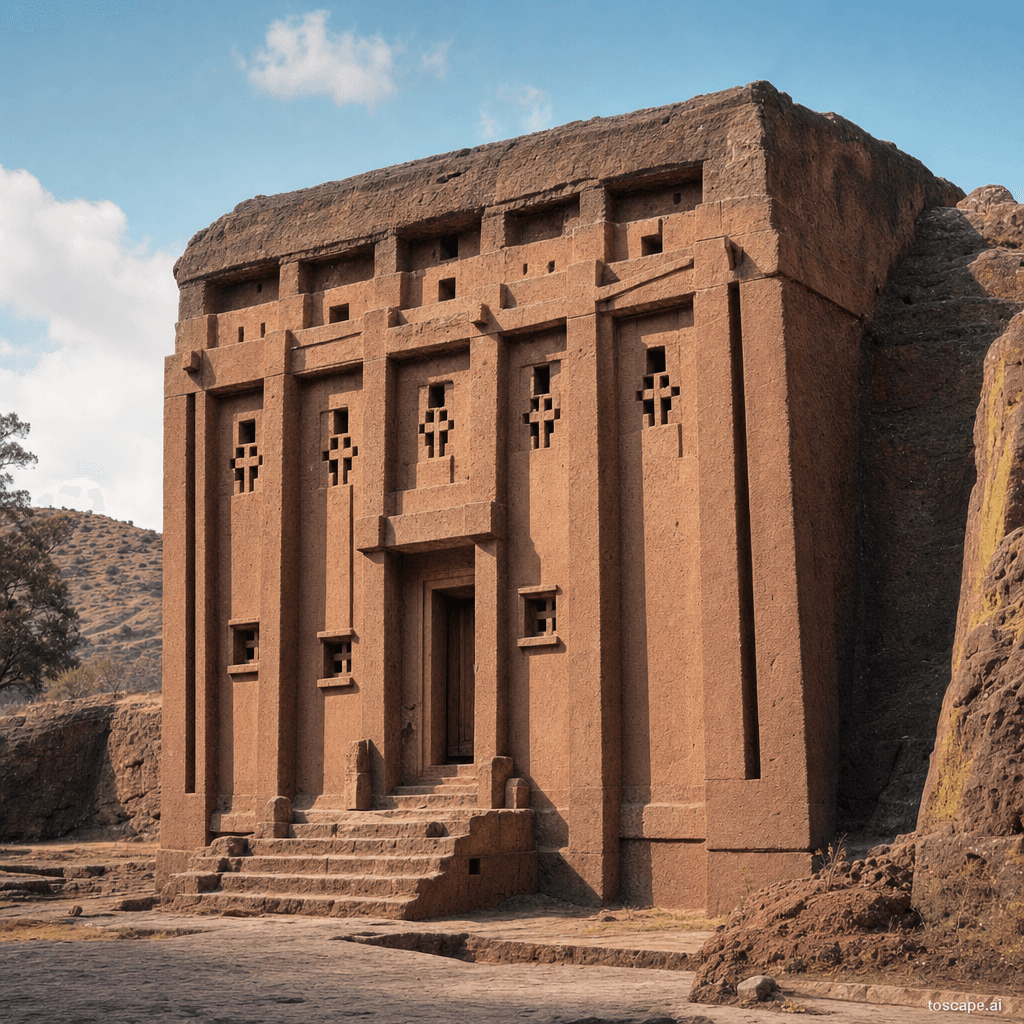
Reference elevation
Lalibela Rock-Hewn — characteristic facade composition, architectural identity of Lalibela.
Context Snapshot
The architectural identity of Lalibela — the eleven monolithic rock-hewn churches of Roha (now Lalibela), carved downward into the pink-red volcanic tuff bedrock during the Zagwe dynasty (c. Lalibela sits at ~2,500 m elevation in the Ethiopian Highlands.
Contemporary Relevance
Lalibela Rock-Hewn is useful today for residential, hospitality, civic, and place-branding work that needs Ethiopia-specific character grounded in local massing, material tone, climate response, and settlement logic rather than generic international styling.
Use this style in Toscape
Explore Lalibela Rock-Hewn directly inside Toscape using the Facade Re-Style and Design Options workflows.
Open Lalibela Rock-Hewn in the galleryFrequently asked questions
What is Lalibela Rock-Hewn?
Lalibela Rock-Hewn is a regional architectural identity from Ethiopia. The monolithic rock-cut churches of Lalibela — the 12th–13th century subterranean basilicas carved from living volcanic tuff, the cross-shaped cruciform plans, and the Aksumite-der.
What materials define Lalibela Rock-Hewn?
The single material is pink-red volcanic tuff (ignimbrite), varying in hue from pale rose to deep russet depending on oxidation and exposure. No applied finishes — the carved surface IS the finish.
What is the Lalibela Rock-Hewn color palette?
Stone gray, weathered timber brown, mineral white, muted charcoal, and restrained landscape greens define the palette. The building should feel rooted in terrain and craft rather than coated in synthetic contrast.
Where does Lalibela Rock-Hewn come from?
The architectural identity of Lalibela — the eleven monolithic rock-hewn churches of Roha (now Lalibela), carved downward into the pink-red volcanic tuff bedrock during the Zagwe dynasty (c. Lalibela sits at ~2,500 m elevation in the Ethiopian Highlands.
When should architects use Lalibela Rock-Hewn?
Lalibela Rock-Hewn is useful today for residential, hospitality, civic, and place-branding work that needs Ethiopia-specific character grounded in local massing, material tone, climate response, and settlement logic rather than generic international styling.
How do you render Lalibela Rock-Hewn in Toscape?
Open Toscape on Windows, load your own photo, elevation, sketch, or CAD view, then apply the Lalibela Rock-Hewn reference from the built-in style library. The Facade Re-Style and Design Options workflows keep your project geometry and camera while shifting materials, proportion, and detailing toward Lalibela Rock-Hewn.