Luzon
Philippines · Ilocos Region & Central Luzon
Bahay na Bato, Spanish Colonial Heritage & Vigan Urban Fabric
Definition
Luzon is a regional architectural identity from Philippines. Bahay na Bato, Spanish Colonial Heritage & Vigan Urban Fabric.
- Country
- Philippines
- Region
- Ilocos Region & Central Luzon.
- Massing
- Urban: rectangular lot, narrow street frontage, deep interior extending through entire block. Two stories with entresuelo (mezzanine).
- Materials
- Piedra china: grey-black volcanic tuff stone — Vigan's foundational building block, quarried from local hills, distinctive dark texture contrasting white lime mortar joints.
- Palette
- White, cream, pale sand, warm timber, and shadow-driven dark metal accents define the palette.
- Climate response
- Tropical monsoon (Am) and tropical savanna (Aw) — hot humid year-round (25-35°C), distinct wet season (June-November typhoons), dry season (December-May).
Overview
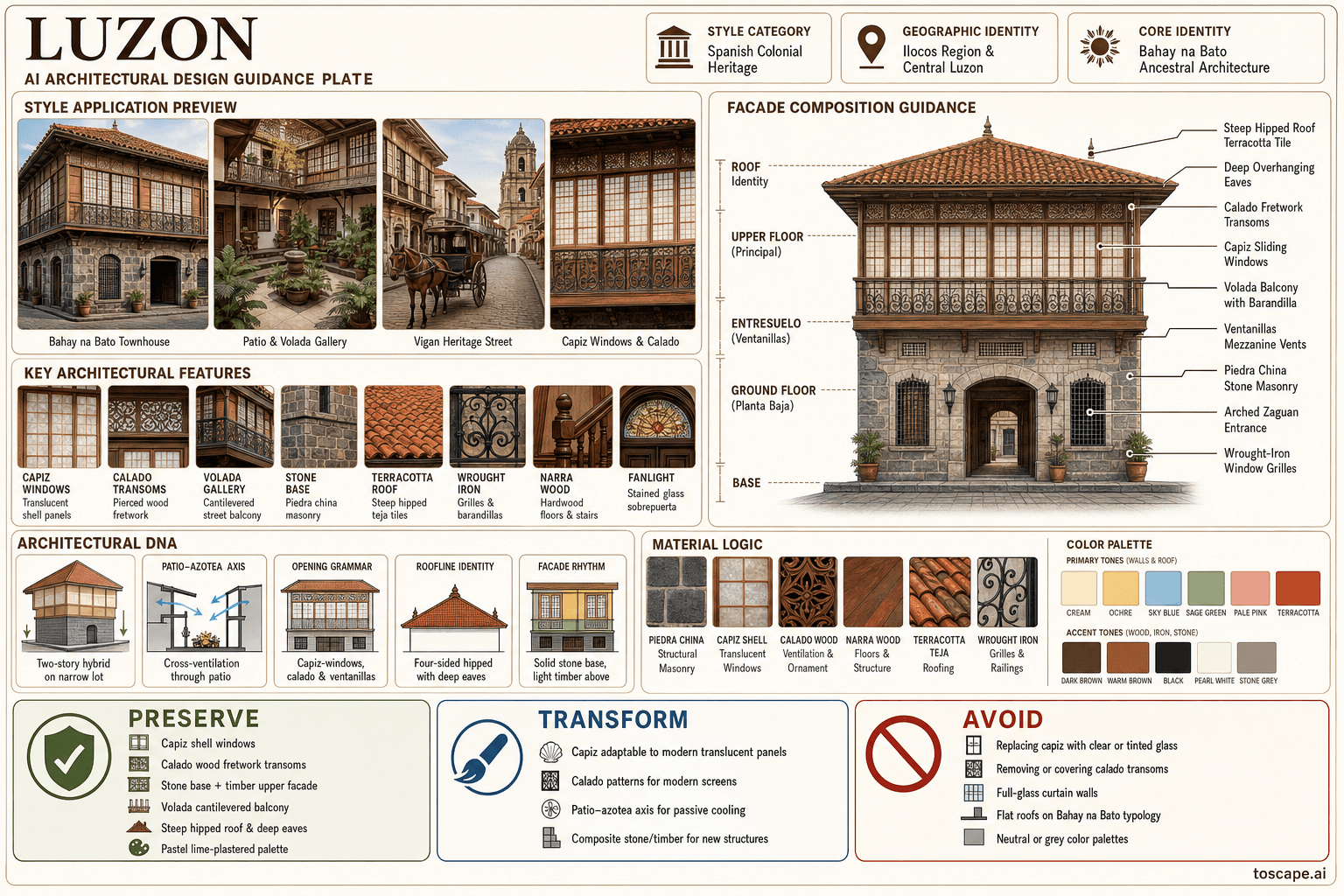
Luzon is a regional architectural identity in Philippines. Ilocos Region & Central Luzon — Bahay na Bato urban ancestral houses. Two-story hybrid typology — planta baja (ground floor) of cut stone or brick masonry (piedra china in Vigan), wooden upper floor (entresuelo/principal) with capiz-shell sliding windows (ventanillas), steep hipped roofs of curved terracotta teja curva tiles, calado wood fretwork transoms and ventilated lattice panels, volada (cantilevered wooden gal...
Visual DNA
Massing & Form
Urban: rectangular lot, narrow street frontage, deep interior extending through entire block. Two stories with entresuelo (mezzanine).
Facade Language
Composite facade — two materials, two expressions: heavy masonry planta baja with arched or flat-headed doors and grilled windows; lighter timber principal with continuous band of capiz sliding windows alternating with solid panel infill. Calado fretwork transoms above windows — intricate floral, geometric, or arabesqu...
Materials & Texture
Piedra china: grey-black volcanic tuff stone — Vigan's foundational building block, quarried from local hills, distinctive dark texture contrasting white lime mortar joints. Adobe: sun-dried mud blocks with lime plaster — Central Luzon alternative.
Color Palette
White, cream, pale sand, warm timber, and shadow-driven dark metal accents define the palette. The facade should stay bright and climate-aware rather than heavy, gray, or over-saturated.
Ornament & Detail
Calado fretwork: the supreme Philippine decorative art — pierced wooden transom panels with floral (palmetas), geometric (estrella — star), Gothic arch, or Arabesque motifs. Volada balustrade: turned wooden balusters (balaustres) or wrought-iron scrollwork.
Climate Response
Tropical monsoon (Am) and tropical savanna (Aw) — hot humid year-round (25-35°C), distinct wet season (June-November typhoons), dry season (December-May). Bahay na Bato is a climate-adapted hybrid: stone ground floor resists flooding and provides thermal mass cooling; timber upper floor with capiz windows maximizes cro...
Landscape & Ground
Ilocos Region & Central Luzon — Bahay na Bato urban ancestral houses. Tropical monsoon (Am) and tropical savanna (Aw) — hot humid year-round (25-35°C), distinct wet season (June-November typhoons), dry season (December-May).
Reference elevation
Luzon — characteristic facade composition, Ilocos Region & Central Luzon.
Context Snapshot
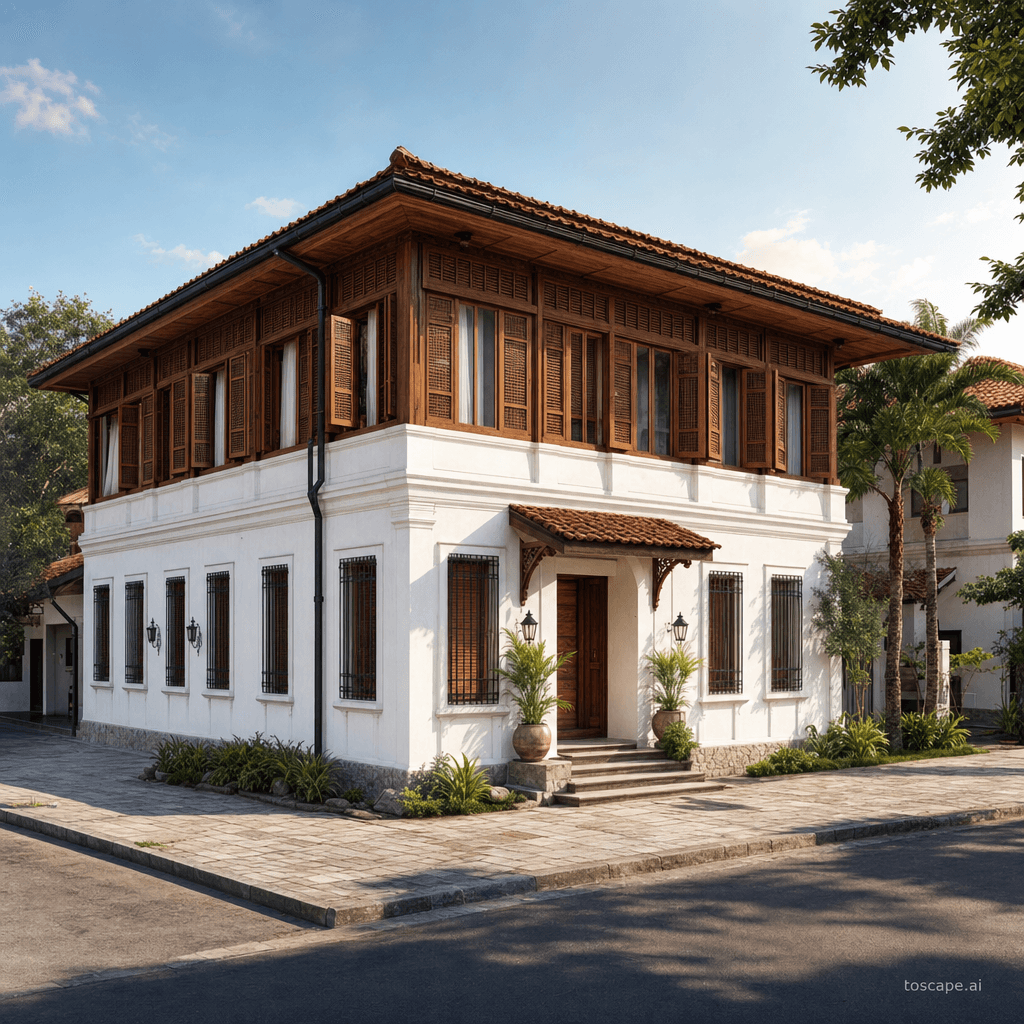
Ilocos Region & Central Luzon — Bahay na Bato urban ancestral houses Tropical monsoon (Am) and tropical savanna (Aw) — hot humid year-round (25-35°C), distinct wet season (June-November typhoons), dry season (December-May).
Contemporary Relevance
Luzon is useful today for residential, hospitality, civic, and place-branding work that needs Philippines-specific character grounded in local massing, material tone, climate response, and settlement logic rather than generic international styling.
Use this style in Toscape
Explore Luzon directly inside Toscape using the Facade Re-Style and Design Options workflows.
Open Luzon in the galleryFrequently asked questions
What is Luzon?
Luzon is a regional architectural identity from Philippines. Bahay na Bato, Spanish Colonial Heritage & Vigan Urban Fabric.
What materials define Luzon?
Piedra china: grey-black volcanic tuff stone — Vigan's foundational building block, quarried from local hills, distinctive dark texture contrasting white lime mortar joints. Adobe: sun-dried mud blocks with lime plaster — Central Luzon alternative.
What is the Luzon color palette?
White, cream, pale sand, warm timber, and shadow-driven dark metal accents define the palette. The facade should stay bright and climate-aware rather than heavy, gray, or over-saturated.
Where does Luzon come from?
Ilocos Region & Central Luzon — Bahay na Bato urban ancestral houses Tropical monsoon (Am) and tropical savanna (Aw) — hot humid year-round (25-35°C), distinct wet season (June-November typhoons), dry season (December-May).
When should architects use Luzon?
Luzon is useful today for residential, hospitality, civic, and place-branding work that needs Philippines-specific character grounded in local massing, material tone, climate response, and settlement logic rather than generic international styling.
How do you render Luzon in Toscape?
Open Toscape on Windows, load your own photo, elevation, sketch, or CAD view, then apply the Luzon reference from the built-in style library. The Facade Re-Style and Design Options workflows keep your project geometry and camera while shifting materials, proportion, and detailing toward Luzon.