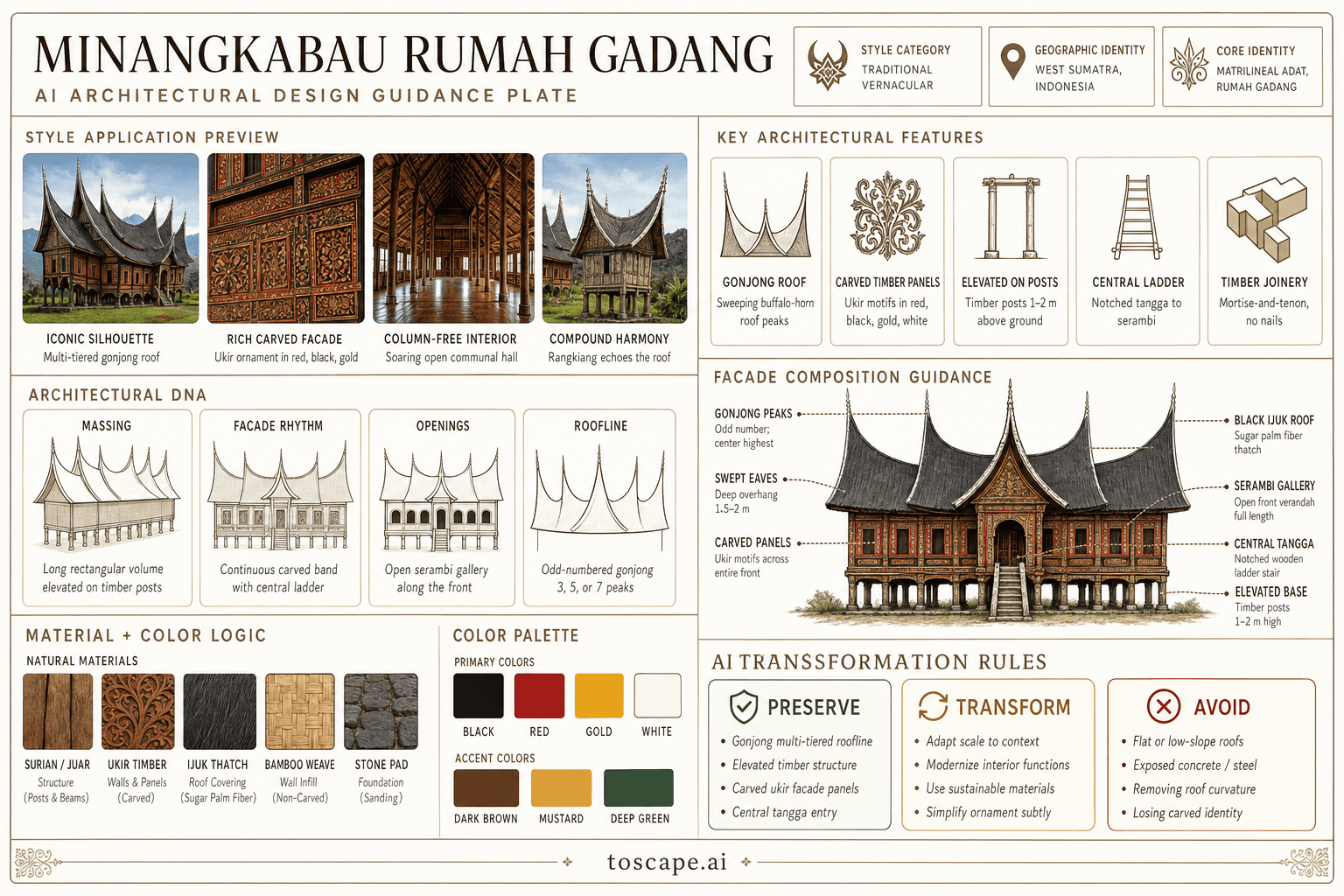
Minangkabau Rumah Gadang
Indonesia · Rumah Gadang (Big House) of the Minangkabau people of West Sumatra, Indonesia
The Great House of the Minangkabau — the sweeping buffalo-horn roof (gonjong) that defines the world's largest matrilineal society, rising in multi-tiered curves above the highland...
Definition
Minangkabau Rumah Gadang is a regional architectural identity from Indonesia. The Great House of the Minangkabau — the sweeping buffalo-horn roof (gonjong) that defines the world's largest matrilineal society, rising in multi-tiered curves above the highland.
- Country
- Indonesia
- Region
- Rumah Gadang (Big House) of the Minangkabau people of West Sumatra, Indonesia.
- Massing
- The Rumah Gadang is rectangular (12–25 m × 6–10 m), elevated on timber posts 1–2 m above ground — the house reads as a long.
- Materials
- Materials are locally sourced and symbolic: (1) Ijuk (Arenga pinnata fiber) — black sugar palm fiber thatch for the roof — the dominant material visually.
- Palette
- White, cream, pale sand, warm timber, and shadow-driven dark metal accents define the palette.
- Climate response
- The Minangkabau highlands (Bukit Barisan, West Sumatra) have a tropical highland climate: (1) Elevation 300–1,500 m — cooler than lowland tropics, with heavy rainfall (2,500–4,000 mm/year).
Overview
Minangkabau Rumah Gadang is a regional architectural identity in Indonesia. The Rumah Gadang (Big House) of the Minangkabau people of West Sumatra, Indonesia — a rectangular elevated timber house (12–25 m long, 6–10 m wide) on a post-and-beam frame, built on timber stilts 1–2 m above ground, with the iconic multi-peaked roof whose sweeping upturned eaves (gonjong) curve upward like buffalo horns — the house is the architectural expression of Minangkabau adat (customary law), matrilineal inhe...
Visual DNA
Massing & Form
The Rumah Gadang is rectangular (12–25 m × 6–10 m), elevated on timber posts 1–2 m above ground — the house reads as a long, narrow horizontal volume capped by a dramatically vertical roof. The roof is the dominant mass: multiple-tiered, with each tier defined by the gonjong — the roof ridge runs the full length, and a...
Facade Language
The front (long) facade is the principal face: (1) The carved wall panels (ukir) form a continuous horizontal band of dense ornament — floral scrolls (kaluak paku — fern tendril), geometric patterns (pucuak rabuang — bamboo shoot), and calligraphic motifs across the entire front elevation. (2) The serambi (front galler...
Materials & Texture
Materials are locally sourced and symbolic: (1) Ijuk (Arenga pinnata fiber) — black sugar palm fiber thatch for the roof — the dominant material visually, creating the dense, dark, textured surface. (2) Surian (Toona sinensis) or juar (Cassia siamea) timber — for the main structural posts and frame — strong, durable, t...
Color Palette
White, cream, pale sand, warm timber, and shadow-driven dark metal accents define the palette. The facade should stay bright and climate-aware rather than heavy, gray, or over-saturated.
Ornament & Detail
Minangkabau ornament (ukir) is a visual language encoding adat law: (1) Kaluak paku — the fern tendril spiral, symbolizing self-development and growth. (2) Pucuak rabuang — the bamboo shoot, a triangular ascending motif symbolizing education and rising through life.
Climate Response
The Minangkabau highlands (Bukit Barisan, West Sumatra) have a tropical highland climate: (1) Elevation 300–1,500 m — cooler than lowland tropics, with heavy rainfall (2,500–4,000 mm/year). (2) The elevated floor protects against groundwater, flooding, and humidity.
Landscape & Ground
The Rumah Gadang (Big House) of the Minangkabau people of West Sumatra, Indonesia — a rectangular elevated timber house (12–25 m long, 6–10 m wide) on a post-and-beam frame, built on timber stilts 1–2 m above ground, with the iconic multi-peaked roof whose sweeping upturned eaves (gonjong) curve upward like buffalo hor...
Reference elevation
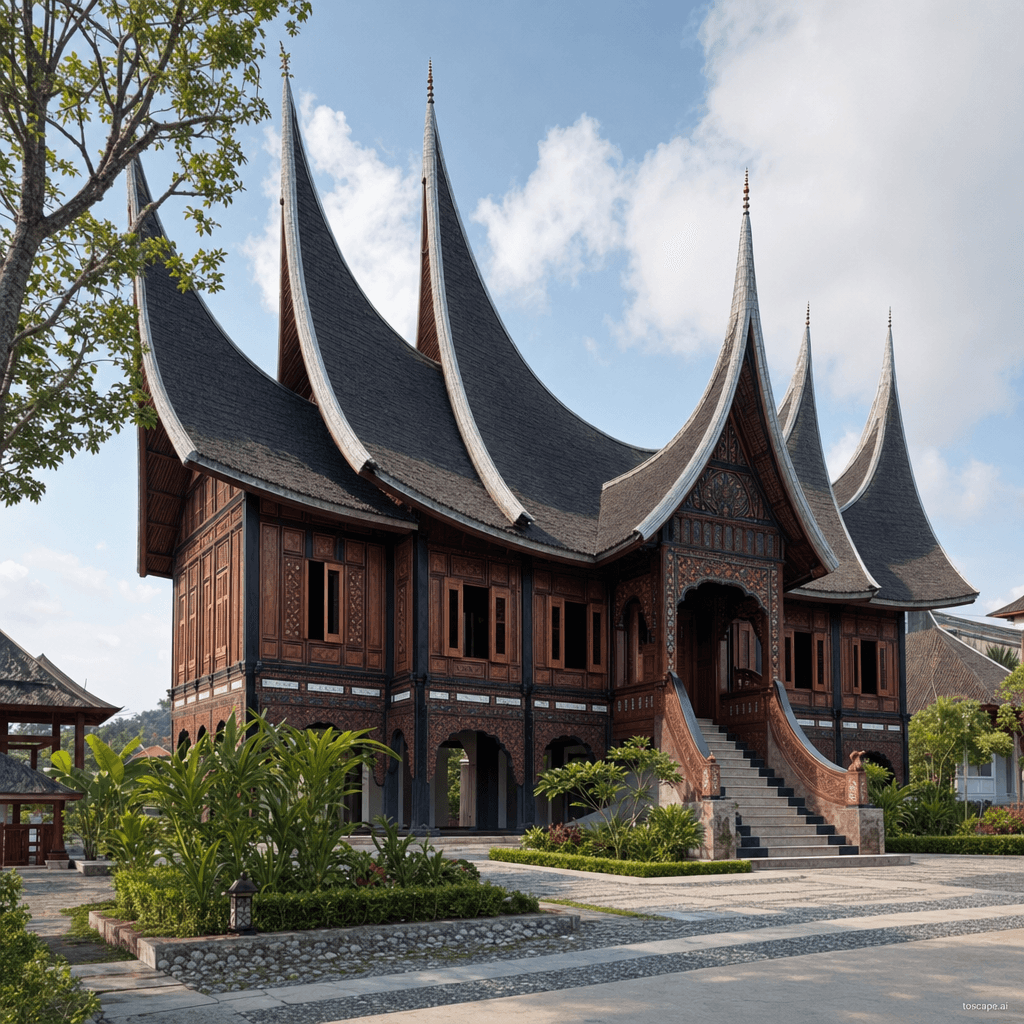
Minangkabau Rumah Gadang — characteristic facade composition, Rumah Gadang (Big House) of the Minangkabau people of West Sumatra, Indonesia.
Context Snapshot
The Rumah Gadang (Big House) of the Minangkabau people of West Sumatra, Indonesia — a rectangular elevated timber house (12–25 m long, 6–10 m wide) on a post-and-beam frame, built on timber stilts 1–2... The Minangkabau highlands (Bukit Barisan, West Sumatra) have a tropical highland climate: (1) Elevation 300–1,500 m — cooler than lowland tropics, with heavy rainfall (2,500–4,000 mm/year).
Contemporary Relevance
Minangkabau Rumah Gadang is useful today for residential, hospitality, civic, and place-branding work that needs Indonesia-specific character grounded in local massing, material tone, climate response, and settlement logic rather than generic international styling.
Use this style in Toscape
Explore Minangkabau Rumah Gadang directly inside Toscape using the Facade Re-Style and Design Options workflows.
Open Minangkabau Rumah Gadang in the galleryFrequently asked questions
What is Minangkabau Rumah Gadang?
Minangkabau Rumah Gadang is a regional architectural identity from Indonesia. The Great House of the Minangkabau — the sweeping buffalo-horn roof (gonjong) that defines the world's largest matrilineal society, rising in multi-tiered curves above the highland.
What materials define Minangkabau Rumah Gadang?
Materials are locally sourced and symbolic: (1) Ijuk (Arenga pinnata fiber) — black sugar palm fiber thatch for the roof — the dominant material visually, creating the dense, dark, textured surface. (2) Surian (Toona sinensis) or juar (Cassia siamea) timber — for the main structural posts and frame — strong, durable, t.
What is the Minangkabau Rumah Gadang color palette?
White, cream, pale sand, warm timber, and shadow-driven dark metal accents define the palette. The facade should stay bright and climate-aware rather than heavy, gray, or over-saturated.
Where does Minangkabau Rumah Gadang come from?
The Rumah Gadang (Big House) of the Minangkabau people of West Sumatra, Indonesia — a rectangular elevated timber house (12–25 m long, 6–10 m wide) on a post-and-beam frame, built on timber stilts 1–2... The Minangkabau highlands (Bukit Barisan, West Sumatra) have a tropical highland climate: (1) Elevation 300–1,500 m — cooler than lowland tropics, with heavy rainfall (2,500–4,000 mm/year).
When should architects use Minangkabau Rumah Gadang?
Minangkabau Rumah Gadang is useful today for residential, hospitality, civic, and place-branding work that needs Indonesia-specific character grounded in local massing, material tone, climate response, and settlement logic rather than generic international styling.
How do you render Minangkabau Rumah Gadang in Toscape?
Open Toscape on Windows, load your own photo, elevation, sketch, or CAD view, then apply the Minangkabau Rumah Gadang reference from the built-in style library. The Facade Re-Style and Design Options workflows keep your project geometry and camera while shifting materials, proportion, and detailing toward Minangkabau Rumah Gadang.