Mindanao
Philippines · Lanao del Sur
Maranao Torogan Royal House, Okir Carving & Islamic Vernacular
Definition
Mindanao is a regional architectural identity from Philippines. Maranao Torogan Royal House, Okir Carving & Islamic Vernacular.
- Country
- Philippines
- Region
- Lanao del Sur
- Massing
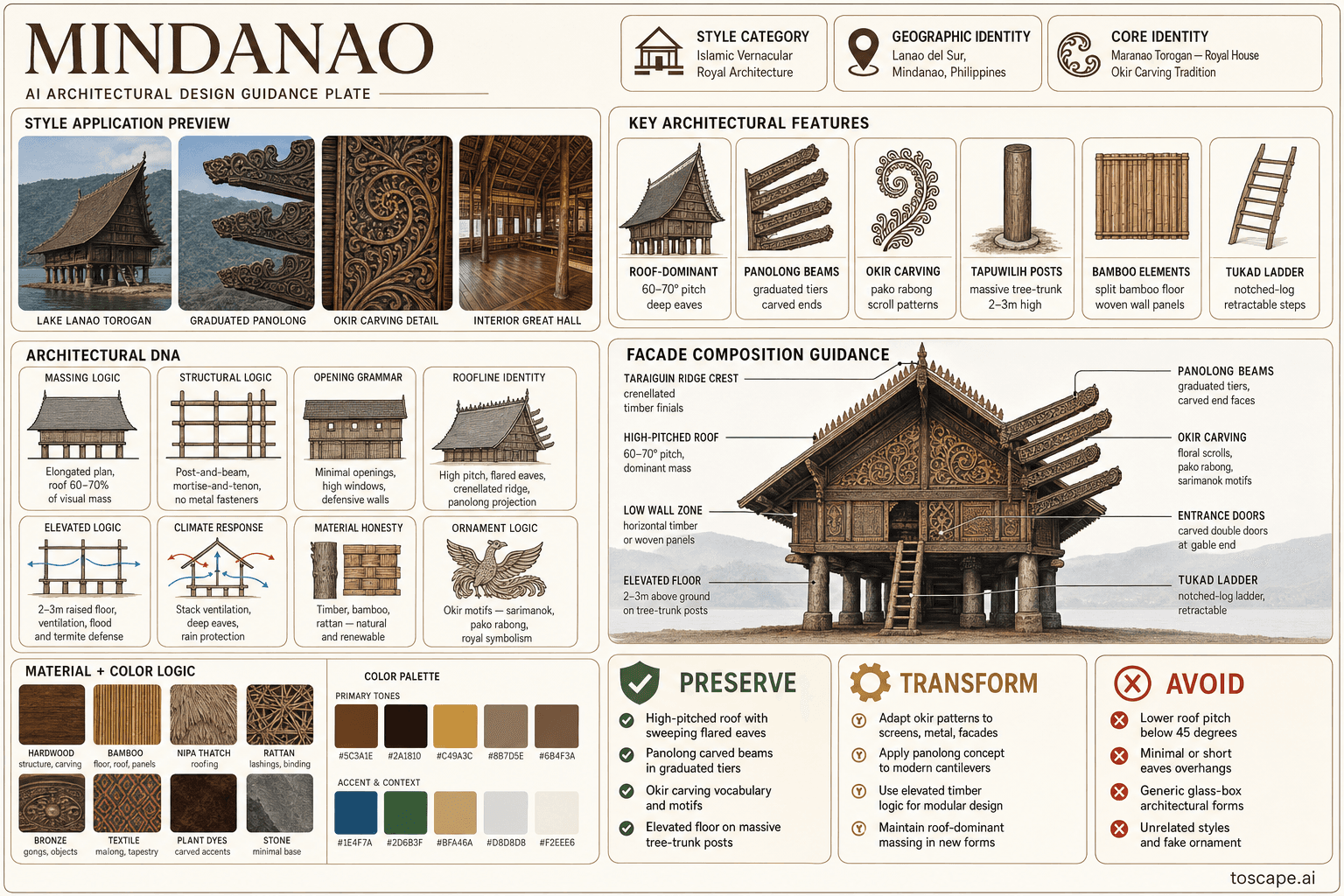
- Torogan: elongated rectangular plan — typically 8-10 meters wide by 30-50 meters long, oriented east-west. Single great hall (sulod/ka-dayawatan) spanning full interior.
- Materials
- Tapuwilih (hardwood posts): massive round trunks — tugas (molave), mabunu, bait — up to 70cm diameter, bark left intact or stripped, dark brown to near-black.
- Palette
- Warm earth, sandy beige, ochre, clay brown, and sun-softened mineral tones should dominate, with palm green or weathered timber as secondary accents.
- Climate response
- Tropical rainforest (Af) — Lake Lanao plateau (700m elevation), high humidity, heavy monsoon rainfall (2,500mm+ annually), warm year-round (22-30°C).
Overview
Mindanao is a regional architectural identity in Philippines. Lanao del Sur — Maranao torogan royal house and okir ornamental tradition. Torogan — the Sultan's great house: massive elevated timber hall (40m+ long) raised on colossal tree-trunk pillars (tapuwilih), no nails — all mortise-and-tenon and peg joinery, enormous steeply-pitched crenellated roof with sweeping flared eaves extending into elaborately carved prow-like projections (panolong) at gable ends, richly carved ok...
Visual DNA
Massing & Form
Torogan: elongated rectangular plan — typically 8-10 meters wide by 30-50 meters long, oriented east-west. Single great hall (sulod/ka-dayawatan) spanning full interior.
Facade Language
The torogan facade is dominated by the sweeping, flared roof form, crenellated ridge decoration, and the projecting panolong beams. Walls are secondary — low, with horizontal board cladding or woven bamboo panels (bidang).
Materials & Texture
Tapuwilih (hardwood posts): massive round trunks — tugas (molave), mabunu, bait — up to 70cm diameter, bark left intact or stripped, dark brown to near-black, immensely durable (century lifespan in ground contact). Okir-carved timber: hardwood panels — tugas, narra, or maranao — reddish-brown to dark mahogany, deeply c...
Color Palette
Warm earth, sandy beige, ochre, clay brown, and sun-softened mineral tones should dominate, with palm green or weathered timber as secondary accents. The palette should read as land-derived rather than polished or urban-generic.
Ornament & Detail
Okir: the defining Maranao visual language — flowing curvilinear scroll patterns carved in relief on timber panels, beams, doors, and panolong end-faces. Two categories: okir a dato (male designs) — more austere, geometricized scrolls, used for sultan's areas and exterior; okir a bay (female designs) — more intricate...
Climate Response
Tropical rainforest (Af) — Lake Lanao plateau (700m elevation), high humidity, heavy monsoon rainfall (2,500mm+ annually), warm year-round (22-30°C). Steep high-pitched roof: rapid rain shedding, large air volume for ventilation and heat stratification.
Landscape & Ground
Lanao del Sur — Maranao torogan royal house and okir ornamental tradition. Tropical rainforest (Af) — Lake Lanao plateau (700m elevation), high humidity, heavy monsoon rainfall (2,500mm+ annually), warm year-round (22-30°C).
Reference elevation
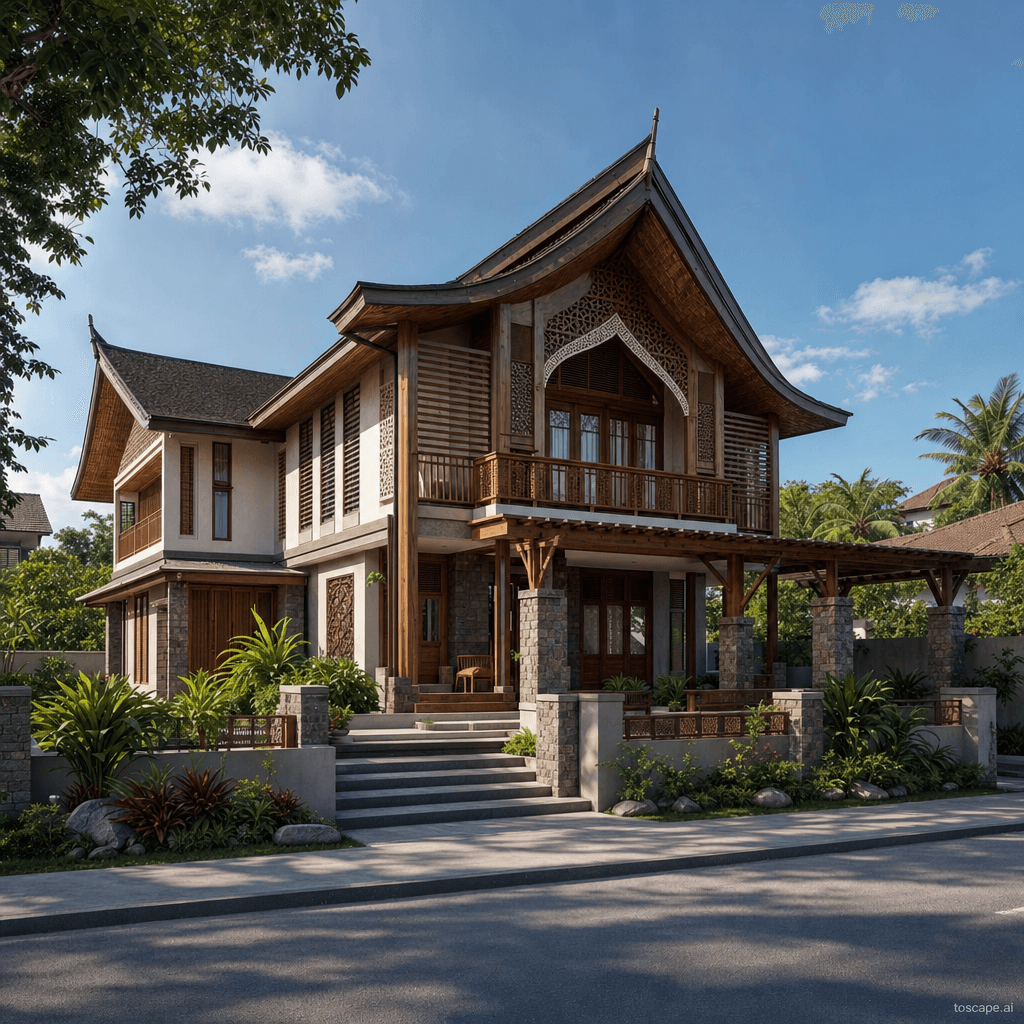
Mindanao — characteristic facade composition, Lanao del Sur.
Context Snapshot
Lanao del Sur — Maranao torogan royal house and okir ornamental tradition Tropical rainforest (Af) — Lake Lanao plateau (700m elevation), high humidity, heavy monsoon rainfall (2,500mm+ annually), warm year-round (22-30°C).
Contemporary Relevance
Mindanao is useful today for residential, hospitality, civic, and place-branding work that needs Philippines-specific character grounded in local massing, material tone, climate response, and settlement logic rather than generic international styling.
Use this style in Toscape
Explore Mindanao directly inside Toscape using the Facade Re-Style and Design Options workflows.
Open Mindanao in the galleryFrequently asked questions
What is Mindanao?
Mindanao is a regional architectural identity from Philippines. Maranao Torogan Royal House, Okir Carving & Islamic Vernacular.
What materials define Mindanao?
Tapuwilih (hardwood posts): massive round trunks — tugas (molave), mabunu, bait — up to 70cm diameter, bark left intact or stripped, dark brown to near-black, immensely durable (century lifespan in ground contact). Okir-carved timber: hardwood panels — tugas, narra, or maranao — reddish-brown to dark mahogany, deeply c.
What is the Mindanao color palette?
Warm earth, sandy beige, ochre, clay brown, and sun-softened mineral tones should dominate, with palm green or weathered timber as secondary accents. The palette should read as land-derived rather than polished or urban-generic.
Where does Mindanao come from?
Lanao del Sur — Maranao torogan royal house and okir ornamental tradition Tropical rainforest (Af) — Lake Lanao plateau (700m elevation), high humidity, heavy monsoon rainfall (2,500mm+ annually), warm year-round (22-30°C).
When should architects use Mindanao?
Mindanao is useful today for residential, hospitality, civic, and place-branding work that needs Philippines-specific character grounded in local massing, material tone, climate response, and settlement logic rather than generic international styling.
How do you render Mindanao in Toscape?
Open Toscape on Windows, load your own photo, elevation, sketch, or CAD view, then apply the Mindanao reference from the built-in style library. The Facade Re-Style and Design Options workflows keep your project geometry and camera while shifting materials, proportion, and detailing toward Mindanao.