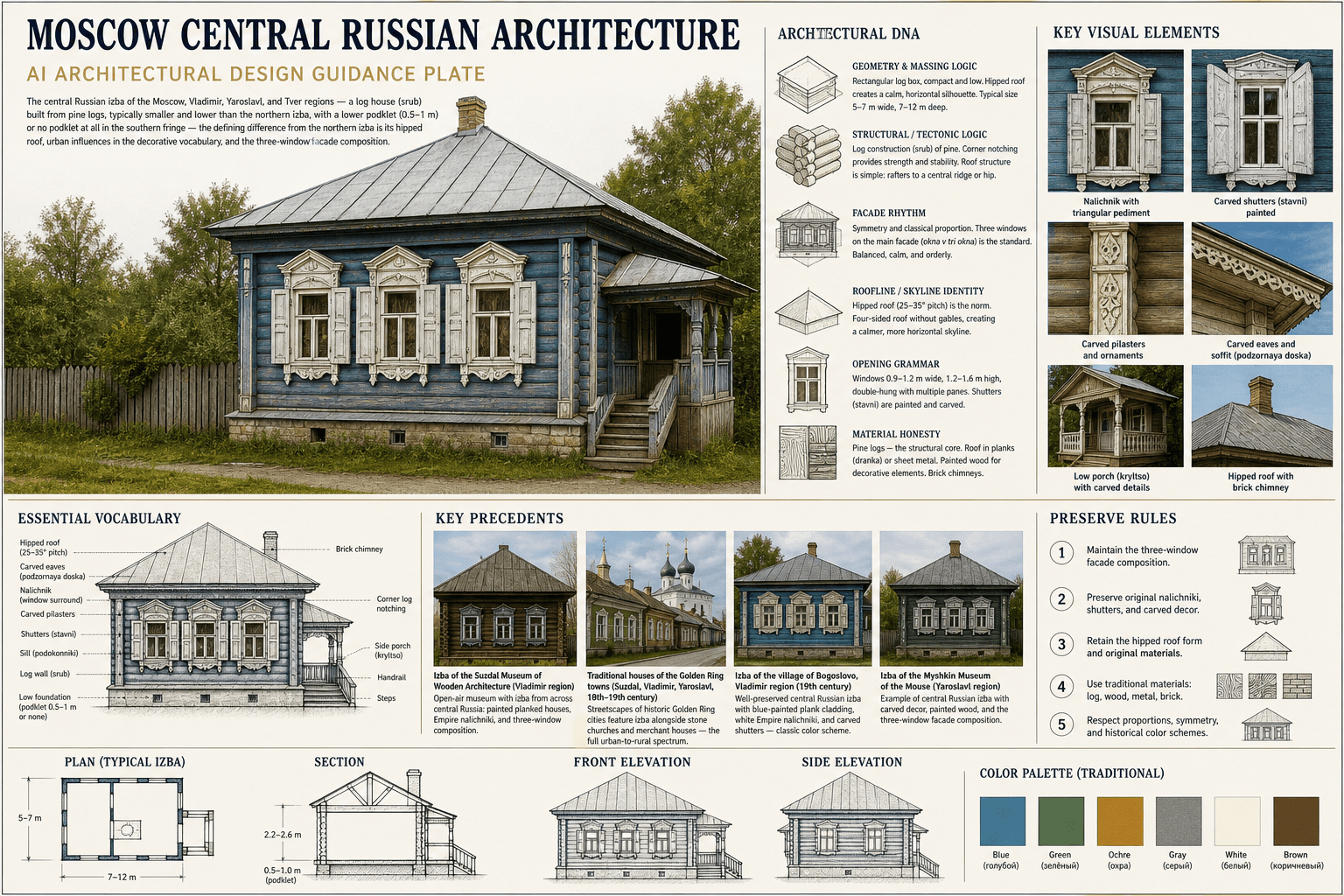
Moscow Central Russian
Russia · central Russian izba of the Moscow, Vladimir, Yaroslavl, and Tver regions
The log-built izba of central Russia and the Moscow region — a more modest version of the northern tradition, with classical Empire-style nalichniki, hipped roofs, and the urban-to...
Definition
Moscow Central Russian is a regional architectural identity from Russia. The log-built izba of central Russia and the Moscow region — a more modest version of the northern tradition, with classical Empire-style nalichniki, hipped roofs, and the urban-to.
- Country
- Russia
- Region
- central Russian izba of the Moscow, Vladimir, Yaroslavl, and Tver regions.
- Massing
- The central Russian izba is a rectangular log box, lower and more compact than the northern type.
- Materials
- Materials are transitional between the northern timber tradition and southern masonry influences: (1) Pine logs — the structural core, typically covered with plank cladding.
- Palette
- White, cream, pale sand, warm timber, and shadow-driven dark metal accents define the palette.
- Climate response
- Central Russia has a continental climate: (1) Cold winters (-15 to -30°C) with moderate snow — the hipped roof sheds snow; the log walls provide insulation.
Overview
Moscow Central Russian is a regional architectural identity in Russia. The central Russian izba of the Moscow, Vladimir, Yaroslavl, and Tver regions — a log house (srub) built from pine logs, typically smaller and lower than the northern izba, with a lower podklet (0.5–1 m) or no podklet at all in the southern fringe — the defining difference from the northern izba is the influence of classical and Empire-style architecture on the carved ornament: the nalichniki in central Russia incorp...
Visual DNA
Massing & Form
The central Russian izba is a rectangular log box, lower and more compact than the northern type. The hipped roof creates a pyramidal or trapezoidal profile, less dramatic than the steep northern gable.
Facade Language
The facade is characterized by symmetry and classical proportion: (1) Three windows on the main street facade (the three-window rule) — symmetrical, evenly spaced. (2) Each window has an Empire-style nalichnik: a triangular pediment top, fluted or carved pilasters on the sides, and a projecting sill — the carving is sa...
Materials & Texture
Materials are transitional between the northern timber tradition and southern masonry influences: (1) Pine logs — the structural core, typically covered with plank cladding. (2) Plank cladding (obshivka) — horizontal boards 15–20 cm wide, painted white, blue, green, yellow, or ochre.
Color Palette
White, cream, pale sand, warm timber, and shadow-driven dark metal accents define the palette. The facade should stay bright and climate-aware rather than heavy, gray, or over-saturated.
Ornament & Detail
Central Russian house carving is defined by the Empire (Ampir) style influence: (1) The triangular pediment — the top of the nalichnik, with dentil molding beneath. (2) Pilasters — flat carved columns on either side of the window, with simplified Doric or Ionic capitals.
Climate Response
Central Russia has a continental climate: (1) Cold winters (-15 to -30°C) with moderate snow — the hipped roof sheds snow; the log walls provide insulation. (2) Warm summers (20–30°C) — the painted plank cladding protects the logs from summer rain and sun.
Landscape & Ground
The central Russian izba of the Moscow, Vladimir, Yaroslavl, and Tver regions — a log house (srub) built from pine logs, typically smaller and lower than the northern izba, with a lower podklet (0.5–1 m) or no podklet at all in the southern fringe — the defining difference from the northern izba is the influence of cla...
Reference elevation
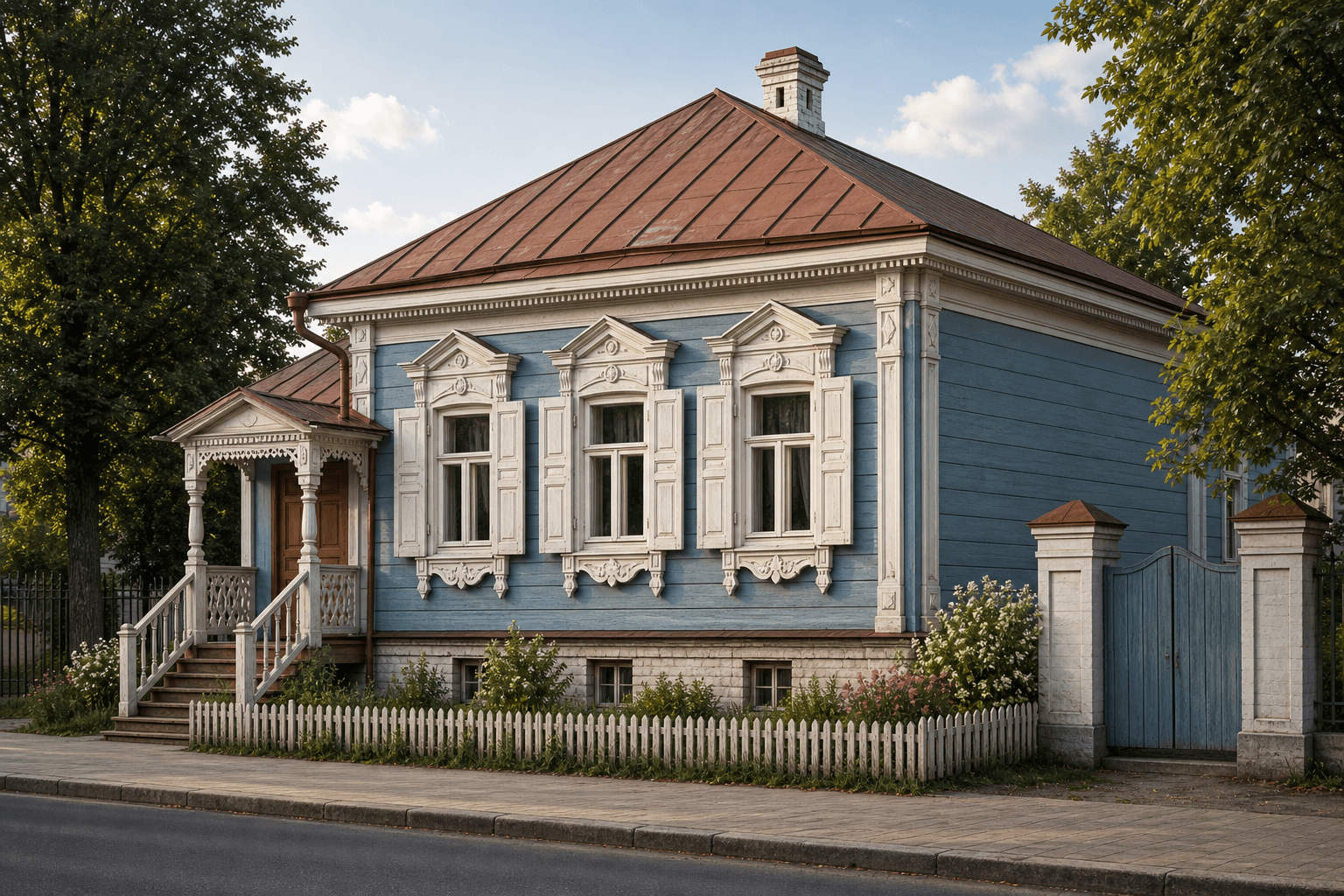
Moscow Central Russian — characteristic facade composition, central Russian izba of the Moscow, Vladimir, Yaroslavl, and Tver regions.
Context Snapshot
The central Russian izba of the Moscow, Vladimir, Yaroslavl, and Tver regions — a log house (srub) built from pine logs, typically smaller and lower than the northern izba, with a lower podklet (0.5–1... Central Russia has a continental climate: (1) Cold winters (-15 to -30°C) with moderate snow — the hipped roof sheds snow; the log walls provide insulation.
Contemporary Relevance
Moscow Central Russian is useful today for residential, hospitality, civic, and place-branding work that needs Russia-specific character grounded in local massing, material tone, climate response, and settlement logic rather than generic international styling.
Use this style in Toscape
Explore Moscow Central Russian directly inside Toscape using the Facade Re-Style and Design Options workflows.
Open Moscow Central Russian in the galleryFrequently asked questions
What is Moscow Central Russian?
Moscow Central Russian is a regional architectural identity from Russia. The log-built izba of central Russia and the Moscow region — a more modest version of the northern tradition, with classical Empire-style nalichniki, hipped roofs, and the urban-to.
What materials define Moscow Central Russian?
Materials are transitional between the northern timber tradition and southern masonry influences: (1) Pine logs — the structural core, typically covered with plank cladding. (2) Plank cladding (obshivka) — horizontal boards 15–20 cm wide, painted white, blue, green, yellow, or ochre.
What is the Moscow Central Russian color palette?
White, cream, pale sand, warm timber, and shadow-driven dark metal accents define the palette. The facade should stay bright and climate-aware rather than heavy, gray, or over-saturated.
Where does Moscow Central Russian come from?
The central Russian izba of the Moscow, Vladimir, Yaroslavl, and Tver regions — a log house (srub) built from pine logs, typically smaller and lower than the northern izba, with a lower podklet (0. 5–1.
When should architects use Moscow Central Russian?
Moscow Central Russian is useful today for residential, hospitality, civic, and place-branding work that needs Russia-specific character grounded in local massing, material tone, climate response, and settlement logic rather than generic international styling.
How do you render Moscow Central Russian in Toscape?
Open Toscape on Windows, load your own photo, elevation, sketch, or CAD view, then apply the Moscow Central Russian reference from the built-in style library. The Facade Re-Style and Design Options workflows keep your project geometry and camera while shifting materials, proportion, and detailing toward Moscow Central Russian.