Mosul Marble
Iraq · Mosul (Al-Mawsil)
The alabaster city of northern Iraq — marble courtyard houses, elaborate window surrounds, Tigris River stonework, and the distinct architectural dialect of Mosul
Definition
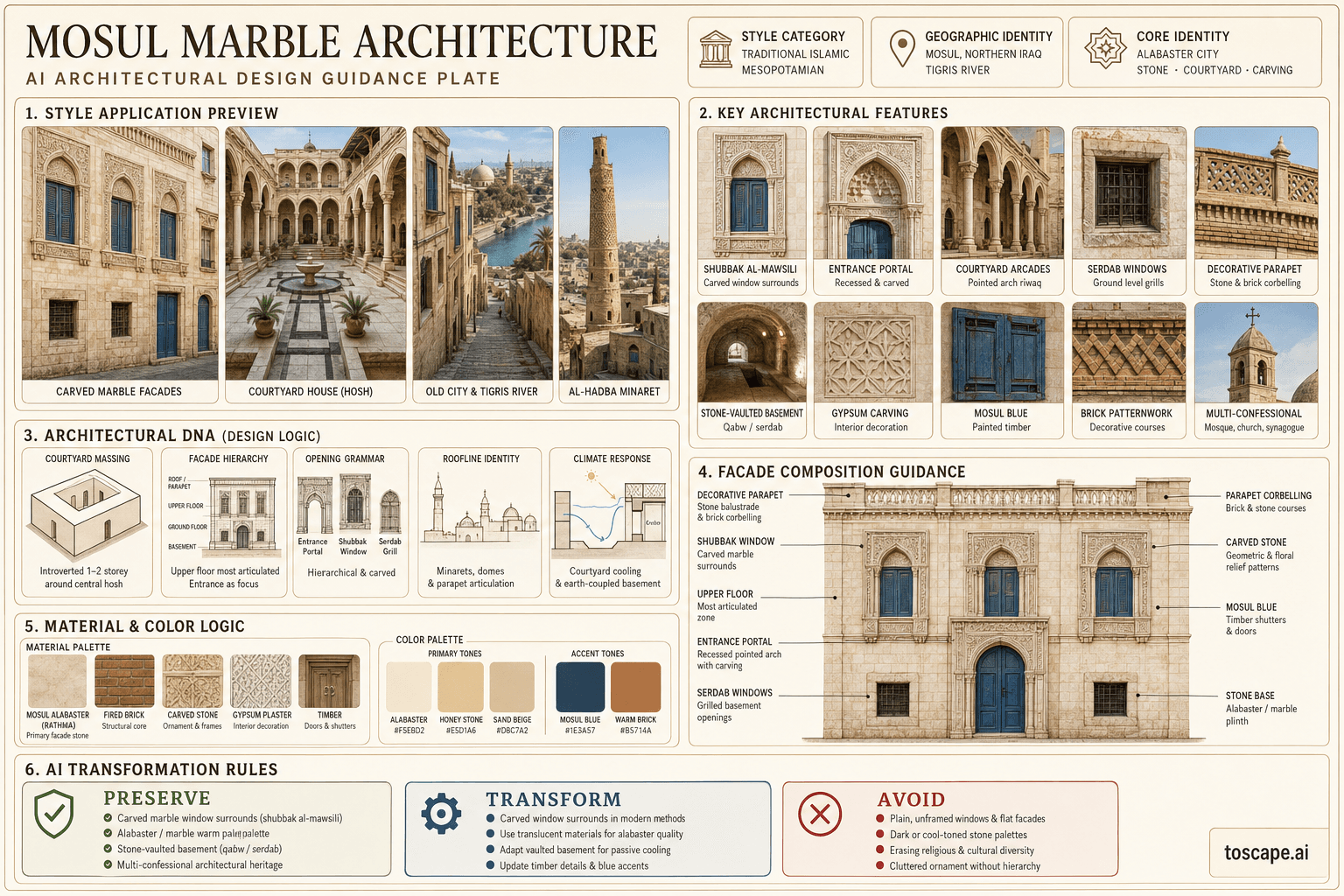
Mosul Marble is a regional architectural identity from Iraq. The alabaster city of northern Iraq — marble courtyard houses, elaborate window surrounds, Tigris River stonework, and the distinct architectural dialect of Mosul.
- Country
- Iraq
- Region
- Mosul (Al-Mawsil)
- Massing
- Mosuli courtyard houses are 1–2 storey rectangular volumes — typically 10–16 m wide × 14–22 m deep — organized around a central courtyard.
- Materials
- Mosul alabaster/marble (rathma) — pale cream to honey-colored, translucent when thin — the defining Mosuli building material Fired brick (ajur) — the structural core behind stone.
- Palette
- White, cream, pale sand, warm timber, and shadow-driven dark metal accents define the palette.
- Climate response
- Mosul's architecture responds to a continental climate with hot summers and cold winters: (1) Marble thermal mass — the stone facades absorb daytime heat and release.
Overview
Mosul Marble is a regional architectural identity in Iraq. Traditional architecture of Mosul (Al-Mawsil) — the historic northern capital of Iraq on the Tigris River, known for its distinctive use of local alabaster and marble ("Mosul marble") in building construction, its elaborate carved window surrounds, and an architectural dialect that is recognizably Mesopotamian yet distinctly different from both Baghdad and Basra. Alabaster and local marble (rathma / farsh) as the def...
Visual DNA
Massing & Form
Mosuli courtyard houses are 1–2 storey rectangular volumes — typically 10–16 m wide × 14–22 m deep — organized around a central courtyard. The massing is introverted like Baghdad, but Mosul houses are distinguished by their greater use of stone, more elaborate facade articulation on the upper floor, and the distinctive...
Facade Language
The Mosuli street facade displays a more articulated, stone-emphasized character than Baghdad: Ground floor: Stone-faced or rendered brick wall with the entrance portal as the focal point. The entrance is a recessed pointed arch framed in carved alabaster/marble — often with geometric banding and calligraphic panels.
Materials & Texture
Mosul alabaster/marble (rathma) — pale cream to honey-colored, translucent when thin — the defining Mosuli building material Fired brick (ajur) — the structural core behind stone veneer Gypsum plaster (juss) — interior render, often carved with geometric patterns Carved stone — window surrounds, entrance portals, colum...
Color Palette
White, cream, pale sand, warm timber, and shadow-driven dark metal accents define the palette. The facade should stay bright and climate-aware rather than heavy, gray, or over-saturated.
Ornament & Detail
Mosuli ornament is distinguished by its stone-carving tradition: (1) Carved marble window surrounds (shubbak al-mawsili) — the primary decorative element. Geometric star patterns, arabesque scrollwork, and stylized floral motifs carved in relief on pale alabaster.
Climate Response
Mosul's architecture responds to a continental climate with hot summers and cold winters: (1) Marble thermal mass — the stone facades absorb daytime heat and release it slowly at night, moderating interior temperatures. (2) The serdab (basement room) — similar to Baghdad, providing summer cooling through earth-coupling...
Landscape & Ground
Traditional architecture of Mosul (Al-Mawsil) — the historic northern capital of Iraq on the Tigris River, known for its distinctive use of local alabaster and marble ("Mosul marble") in building construction, its elaborate carved window surrounds, and an architectural dialect that is recognizably Mesopotamian yet dist...
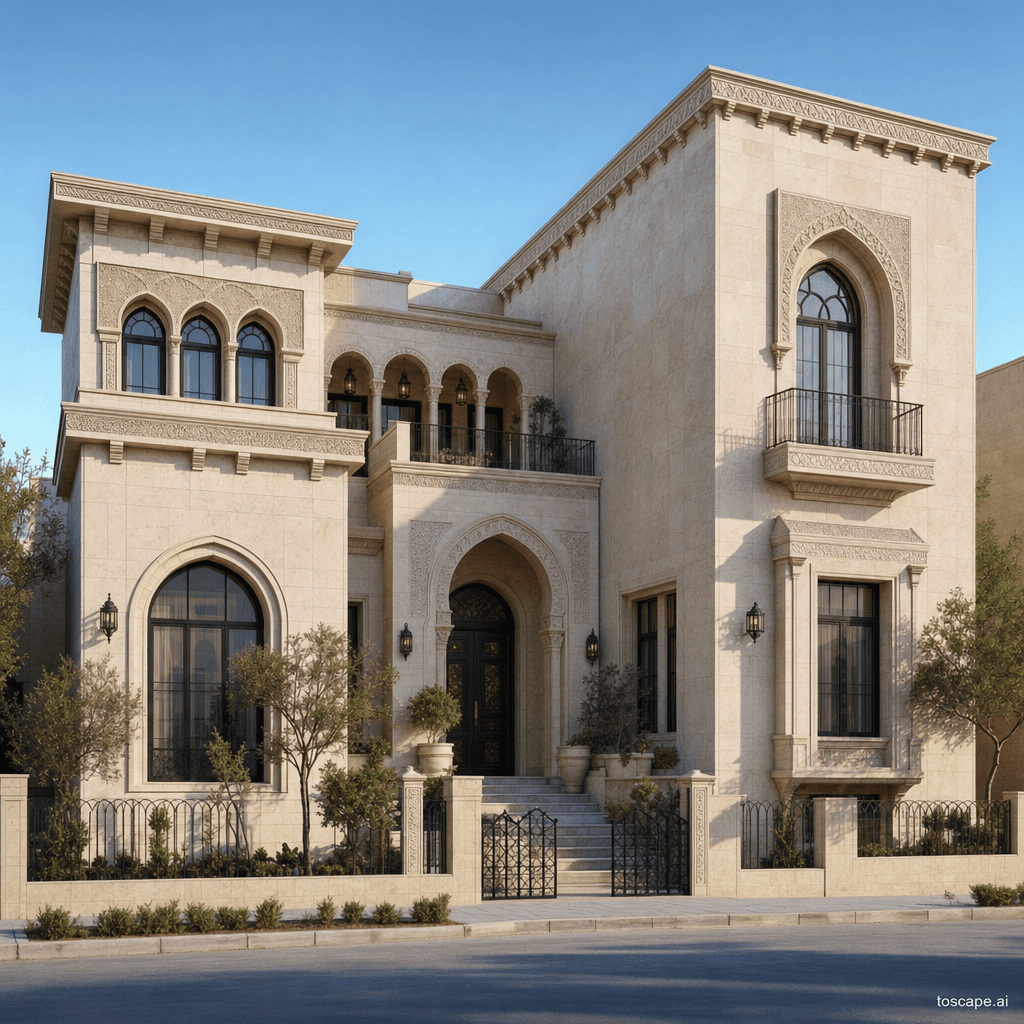
Reference elevation
Mosul Marble — characteristic facade composition, Mosul (Al-Mawsil).
Context Snapshot
Traditional architecture of Mosul (Al-Mawsil) — the historic northern capital of Iraq on the Tigris River, known for its distinctive use of local alabaster and marble ("Mosul marble") in building cons... Mosul's architecture responds to a continental climate with hot summers and cold winters: (1) Marble thermal mass — the stone facades absorb daytime heat and release it slowly at night, moderating interior temperatures.
Contemporary Relevance
Mosul Marble is useful today for residential, hospitality, civic, and place-branding work that needs Iraq-specific character grounded in local massing, material tone, climate response, and settlement logic rather than generic international styling.
Use this style in Toscape
Explore Mosul Marble directly inside Toscape using the Facade Re-Style and Design Options workflows.
Open Mosul Marble in the galleryFrequently asked questions
What is Mosul Marble?
Mosul Marble is a regional architectural identity from Iraq. The alabaster city of northern Iraq — marble courtyard houses, elaborate window surrounds, Tigris River stonework, and the distinct architectural dialect of Mosul.
What materials define Mosul Marble?
Mosul alabaster/marble (rathma) — pale cream to honey-colored, translucent when thin — the defining Mosuli building material Fired brick (ajur) — the structural core behind stone veneer Gypsum plaster (juss) — interior render, often carved with geometric patterns Carved stone — window surrounds, entrance portals, colum.
What is the Mosul Marble color palette?
White, cream, pale sand, warm timber, and shadow-driven dark metal accents define the palette. The facade should stay bright and climate-aware rather than heavy, gray, or over-saturated.
Where does Mosul Marble come from?
Traditional architecture of Mosul (Al-Mawsil) — the historic northern capital of Iraq on the Tigris River, known for its distinctive use of local alabaster and marble ("Mosul marble") in building cons.
When should architects use Mosul Marble?
Mosul Marble is useful today for residential, hospitality, civic, and place-branding work that needs Iraq-specific character grounded in local massing, material tone, climate response, and settlement logic rather than generic international styling.
How do you render Mosul Marble in Toscape?
Open Toscape on Windows, load your own photo, elevation, sketch, or CAD view, then apply the Mosul Marble reference from the built-in style library. The Facade Re-Style and Design Options workflows keep your project geometry and camera while shifting materials, proportion, and detailing toward Mosul Marble.