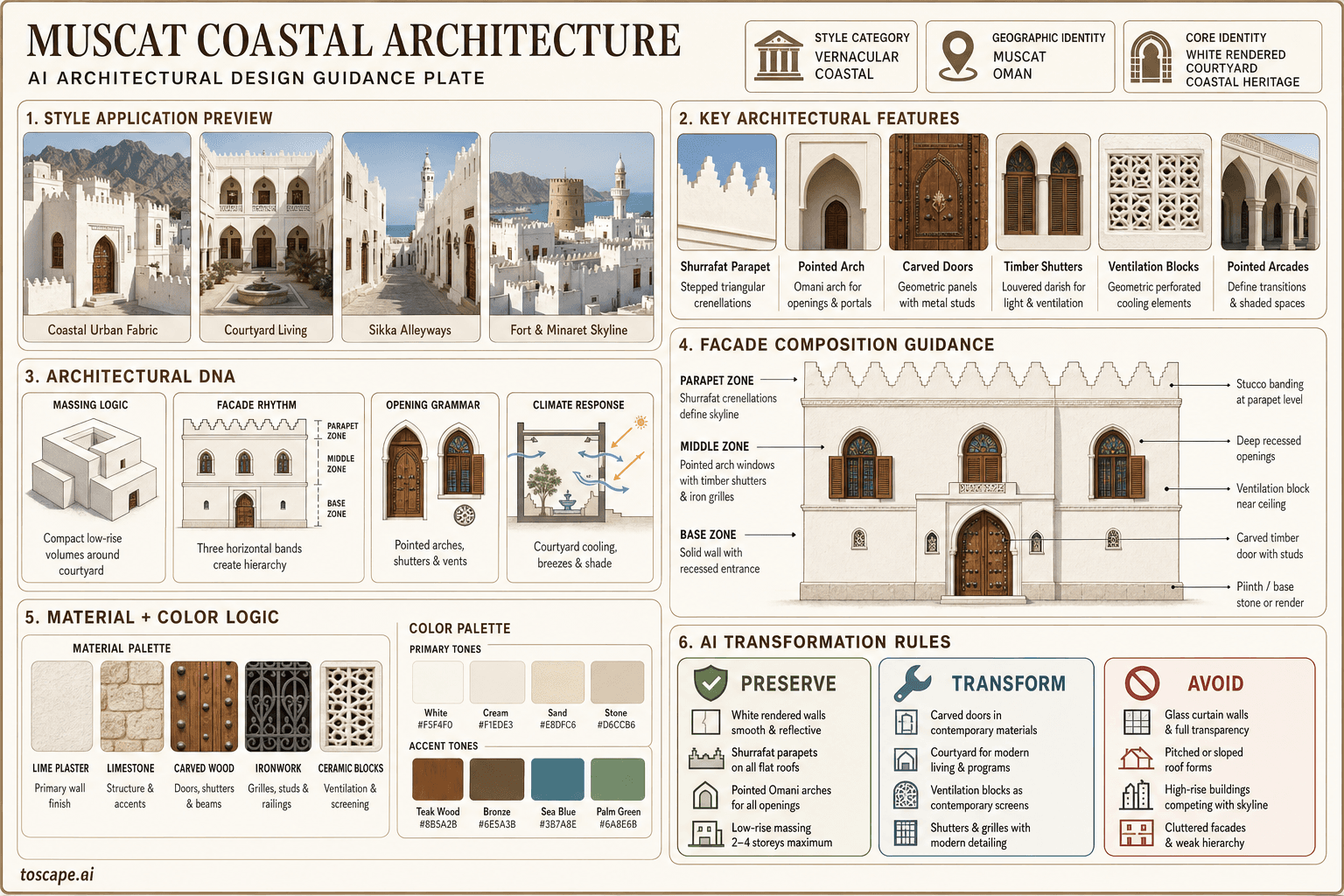
Muscat Coastal
Oman · Muscat Governorate and the Batinah coast
White-rendered maritime architecture shaped by Omani arches, crenellated parapets, carved doors, and the mountain-sea setting of Muscat.
Definition
Muscat Coastal is a regional architectural identity from Oman. White-rendered maritime architecture shaped by Omani arches, crenellated parapets, carved doors, and the mountain-sea setting of Muscat.
- Country
- Oman
- Region
- Muscat Governorate and the Batinah coast.
- Massing
- Buildings read as compact horizontal blocks, usually two to three storeys, with flat roofs and strong parapet lines.
- Materials
- Smooth white or cream gypsum-lime render dominates, with carved timber doors, shutters, decorative ironwork, and occasional stone accents.
- Palette
- White, cream, pale sand, weathered timber, dark metal, and bougainvillea greens and magentas define the palette.
- Climate response
- Small openings, thick rendered walls, courtyards, shaded alleys, and roof terraces respond to intense heat and coastal humidity.
Overview
Muscat Coastal is Oman's maritime urban identity, defined by low-rise white-rendered architecture, crenellated parapets, pointed Omani arches, carved timber doors, and compact courtyard organization. It is characterized by a disciplined horizontal skyline that lets forts, mosques, mountains, and the Gulf of Oman remain the dominant visual anchors of the city.
Visual DNA
Massing & Form
Buildings read as compact horizontal blocks, usually two to three storeys, with flat roofs and strong parapet lines. Massing remains low-rise and dense, preserving the visual primacy of mountains, forts, and minarets behind the harbor fabric.
Facade Language
Facades are organized in calm horizontal bands: a solid base, an upper zone of arched openings, and a crenellated parapet skyline. The pointed Omani arch and deeply recessed openings are the clearest identity markers.
Materials & Texture
Smooth white or cream gypsum-lime render dominates, with carved timber doors, shutters, decorative ironwork, and occasional stone accents. The finish should feel maintained, sun-reflective, and unified rather than rustic or rough.
Color Palette
White, cream, pale sand, weathered timber, dark metal, and bougainvillea greens and magentas define the palette. The bright wall plane is essential because it ties the architecture to heat, glare control, and the coastal mountain backdrop.
Ornament & Detail
Detail is concentrated at entries, parapets, window surrounds, and timber doors with studwork and geometric carving. Ornament stays precise and restrained, never spreading across the full wall field.
Climate Response
Small openings, thick rendered walls, courtyards, shaded alleys, and roof terraces respond to intense heat and coastal humidity. The reflective render and inward plan help the architecture stay cool while preserving privacy.
Landscape & Ground
The identity depends on a tight relationship between sea edge, corniche, narrow sikka lanes, planted courts, and the Hajar mountain wall beyond. Buildings should feel anchored between harbor life and rocky terrain rather than isolated as objects.
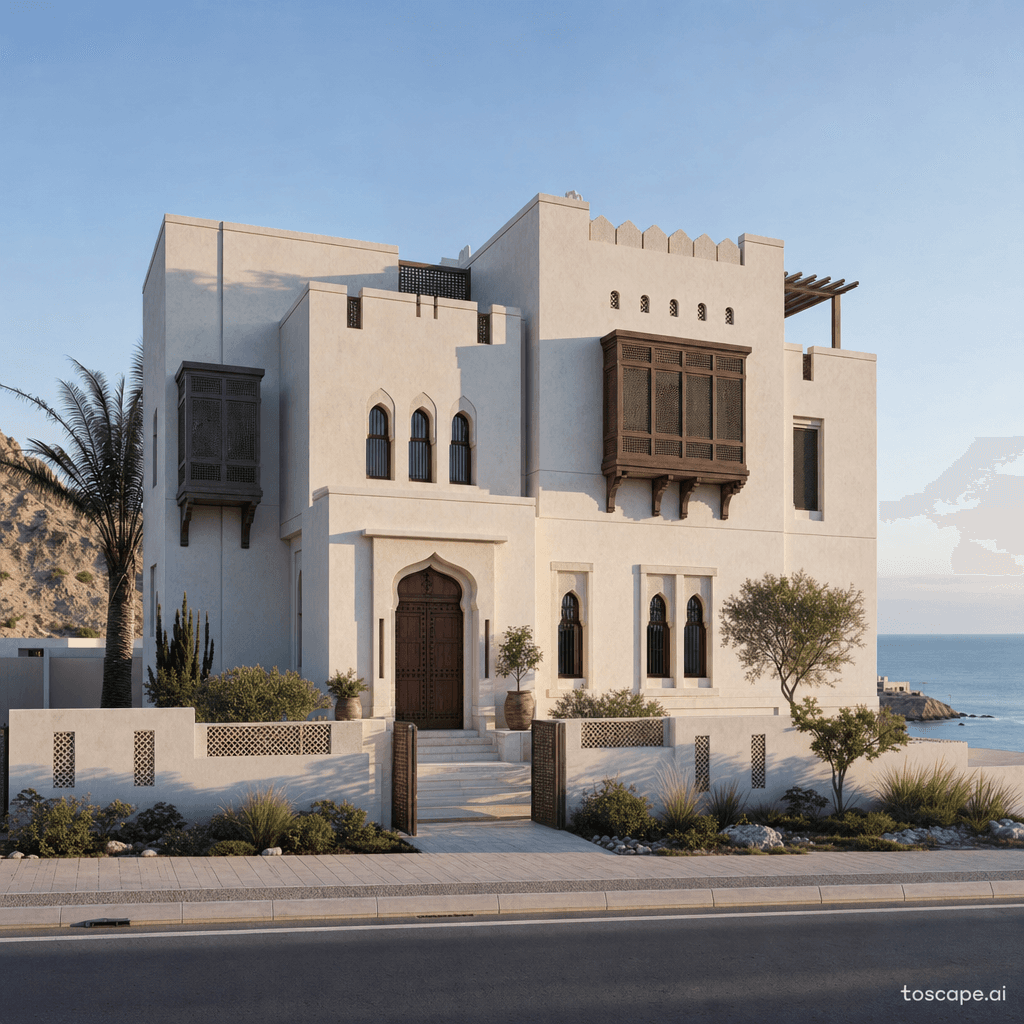
Reference elevation
Muscat Coastal — characteristic facade composition, Muscat Governorate and the Batinah coast.
Context Snapshot
This identity grew from Muscat's harbor settlements, Indian Ocean trade links, and a long tradition of defensive fort architecture adapted to domestic and civic scale. Muscat Municipality regulations continue to reinforce this language, preserving the legibility of white cubic volumes, parapet rhythm, and courtyard privacy across contemporary construction.
Contemporary Relevance
Muscat Coastal is highly usable today for hospitality, civic, and residential projects that need an unmistakably Omani character without abandoning current structure and services. In Toscape it responds best when prompts emphasize white rendered massing, pointed arches, carved timber doors, crenellations, and a mountain-to-sea urban setting.
Use this style in Toscape
Explore Muscat Coastal directly inside Toscape using the Facade Re-Style and Design Options workflows.
Open Muscat Coastal in the galleryFrequently asked questions
What is Muscat Coastal?
Muscat Coastal is a regional architectural identity from Oman. White-rendered maritime architecture shaped by Omani arches, crenellated parapets, carved doors, and the mountain-sea setting of Muscat.
What materials define Muscat Coastal?
Smooth white or cream gypsum-lime render dominates, with carved timber doors, shutters, decorative ironwork, and occasional stone accents. The finish should feel maintained, sun-reflective, and unified rather than rustic or rough.
What is the Muscat Coastal color palette?
White, cream, pale sand, weathered timber, dark metal, and bougainvillea greens and magentas define the palette. The bright wall plane is essential because it ties the architecture to heat, glare control, and the coastal mountain backdrop.
Where does Muscat Coastal come from?
This identity grew from Muscat's harbor settlements, Indian Ocean trade links, and a long tradition of defensive fort architecture adapted to domestic and civic scale. Muscat Municipality regulations continue to reinforce this language, preserving the legibility of white cubic volumes, parapet rhythm, and courtyard privacy across contemporary construction.
When should architects use Muscat Coastal?
Muscat Coastal is highly usable today for hospitality, civic, and residential projects that need an unmistakably Omani character without abandoning current structure and services. In Toscape it responds best when prompts emphasize white rendered massing, pointed arches, carved timber doors, crenellations, and a mountain-to-sea urban setting.
How do you render Muscat Coastal in Toscape?
Open Toscape on Windows, load your own photo, elevation, sketch, or CAD view, then apply the Muscat Coastal reference from the built-in style library. The Facade Re-Style and Design Options workflows keep your project geometry and camera while shifting materials, proportion, and detailing toward Muscat Coastal.