Mzab Valley Pentapolis
Algeria · architectural identity of the M'zab Valley pentapolis (Ghardaïa, Beni Isguen, Me...
The Ibadi whitewashed cubic architecture of the M'zab Valley — Ghardaïa and the pentapolis, pyramidal mosque minarets, and the UNESCO World Heritage Saharan architectural identity
Definition
Mzab Valley Pentapolis is a regional architectural identity from Algeria. The Ibadi whitewashed cubic architecture of the M'zab Valley — Ghardaïa and the pentapolis, pyramidal mosque minarets, and the UNESCO World Heritage Saharan architectural identity.
- Country
- Algeria
- Region
- architectural identity of the M'zab Valley pentapolis (Ghardaïa, Beni Isguen, Me.
- Massing
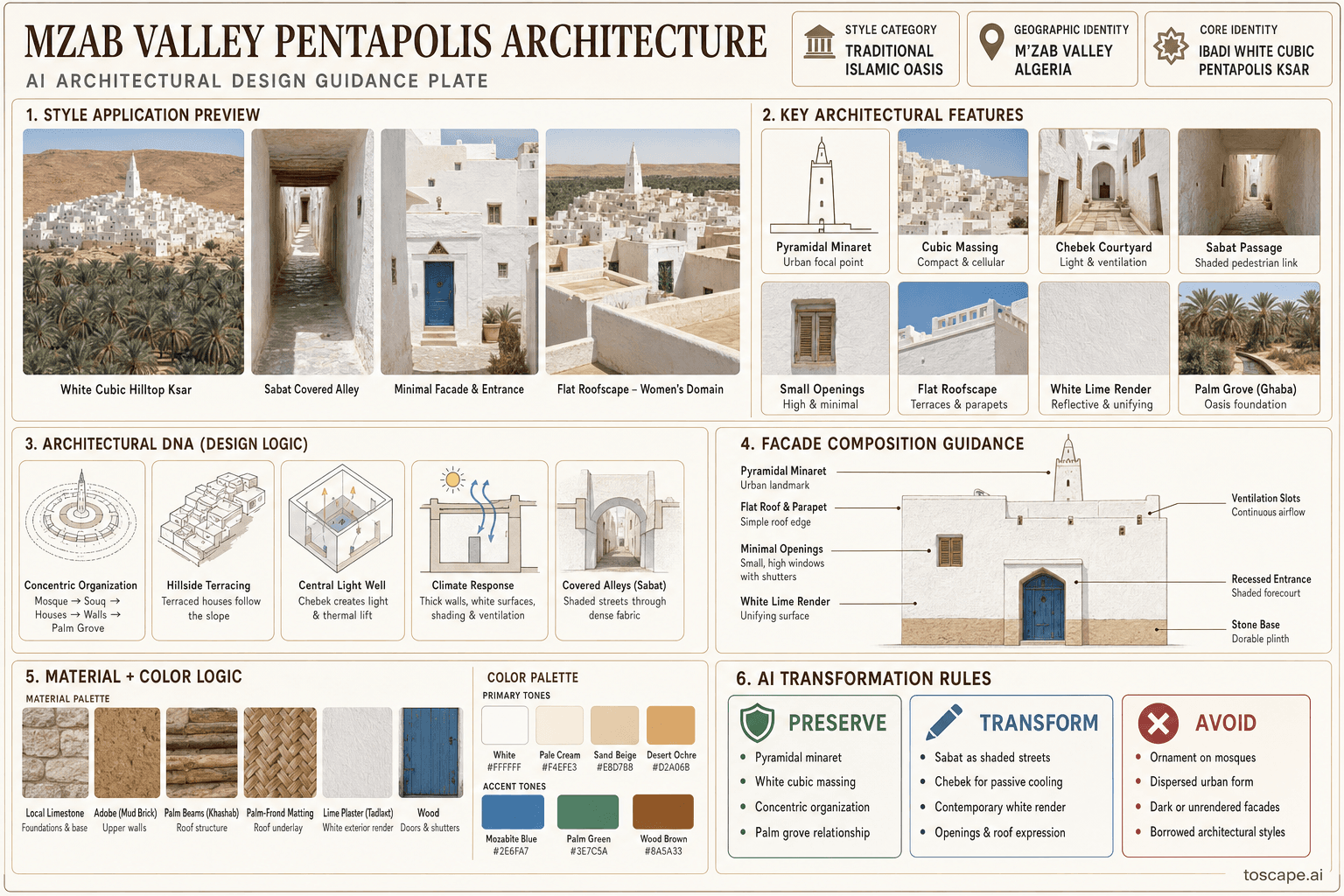
- Each M'zab pentapolis settlement (ksar) is organized around a central mosque — the mosque minaret dominates the settlement skyline as both religious and visual focal point.
- Materials
- Local limestone — for foundations and lower walls Mud brick (adobe) — for upper walls Palm trunk beams — for flat roof structure Palm-frond matting.
- Palette
- White, cream, pale sand, warm timber, and shadow-driven dark metal accents define the palette.
- Climate response
- The M'zab architecture is an extraordinary response to the extreme Saharan climate: (1) Hillside siting — settlements occupy hilltops.
Overview
Mzab Valley Pentapolis is a regional architectural identity in Algeria. The architectural identity of the M'zab Valley pentapolis (Ghardaïa, Beni Isguen, Melika, Bou Noura, and El Atteuf) in northern Sahara, Algeria — a UNESCO World Heritage site since 1982, representing one of the world's most architecturally and socially intact traditional Saharan urban civilizations, created by the Ibadi (Mozabite) Muslim community in the 11th century. Whitewashed cubic volumes — pyramidal mosque mina...
Visual DNA
Massing & Form
Each M'zab pentapolis settlement (ksar) is organized around a central mosque — the mosque minaret dominates the settlement skyline as both religious and visual focal point. The urban fabric radiates outward in concentric rings from the mosque: innermost ring — mosque and religious buildings, second ring — market (souq)...
Facade Language
The Mozabite street facade is characterized by extreme simplicity and whiteness: White render: All external surfaces are coated in white or pale cream lime plaster — the unifying surface. The white reflects solar radiation and creates the visual identity of the pentapolis — five white hilltop settlements rising from th...
Materials & Texture
Local limestone — for foundations and lower walls Mud brick (adobe) — for upper walls Palm trunk beams — for flat roof structure Palm-frond matting — for roof underlay Lime plaster (tadlakt) — white waterproof render for all external surfaces Gypsum plaster — for internal wall finishes Wood — for doors, window shutters...
Color Palette
White, cream, pale sand, warm timber, and shadow-driven dark metal accents define the palette. The facade should stay bright and climate-aware rather than heavy, gray, or over-saturated.
Ornament & Detail
The Ibadi architectural tradition is characterized by austerity and restraint — ornament is minimal and never applied to religious buildings (the mosque interior is unornamented, reflecting Ibadi theological principles): (1) White surface as ornament — the purity of the white-rendered wall is itself the aesthetic state...
Climate Response
The M'zab architecture is an extraordinary response to the extreme Saharan climate: (1) Hillside siting — settlements occupy hilltops, preserving the valuable valley-floor agricultural land for the palm grove (ghaba). (2) Compact urban form — the dense, cellular fabric minimizes exposed surface area and creates mutual...
Landscape & Ground
The architectural identity of the M'zab Valley pentapolis (Ghardaïa, Beni Isguen, Melika, Bou Noura, and El Atteuf) in northern Sahara, Algeria — a UNESCO World Heritage site since 1982, representing one of the world's most architecturally and socially intact traditional Saharan urban civilizations, created by the Ibad...
Reference elevation
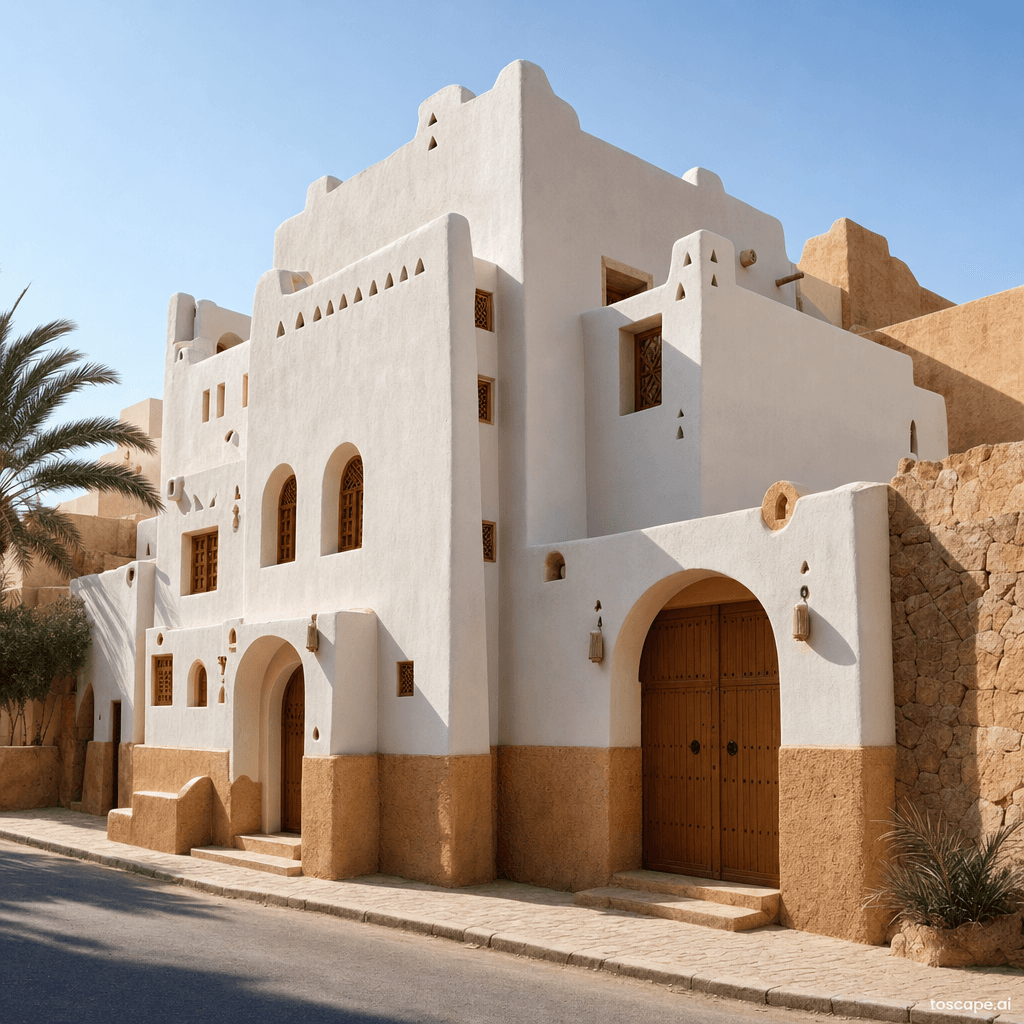
Mzab Valley Pentapolis — characteristic facade composition, architectural identity of the M'zab Valley pentapolis (Ghardaïa, Beni Isguen, Me....
Context Snapshot
The architectural identity of the M'zab Valley pentapolis (Ghardaïa, Beni Isguen, Melika, Bou Noura, and El Atteuf) in northern Sahara, Algeria — a UNESCO World Heritage site since 1982, representing... The M'zab architecture is an extraordinary response to the extreme Saharan climate: (1) Hillside siting — settlements occupy hilltops, preserving the valuable valley-floor agricultural land for the palm grove (ghaba).
Contemporary Relevance
Mzab Valley Pentapolis is useful today for residential, hospitality, civic, and place-branding work that needs Algeria-specific character grounded in local massing, material tone, climate response, and settlement logic rather than generic international styling.
Use this style in Toscape
Explore Mzab Valley Pentapolis directly inside Toscape using the Facade Re-Style and Design Options workflows.
Open Mzab Valley Pentapolis in the galleryFrequently asked questions
What is Mzab Valley Pentapolis?
Mzab Valley Pentapolis is a regional architectural identity from Algeria. The Ibadi whitewashed cubic architecture of the M'zab Valley — Ghardaïa and the pentapolis, pyramidal mosque minarets, and the UNESCO World Heritage Saharan architectural identity.
What materials define Mzab Valley Pentapolis?
Local limestone — for foundations and lower walls Mud brick (adobe) — for upper walls Palm trunk beams — for flat roof structure Palm-frond matting — for roof underlay Lime plaster (tadlakt) — white waterproof render for all external surfaces Gypsum plaster — for internal wall finishes Wood — for doors, window shutters.
What is the Mzab Valley Pentapolis color palette?
White, cream, pale sand, warm timber, and shadow-driven dark metal accents define the palette. The facade should stay bright and climate-aware rather than heavy, gray, or over-saturated.
Where does Mzab Valley Pentapolis come from?
The architectural identity of the M'zab Valley pentapolis (Ghardaïa, Beni Isguen, Melika, Bou Noura, and El Atteuf) in northern Sahara, Algeria — a UNESCO World Heritage site since 1982, representing... The M'zab architecture is an extraordinary response to the extreme Saharan climate: (1) Hillside siting — settlements occupy hilltops, preserving the valuable valley-floor agricultural land for the palm grove (ghaba).
When should architects use Mzab Valley Pentapolis?
Mzab Valley Pentapolis is useful today for residential, hospitality, civic, and place-branding work that needs Algeria-specific character grounded in local massing, material tone, climate response, and settlement logic rather than generic international styling.
How do you render Mzab Valley Pentapolis in Toscape?
Open Toscape on Windows, load your own photo, elevation, sketch, or CAD view, then apply the Mzab Valley Pentapolis reference from the built-in style library. The Facade Re-Style and Design Options workflows keep your project geometry and camera while shifting materials, proportion, and detailing toward Mzab Valley Pentapolis.