Najran Contemporary
Saudi Arabia · Najran Highlands
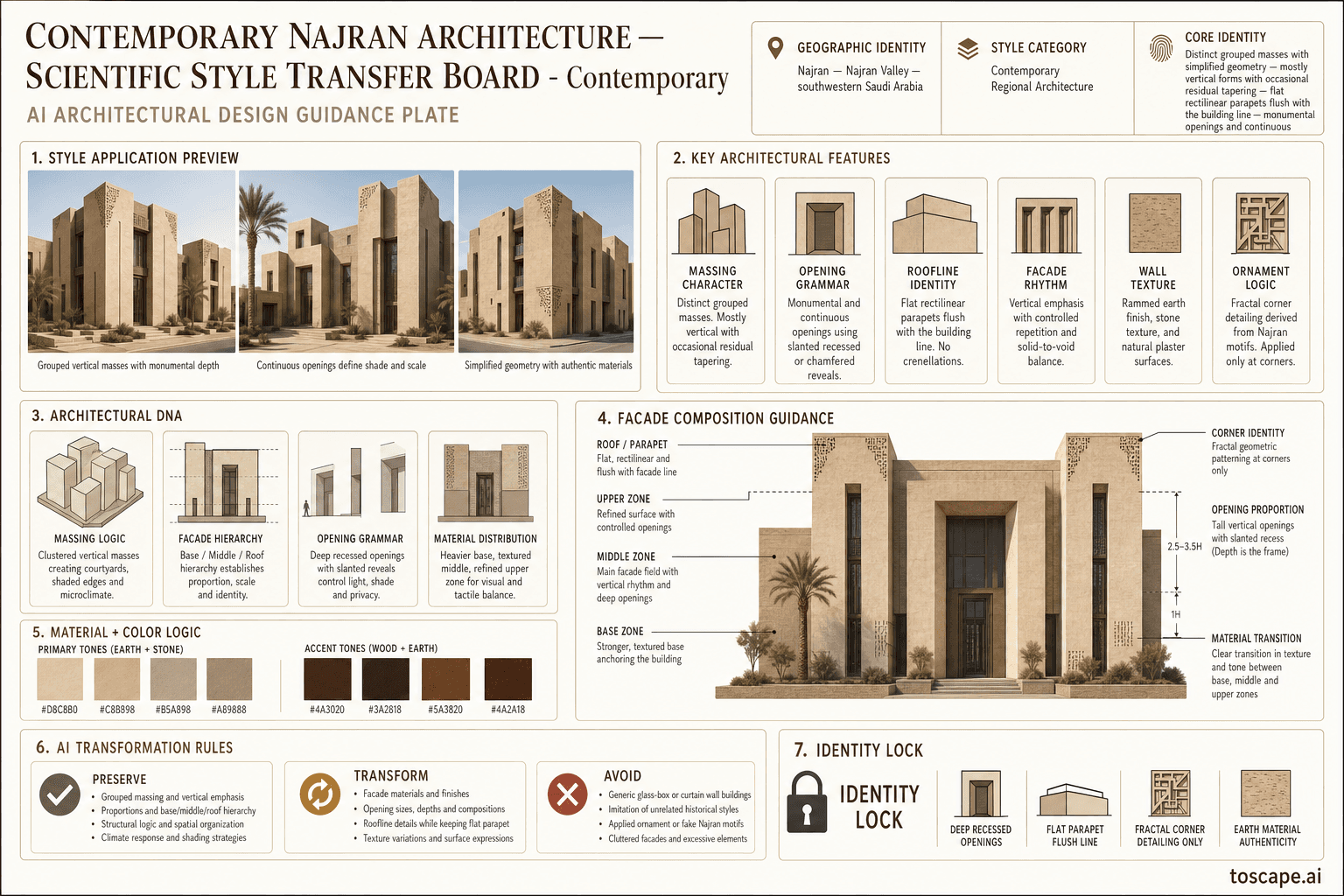
Abstraction of Najran identity into a refined modern language using simplified massing, flush parapets, chamfered recessed openings, fractal corner detailing, and regional material...
Definition
Najran Contemporary is a regional architectural identity from Saudi Arabia. Abstraction of Najran identity into a refined modern language using simplified massing, flush parapets, chamfered recessed openings, fractal corner detailing, and regional material.
- Country
- Saudi Arabia
- Region
- Najran Highlands
- Massing
- Contemporary Najran keeps the regional preference for GROUPED and STEPPED massing, but abstracts it into cleaner and more rectilinear forms .
- Materials
- Materials should be more REFINED than Traditional and Transitional Najran. REFINED PLASTERED WALLS — less porous, more controlled texture.
- Palette
- The palette should read as sun-baked earth updated for current construction: warm sand, clay beige, chalky off-white, and controlled dark bronze or timber accents.
- Climate response
- The architecture continues to rely on terraces, courtyards, recessed entries, and shaded depth .
Overview
Najran Contemporary is a Saudi architectural identity rooted in Najran Highlands. Najran vernacular principles reinterpreted through contemporary proportions, cleaner detailing, and modern construction systems compatible with local identity. Najran — Najran Valley — southwestern Saudi Arabia.
Visual DNA
Massing & Form
Contemporary Najran keeps the regional preference for GROUPED and STEPPED massing, but abstracts it into cleaner and more rectilinear forms . The architecture must still feel assembled from distinct masses and should step down as height increases — yet the expression is more MONOLITHIC, less porous, and less tapered th...
Facade Language
Facade rhythm comes from large but controlled openings, depth in slanted or chamfered reveals, selective horizontal articulation at a larger scale, and the relationship between distinct masses . The composition should feel DISCIPLINED and QUIET — not generic or over-animated.
Materials & Texture
Materials should be more REFINED than Traditional and Transitional Najran. REFINED PLASTERED WALLS — less porous, more controlled texture.
Color Palette
The palette should read as sun-baked earth updated for current construction: warm sand, clay beige, chalky off-white, and controlled dark bronze or timber accents. Cool greys and blue-white finishes break the Najdi reading and should be avoided.
Ornament & Detail
Contemporary Najran does not abandon ornament; it ABSTRACTS it. The key source-supported move: use FRACTAL ELEMENTS extrapolated from historical local patterns to detail the CORNERS of different masses .
Climate Response
The architecture continues to rely on terraces, courtyards, recessed entries, and shaded depth . Climate response is expressed through massing, roof use, and opening depth rather than through literal historic repetition.
Landscape & Ground
Najran — Najran Valley — southwestern Saudi Arabia. The architecture continues to rely on terraces, courtyards, recessed entries, and shaded depth .
Reference elevation
Najran Contemporary — characteristic facade composition, Najran Highlands.
Context Snapshot
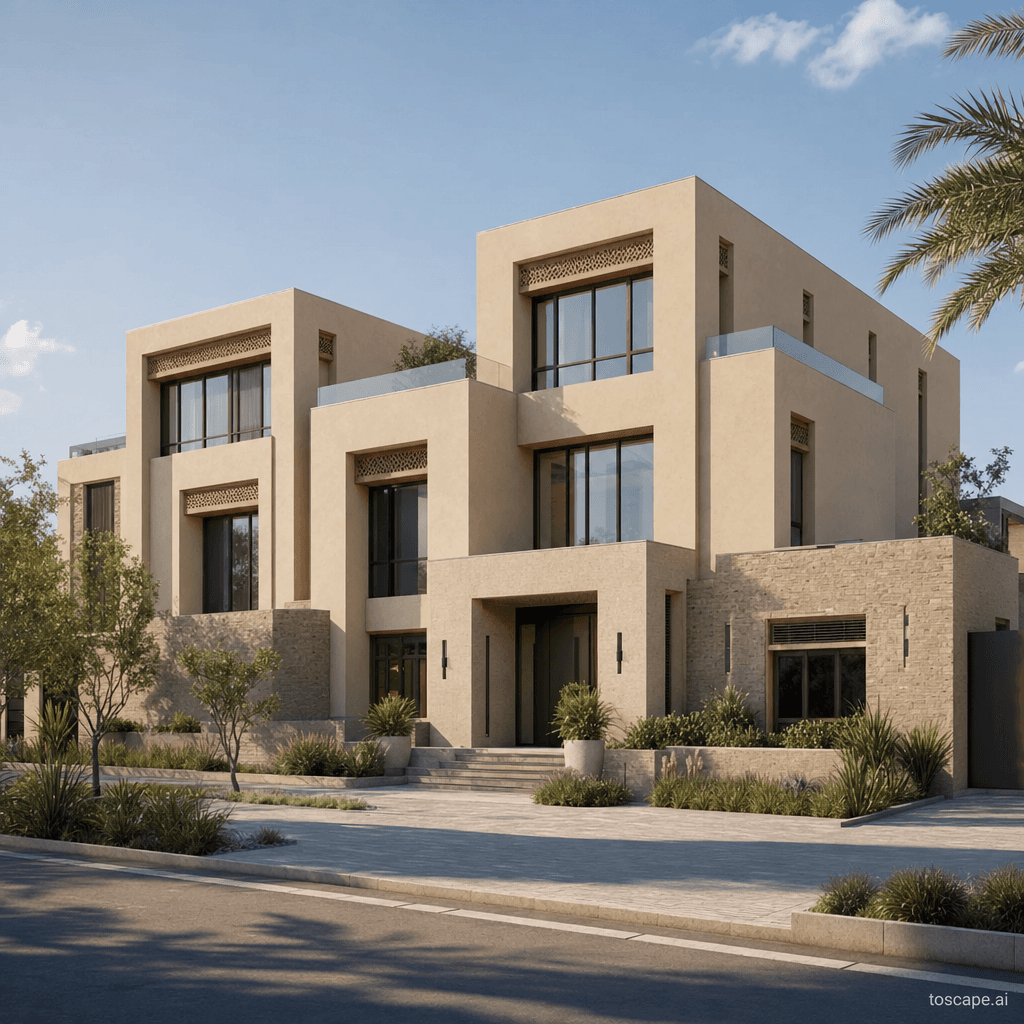
Contemporary Najran architecture — the tower-house tradition fully abstracted into monolithic contemporary forms with slanted recessed openings, continuous glazing, and fractal pattern extrapolation Najran vernacular principles reinterpreted through contemporary proportions, cleaner detailing, and modern construction systems compatible with local identity Najran — Najran Valley — southwestern Saudi Arabia
Contemporary Relevance
Najran Contemporary aligns naturally with current Saudi practice, where regional identity is carried by proportion, shading depth, material tone, and controlled abstraction rather than direct historic imitation. It suits present-day residential, hospitality, and mixed-use work that needs strong local character inside a modern planning and construction framework.
Use this style in Toscape
Explore Najran Contemporary directly inside Toscape using the Facade Re-Style and Design Options workflows.
Open Najran Contemporary in the galleryFrequently asked questions
What is Najran Contemporary?
Najran Contemporary is a regional architectural identity from Saudi Arabia. Abstraction of Najran identity into a refined modern language using simplified massing, flush parapets, chamfered recessed openings, fractal corner detailing, and regional material.
What materials define Najran Contemporary?
Materials should be more REFINED than Traditional and Transitional Najran. REFINED PLASTERED WALLS — less porous, more controlled texture.
What is the Najran Contemporary color palette?
The palette should read as sun-baked earth updated for current construction: warm sand, clay beige, chalky off-white, and controlled dark bronze or timber accents. Cool greys and blue-white finishes break the Najdi reading and should be avoided.
Where does Najran Contemporary come from?
Contemporary Najran architecture — the tower-house tradition fully abstracted into monolithic contemporary forms with slanted recessed openings, continuous glazing, and fractal pattern extrapolation Najran vernacular principles reinterpreted through contemporary proportions, cleaner detailing, and modern construction systems compatible with local identity Najran — Najran Valley — southwestern Saudi Arabia.
When should architects use Najran Contemporary?
Najran Contemporary aligns naturally with current Saudi practice, where regional identity is carried by proportion, shading depth, material tone, and controlled abstraction rather than direct historic imitation. It suits present-day residential, hospitality, and mixed-use work that needs strong local character inside a modern planning and construction framework.
How do you render Najran Contemporary in Toscape?
Open Toscape on Windows, load your own photo, elevation, sketch, or CAD view, then apply the Najran Contemporary reference from the built-in style library. The Facade Re-Style and Design Options workflows keep your project geometry and camera while shifting materials, proportion, and detailing toward Najran Contemporary.